Export Requirements for Non-Feed Animal By-Products: Understanding GB Health Certification
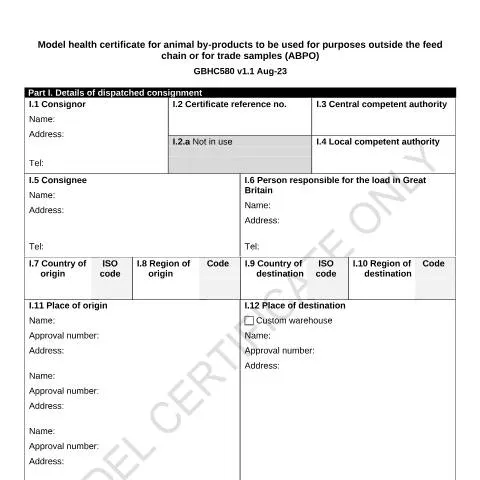
When British businesses handle animal by-products destined for technical use rather than feed or food production, they must navigate a complex certification landscape that ensures both animal health protection and trade compliance. The GBHC580 model health certificate serves as the official gateway for exporting processed animal materials, trade samples, and industrial by-products from Great Britain to international markets.
This specialised certification framework, administered jointly by the Animal and Plant Health Agency (APHA), the Food Standards Agency, and DEFRA, addresses a critical gap in international trade where standard food export certificates don't apply. Whether dealing with pharmaceutical gelatine, technical fats, or research specimens, exporters must demonstrate that their products meet stringent animal health standards whilst clearly establishing their non-feed status.
The certificate's dual nature—covering both trade samples and technical-use products—reflects the diverse commercial realities of modern animal by-product industries, from cosmetics manufacturing to laboratory research, where traceability and health assurance remain paramount despite the products' non-consumable end use.
Scope of Certification: What Qualifies for GBHC580 Documentation
The GBHC580 certificate specifically covers animal by-products that fall outside the feed chain, creating a distinct regulatory pathway for materials with technical, industrial, or research applications. This includes processed animal proteins destined for pharmaceutical manufacturing, rendered fats for cosmetic production, and specialised gelatin for industrial processes.
Trade samples represent a significant portion of certified consignments, encompassing specimens sent for analysis, research purposes, or commercial evaluation. These samples must bear clear labelling stating "TRADE SAMPLE NOT FOR HUMAN CONSUMPTION" and comply with specific quantity restrictions that vary by destination country.
The certification framework excludes certain categories that require alternative documentation:
- Pet food ingredients, which fall under feed chain regulations
- Human food products, covered by standard export health certificates
- Live animals or fresh meat, requiring separate veterinary certification
- Pharmaceutical products already licensed through medicines regulators
Establishments producing certifiable by-products must hold appropriate approval numbers from APHA, with different codes applying to rendering plants, processing facilities, and collection centres. These approval numbers appear prominently on the certificate, enabling destination authorities to verify the facility's compliance status.
Temperature and Packaging Classifications
The certificate accommodates various product states—ambient, chilled, or frozen—with specific requirements varying according to the processing method and intended use. Frozen technical fats, for instance, may have different certification requirements compared to ambient-temperature processed proteins, particularly regarding storage and transport conditions.
Veterinary Certification Process: From Application to Approval
Only official veterinarians authorised by APHA can issue GBHC580 certificates, ensuring that animal health assessments meet international standards. The certification process begins with the exporter submitting detailed consignment information, including product specifications, processing establishment details, and destination requirements.
The examining veterinarian must verify that source animals comply with territorial disease control requirements, particularly regarding foot-and-mouth disease, classical and African swine fever, and highly pathogenic avian influenza. These assessments involve reviewing holding records, slaughter documentation, and regional disease surveillance data.
| Disease Category | Monitoring Period | Radius of Surveillance |
|---|---|---|
| Foot-and-mouth disease | 60 days (holding), 30 days (vicinity) | 25 km |
| Classical/African swine fever | 40 days | 10 km |
| Newcastle disease, HPAI | 30 days | 10 km |
For wild-caught animal by-products, additional requirements apply regarding capture locations and disease-free zones. The veterinarian must confirm that capture sites maintain specified distances from disease outbreaks and border areas, with enhanced surveillance requirements for cross-border regions.
Establishment Verification Requirements
Processing establishments undergo regular APHA inspections to maintain their approval status. The certifying veterinarian must verify current approval numbers and confirm that facilities comply with processing temperature requirements, typically 133°C for 20 minutes at 3 bar pressure for Category 3 materials.
Territory-Specific Requirements and Third Country Provisions
The certificate's territorial requirements section addresses complex scenarios where by-products originate from multiple countries or involve transit arrangements. Products may qualify under different pathways depending on their origin, processing location, and intended destination.
For third country materials, the certificate must demonstrate that source countries hold authorisation to export fresh meat to Great Britain, establishing equivalence of animal health standards. This requirement ensures that by-products maintain the same health assurances as primary food products, even when destined for non-food use.
Animals contributing to certified by-products must demonstrate either:
- Continuous residence in approved territories for at least three months before slaughter
- Birth and lifelong residence in qualifying regions
- Wild capture in approved disease-free zones
The transit provisions allow Great Britain to serve as a conduit for animal by-products moving between third countries, provided appropriate documentation accompanies the consignment and border control posts handle the transfer according to prescribed protocols.
Regional Code Classifications
Destination regions receive specific codes that determine applicable health requirements. EU member states, for instance, may have different certification requirements compared to Asian or African destinations, reflecting varying disease risk assessments and bilateral trade agreements.
Documentation Standards and Consignment Tracking
Each GBHC580 certificate receives a unique reference number that enables full consignment traceability from origin to destination. This numbering system links to APHA's certification database, allowing real-time verification of certificate authenticity and status.
The certificate requires comprehensive consignment details, including:
- Scientific species names for all source animals
- Detailed commodity descriptions using international HS codes
- Processing establishment approval numbers and locations
- Batch numbers linking to production records
- Transport vehicle identification and route documentation
Packaging specifications must reflect the product's intended use and comply with international transport regulations. Technical-use products often require specialised packaging that prevents cross-contamination and maintains product integrity throughout the supply chain.
Border Control Posts receive advance notification of certified consignments, enabling efficient processing while maintaining security protocols. The certificate's transport section must accurately reflect the intended route, including any transhipment points or temporary storage facilities.
Seal and Container Management
Official seals applied to containers or transport vehicles must remain intact throughout the journey, with seal numbers recorded on the certificate. Any seal damage or tampering requires immediate notification to both origin and destination authorities, potentially invalidating the certification.
Commodity Classification and HS Code Requirements
Proper commodity classification using Harmonised System (HS) codes ensures accurate customs processing and duty calculation at destination borders. Animal by-products outside the feed chain typically fall under specific HS code ranges that distinguish them from food products and animal feed.
Common classifications include:
- Processed animal proteins for technical use
- Rendered fats and oils for industrial applications
- Gelatine and collagen for pharmaceutical manufacturing
- Preserved specimens for research or educational purposes
The certificate must specify the nature of commodity in sufficient detail to enable destination authorities to verify compliance with local import requirements. Vague descriptions may result in consignment delays or rejection at border control points.
Batch numbering systems must enable full traceability back to source animals and processing dates. This requirement supports rapid response capabilities in case of disease outbreaks or quality issues that might affect multiple consignments.
Weight and Quantity Declarations
Net weights must accurately reflect the actual product quantity, excluding packaging materials. Discrepancies between declared and actual weights can trigger detailed inspections and potential certificate invalidation.
Certificate Validity and Border Control Procedures
GBHC580 certificates typically remain valid for 30 days from the date of issue, though this period may vary according to destination country requirements and product characteristics. The certificate's validity period begins from the departure date specified in section I.14, not the issue date.
Destination Border Control Posts must receive consignments within the certificate's validity period, with some countries requiring additional advance notification periods. Late arrivals may necessitate re-certification or product return to Great Britain.
The Entry BCP section identifies the specific border control post authorised to receive the consignment. Attempting to clear customs through alternative entry points typically results in refusal, as border posts maintain specific approvals for different product categories.
Upon arrival, destination authorities verify:
- Certificate authenticity through APHA's verification system
- Consignment integrity, including seal conditions
- Product compliance with declared specifications
- Documentation completeness and accuracy
Transit Arrangements and Temporary Storage
Consignments requiring temporary storage or transhipment must comply with additional requirements regarding facility approvals and handling procedures. The certificate must clearly indicate any intermediate stops or storage arrangements to ensure continued compliance with health requirements.
Regulatory Compliance and Enforcement Mechanisms
APHA maintains comprehensive oversight of the certification system through regular audits of approved establishments and post-export verification procedures. Non-compliance can result in suspension of establishment approvals, certificate withdrawal, or restriction of future certification eligibility.
The Data Protection Act 2018 and UK GDPR govern the handling of personal and commercial information contained within certificates, requiring appropriate safeguards for data sharing with international authorities whilst maintaining trade facilitation objectives.
Fraudulent certification or deliberate misrepresentation constitutes a serious offence under animal health legislation, potentially resulting in criminal prosecution and significant financial penalties. The electronic verification system enables rapid detection of forged or altered certificates.
Regular updates to certification requirements reflect evolving international standards and bilateral trade agreements. Exporters must monitor APHA guidance for changes that might affect their certification obligations or processing requirements.
The system's robust framework ensures that British animal by-products maintain their reputation for quality and safety in international markets, whilst supporting diverse industrial sectors that depend on these specialised materials for legitimate commercial purposes.
Specific Requirements for Different Animal By-Product Categories
The classification system for animal by-products under UK regulations follows EU-derived standards, creating three distinct categories with markedly different certification requirements. Understanding these classifications proves essential for determining which model health certificate applies to your specific consignment.
Category 1 materials represent the highest-risk animal by-products and require the most stringent certification procedures. These include specified risk materials (SRM) from cattle, sheep, and goats, such as spinal cord, brain tissue, and certain intestinal sections. Materials from animals suspected or confirmed to have transmissible spongiform encephalopathies (TSEs) also fall within this category. The model health certificates for Category 1 materials typically require detailed declarations about the source animals' health status, including veterinary confirmation that animals showed no clinical signs of notifiable diseases at the time of slaughter.
When completing certificates for Category 1 by-products, particular attention must be paid to the traceability requirements. The certificate must include comprehensive details about the originating establishment, including its approval number, the specific dates of collection or processing, and temperature records during transport. APHA inspectors frequently scrutinise these certificates during border checks, as any discrepancies in documentation can result in immediate detention of the consignment.
Category 2 materials encompass a broader range of animal by-products, including manure, digestive tract contents, and materials from animals that died other than by slaughter for human consumption. The certification requirements for Category 2 materials vary significantly depending on the intended use. Materials destined for biogas production require different attestations compared to those intended for composting or land application.
For Category 2 by-products intended for processing into technical products, the model health certificate must include specific declarations about the processing methods to be employed. This includes confirmation that materials will undergo appropriate heat treatment, pressure processing, or chemical treatment as specified in the relevant technical standards. The certificate must also confirm that the receiving establishment holds appropriate approvals for handling Category 2 materials.
Category 3 materials, while considered lower risk, still require careful certification, particularly when crossing international borders. These include parts of slaughtered animals fit for human consumption but not intended for human consumption for commercial reasons, fresh fish from fish processing industries, and shells from shellfish farms. The model certificates for Category 3 materials often focus on commercial rather than purely health-related attestations.
Temperature control requirements feature prominently in certificates for all categories, but the specific parameters vary. Category 1 materials typically require continuous refrigeration below specific temperatures, with the certificate confirming that cold chain integrity has been maintained throughout transport. Some Category 2 and 3 materials may permit ambient temperature transport under certain conditions, but this must be clearly documented in the accompanying certificate.
Documentation Workflows and Processing Timelines
The administrative workflow for obtaining model health certificates involves multiple stakeholders and can extend over several weeks, particularly for first-time exporters or complex consignments. Understanding these timelines proves crucial for businesses planning international shipments of animal by-products.
Initial application procedures typically commence with the exporter submitting a formal request to APHA, including detailed specifications about the animal by-products, their intended destination, and proposed transport arrangements. This initial submission must include supporting documentation such as processing facility approvals, transport company credentials, and receiving establishment confirmations from the destination country.
APHA's initial review process can take 5-10 working days for straightforward applications, but complex cases involving novel products or destinations may require 15-20 working days or longer. During this period, APHA veterinary staff review the technical aspects of the application, verify that the proposed model certificate template aligns with the specific requirements, and may request additional information or clarifications.
Once the application receives preliminary approval, the scheduling of any required inspections begins. Physical inspections of processing facilities, storage areas, and transport vehicles may be necessary, particularly for Category 1 materials or first-time exporters. These inspections must be scheduled during normal business hours and may require several weeks' advance notice, depending on APHA's regional workload.
Certificate completion and endorsement represents the final stage before shipment. The authorised veterinarian or APHA inspector must physically examine the consignment, verify that it matches the descriptions in the certificate, and confirm that all processing and packaging requirements have been met. This examination process can take several hours for large or complex consignments.
The actual endorsement procedure involves the certifying officer signing and stamping the certificate using official APHA stamps and signatures. These endorsements must be completed in indelible ink, and any corrections or amendments require counter-signature by the certifying officer. Electronic endorsement systems exist for certain certificate types, but many animal by-product certificates still require traditional paper-based endorsement.
Rush processing procedures are available in exceptional circumstances, but these carry additional costs and strict eligibility criteria. Emergency certificates can sometimes be issued within 24-48 hours for urgent shipments, but this requires compelling justification such as humanitarian aid or critical industrial supplies. Standard commercial shipments rarely qualify for expedited processing.
Businesses should also account for potential delays due to public holidays, staff availability, or unexpected technical issues. APHA offices operate on standard UK government working hours, and certificate processing typically ceases during bank holidays and the Christmas/New Year period. Planning shipments around these periods requires careful consideration of lead times.
Common Compliance Challenges and Resolution Strategies
Exporters of animal by-products frequently encounter specific compliance obstacles that can delay shipments or result in certificate rejection. Understanding these common pitfalls and their solutions helps businesses navigate the certification process more effectively.
Traceability documentation gaps represent one of the most frequent causes of certificate delays. APHA requires complete traceability from the source animal through all processing stages to the final packaged product. Missing links in this chain, such as unclear slaughterhouse records, incomplete processing logs, or inadequate storage documentation, can halt the certification process entirely.
To address traceability issues, exporters should implement comprehensive record-keeping systems that capture every stage of handling. This includes maintaining detailed logs of source animal identification, slaughter dates and locations, processing temperatures and durations, storage conditions, and packaging details. Digital tracking systems increasingly prove valuable for maintaining these records, though paper-based systems remain acceptable if properly maintained.
Facility approval discrepancies often arise when processing or storage facilities lack appropriate approvals for handling specific categories of animal by-products. APHA cannot issue health certificates for materials processed at unapproved facilities, regardless of the actual safety or quality of the products. These approval issues can be particularly complex when multiple facilities are involved in processing a single consignment.
Resolving facility approval issues typically requires engaging with APHA's establishment approval team well in advance of planned shipments. The approval process for new facilities can take several months and involves detailed facility inspections, staff training verification, and implementation of appropriate HACCP systems. Businesses should verify facility approvals before establishing supply relationships or committing to export contracts.
Laboratory testing complications can arise when certificates require specific microbiological, chemical, or other analytical testing results. Some model certificates mandate testing for particular pathogens, residues, or contaminants, and these tests must be performed by UKAS-accredited laboratories using specified methodologies.
Testing delays often occur due to limited laboratory capacity, especially for specialised analyses. Sample collection procedures must follow strict protocols to ensure validity, and any deviations can necessitate re-testing. Weather conditions, transport delays, or laboratory equipment failures can extend testing timelines significantly. Businesses should identify approved laboratories early in the process and establish backup testing arrangements where possible.
Destination country requirement changes present ongoing challenges, as importing countries may modify their requirements with limited advance notice. These changes can affect acceptable certificate formats, required attestations, or processing standards, potentially invalidating certificates that were correct when initially prepared.
Staying informed about destination country changes requires monitoring multiple official sources, including the importing country's veterinary authorities, UK trade associations, and APHA updates. Many businesses subscribe to commercial intelligence services that track regulatory changes, though these services cannot replace direct communication with official authorities. Maintaining relationships with importers or agents in destination countries often provides early warning of potential changes.
Transport and logistics coordination challenges can compromise certificate validity even after successful endorsement. Certificates typically specify particular transport conditions, routes, or timelines, and deviations from these specifications can invalidate the documentation. Cold chain failures, transport delays, or route changes can all create compliance issues.
Effective logistics management requires close coordination between exporters, transport companies, and receiving establishments. Contingency planning should address potential transport disruptions, including alternative routes, backup transport arrangements, and emergency contact procedures. Real-time monitoring systems for temperature-sensitive consignments provide valuable documentation of compliance throughout the journey.