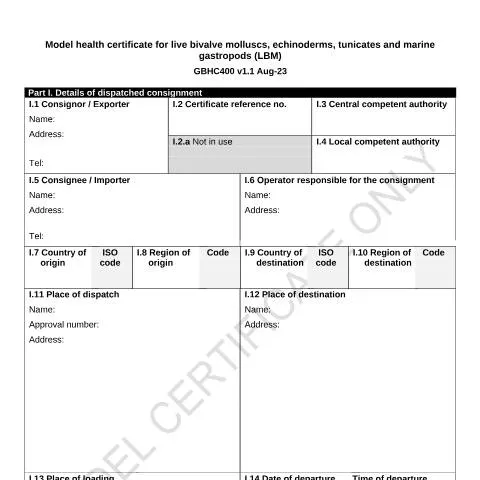
Securing Trade Approval for Marine Delicacies: The Critical GBHC400 Certificate
When a shipment of fresh oysters from France arrives at Dover's border control post, or when Scottish scallop exporters prepare consignments for international markets, a single document stands between commercial success and regulatory rejection: the GBHC400 model health certificate. This specialised certification, managed by the Animal and Plant Health Agency (APHA) under Defra's oversight, serves as the gold standard for validating the safety and compliance of live bivalve molluscs, echinoderms, tunicates and marine gastropods entering or leaving Great Britain's borders.
The certificate represents far more than bureaucratic formality. In an industry where a single contaminated batch can trigger widespread food safety alerts and devastating economic losses, the GBHC400 functions as both shield and passport—protecting public health whilst enabling the £1.4 billion UK shellfish trade to operate across international boundaries. Every consignment of live mussels, clams, sea urchins, and whelks must navigate this certification maze, where precise documentation can mean the difference between profitable trade and costly rejection at port.
Operational Framework: Who Requires GBHC400 Certification
The certificate's jurisdiction extends across multiple commercial scenarios, each governed by specific regulatory triggers. Importers bringing live shellfish into Great Britain represent the primary user group, whether sourcing premium langoustines from Norwegian fjords or Mediterranean sea urchins for London's high-end restaurant market. These businesses must present valid GBHC400 documentation at designated Border Control Posts, where APHA officers conduct physical inspections and verify certification authenticity.
Export operations constitute the second major category. British shellfish producers targeting EU markets, third countries, or Crown Dependencies require GBHC400 certificates to demonstrate compliance with destination country requirements. A Cornish mussel farm exporting to Spain, for instance, must secure appropriate certification even for products harvested from classified UK waters, as the certificate validates the entire production chain from harvest through processing and packaging.
| Business Category | Certification Trigger | Typical Volume Threshold |
|---|---|---|
| Commercial Importers | Any quantity entering GB ports | No minimum threshold |
| Export Businesses | Destination country requirements | Varies by destination |
| Processing Facilities | Live product handling | Commercial quantities only |
| Retail Distributors | Direct import operations | Above personal use limits |
Processing establishments handling live products also fall within certification scope, particularly facilities conducting purification, relaying, or packaging operations. Even businesses operating sophisticated depuration systems must demonstrate compliance through proper certification, as the GBHC400 validates not just product origin but entire handling protocols from source to final packaging.
Exemptions and Special Circumstances
Personal importation for non-commercial purposes typically escapes certification requirements, though quantities must remain within reasonable personal consumption limits. Additionally, certain intra-UK movements between England, Scotland, and Wales may not require full GBHC400 certification, though alternative documentation proving compliance with food safety regulations remains mandatory.
Certification Scope: What the GBHC400 Actually Validates
The certificate's dual-track approach addresses both animal health and public health concerns through comprehensive attestation requirements. On the animal health front, certification validates freedom from specific notifiable diseases that could devastate aquaculture operations. The document specifically addresses three critical pathogen categories: Bonamia exitiosa and Perkinsus marinus for certain bivalve species, Marteilia refringens and Bonamia ostreae for oyster populations, and Ostreid herpesvirus 1 µvar (OsHV-1µvar) affecting multiple shellfish species.
These attestations aren't merely administrative checkboxes. They represent extensive surveillance programmes conducted by competent authorities in the country of origin, involving regular sampling, laboratory testing, and zone classification systems. When a certifying officer signs the animal health section, they're validating that the source territory maintains robust disease monitoring and meets GB's strict import standards for aquatic animal health.
Public health certification encompasses an equally rigorous framework. The certificate validates compliance with Hazard Analysis and Critical Control Points (HACCP) principles throughout the production chain, ensuring establishments operate under systematic food safety management. This extends beyond basic hygiene to encompass water quality monitoring, harvest area classification, and post-harvest handling protocols that prevent contamination and maintain product integrity.
Production Chain Validation Elements
- Harvest area classification: Confirmation that collection sites meet water quality standards and monitoring requirements
- Handling and processing compliance: Validation of purification, relaying, and packaging operations under approved conditions
- Transport and storage standards: Certification that products maintain appropriate temperature and hygiene conditions throughout distribution
- Labelling and traceability: Verification of proper identification marking enabling full supply chain tracking
- Residue monitoring compliance: For aquaculture products, confirmation that residue monitoring plans meet GB regulatory standards
Application Process: Securing Your GBHC400 Certificate
The certification journey begins with identifying the appropriate competent authority in the country of origin or export. For UK exports, APHA serves as the primary certifying body, though specific regional offices handle applications based on business location and product origin. Scottish shellfish exporters typically work with APHA Scotland offices, while Welsh operations coordinate through APHA Wales divisions.
Initial application requires comprehensive documentation demonstrating compliance with both production and processing requirements. Businesses must provide detailed facility registrations, current approval numbers for processing establishments, and evidence of ongoing compliance with food safety regulations. The application process isn't simply form completion—it involves demonstrating systematic compliance with complex regulatory frameworks governing aquaculture and shellfish processing operations.
Pre-certification inspections represent a critical stage where APHA officers verify on-site compliance with stated requirements. These inspections examine physical facilities, review HACCP documentation, assess water quality monitoring systems, and verify traceability procedures. Establishments must demonstrate not just current compliance but ongoing systems ensuring continued adherence to certification standards.
Documentation Requirements by Business Type
Import businesses must coordinate with overseas competent authorities to secure proper certification before shipment arrival. This involves providing UK-specific requirements to foreign certifying officers, ensuring they understand GB regulatory standards and complete appropriate certificate sections. The process requires careful timing, as certificates must be issued close to shipment departure to maintain validity periods.
Export operations face different challenges, requiring demonstration that UK-sourced products meet destination country requirements. APHA certifying officers must verify not only compliance with GB standards but also specific requirements imposed by importing countries. This dual compliance framework often necessitates additional testing, documentation, or processing steps beyond standard UK requirements.
Certificate Validity and Renewal Protocols
GBHC400 certificates operate under strict validity periods designed to ensure product freshness and continued compliance with safety standards. For most live shellfish consignments, certificates remain valid for 72 hours from issuance, reflecting the perishable nature of live products and the need for rapid processing through international supply chains.
This tight timeframe creates significant logistical challenges for businesses operating complex international supply chains. A certificate issued on Monday morning for a French mussel shipment must see those products cleared through UK border controls and delivered to final destinations by Thursday morning. Any delays in transport, customs clearance, or border inspection procedures can render certificates invalid, requiring costly re-certification or product rejection.
Renewal protocols vary depending on circumstances. Products already in transit cannot typically receive certificate extensions, requiring businesses to manage timing carefully through coordination with suppliers, shipping companies, and border control operations. However, products held in approved storage facilities may qualify for fresh certification if they continue meeting safety and quality standards.
| Certificate Status | Validity Period | Renewal Options |
|---|---|---|
| Standard Issue | 72 hours from signature | None for products in transit |
| Storage Extension | Additional 72 hours maximum | Requires facility re-inspection |
| Processing Delay | Case-by-case assessment | New certificate required |
Managing Certificate Expiry
Businesses must develop sophisticated logistics management systems accounting for certificate validity periods. This includes coordinating harvest timing with transport schedules, ensuring adequate buffer time for border control procedures, and maintaining contingency plans for unexpected delays. Many successful operators build relationships with approved storage facilities at key ports, enabling temporary holding if transport delays threaten certificate validity.
Practical Applications Across the Supply Chain
The certificate's impact extends throughout complex international seafood supply chains, influencing everything from harvest scheduling to retail distribution strategies. Wholesale importers serving London's Billingsgate Fish Market rely on GBHC400 certification to maintain continuous supply of premium shellfish from European sources. These businesses coordinate with multiple overseas suppliers, managing certificate timing to ensure products arrive within validity periods whilst maintaining quality standards demanded by discerning restaurant customers.
Restaurant chains operating multiple locations face particular challenges when sourcing certified shellfish. A single certificate covers specific consignments, requiring careful allocation across distribution networks to ensure all locations receive properly documented products within validity periods. This often necessitates sophisticated inventory management systems tracking certificate numbers, expiry dates, and product allocation across multiple delivery points.
Processing facilities conducting value-added operations must navigate complex certification requirements when handling live products. A Scottish processing plant receiving live langoustines for preparation and re-export requires incoming GBHC400 certificates whilst also securing separate certification for outgoing processed products. This dual certification requirement demands careful coordination with both suppliers and customers to maintain unbroken certification chains.
Border Control Post Interactions
At designated Border Control Posts, APHA officers conduct systematic inspections verifying certificate authenticity and product compliance. These inspections involve document review, physical product examination, and often laboratory sampling to confirm safety standards. Officers check certificate completion accuracy, verify consignment details match documentation, and assess product condition against certified standards.
Businesses must prepare for potential inspection delays, particularly during peak import periods or when handling first-time consignments from new suppliers. Successful operators maintain detailed knowledge of specific BCP procedures, build relationships with inspection staff, and ensure documentation accuracy to minimise processing delays.
Compliance Challenges and Regulatory Evolution
The post-Brexit regulatory landscape has significantly complicated GBHC400 certification requirements, as GB standards have diverged from EU frameworks whilst maintaining substantial alignment in many areas. Businesses must navigate evolving requirements where GB regulations reference "retained EU law" whilst incorporating UK-specific modifications and interpretations.
This regulatory evolution creates ongoing compliance challenges for businesses operating across multiple jurisdictions. A certificate valid for GB import may not automatically satisfy EU requirements for onward export, requiring businesses to understand subtle differences between regulatory frameworks and plan accordingly. Similarly, changes in disease status classifications or water quality standards can suddenly affect certification requirements for established trade routes.
Technology integration represents both opportunity and challenge within the certification system. Digital certification systems promise improved efficiency and reduced fraud risk, but implementation requires coordination across multiple competent authorities and border control systems. Businesses must prepare for gradual digitalisation whilst maintaining capability to handle traditional paper-based systems during transition periods.
International Harmonisation Efforts
Great Britain participates in international efforts to harmonise shellfish certification standards through organisations like the World Organisation for Animal Health (OIE) and Codex Alimentarius. These initiatives aim to reduce trade barriers whilst maintaining robust safety standards, but implementation often requires lengthy negotiation and gradual regulatory alignment.
Businesses benefit from understanding these harmonisation efforts as they influence long-term regulatory directions and may affect future certification requirements. Early adaptation to emerging international standards can provide competitive advantages when new requirements become mandatory.
Risk Management and Business Continuity
Effective GBHC400 certificate management requires sophisticated risk assessment and mitigation strategies addressing multiple failure points within international supply chains. Certificate rejection at border control posts represents the most immediate and costly risk, potentially resulting in complete consignment loss if products cannot maintain quality during re-certification procedures.
Businesses must develop comprehensive contingency plans addressing various failure scenarios. This includes identifying alternative suppliers with different disease status classifications, maintaining relationships with multiple competent authorities, and establishing emergency storage arrangements at key ports. Insurance coverage specifically addressing certification-related losses provides additional protection, though policies must carefully address the specific risks associated with perishable live products.
Supply chain diversification offers protection against regional disease outbreaks or regulatory changes affecting specific source territories. A retailer sourcing mussels exclusively from Dutch producers faces significant vulnerability if disease outbreaks affect Dutch classification status, while businesses maintaining supplier relationships across multiple countries can more easily adapt to changing circumstances.
Regular monitoring of disease surveillance reports and regulatory updates enables proactive risk management. APHA publishes regular updates on disease status classifications and regulatory changes affecting certification requirements. Businesses that monitor these updates and adapt procurement strategies accordingly maintain competitive advantages over those reacting to sudden certification disruptions.