Maritime Transport Requirements for Live Animal Imports to Great Britain
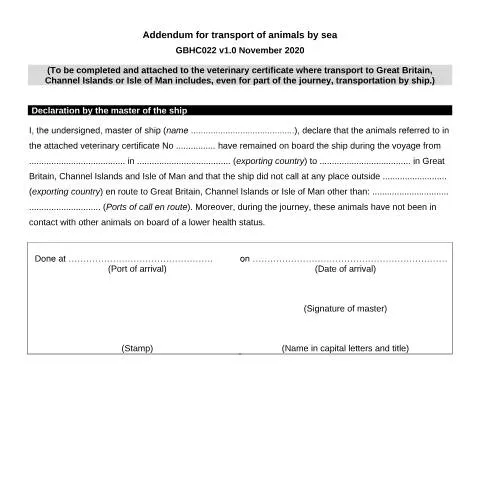
When importing live animals to Great Britain, the Channel Islands, or the Isle of Man via sea transport, importers face additional certification requirements beyond standard veterinary health certificates. The GBHC022 addendum represents a critical maritime-specific declaration that must accompany animal shipments where any portion of the journey involves ship transport, even if combined with other transport methods.
This document addresses a fundamental concern in international animal health protocols: ensuring the integrity of health status during sea voyages. Maritime transport presents unique biosecurity challenges, as ships may call at multiple ports or carry animals of varying health statuses, potentially compromising the health guarantees provided by the original exporting country's veterinary authorities.
Legal Framework and Biosecurity Imperatives
The GBHC022 addendum operates within the broader framework of post-Brexit animal health regulations administered by the Animal and Plant Health Agency (APHA) under the Department for Environment, Food & Rural Affairs (Defra). Following the UK's departure from the EU, Great Britain established its own third-country import requirements, necessitating enhanced documentation for animal imports from all non-GB territories.
The maritime addendum specifically addresses Article 48 requirements of retained EU Regulation 2016/429 on transmissible animal diseases, which mandates that animals maintain their certified health status throughout the entire transport chain. This becomes particularly complex during sea transport, where vessels may encounter:
- Unscheduled port calls in countries with different animal health statuses
- Loading of additional animals with potentially lower health certifications
- Extended voyage durations that could compromise initial health assessments
- Contact with resident ship animals such as ship cats or working animals
Ship Master's Declaration Requirements and Responsibilities
The ship master bears direct legal responsibility for completing and signing the GBHC022 declaration upon arrival at the destination port. This responsibility cannot be delegated to crew members, shipping agents, or import brokers, as maritime law recognises the master as the ultimate authority aboard the vessel.
The declaration encompasses several critical attestations that the master must verify through direct knowledge or ship's records:
| Declaration Element | Master's Responsibility | Documentation Required |
|---|---|---|
| Animal continuity | Confirm animals remained aboard throughout voyage | Cargo manifest, loading/unloading records |
| Port call verification | List all intermediate stops outside exporting country | Ship's log, port clearance documents |
| Animal segregation | Certify no contact with lower health status animals | Deck plans, crew observations |
| Arrival details | Provide accurate port and date of GB arrival | Port authority clearance |
Maritime Jurisdiction and Stamp Requirements
The declaration must be completed "at the port of arrival" and bear the ship's official stamp or seal. This timing requirement reflects the legal principle that the declaration becomes valid only upon entry into GB territorial waters. The stamp serves as authentication of the vessel's identity and the master's authority, often incorporating the ship's IMO number and flag state registration details.
Integration with Veterinary Health Certificates
The GBHC022 addendum cannot function independently but must be physically attached to the primary veterinary health certificate issued by the exporting country's competent veterinary authority. This attachment requirement creates a unified document package that APHA border inspection posts treat as a single certification unit.
The integration process involves specific cross-referencing requirements:
- Certificate number matching: The addendum must reference the exact veterinary certificate number
- Animal identification alignment: Species, quantities, and identification details must correspond precisely
- Consignment integrity: The addendum covers only animals specifically listed in the attached veterinary certificate
Where multiple veterinary certificates accompany a single shipment—common in mixed livestock consignments—separate GBHC022 addenda may be required for each certificate, depending on whether the animals shared transport conditions throughout the voyage.
Port Call Disclosure and Third Country Transit
One of the most operationally challenging aspects of the GBHC022 declaration involves accurately reporting intermediate port calls. Ship masters must distinguish between technical stops (fuel, provisions, crew changes) and ports where the vessel took on additional cargo or animals.
The declaration requires specific attention to countries with different animal health classifications than the original exporting nation. For instance, if animals embark in New Zealand (generally considered high health status) but the vessel calls at a Southeast Asian port en route to Great Britain, this could potentially affect the animals' eligibility for reduced inspection protocols.
Emergency Port Calls and Force Majeure Situations
Maritime law recognises that vessels may be compelled to seek shelter or assistance at unplanned ports due to weather, mechanical failure, or medical emergencies. The GBHC022 framework accommodates such situations, but masters must:
- Document the emergency nature of any unscheduled stops
- Maintain detailed records of whether animals remained sealed in their transport compartments
- Report any potential exposure to local animal populations or contaminated facilities
- Obtain port health clearance documentation where available
Compliance Verification and Border Inspection Procedures
Upon arrival at GB ports, APHA border inspection officers conduct documentary verification of the GBHC022 addendum alongside physical inspection of the animals. This process typically occurs at designated Border Control Posts (BCPs) equipped with animal holding facilities.
The inspection protocol includes several verification steps that can impact clearance timelines:
- Document authenticity checks: Verification of ship stamps, master signatures, and cross-references with vessel registration databases
- Timeline analysis: Comparison of declared voyage dates with shipping manifests and port authority records
- Route verification: Assessment of reported port calls against known vessel tracking data
- Animal welfare evaluation: Physical inspection to confirm animals match certificate descriptions and show no signs of disease
Non-Compliance Consequences and Remediation
Incomplete or inaccurate GBHC022 declarations can result in significant delays and additional costs for importers. APHA may require:
- Extended quarantine periods while documentation discrepancies are resolved
- Additional veterinary examinations at importer expense
- Re-certification by GB-approved veterinarians in severe cases
- Consignment rejection and return to country of origin for serious non-compliance
Digital Transformation and Future Developments
While the current GBHC022 format requires physical paper documentation with wet signatures and stamps, Defra has indicated intentions to develop digital certification systems aligned with international standards. The World Organisation for Animal Health (OIE) electronic certification framework may influence future UK requirements.
Current pilot programmes involving major shipping companies and livestock importers are testing:
- Blockchain-based certification to ensure document integrity during multi-modal transport
- Real-time voyage tracking integration with automatic port call reporting
- Digital master signatures using maritime-approved cryptographic systems
- Automated cross-referencing with international animal health databases
Practical Considerations for Importers and Shipping Companies
Successful completion of GBHC022 declarations requires advance planning and clear communication between importers, shipping companies, and vessel masters. Many experienced livestock importers establish specific protocols with their preferred shipping lines to ensure masters understand the certification requirements before departure.
Key operational considerations include:
| Planning Phase | Action Required | Responsibility |
|---|---|---|
| Pre-shipment | Brief ship master on GBHC022 requirements | Shipping agent/Importer |
| Loading | Verify veterinary certificate numbers and animal details | Ship master/Port veterinarian |
| Voyage | Maintain detailed log of port calls and animal welfare | Ship master/Crew |
| Arrival | Complete declaration before port authority clearance | Ship master |
The November 2020 version date on current GBHC022 forms reflects the post-transition period implementation, but importers should verify with APHA that they are using the most current version, as animal health requirements may be updated based on disease outbreak situations or changes in international agreements. The certificate's effectiveness ultimately depends on accurate completion and integration with the broader animal import control system that protects Great Britain's livestock industry and public health.
Species-Specific Documentation Requirements and Veterinary Protocols
Different animal categories require distinct veterinary certification approaches under UK import regulations. The Animal and Plant Health Agency (APHA) maintains detailed species-specific requirements that extend beyond basic health certificates, particularly for exotic species, laboratory animals, and breeding stock.
For exotic mammals and birds, veterinary surgeons must complete additional CITES documentation when specimens fall under Convention on International Trade in Endangered Species regulations. The health certificate must reference the CITES permit number and confirm the animal's legal acquisition. Primates require particularly stringent certification, including tuberculosis testing results and behavioural assessments from qualified veterinary behaviourists.
Laboratory animals destined for research facilities need genetic health screening documentation alongside standard health certificates. This includes confirmation of specific pathogen-free (SPF) status for rodents, with testing protocols varying according to the receiving institution's requirements. Breeding colonies often require additional certification of genetic lineage and breeding performance records.
Aquatic species present unique certification challenges, with health certificates requiring water quality parameters and species-specific disease screening. Fish health inspectors must certify freedom from notifiable diseases such as viral haemorrhagic septicaemia (VHS) and infectious salmon anaemia (ISA). The certification must include water temperature ranges, pH levels, and dissolved oxygen concentrations during transport.
For invertebrates and arthropods, health certificates must address pest risk assessments alongside health considerations. Beneficial insects for biological control require certification from recognised breeding facilities and confirmation of species identification by qualified entomologists. The documentation must include life stage information and population counts where applicable.
Veterinary surgeons issuing health certificates for exotic species must hold appropriate additional qualifications or experience in the relevant species group. The Royal College of Veterinary Surgeons maintains lists of veterinarians qualified to certify specific exotic species, and importing parties should verify the certifying veterinarian's credentials before shipment.
Border Inspection Procedures and Physical Examination Protocols
Upon arrival at designated Border Control Posts (BCPs), live animals undergo systematic inspection procedures that complement pre-arrival health certificate verification. UK border inspection teams include Official Veterinarians (OVs) trained in species-specific examination techniques and import regulation enforcement.
The physical examination protocol begins with documentary checks, where inspectors verify health certificate authenticity using security features and cross-reference details with TRACES NT system records. Any discrepancies between certificate details and actual animals trigger enhanced examination procedures, potentially including quarantine extension or shipment rejection.
During clinical examination, Official Veterinarians assess general condition indicators including body condition scoring, respiratory patterns, and behavioural responses. Species-specific examination protocols address particular vulnerability points – for example, birds undergo detailed feather and cloaca examinations, while mammals receive thorough skin and mucous membrane assessments.
Sampling procedures may be initiated during border inspection when risk indicators suggest potential health issues not covered by pre-arrival certification. Blood sampling for serology testing, faecal samples for parasitology, and swab samples for bacterial culture follow standardised protocols established by the Animal and Plant Health Agency. Results from border sampling can override health certificate clearances if significant health risks are identified.
Transport container inspection forms an integral part of border procedures, with inspectors checking biosecurity measures including container cleanliness, ventilation adequacy, and feed/water provision. Containers showing signs of contamination or inadequate animal welfare provision can result in immediate intervention, regardless of health certificate validity.
High-risk shipments, including those from countries with recent disease outbreaks or first-time exporters, undergo enhanced inspection protocols. These may include extended observation periods, additional sampling requirements, or temporary holding at border facilities while laboratory results are processed. The inspection intensity correlates with risk assessment scores calculated using factors including origin country disease status, species vulnerability, and consignment size.
Documentation of border inspection outcomes generates official records that influence future import risk assessments for the same exporter or origin facility. Consistent compliance with health certificate standards builds positive import history, while repeated discrepancies can trigger enhanced scrutiny for subsequent shipments from the same source.
Post-Import Monitoring and Ongoing Compliance Obligations
Health certificate validity extends beyond border clearance, establishing ongoing monitoring obligations for importing establishments throughout specified post-import periods. The Animal and Plant Health Agency (APHA) maintains surveillance protocols that ensure continued compliance with health standards certified at import.
Quarantine facility obligations begin immediately upon animal arrival, with facility operators required to maintain detailed records correlating with original health certificate parameters. Daily health monitoring logs must document clinical observations, feed intake patterns, and any deviations from normal behaviour. These records remain subject to unannounced APHA inspections throughout the quarantine period.
Mortality reporting protocols require immediate notification to APHA when deaths occur during post-import quarantine, regardless of apparent cause. Post-mortem examination requirements vary according to species and risk classification, with high-risk imports requiring comprehensive pathological investigation by approved veterinary pathologists. Findings that contradict original health certificate assertions can trigger enhanced surveillance for related shipments.
For breeding animals, reproductive performance monitoring extends health certificate obligations beyond initial quarantine periods. Breeding establishments must maintain records demonstrating continued health status through successful reproduction cycles, with fertility rates and offspring viability serving as ongoing health indicators. Significant deviations from expected performance may prompt retrospective health certificate investigations.
Disease surveillance obligations require reporting of notifiable diseases identified during extended post-import periods, even when initial health certificates showed negative test results. The incubation periods for certain diseases may exceed standard quarantine durations, making ongoing surveillance essential for maintaining UK animal health security.
Integration into existing UK animal populations requires herd health plan updates incorporating imported animals' health histories. Veterinary surgeons managing recipient herds must review health certificates when developing ongoing health management strategies, ensuring compatibility between imported animals' health status and existing population health programmes.
Record retention requirements mandate preservation of health certificates and associated documentation for extended periods following import completion. Traceability obligations may require producing original health certificates years after import when disease investigations trace back to specific animal movements. Digital archiving systems must maintain document integrity while ensuring authorised access for regulatory authorities.
Non-compliance with post-import monitoring obligations can result in suspension of future import licences, regardless of initial health certificate validity. The cumulative compliance history influences APHA risk assessments for subsequent import applications, emphasising the importance of maintaining standards throughout the entire import process rather than merely achieving border clearance.