Understanding the Commons Act 2006: Landowner Statements, Highway Statements, and Declarations
The Commons Act 2006 introduces specific procedures for landowners and authorities to manage and register rights of way, town or village greens, and other land interests. This guide provides an overview of the official process, focusing on the application form known as Form CA16, which is used to deposit statements and declarations under the Act. It aims to clarify who needs to complete these documents, the legal context, and the practical steps involved.
Purpose and Scope of the Form CA16
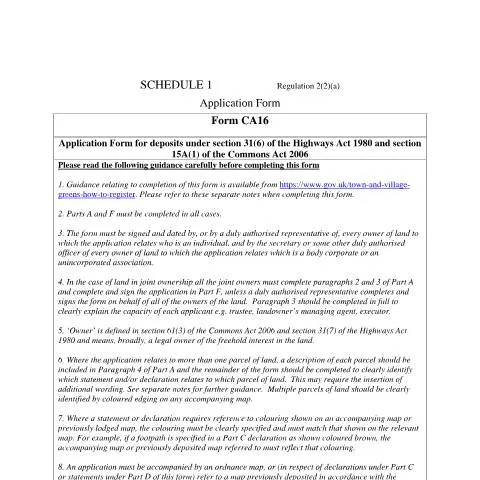
Form CA16 is an official application form used by landowners, local authorities, and other relevant parties to deposit statements and declarations concerning land under the provisions of the Highways Act 1980 and the Commons Act 2006. These statements serve to record existing rights of way, land ownership, or to formally declare land as a town or village green. The form ensures that the land's legal status and rights are properly documented and accessible to the appropriate authorities.
The form applies primarily to:
- Deposits related to rights of way such as footpaths, bridleways, or restricted byways.
- Declarations concerning the registration of town or village greens.
- Statements about land ownership and boundary definitions.
Who Must Complete the Form and How?
Completion of Form CA16 is mandatory for all landowners or their authorized representatives when submitting statements or declarations concerning land interests. The form must be signed and dated by every owner of the land involved, whether they are individuals or corporate bodies. In cases of joint ownership, all owners are required to complete specific parts of the form unless a duly authorized agent acts on behalf of all owners.
It is essential to specify the capacity of each applicant, such as trustee or managing agent, to clarify their authority to act on behalf of the landowner. The form also requires details about the land, including a full description, address, and precise geographic references, such as six-figure grid references, to ensure accurate identification.
Legal Definitions and Geographic Requirements
The term 'owner' refers broadly to the legal owner of the freehold interest in the land, as defined in the relevant legislation. When multiple parcels of land are involved, each must be described separately, with clear identification on accompanying maps. The maps must be at a scale of at least 1:10,560 and show the boundaries of the land with coloured edging corresponding to the statements or declarations made.
Supporting Documentation and Fees
Applicants must submit the completed form alongside an Ordnance Survey map that accurately reflects the land boundaries and any relevant rights or restrictions. The map should be coloured to match the details provided in the statements or declarations. Additionally, the application must be accompanied by the appropriate fee, which varies depending on the nature of the deposit and the authority involved.
Role of the Appropriate Authority
The 'appropriate authority' refers to the local council or the commons registration authority responsible for processing the deposit. This authority reviews the submitted statements, maps, and fees to ensure compliance with legal requirements. Once accepted, the deposit becomes part of the official land records, providing clarity and legal certainty for landowners, authorities, and the public.
Implications for Landowners and Authorities
Depositing statements and declarations under the Commons Act 2006 helps prevent disputes over land rights and ensures transparency in land registration. It is a crucial step for landowners wishing to formalize their rights or clarify existing ones. For authorities, these deposits support land management, planning, and conservation efforts by maintaining accurate and authoritative records of land interests and rights of way.
Understanding and correctly completing Form CA16 is vital for anyone involved in the management, registration, or dispute resolution concerning land under the scope of the Commons Act 2006. Proper adherence to the process ensures legal clarity and helps protect land rights for the future.