When a Family Loss Demands Legal Authority: Understanding Probate Applications by Post
The death of a loved one brings not only grief but also the practical necessity of managing their estate. When someone dies leaving a will, their executors must obtain legal authority to handle the deceased's affairs—a process known as applying for probate. The PA1P form serves as the traditional postal route for this essential legal procedure, enabling executors to secure a Grant of Probate that validates their authority to distribute assets, settle debts, and fulfil the deceased's final wishes.
This postal application method remains particularly valuable for those who prefer tangible paperwork over digital processes, lack reliable internet access, or find themselves dealing with complex estate matters that benefit from careful, considered completion away from online time constraints. The PA1P represents a deliberate, methodical approach to what is often an emotionally charged administrative task.
Eligibility Requirements and Executor Responsibilities
The PA1P form is specifically designed for situations where the deceased left a valid will. This immediately distinguishes it from intestacy cases, where different procedures apply. All applicants must be at least 18 years old, and a maximum of four executors can apply jointly on a single form, though fewer may choose to act if multiple executors were named in the will.
The form accommodates various executor scenarios. When the original executors named in the will are unable or unwilling to act—perhaps due to death, incapacity, or personal circumstances—substitute applicants may step forward. However, their eligibility depends on specific legal provisions, particularly when beneficiaries under 18 are involved, which typically requires at least two applicants to ensure proper oversight.
Identity Matching and Documentation Standards
A critical requirement often overlooked until completion is that applicant names on the PA1P must exactly match those on formal identification documents such as passports or driving licences. This extends to the way names appear in the will itself. If an executor's legal name differs from how they're identified in the will—due to marriage, deed poll, or informal name usage—this discrepancy must be clearly noted in the relevant sections.
The form addresses this through specific questions asking whether names differ between the will and the applicant's current legal identity. Such variations are common and entirely manageable, but failure to declare them can cause significant processing delays.
Mandatory Documentation: Building Your Submission Package
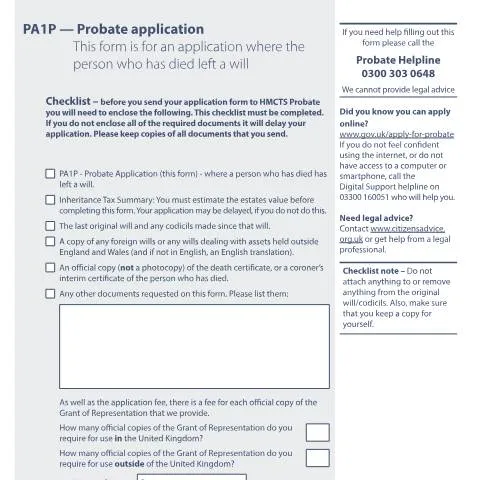
The PA1P requires a comprehensive document package that goes well beyond the completed form itself. Each element serves a specific legal purpose and missing items invariably delay processing.
| Document Type | Specific Requirements | Common Issues |
|---|---|---|
| Original Will | Last will plus any codicils; must not be altered or have anything attached/removed | Paperclips, sticky notes, or highlighting can invalidate submission |
| Death Certificate | Official copy (not photocopy) or coroner's interim certificate | Certified copies from register offices accepted; funeral director copies often insufficient |
| Foreign Wills | Copies of any wills dealing with overseas assets, with English translations if required | Professional translation may be necessary for non-English documents |
| Inheritance Tax Summary | Estate valuation completed before PA1P submission | Delays common when valuations are incomplete or inaccurate |
The Critical Inheritance Tax Component
Before completing the PA1P, applicants must undertake a comprehensive estate valuation. This isn't merely an estimate—it requires systematic assessment of all assets, liabilities, and potential exemptions. The inheritance tax summary forms an integral part of the application, and incomplete valuations represent the most common cause of processing delays.
This requirement often surprises first-time applicants who assume probate and tax matters are separate processes. In reality, HMRC and HMCTS work in tandem, with probate applications requiring inheritance tax clearance even when no tax is ultimately payable.
Navigating the Application Sections: Personal Details and Deceased Information
The PA1P divides into clearly defined sections, each serving distinct legal and administrative purposes. Section A captures applicant details with particular emphasis on accurate contact information, as all correspondence, including the Grant of Probate itself, will be sent to the first named applicant.
Email addresses receive special attention, with HMCTS aiming to contact applicants within 10 working days of receipt. This digital communication preference, even within a postal application system, reflects modern administrative efficiency while maintaining the traditional paper-based submission method.
Handling Name Variations and Address Complexities
Section B focuses on the deceased's details, drawing information directly from the death certificate. This section demands precision, as discrepancies between the PA1P and official death records can halt processing entirely. The form specifically accommodates situations where the deceased was known by different names when holding various assets—a common occurrence with married individuals who maintained accounts or properties in maiden names, or those who used professional names.
Address requirements reflect the deceased's permanent address rather than any temporary residence at the time of death. This distinction becomes significant when someone dies away from home, perhaps in hospital or care facilities.
Fee Structure and Official Copy Requirements
The PA1P involves multiple fee components beyond the basic application charge. Applicants must calculate their requirements for official copies of the Grant of Probate, with different fees applying for domestic and international use.
The number of official copies needed depends entirely on the estate's complexity. Banks, investment companies, and property registries each typically require an original Grant of Probate, meaning estates with multiple financial institutions may need numerous copies. International assets demand separate copies certified for overseas use, often at higher fees.
Payment Methods and Processing Requirements
Payment must accompany the application via cheque or postal order made payable to 'HMCTS', with a specific requirement to write the deceased's name on the reverse. This seemingly minor detail helps HMCTS match payments to applications, preventing processing delays caused by anonymous payments.
The total fee calculation includes both the application fee and copy charges, requiring careful arithmetic before submission. Underpayment necessitates additional correspondence and delays, while overpayment requires refund processing.
Submission Process and Contact Channels
Completed PA1P applications must be sent to a specific HMCTS Probate address in Harlow, with all required documents and payment included in a single package. The postal system requires careful packaging to protect original wills and certificates during transit, though HMCTS cannot accept responsibility for items lost in post.
The Probate Helpline (0300 303 0648) provides administrative guidance for form completion, though crucially cannot offer legal advice. This distinction matters significantly—the helpline can explain what information goes where, but cannot advise on complex inheritance law questions or family disputes.
Digital Alternatives and Support Services
While the PA1P represents the traditional postal route, HMCTS actively promotes its online probate service as a faster, more efficient alternative. The digital option offers real-time validation, immediate feedback on errors, and faster processing times. However, the postal route remains essential for those uncomfortable with digital processes or dealing with particularly complex estates.
The Digital Support helpline (03300 160051) assists those willing to attempt online submission but lacking technical confidence. This service bridges the gap between traditional postal applications and modern digital efficiency.
Processing Timeline and Follow-up Procedures
After submission, HMCTS processes PA1P applications according to current workloads and seasonal variations. Probate applications typically surge following winter months, when death rates naturally increase, creating predictable processing backlogs during spring periods.
Initial contact usually occurs within 10 working days, though this represents acknowledgment rather than completion. Complex estates, missing documentation, or inheritance tax queries can extend processing significantly. Applicants should maintain copies of all submitted documents, as replacement requests for lost originals can add weeks to processing times.
The Grant of Probate, once issued, provides legal authority to act on the deceased's behalf. This document enables executors to close bank accounts, transfer property ownership, settle debts, and distribute assets according to the will's provisions. The grant remains valid indefinitely, though practical challenges may arise if significant time passes between issue and use.
For those navigating this process during an already difficult time, the PA1P offers a structured, methodical approach to securing the legal authority needed to honour a loved one's final wishes. While digital alternatives exist, the postal route provides the deliberate pace and tangible documentation that many find comforting during bereavement.
Navigating Common Complications and Special Circumstances
The probate application process becomes significantly more complex when dealing with certain types of estates or unusual circumstances. Understanding these complications beforehand can prevent costly delays and additional correspondence with the Probate Registry.
Foreign Assets and International Elements
When the deceased owned property or assets abroad, Form PA1P requires additional documentation and careful consideration of international probate rules. You must declare all foreign assets on the inheritance tax forms, even if they don't form part of the UK estate for probate purposes. Properties in Scotland or Northern Ireland may require separate legal proceedings, as these jurisdictions operate under different legal systems.
For assets in EU countries, you may need to obtain a European Certificate of Succession alongside your UK grant of probate. Some countries, particularly those with civil law systems like France or Spain, may not automatically recognise a UK grant of probate, requiring you to apply for local probate or succession procedures.
If the deceased held dual nationality or was domiciled abroad for tax purposes, this can significantly complicate both the probate application and inheritance tax calculations. The Probate Registry may request additional evidence of domicile status, including documentation of the deceased's intentions regarding their permanent home.
Business Interests and Partnership Assets
Estates involving business interests present unique challenges for probate applications. Sole trading businesses typically form part of the deceased's estate, but you must carefully value ongoing contracts, work in progress, and business goodwill. Partnership interests require examination of the partnership agreement, which may contain provisions for automatic transfer of the deceased partner's share to surviving partners.
Limited company shareholdings need careful valuation, particularly in private companies where shares aren't publicly traded. You may need professional valuations for significant shareholdings, and the inheritance tax forms require detailed information about the company's activities and financial position.
If the deceased was a director of a company, you must notify Companies House of their death and arrange for their resignation from directorships. This may affect the company's ability to operate if they were the sole director or held specific powers under the company's articles of association.
Disputed Wills and Contentious Probate Issues
While Form PA1P assumes an uncontested probate application, disputes can arise even after you've submitted your application. Common grounds for challenging a will include lack of testamentary capacity, undue influence, improper execution, or claims that a later will exists.
If someone enters a caveat against the estate at the Probate Registry, this prevents the grant of probate from being issued. You'll receive notification and must either negotiate with the caveator or apply to the registry to remove the caveat. This process can add months to the probate timeline and may require legal representation.
Family provision claims under the Inheritance (Provision for Family and Dependants) Act 1975 don't prevent probate being granted, but they create ongoing liabilities for the estate. As executor, you must carefully consider whether to distribute assets immediately upon receiving the grant of probate or wait until the six-month claim period expires.
Managing Inheritance Tax Obligations and HMRC Procedures
The intersection between probate applications and inheritance tax requirements often creates the most significant administrative burden for executors. Understanding HMRC's procedures and expectations can streamline both processes considerably.
Inheritance Tax Thresholds and Exemptions
For the 2023-24 tax year, the nil rate band remains £325,000, with an additional residence nil rate band of £175,000 available when passing the family home to direct descendants. However, the residence nil rate band tapers away for estates exceeding £2 million, reducing by £1 for every £2 over this threshold.
Spouse exemption allows unlimited transfers between spouses and civil partners who are both UK domiciled, but transfers to non-UK domiciled spouses are limited to £325,000. Charitable exemptions require careful documentation, particularly for overseas charities that may not qualify for UK tax relief.
Business property relief and agricultural property relief can reduce inheritance tax liability by 50% or 100%, but these reliefs have strict qualifying conditions. Business property must have been owned for at least two years before death, and certain types of business activities (such as dealing in securities or land development) may not qualify for relief.
Valuation Complexities and Professional Requirements
HMRC expects realistic valuations based on open market value at the date of death. For residential property, you can often use estate agent valuations, but HMRC may challenge these if they appear unrealistic compared to local market conditions or recent sale prices.
Quoted shares and unit trusts must be valued using the lower of the two prices quoted on the date of death, or the average if only one price is available. For shares that didn't trade on the date of death, you must use the closing prices on the previous trading day.
Personal possessions require careful consideration, particularly valuable items like jewellery, artwork, or antiques. HMRC may accept reasonable estimates for household contents, but significant individual items typically need professional valuations. The "related property" rules can affect valuations when the deceased owned part of a set or collection, with other parts owned by their spouse or controlled entities.
Payment Options and Instalment Arrangements
Inheritance tax is normally due six months after the end of the month in which death occurred, but HMRC offers various payment arrangements to help executors manage cash flow difficulties. You can pay inheritance tax on certain assets by instalments over ten years, including land, buildings, and qualifying business or agricultural property.
The direct payment scheme allows banks and building societies to transfer funds directly to HMRC from the deceased's accounts, even before probate is granted. This can be particularly helpful when the estate has sufficient liquid assets but you need to pay inheritance tax before receiving the grant of probate to access other accounts.
If the estate lacks sufficient liquid assets to pay the inheritance tax bill, you may need to consider borrowing against estate assets or applying for a loan from beneficiaries. Some executors arrange bridging finance secured against property in the estate, though this adds costs and complexity to the administration process.
Post-Grant Administration and Compliance Requirements
Receiving the grant of probate marks the beginning, rather than the end, of your responsibilities as executor. The post-grant administration period involves numerous legal and practical obligations that can extend for many months or even years.
Asset Collection and Account Management
Armed with the grant of probate, you can now access the deceased's bank accounts, investments, and other assets. However, financial institutions have their own procedures and requirements. Banks typically require certified copies of the grant of probate and may freeze accounts temporarily while they verify the documentation.
Investment platforms and pension providers often have complex procedures for transferring or liquidating holdings. Some investments may need to be retained in their current form to preserve tax reliefs or avoid early redemption penalties. ISAs lose their tax-free status on death, but the additional permitted subscription allowance allows surviving spouses and civil partners to make additional ISA contributions equal to the value of the deceased's ISAs.
Life insurance policies require careful handling, particularly when they're written in trust or have different beneficiaries from the main estate. Policies written in trust don't form part of the estate and can be claimed directly by the beneficiaries, but you may need to assist with the claims process.
Debt Settlement and Creditor Claims
Before distributing assets to beneficiaries, you must settle all legitimate debts and claims against the estate. This includes obvious debts like credit cards, loans, and utility bills, but also potential claims that may not be immediately apparent.
The Trustee Act 1925 provides protection for executors who advertise for creditors in the London Gazette and a local newspaper, then wait two months before distributing assets. This statutory advertisement procedure protects you from personal liability for unknown debts, provided you act reasonably in investigating and settling claims.
Some debts may be disputed or time-barred under the Limitation Act 1980. Credit card companies and other unsecured creditors generally cannot pursue debts more than six years old, but secured debts against property typically survive much longer. Mortgage lenders retain their security over property regardless of when the debt arose.
Tax debts require particular attention, as HMRC has extensive powers to pursue outstanding liabilities. Income tax and capital gains tax for the period up to death must be calculated and settled, potentially requiring preparation of final tax returns. The deceased's tax affairs for previous years may also be subject to enquiry or amendment.
Distribution Planning and Beneficiary Relations
Once you've settled debts and obtained final tax clearances, you can proceed with distributing assets to beneficiaries. However, this process requires careful planning and clear communication to avoid disputes and ensure compliance with the will's terms.
Specific bequests should generally be distributed first, followed by pecuniary legacies (fixed cash amounts), with the residuary estate distributed last. If the estate lacks sufficient assets to pay all legacies in full, the Administration of Estates Act 1925 provides a statutory order for abating (reducing) different types of gifts.
Beneficiaries under 18 cannot give valid receipts for their inheritance, requiring you to hold their share until they reach majority or make appropriate trust arrangements. The will may contain specific provisions for minor beneficiaries, but if not, you may need to establish interim trusts or seek court directions.
Tax planning opportunities may arise during the distribution process, particularly regarding capital gains tax and income tax on estate assets. The timing of distributions can affect beneficiaries' tax positions, and you may need to coordinate with their tax advisers to optimise the overall tax efficiency of the distribution process.