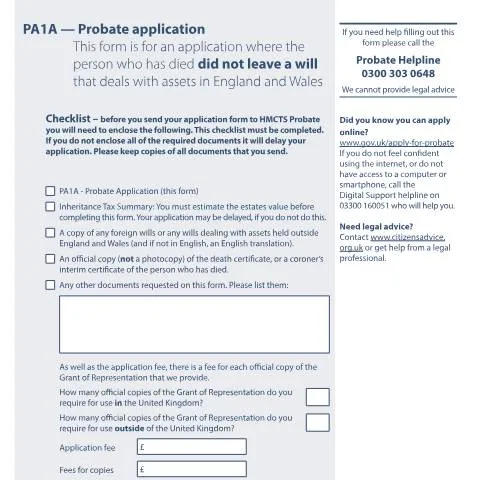
When Death Arrives Without a Will: Understanding the PA1A Application Process
When someone dies intestate—without leaving a valid will—their family faces a complex legal maze. In England and Wales, this scenario triggers specific procedures under the Administration of Estates Act 1925, requiring surviving relatives to obtain what's called Letters of Administration rather than the more familiar Grant of Probate. The PA1A form serves as the gateway to this process, designed specifically for situations where the deceased left no will dealing with assets in England and Wales.
Unlike probate applications where an executor is named in the will, intestacy cases follow strict legal hierarchy rules. The Administration of Estates Act determines who can apply, typically starting with surviving spouses or civil partners, then children, parents, siblings, and so forth. This rigid sequence can create unexpected complications, particularly when family relationships are complex or when potential applicants are overseas, under 18, or lack mental capacity.
The PA1A represents a postal alternative to online applications, catering to applicants who prefer traditional methods or lack digital access. HM Courts & Tribunals Service processes these applications through their Harlow centre, handling the intricate verification process that transforms grieving relatives into legal administrators of an estate.
Navigating the Intestacy Hierarchy: Who Can Actually Apply
The intestacy rules create a strict pecking order that surprises many families. A surviving spouse or civil partner takes absolute priority, even if they've been separated for years—only divorce or dissolution removes this right. When no spouse exists, or they've renounced their right, adult children share equal standing. Crucially, all children in the same category must either apply together or formally renounce their rights.
Complex family structures create particular challenges. Adopted children hold identical rights to biological children, but step-children typically have no automatic claim unless legally adopted. The form specifically asks about adoptions because these relationships fundamentally alter the inheritance hierarchy. Similarly, children born outside marriage now enjoy equal rights following the Family Law Reform Act 1987.
When beneficiaries include minors, the application requirements change significantly. At least two applicants must apply jointly to protect children's interests—a safeguard that prevents single administrators from potentially mismanaging assets meant for minors. This rule often forces estranged family members to cooperate or seek legal mediation.
| Relationship to Deceased | Priority Order | Special Requirements |
|---|---|---|
| Spouse/Civil Partner | 1st | Must not be divorced/dissolved |
| Children (including adopted) | 2nd | All must apply or renounce |
| Parents | 3rd | Both parents equal priority |
| Siblings (full blood) | 4th | Half-siblings rank lower |
| Grandparents | 5th | All four grandparents equal |
Overseas applicants face additional hurdles. While living abroad doesn't disqualify someone from applying, practical challenges multiply. Document authentication, postal delays, and potential language barriers can significantly extend processing times. Some jurisdictions require apostille certification for documents, adding weeks to the preparation phase.
Assembling Your Documentary Arsenal: Beyond Basic Requirements
The PA1A's checklist appears deceptively simple, but each document category conceals potential complications. The official death certificate requirement excludes photocopies entirely—a rule that catches many applicants off-guard. Register offices provide these certified copies, but processing times vary significantly across different authorities. In cases involving coroner investigations, an interim certificate suffices initially, though the final certificate may be required later.
The Inheritance Tax Summary represents perhaps the most complex requirement. Even estates below the £325,000 threshold must complete inheritance tax forms, though different versions apply depending on estate size and complexity. The PA1A specifically warns that failure to estimate the estate's value beforehand will delay processing—a stern reminder that probate applications require comprehensive financial preparation before submission.
Foreign wills create particular documentation challenges. Any will dealing with assets outside England and Wales must be included, even if it doesn't affect the UK estate directly. Non-English documents require certified translations, preferably by sworn translators recognised by UK courts. These translations must bear official stamps or seals—simple translations by bilingual relatives won't suffice.
Additional documents requested "on this form" vary dramatically by case. Bank statements, property valuations, business accounts, insurance policies, and pension documentation may all be required. The form provides blank lines for applicants to list these additional requirements, but determining what's needed often requires careful review of the entire estate's complexity.
The Critical Distinction: PA1A Versus PA1P and When Each Applies
Understanding when to use PA1A rather than PA1P prevents costly delays and rejections. The PA1A specifically handles cases where no will exists or where any existing will doesn't deal with English and Welsh assets. This distinction proves crucial when deceased persons lived internationally or held complex asset structures.
Consider a scenario where someone dies leaving a foreign will disposing of overseas property but holding UK bank accounts and shares. This situation requires PA1A for the UK assets, even though a will exists—because that will doesn't address the English and Welsh estate. Conversely, a UK will that mentions "all my property wherever situated" would trigger PA1P requirements instead.
Partial intestacy situations add another layer of complexity. When a will exists but fails to dispose of all assets—perhaps mentioning specific items but ignoring bank accounts—both probate and letters of administration may be required. These hybrid cases often benefit from professional legal advice before choosing between PA1A and PA1P.
The forms' different evidence requirements reflect their distinct purposes. PA1A applications face stricter scrutiny regarding family relationships and domicile status because no will exists to clarify the deceased's intentions. Questions about adoption, overseas residence, and alternative names receive particular attention in intestacy cases.
Mastering the Multi-Applicant Coordination Challenge
When multiple family members must apply jointly, coordination becomes crucial. The PA1A accommodates up to four joint applicants, but all must sign the final document and provide matching identification. Names on the form must correspond exactly with passport or driving licence details—a requirement that trips up applicants who use different versions of their names socially.
The first-named applicant receives all correspondence, including the eventual Grant of Letters of Administration. This person effectively becomes the primary contact, responsible for keeping other applicants informed. Choosing this lead applicant requires careful consideration of availability, communication skills, and geographic convenience.
Joint applications create interesting dynamics when applicants disagree about estate management. While the PA1A doesn't address these potential conflicts directly, successful applications require consensus on basic administrative decisions. Disagreements about property sales, investment strategies, or beneficiary distributions can derail the entire process.
Email addresses for all applicants enable HMCTS to communicate directly with each person, reducing miscommunication risks. However, applicants should establish clear protocols about who responds to queries and how decisions get made collectively. The 10-working-day response commitment from HMCTS assumes applicants can coordinate their replies efficiently.
Managing Geographic Separation
When applicants live in different regions or countries, practical coordination challenges multiply. Document circulation, signature collection, and communication timing all become more complex. Some families establish one person as the document coordinator, while others use secure postal services or arrange face-to-face meetings for signing sessions.
The requirement for original signatures on the final application prevents electronic coordination entirely. Each applicant must physically sign the same document, necessitating careful planning about document routing and timing. Rush situations may require express postal services or personal courier arrangements.
Decoding the Fee Structure and Payment Logistics
The PA1A's fee structure operates on two levels: the basic application fee plus charges for official copies of the eventual grant. While the form doesn't specify exact amounts (these change periodically), applicants must calculate their total payment before submission. Underpayment results in automatic rejection, while overpayment creates refund delays.
Official copy requirements need careful consideration upfront. Each UK financial institution typically requires an original grant copy, while overseas institutions may need additional copies for their jurisdictions. Property transactions, insurance claims, and pension transfers each consume separate copies. Underestimating requirements forces applicants to request additional copies later at higher individual costs.
The payment method restriction to cheques or postal orders reflects the form's postal nature but creates practical challenges for some applicants. All payments must be made payable to "HMCTS" with the deceased's name written on the reverse. This specific requirement prevents processing delays caused by incorrect payee details.
| Copy Destination | Typical Quantity Needed | Special Considerations |
|---|---|---|
| UK Banks/Building Societies | 1 per institution | Some accept certified copies |
| Property Sales | 1 per transaction | Solicitors may retain copies |
| Insurance Companies | 1 per policy | Life policies need originals |
| Overseas Assets | Variable | May need apostille certification |
| Government Departments | 1 each (HMRC, DWP) | Tax and benefit purposes |
International Copy Requirements
Assets held outside the UK create additional copy complications. Some foreign jurisdictions require apostille certification of grants before recognising their validity. This process adds several weeks and additional costs to asset recovery efforts. Applicants should research specific country requirements before determining copy quantities needed.
Addressing Domicile Questions and Cross-Border Complications
Question 2.8 about permanent residence and domicile intention often proves the most legally complex aspect of PA1A completion. Domicile in legal terms differs significantly from simple residence, involving psychological intention to make England and Wales a permanent home. This concept becomes crucial for inheritance tax purposes and determining which country's laws govern estate distribution.
The form's guidance suggests seeking legal advice about domicile questions—advice worth heeding in complex cases. Someone might live overseas for decades while retaining English domicile, or conversely, live in England temporarily while maintaining foreign domicile. These distinctions affect both the application's validity and the estate's tax treatment.
Foreign domicile doesn't prevent PA1A applications but may limit the grant's scope to English and Welsh assets only. This restriction becomes significant when coordinating with overseas probate proceedings or when beneficiaries expect unified estate administration across multiple jurisdictions.
Brexit has complicated EU-related domicile questions, particularly for UK citizens who moved to Europe before 2021. Previous EU regulations that simplified cross-border estate administration no longer apply automatically, creating uncertainty about jurisdictional boundaries and applicable laws.
Practical Domicile Assessment
Key factors indicating English/Welsh domicile include: maintaining UK bank accounts, retaining UK property, voting in UK elections, holding UK pensions, and expressing intentions to return permanently. Conversely, acquiring foreign nationality, selling all UK property, establishing overseas businesses, and making foreign wills may indicate changed domicile intentions.
Strategic Timing and the Hidden Complexities of Estate Valuation
The PA1A's emphasis on estate valuation before submission reflects HMCTS's desire to prevent processing delays, but this requirement creates a chicken-and-egg problem. Accurate valuations often require the very grant that the application seeks to obtain. Banks won't provide detailed account information without grants, while property valuers may refuse instructions from non-administrators.
Professional estate administrators typically work around this challenge through preliminary valuations and estimates, updating figures as more precise information becomes available. The key lies in demonstrating reasonable efforts to assess the estate's value rather than achieving perfect accuracy from the outset.
Timing considerations extend beyond mere valuation accuracy. The inheritance tax year runs from 6 April to 5 April, affecting tax calculations and allowances. Applications submitted near year-end may benefit from waiting until the new tax year begins, particularly if the estate's value hovers near significant thresholds.
Market fluctuations add another timing dimension, especially for estates heavy in investments or property. Share values and property prices can change significantly during the months-long application process, potentially affecting tax liabilities and beneficiary expectations. Some applicants choose to liquidate volatile assets quickly to establish fixed values, while others accept the uncertainty as unavoidable.
The requirement to estimate inheritance tax liability before PA1A submission means applicants must navigate complex tax forms without professional representation in many cases. Form IHT205 for smaller estates or IHT400 for larger ones both demand detailed financial analysis that many families find overwhelming. However, HMCTS's warning about processing delays for inadequate valuations makes this preparation step non-negotiable.