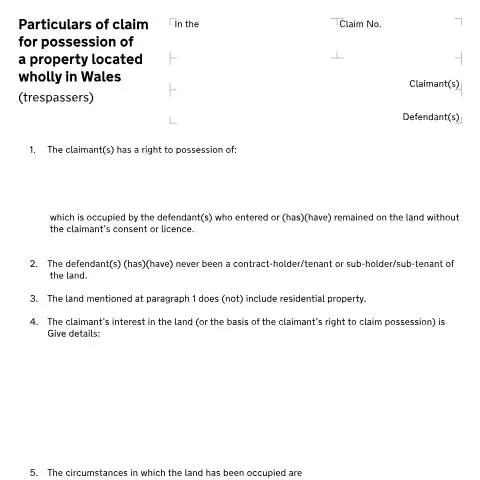
Understanding the N121 Form: A Tool for Landowners in Wales
When a landowner finds themselves facing encroachment by trespassers, the urgency to reclaim their property can be paramount. In such instances, the N121 Form, officially termed the Particulars of Claim for Possession of a Property Located Wholly in Wales (Trespassers), becomes a vital document in the legal toolkit. This form is essential not just for initiating a claim but also for articulating the particulars of the situation at hand. Its completion requires careful attention to detail and a clear understanding of the circumstances surrounding the trespass.
The Chronology of Filing: From Trespass to Court
The process of filing the N121 begins with the identification of trespassers. Once a landowner recognizes that individuals have occupied their property without permission, it’s crucial to act swiftly. Here’s a general timeline of events:
- Immediate Action: Document the trespass, noting the date and time, and gather any evidence such as photographs or witness statements.
- Initial Communication: Attempt to contact the trespassers, demanding they vacate the property. This may not always be effective but serves as a formal record of your intent.
- Filing the N121: If the trespassers refuse to leave, prepare and submit the N121 form.
- Court Proceedings: Await a court date assigned for hearing your claim.
- Judgment and Enforcement: If granted possession, the court may issue an order for possession, which may then require enforcement through bailiffs if compliance isn't met.
Decoding the N121: Key Sections Explained
Filling out the N121 requires a clear understanding of its sections to ensure accuracy and completeness. Each part requests specific information pertinent to the claim:
- Claimant Details: Include your name and address, making sure it’s clear you are the rightful owner.
- Property Information: Clearly describe the property involved, including its location and any relevant identifiers.
- Details of Trespass: This section requires a thorough explanation of how and when the trespass occurred. Specific details help substantiate your claim.
- Claim for Costs: You may include a request for the recovery of costs incurred in the process of making the claim, which is a standard inclusion in such forms.
- Statement of Truth: The importance of this declaration cannot be overstated; it affirms the accuracy of the information provided. False statements could lead to serious legal repercussions.
Who Should Use the N121 Form? A Profile of Users
The N121 is not a catch-all for every property dispute; its use is tailored specifically for situations involving trespassers. Below are profiles of typical users:
- Private Landowners: Those who own land that is being occupied without consent.
- Businesses: Companies that hold property rights and have encountered unauthorized occupation.
- Local Authorities: Entities needing to take action against unlawful occupiers on public lands.
Each user may approach the N121 with unique circumstances, such as varying degrees of evidence or different methods of attempting to resolve the trespass before escalating to court.
Key Evidence to Prepare: Fortifying Your Claim
To bolster your claim, gathering the right documentation is crucial. The type of evidence required can vary based on the nature of the trespass:
| Type of Evidence | Description | Purpose |
|---|---|---|
| Photographic Evidence | Images showing the trespassers on your property. | To visually substantiate your claim of unlawful occupation. |
| Witness Statements | Accounts from individuals who observed the trespass. | To provide corroboration of your claim. |
| Previous Correspondence | Records of any communication with the trespassers. | To demonstrate attempts to resolve the issue amicably. |
| Title Deeds | Proof of ownership of the property. | To establish your legal right to reclaim the property. |
The Legal Framework Surrounding the N121 Form
Understanding the legal backdrop against which the N121 operates is essential for any claimant. The possession claims guided by this form fall under the auspices of the Housing Act 1988 and subsequent amendments which outline the rights of occupiers and the procedures for seeking possession. This legislation defines what constitutes unauthorized occupation and outlines the procedures for landlords and landowners to follow when reclaiming their property. The process is designed to balance the rights of the claimant with those of the occupiers, necessitating a structured approach whereby all claims are substantiated with appropriate evidence and procedural compliance.
Exceptional Circumstances: Addressing Unique Situations
Certain situations may complicate the filing of the N121 form or influence the proceedings that follow. Below are some examples of exceptional circumstances:
- Minors as Claimants: If the claimant is a minor, a litigation friend must sign the N121 on their behalf.
- Complex Cases: If the trespassers are vulnerable individuals (e.g., those who are homeless or have mental health issues), additional considerations may arise.
- Foreign Nationals: If the trespassers are not from the UK, this may affect jurisdiction and the handling of the claim.
Each of these scenarios might require additional documentation, legal advice, or even different judicial procedures, further emphasizing the need for thorough preparation.
After Submission: Navigating the Court System
Once the N121 is submitted, the path to resolution can vary significantly based on the circumstances. Typically, the court will assign a hearing date where both parties can present their cases. Here’s what to expect:
- Court Notification: You will receive a notice indicating when your case will be called.
- Preparing for Court: Both sides will be encouraged to present their evidence and witnesses. It is prudent to seek legal representation during this phase.
- Judgment Issuance: After hearing both sides, the court will issue a judgment, which may grant or deny possession.
- Possession Order: If you are granted possession, the court will issue an order that may require enforcement through bailiffs if the trespassers do not vacate voluntarily.
The Role of Legal Advice in the Process
Even though the N121 form is designed for self-representation, it is often beneficial to seek legal counsel. Legal professionals can assist in several critical areas:
- Form Completion: Ensuring that all sections are accurately filled out and that the language used may strengthen your case.
- Evidence Collection: Legal advisors can guide you in gathering the necessary evidence and bolstering your submission.
- Representation in Court: Having a solicitor represent you during court proceedings can significantly impact the outcome of your case.
The N121 form serves as a crucial mechanism for property owners in Wales to reclaim their rightful possession when faced with unauthorized occupation. While the process may seem daunting, understanding its structure, requirements, and the surrounding legal context can empower claimants to approach their situation with confidence.
Understanding the Structure of Form N121 in Wales
The Form N121, which pertains to particulars of claim for trespassing cases in Wales, is structured to ensure that claimants provide exhaustive details to support their case effectively. This structured approach is not just a matter of formality; it plays a crucial role in the court's ability to understand the circumstances surrounding the trespass. The form includes several key sections that demand clear and precise information.
Firstly, the claimant must provide personal details, including their full name, address, and contact information. This is essential as it allows the court to recognize the claimant and correspond effectively regarding the case. Next, claimants are required to specify the defendant's details, ensuring that any potential correspondence or hearings can be accurately directed.
One of the critical sections of the N121 is the description of the trespass incident. Claimants are encouraged to detail the events leading to the trespass, including dates, times, and the nature of the intrusion. This narrative should be factual and devoid of emotive language. It is important to specify the location of the trespass, as well as any witnesses present who can corroborate the claimant's account. This section is where claimants can set the foundation of their case, making it imperative to provide a clear, chronological account of events that led to the claim.
Moreover, claimants must detail the remedy they seek. Whether it is financial damages, an injunction to prevent further trespassing, or specific performance, being explicit about the desired outcome is vital for the court to consider the claim appropriately. Claimants should also consider including any relevant legal precedents or statutes that support their claim, providing a broader context to the legal argument being presented.
Procedural Steps Following Submission of Form N121
After submitting the Form N121, claimants must navigate several procedural steps to ensure their claim moves forward in the court system. Once the form is filed with the court, the claimant is responsible for serving the claim on the defendant, which can be done via mail or personal service. This step is crucial as it ensures that the defendant is officially notified of the claim and has the opportunity to respond. Failure to serve the claim correctly can result in delays or even dismissal of the case.
Upon service of the claim, the defendant typically has 14 days to file a defence against the particulars of claim outlined in Form N121. If the defendant fails to respond within this timeframe, the claimant may apply for a default judgment, which can result in a ruling in their favour without a trial. However, if the defendant does respond, the case may proceed to a hearing, where both parties present their evidence and arguments.
It is also important for claimants to prepare for potential mediation. In some cases, the court may suggest mediation as a way to resolve the dispute without resorting to a full hearing. Claimants should be prepared to engage in this process, which can be a faster and less adversarial means of resolving the dispute.
Throughout this process, maintaining clear records and communications with the court, the defendant, and any witnesses is essential. Documentation such as emails, letters, and notes from conversations can be invaluable if the case proceeds to trial, where every detail matters in establishing the claimant's position.
Common Challenges and How to Overcome Them When Filing Form N121
When dealing with the particulars of claim concerning trespass, individuals may encounter a range of challenges that can complicate the process. One common issue is ensuring that the particulars provided are detailed and comprehensive. Claimants often underestimate the importance of clarity and specificity, which can lead to their claims being dismissed or delayed. To overcome this, it is advisable to draft the particulars of claim well in advance of filing the N121. Seeking input from legal professionals or utilizing templates designed for this specific form can significantly enhance the quality of the submission.
Another challenge frequently faced is the defendant's response. In some instances, defendants may file a counterclaim, which can complicate proceedings. Claimants should be prepared for this potential scenario by understanding their rights and options. Consulting with a solicitor who specializes in property law can provide insights into how to navigate counterclaims and what evidence will be needed to rebut any allegations the defendant may pose.
Moreover, claimants might also face difficulties in gathering sufficient evidence to support their claims. This is especially true in cases where the trespass occurred without witnesses or physical evidence. In such cases, it can be beneficial to gather corroborating information, such as photographs of the trespass location, any relevant communications with the defendant, or even expert testimony if applicable. Being proactive in evidence collection can bolster the chances of a successful claim.
Lastly, understanding the potential costs associated with filing Form N121 is crucial. While there may not be a fee for submitting this form in certain circumstances, subsequent legal actions or hearings may incur fees. It is essential to be aware of the potential financial implications, as well as exploring options for legal aid if the claimant meets the eligibility criteria. Claimants should also consider whether they have insurance that covers legal costs, which can alleviate some of the financial burdens associated with pursuing a claim for trespassing.