When Court Proceedings Demand Full Transparency: Understanding Document Disclosure Obligations
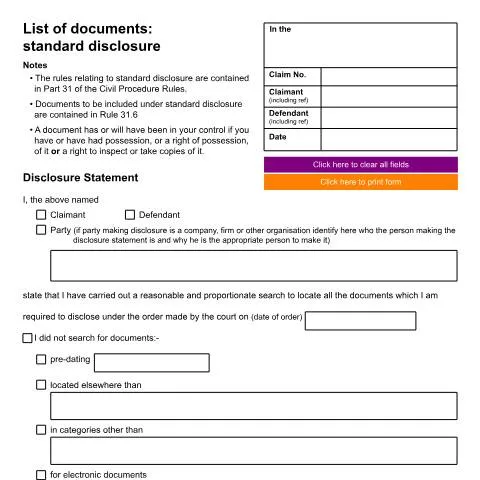
Civil litigation in England and Wales operates on a fundamental principle: parties must lay their cards on the table. Form N265 represents one of the most consequential moments in any court case—the point where you must formally declare to your opponent and the court exactly what documents you possess that relate to the dispute. This isn't merely an administrative exercise; it's a legal obligation that can determine the entire trajectory of your case.
The standard disclosure process governed by Part 31 of the Civil Procedure Rules requires parties to conduct what the courts term a "reasonable and proportionate search" for all documents that support, advance, or damage either party's case. Form N265 serves as your sworn statement that this search has been completed thoroughly and honestly.
The Legal Framework Behind Document Disclosure
The obligation to disclose documents stems from the overriding objective of the Civil Procedure Rules: to deal with cases justly and at proportionate cost. The courts recognised that justice cannot be achieved if parties can simply hide inconvenient documents. Rule 31.6 specifically defines which documents must be disclosed, encompassing not only those that support your own case, but critically, those that adversely affect your position or support your opponent's case.
This transparency requirement extends beyond documents currently in your possession. The disclosure duty covers any document that "is or has been" in your control—including documents you once had access to but may no longer possess directly.
Navigating the Three-Part Document Classification System
Form N265 organises your document disclosure into three distinct categories, each carrying different implications for the ongoing litigation. Understanding these classifications is crucial, as misplacing a document in the wrong category can have serious procedural consequences.
Documents Available for Inspection
The first section requires you to list all documents in your control that you do not object to the other party inspecting. This typically includes:
- Correspondence and communications directly relevant to the dispute
- Contracts, agreements, and formal documentation that form the foundation of your case
- Financial records, invoices, and receipts that support your claimed losses or payments
- Internal memoranda and notes that don't attract legal privilege
- Third-party communications where no confidentiality concerns arise
Each document must be numbered and described sufficiently for identification. The courts expect a "short description" that allows the other party to understand what they're requesting to see—vague entries like "various correspondence" will not suffice.
Documents Subject to Inspection Objections
The second category covers documents you acknowledge possessing but refuse to allow inspection of. Common grounds for objection include:
| Objection Ground | Typical Documents | Legal Basis |
|---|---|---|
| Legal Professional Privilege | Solicitor correspondence, counsel advice | Rule 31.19(3) |
| Litigation Privilege | Expert reports, witness statements in draft | Rule 31.19(4) |
| Without Prejudice Communications | Settlement negotiations, mediation discussions | Rule 31.19(5) |
| Disproportionality | Voluminous files of marginal relevance | Rule 31.19(6) |
The burden lies on you to justify each objection. Simply asserting privilege without explanation will likely prompt a court application from your opponent challenging the claimed exemption.
Documents No Longer in Control
The third section addresses documents you previously possessed but can no longer access. For each such document, you must specify when it was last in your control and its current location. This might include documents held by former employees, destroyed in the ordinary course of business, or transferred to third parties.
The courts take a dim view of convenient document destruction once litigation is contemplated. If you destroyed relevant documents after you knew or should have known that legal proceedings were likely, you may face adverse inferences or even contempt proceedings.
Conducting Your Document Search: Scope and Limitations
The disclosure statement section of Form N265 requires you to certify the extent and limitations of your document search. This isn't a box-ticking exercise—the courts expect a genuine, thoughtful approach tailored to your specific circumstances.
Temporal and Geographic Boundaries
You may legitimately limit your search by excluding documents pre-dating a specific date, particularly where earlier documents have no bearing on the current dispute. However, this date limitation must be reasonable and defensible. Similarly, you can exclude searches of locations that are genuinely unlikely to contain relevant documents, but you must be specific about what you've excluded and why.
Electronic Document Considerations
Modern disclosure increasingly focuses on electronic documents, which present unique challenges. Form N265 requires detailed specification of your electronic search parameters, including:
- Systems searched: PCs, servers, databases, mobile devices, cloud storage
- File types examined: emails, documents, spreadsheets, presentations
- Search methodology: keyword searches, date ranges, sender/recipient filters
- Systems not searched: with justification for exclusion
The concept of "proportionate search" is particularly relevant for electronic documents. A small commercial dispute may not justify forensic recovery of deleted files from backup tapes, whilst a major commercial fraud case might require exactly that level of investigation.
Keyword Search Strategies
If you've limited your electronic search to specific keywords or concepts, you must list these on the form. Effective keyword selection requires careful thought about how the relevant events and relationships might have been described in contemporary documents. Consider variations in terminology, abbreviations, and the language patterns of different document authors.
The Disclosure Statement: Your Sworn Commitment
The disclosure statement section of Form N265 represents your formal certification to the court and other parties. This isn't merely procedural—it's a sworn statement with potential consequences for perjury if deliberately false.
The statement encompasses several specific commitments:
- Reasonable and proportionate search: You certify that your document search meets these standards
- Complete disclosure: You confirm that your list includes all documents you're obliged to disclose
- Ongoing obligation: You acknowledge the duty to disclose additional documents that come into your control
- Understanding of duties: You confirm comprehension of your disclosure obligations
Who Can Make the Disclosure Statement
For individual parties, the disclosure statement must be made by the party themselves. However, for companies, firms, or other organisations, the form requires identification of the person making the statement and justification for why they're the appropriate person to do so.
Typically, this will be someone with direct knowledge of the organisation's document management systems and the specific dispute in question. A junior employee without access to senior management communications or historical records may not be the appropriate person, regardless of their job title.
Strategic Considerations in Document Disclosure
Whilst Form N265 appears purely procedural, completing it effectively requires strategic thinking about how your document disclosure will impact the broader litigation.
The Disproportionality Defence
The form allows you to withhold inspection of certain documents on disproportionality grounds under Rule 31.6(b) or (c). This provision recognises that some cases might generate disclosure obligations that dwarf the value or significance of the underlying dispute.
However, claiming disproportionality requires careful justification. The courts will consider factors including the financial value of the claim, the importance of the case to the parties, the complexity of the issues, and the likely cost of disclosure against the potential benefit.
Managing Privilege Claims
Legal professional privilege and litigation privilege protect certain communications from disclosure, but these protections can be waived inadvertently. If you've shared privileged documents with third parties or referred to their contents in non-privileged communications, you may have compromised the privilege claim.
The form requires you to list privileged documents sufficiently for the court and other parties to understand the nature of your privilege claim, but not so detailed as to undermine the privilege itself. This balance requires careful judgment.
Procedural Requirements and Court Expectations
Form N265 must be filed within the timeframe specified in the court's case management directions, typically 4 weeks after the case management conference. Late disclosure can result in cost sanctions and may prejudice your ability to rely on subsequently discovered documents at trial.
Service and Filing Requirements
The completed form must be served on all other parties to the proceedings simultaneously with filing at court. Electronic service through the court's digital systems is increasingly expected, though hard copy service remains acceptable in most circumstances.
The court file should receive the original signed form, whilst parties receive copies. If your disclosure list is extensive, consider whether the documents themselves should be organised into numbered bundles for efficient inspection.
Post-Disclosure Obligations
Completing Form N265 doesn't end your disclosure obligations. The ongoing duty to disclose means you must immediately inform the court and other parties if additional relevant documents come into your control before the case concludes. This might occur through discovery of previously overlooked files, acquisition of documents from third parties, or creation of new relevant documents.
Failure to comply with ongoing disclosure duties can result in the court drawing adverse inferences against you at trial, potentially undermining your entire case regardless of its underlying merits.
Common Pitfalls and Their Consequences
Document disclosure failures can be case-fatal, making awareness of potential problems essential for any party completing Form N265.
Inadequate Search Methodology
Courts increasingly scrutinise the adequacy of document searches, particularly for electronic materials. A search limited to obvious file locations without considering email archives, cloud storage, or mobile devices may be deemed inadequate. Similarly, keyword searches that are too narrow or fail to account for alternative terminology can undermine your disclosure compliance.
Premature Document Destruction
Once litigation is reasonably contemplated, parties come under a duty to preserve potentially relevant documents. Destruction of documents after this point—even pursuant to routine document retention policies—can result in severe sanctions including striking out your case or adverse inferences being drawn against you.
The courts have recognised that modern businesses generate vast quantities of electronic data, but this doesn't excuse wholesale deletion of potentially relevant materials once legal proceedings become likely.
Inadequate Privilege Claims
Simply asserting that documents are privileged without proper justification invites challenge from opposing parties. Each privilege claim should be specific about the nature of the privilege and the grounds for the claim. Generic assertions across categories of documents are likely to be rejected by the court.
Remember that privilege belongs to the client, not the lawyer, and can be waived inadvertently through disclosure to third parties or reference to privileged communications in non-privileged documents.
Beyond Standard Disclosure: When Form N265 Isn't Enough
Standard disclosure represents the default position under the Civil Procedure Rules, but it's not suitable for every case. High-value commercial disputes, cases involving extensive electronic records, or proceedings where parties have been less than forthcoming may require more intensive disclosure regimes.
The courts have powers to order specific disclosure, requiring parties to disclose particular documents or categories of documents beyond the standard disclosure requirements. They can also order disclosure against non-parties who hold relevant documents but aren't involved in the proceedings themselves.
In cases involving extensive electronic disclosure, the court may require the parties to agree a specific electronic disclosure protocol, potentially involving forensic IT specialists and detailed preservation orders. Such cases move well beyond the scope of Form N265 into specialist territory requiring expert legal and technical advice.
Understanding when standard disclosure is insufficient—and being prepared to apply for more extensive disclosure orders when necessary—can be the difference between winning and losing your case. Form N265 represents the starting point of this process, not its conclusion.
Understanding the Court's Disclosure Directions and Your Response Obligations
When the court issues disclosure directions, these typically form part of the case management orders following the directions questionnaire or case management conference. The court will specify the scope of disclosure required, which can vary significantly depending on your case type and the issues in dispute.
Standard disclosure under CPR 31.6 requires you to disclose documents that are or have been in your control and which:
- Support your own case
- Adversely affect your own case
- Adversely affect another party's case
- Support another party's case
The court's directions will usually specify a timeframe for exchanging disclosure lists, commonly between 4-8 weeks from the date of the order. Missing these deadlines can result in sanctions, including having your statement of case struck out or facing cost penalties.
Your disclosure obligations extend beyond documents currently in your possession. You must also disclose documents that were previously in your control but are no longer available, explaining what happened to them in your disclosure statement. This includes documents that have been destroyed in the normal course of business, provided you can demonstrate this was done before litigation was contemplated.
Electronic disclosure presents particular challenges in modern litigation. The court may give specific directions about searching electronic records, including emails, databases, backup systems, and mobile devices. You should preserve all potentially relevant electronic documents once litigation becomes reasonably foreseeable, implementing a litigation hold to prevent routine deletion or overwriting of data.
When completing Form N265, pay careful attention to the disclosure statement section. This sworn statement confirms you understand your disclosure duties and have carried out a reasonable search. The statement must be signed by you personally if you're acting as a litigant in person, or by an appropriate officer if you're representing a company or organisation.
The court may order specific disclosure if standard disclosure appears insufficient for your particular case. This might involve targeted searches of particular categories of documents, inspection of specific locations, or disclosure by non-parties who hold relevant documents. Understanding these possibilities helps you anticipate potential additional disclosure requirements.
Privileged Documents and Confidentiality Considerations in Disclosure
Not all documents within the scope of standard disclosure must be disclosed to other parties. Legal professional privilege protects confidential communications between you and your legal advisers made for the purpose of obtaining or giving legal advice, as well as communications made in connection with actual or contemplated litigation.
Advice privilege covers communications between lawyer and client, while litigation privilege extends to communications with third parties (such as expert witnesses or potential witnesses) made for the dominant purpose of conducting litigation. Documents covered by privilege should still be listed in your Form N265, but marked as privileged and not available for inspection.
Without prejudice communications, made in genuine attempts to settle the dispute, are generally protected from disclosure. However, you must be careful to ensure communications were truly made "without prejudice" - simply marking correspondence as such doesn't automatically confer protection if the communication wasn't genuinely aimed at settlement.
Commercial confidentiality doesn't automatically exempt documents from disclosure, but the court can make orders protecting genuinely confidential information. This might involve redacting sensitive commercial details, restricting who can see certain documents (such as limiting access to legal representatives only), or requiring confidentiality undertakings from the receiving party.
Public interest immunity may apply to documents whose disclosure would harm the public interest, typically involving government departments or public bodies. Claims for public interest immunity require careful consideration and often involve the court examining documents privately to balance competing interests.
Data protection considerations under UK GDPR and the Data Protection Act 2018 don't generally prevent disclosure ordered by the court, as disclosure for legal proceedings falls within the legitimate interests lawful basis. However, you should consider whether personal data can be redacted without affecting the document's relevance to the proceedings.
Joint privilege can arise where multiple parties share a common interest in maintaining confidentiality, such as in group litigation or where parties have received joint legal advice. Understanding these nuances helps ensure you don't inadvertently waive privilege or fail to claim protection for genuinely privileged material.
If you inadvertently disclose privileged documents, you may be able to seek their return, but this isn't automatic. The court will consider factors including how the disclosure occurred, whether the receiving party has already made use of the documents, and the potential prejudice to both parties in deciding whether to order return.
Practical Challenges and Problem-Solving in Document Management
Large-scale disclosure in complex commercial litigation can involve millions of documents, requiring sophisticated document review processes and technology-assisted review tools. Even in smaller cases, effective document management is crucial for meeting your disclosure obligations efficiently and cost-effectively.
Creating a comprehensive document retention policy before litigation arises helps ensure relevant documents are preserved and easily located when needed. This should cover both physical and electronic documents, specifying retention periods for different categories of records and establishing clear procedures for litigation holds.
When conducting your reasonable search, document your methodology and any limitations. The court recognises that searching every possible location may be disproportionate to the value and complexity of the case. Factors affecting the reasonableness of your search include the number of documents involved, the nature and complexity of the proceedings, the ease and expense of retrieval, and the significance of any document likely to be located.
Missing or destroyed documents require careful handling in your disclosure statement. You must explain what happened to documents that were previously in your control, when they were destroyed or lost, and the circumstances surrounding their disappearance. Deliberate destruction of documents after litigation becomes reasonably foreseeable can result in serious sanctions, including adverse inferences being drawn against you.
International elements add complexity to disclosure obligations. Documents held overseas may still be within your control if you can obtain them, even if this involves additional cost or administrative procedures. However, foreign data protection laws or banking secrecy rules might prevent disclosure, requiring applications to the court for directions on how to proceed.
Third-party document holders present particular challenges. While you can't be required to disclose documents not in your control, you may need to take reasonable steps to obtain relevant documents from third parties, such as requesting documents from former employees, suppliers, or professional advisers. The court has separate procedures for ordering disclosure by non-parties under CPR 31.17.
Cost management in disclosure is increasingly important, particularly following the Jackson reforms emphasising proportionality. The court will consider whether the likely benefit of requiring disclosure justifies the expense involved. This includes considering alternative methods of proving the same points and whether disclosure can be limited to specific issues or time periods.
Electronic disclosure protocols may be agreed between parties or ordered by the court, establishing common standards for document formats, metadata preservation, and search terms. These protocols help reduce costs and disputes about the technical aspects of disclosure while ensuring all parties can effectively review disclosed material.
Quality control in document review is essential to avoid disclosing privileged material or missing relevant documents. Implementing systematic review procedures, including appropriate supervision and checking mechanisms, helps ensure compliance with your disclosure obligations while protecting privileged and confidential information.