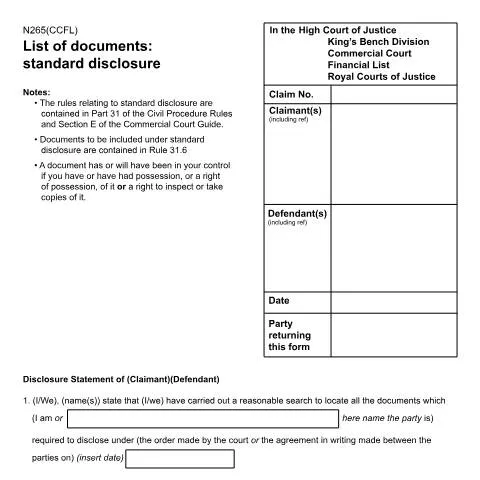
Understanding Form N265(CCFL) in the Context of Standard Disclosure
In the realm of commercial litigation, particularly within the High Court of Justice, Form N265(CCFL) plays a pivotal role in ensuring that all parties uphold their duty of disclosure. This form, also known as the List of Documents: Standard Disclosure specifically for the Commercial Court Financial List, is crucial for managing the evidential landscape of a case. It is utilized by claimants and defendants alike to itemize and certify the documents relevant to their respective arguments.
The Significance of Standard Disclosure
Standard disclosure is governed by Part 31 of the Civil Procedure Rules (CPR) and is a foundational element in the pre-trial process. The intent is to provide transparency and allow both parties to prepare their cases adequately. Under Rule 31.6, a party is required to disclose documents that are or have been in their control, which might be relevant to any matter in issue. This requirement not only promotes fair play but also helps streamline court procedures by narrowing down the issues that need to be resolved.
Who Needs to Complete Form N265(CCFL)?
Form N265(CCFL) is pertinent for parties involved in litigation in the Commercial Court Financial List. Typically, these are:
- Claimants: Individuals or entities initiating a claim in court seeking legal remedy.
- Defendants: Individuals or entities against whom a claim is made.
- Legal Representatives: Solicitors or barristers acting on behalf of either party, who may have the obligation to complete this form with precision.
Each party has distinct obligations and circumstances that can affect how they approach the completion of this form. For instance, a corporate entity may have different considerations compared to an individual.
Deciphering the Sections of Form N265(CCFL)
The form is segmented into various sections, each demanding meticulous attention. Understanding these sections is essential for effective completion.
Disclosure Statement
In the initial part of the form, the party must acknowledge their duty of disclosure. Here’s an overview of the key components:
- Name and Role: Clearly state the name of the party making the declaration (Claimant or Defendant).
- Certification of Reasonable Search: It is imperative to describe the nature of the search undertaken to locate relevant documents. This includes specifying any limitations imposed on the search, such as documents not searched for due to being pre-dating the case or being stored off-site.
It's crucial to be transparent about the search extent and any limitations. For instance, if electronic documents were not fully searched, detailing the specific reasons helps avoid complications later.
Extent of the Search
In this section, parties should outline the depth of their search for documents. Consider the following:
- Types of Searches Conducted:
- Electronic Searches: Indicate what systems were searched (e.g., company servers, local drives).
- Physical Documents: Describe efforts made to locate paper documents.
Detailing these aspects enhances credibility and demonstrates compliance with disclosure obligations.
Limiting the Search
This part requires parties to justify why certain documents were not included in the search. For instance, if a party decides not to search for documents older than a certain date or stored in categories not deemed relevant, they must provide a rationale supported by facts as per the Commercial Court Guide.
Channels for Submitting Form N265(CCFL)
Once completed, understanding how to submit Form N265(CCFL) is equally vital. There are several methods available for filing this form, which can affect the timeline and processing of the case.
Online Submission
The HM Courts & Tribunals Service (HMCTS) has digitized many processes, allowing for online filing. Benefits include:
- Speed: Immediate submission and quicker processing times.
- Tracking: Easier to track the status of your submission.
However, parties must ensure that they are registered on the appropriate court's e-filing system and that they have all necessary documents ready for upload.
Paper Submission
For those who prefer traditional methods or lack access to online services, submitting a paper form remains an option. Steps include:
- Printing the Completed Form: Ensure it is filled out correctly without any errors.
- Delivering to the Court: This can be done via post or in person to the relevant court office.
While this method may take longer, it remains a practical solution for many.
Submission Through Legal Representatives
If a party is represented by a solicitor or barrister, they can file on behalf of their client. This method often assures that the form is completed correctly, as legal professionals are well-versed in the nuances of these documents.
Post-Submission: What Happens Next?
After the form is submitted, parties may wonder about the subsequent steps and how the court processes this form.
Processing the Form
Upon receipt, the court will review the submission for completeness and adherence to disclosure rules. This may involve:
- Verification of Documents Listed: The court checks that all relevant documents have been disclosed as per the rules.
- Determining Compliance: If discrepancies are found, the court may request further details or clarifications.
Following Up on Your Submission
It is important to maintain communication with the court regarding your case. Here are practical steps for follow-up:
- Contacting the Court: Reach out via the specified court contact details to inquire about the status of your submission.
- Monitoring Deadlines: Keep track of any deadlines related to the disclosure process, as non-compliance can negatively impact your case.
Distinguishing Form N265(CCFL) from Other Disclosure Forms
Form N265(CCFL) is not the only document pertaining to disclosure within the UK legal system. Understanding what sets it apart is crucial for accurate compliance.
Comparison with Other Disclosure Forms
- Form N265(CCFL) vs. Other N265 Variants: While N265 is dedicated to standard disclosure in commercial financial cases, other variants may cater to differing contexts or jurisdictions.
Here’s a table that outlines key differences:
| Form | Context | Purpose |
|---|---|---|
| N265(CCFL) | Commercial Court Financial List | Standard disclosure of relevant documents |
| N265 (General) | Various civil claims | General disclosure requirements |
| N264 | Application for disclosure order | Request additional disclosure from the judge |
The main distinction lies in the focus of the case and the specific requirements dictated by the associated disclosure rules.
Common Profiles and Circumstances of Users
Different parties may encounter specific situations that affect the way they complete Form N265(CCFL). Understanding these profiles can provide clarity for users.
Business Entities
Corporate entities may encounter unique scenarios, such as dealing with vast amounts of data across multiple departments. When completing the form, they should:
- Ensure comprehensive searches across all business divisions.
- Consider confidentiality and commercial sensitivity in disclosure.
Individuals in Litigation
For individuals, particularly those who may represent themselves, the process can be daunting. Key considerations include:
- Simplifying the language used in the form to avoid misunderstandings.
- Seeking assistance from legal advisors to ensure compliance with the disclosure duty.
International Parties
If a party is based outside of the UK, they must consider additional complexities such as:
- Understanding UK jurisdiction and procedural rules.
- Ensuring translations and interpretations of documents are accurate for disclosure purposes.
Prepping Your Documents for Form N265(CCFL)
Successfully completing Form N265(CCFL) is heavily reliant on the documentation that parties prepare prior to submission. Proper preparation can save time and reduce errors.
Organizing Your Document List
Prior to submitting the form, parties should:
- Compile a Complete List: Collect all relevant documents, ensuring they are organized logically.
- Categorize Documents: This can be broken down into:
- Non-Objectionable Documents: Those that can be disclosed without issue.
- Objectionable Documents: Clearly outline why certain documents may not be disclosed.
Consideration of Electronic Documents
With the increased reliance on digital documentation, parties must also ensure they account for:
- Electronic Records: Include all pertinent electronic data in your disclosure.
- Cloud Storage: If documents are stored in cloud services, ensure access and availability for review.
Final Thoughts on Form N265(CCFL)
Navigating the intricacies of Form N265(CCFL) can be challenging, but understanding its role and the requirements can significantly enhance compliance and preparation. Engaging with legal counsel when in doubt is advisable to ensure that all legal obligations are met. By carefully organizing documents and following through with the court process, parties can facilitate a smoother litigation experience within the Commercial Court Financial List.
Understanding the Purpose of Standard Disclosure in Commercial Court Financial Lists
The standard disclosure process serves a crucial role in the context of the UK Commercial Court Financial List. Essentially, standard disclosure requires parties involved in litigation to list and disclose documents relevant to the issues in dispute. The overarching aim is to ensure that all pertinent evidence is presented before the court, thereby facilitating a fair trial. This obligation is essential in commercial disputes, where the financial stakes are often high, and transparency is imperative.
Standard disclosure is mandated under the Civil Procedure Rules (CPR), particularly Rule 31.6, which stipulates the types of documents that must be disclosed. Under this rule, parties must disclose documents that they rely upon in their case, as well as those that may adversely affect their case or support the case of another party. This requirement significantly contributes to the strategic positioning of parties during litigation, as it can influence the formulation of arguments and the overall direction of the case.
Parties should also be aware of their duty to conduct a reasonable search for documents, which may involve electronic searches or reviewing physical records. The nature of the documents disclosed can also impact costs; therefore, parties often engage in careful consideration of what documents to include in their disclosure. In complex financial disputes, the need for meticulous documentation and compliance with the disclosure obligations can shape the litigation process and outcome.
Implications of Non-Compliance with Disclosure Obligations
Non-compliance with the standard disclosure requirements outlined in Form N265(CCFL) can lead to severe ramifications for parties involved in litigation. The Commercial Court takes compliance with disclosure obligations very seriously, and failing to adhere to these requirements can not only hinder the litigation process but also adversely affect a party's standing in court.
Firstly, a party that does not disclose relevant documents may face sanctions imposed by the court. Such sanctions can range from costs penalties to more severe measures, including the striking out of pleadings or dismissal of claims. The court has broad discretion in determining appropriate sanctions, and the consequences can be dire, particularly in high-stakes financial disputes where the outcome may significantly impact a party's financial position.
Furthermore, non-compliance can undermine a party’s credibility before the court. If it is established that a party has failed to disclose documents that might influence the proceedings, this can lead to an adverse inference being drawn by the judge. In essence, the court may assume that the undisclosed documents would have been detrimental to the non-compliant party's case, thereby weakening its position significantly.
In addition to legal repercussions, there are strategic considerations regarding relationships and reputation in the business community. Failing to comply with disclosure obligations can damage a party’s professional relationships and reputation, particularly when dealing with other businesses or stakeholders within the industry. Consequently, it is critical for parties to understand the importance of thorough disclosure practices and to implement systems that ensure compliance with the court's expectations.
Steps to Prepare for Standard Disclosure: Best Practices
Preparing for standard disclosure involves a systematic approach that ensures compliance with the requirements outlined in Form N265(CCFL). Here are some best practices that parties should consider when preparing for their disclosure obligations:
- Document Management Strategy: Establish a comprehensive document management system that allows for easy retrieval and organization of documents. This system should differentiate between types of documents (e.g., emails, contracts, financial statements) to facilitate efficient searches.
- Identify Relevant Documents: Conduct a thorough review of all documents that may be relevant to the case. This includes those that support your claims, those that may weaken your position, and any documents that could benefit the opposing party. Engaging legal counsel to assist in this review can be invaluable.
- Perform a Reasonable Search: Implement a plan for conducting a reasonable search for documents, which may involve electronic searches of databases and archives. Consider involving IT specialists if necessary, especially for cases with extensive electronic documentation.
- Engage in Early Case Assessment: Conduct early assessments of potential issues and dispute areas through discussions with legal advisors. This can help clarify what documents are likely to be critical and ensure that they are not overlooked during the disclosure process.
- Regularly Update Documentation: Maintain up-to-date records and documentation throughout the litigation process. This includes monitoring any new developments that may produce additional relevant documents, thus ensuring that your disclosure remains comprehensive.
- Implement Training: Invest in training for staff involved in the litigation process regarding the importance of disclosure compliance. Understanding the implications of non-compliance can foster a culture of diligence and accountability.
By adopting these best practices, parties can navigate the complexities of standard disclosure effectively, thereby positioning themselves to present their case in the strongest possible light.