When Debtors Shield Assets Through Third Parties: The Strategic Use of Form N349
Judgment creditors often find themselves in a frustrating position: they have secured a court judgment against a debtor, yet the debtor appears to have no readily accessible assets to satisfy the debt. However, money owed to the judgment debtor by third parties—whether held in bank accounts, as wages, or other debts—can provide an alternative route to recovery. Form N349 represents a powerful legal mechanism that allows creditors to intercept these funds directly from the third party, bypassing the judgment debtor entirely.
This application process, governed by Part 72 of the Civil Procedure Rules, transforms what might otherwise be an uncollectable judgment into a recoverable debt. The third-party debt order procedure operates on the principle that if someone owes money to your debtor, the court can redirect that payment to you instead, up to the value of your outstanding judgment.
The effectiveness of Form N349 lies in its ability to capture funds that the judgment debtor might otherwise move, spend, or conceal. Unlike other enforcement methods that rely on the debtor's cooperation or the seizure of physical assets, third-party debt orders can secure liquid funds held by banks, employers, or other entities before the debtor becomes aware of the enforcement action.
Dissecting the Core Elements: Parties, Debts, and Legal Foundations
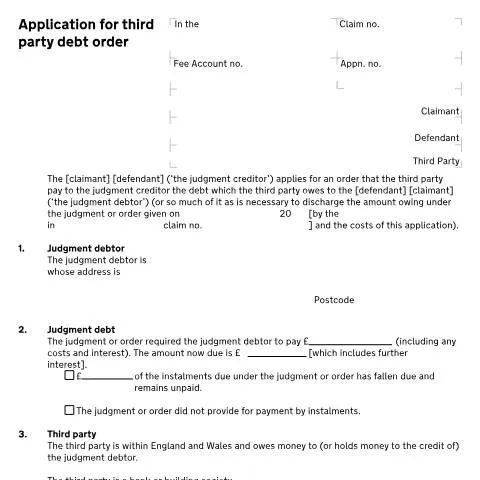
Form N349 operates within a triangular relationship involving three distinct legal entities, each with specific roles and obligations. The judgment creditor is the party who has obtained a court judgment and now seeks to enforce it through this mechanism. This creditor must demonstrate not only the existence of a valid, unsatisfied judgment but also specific knowledge or reasonable belief about the debtor's financial arrangements with third parties.
The judgment debtor occupies the central position in this enforcement triangle. Section 1 of the form requires comprehensive identification details, including full name and current address with postcode. This information must be accurate and up-to-date, as any errors can result in the application being struck out or the wrong person being targeted. The court requires precision here because the third-party debt order will ultimately affect the debtor's legal rights and financial arrangements.
Section 2 addresses the underlying judgment debt itself, requiring specific financial details that demonstrate both the legal basis for enforcement and the current amount owed. Applicants must distinguish between the original judgment amount and any additional interest that has accrued. Where the original order provided for instalment payments, the form requires explicit confirmation of which instalments have fallen due and remain unpaid—a crucial distinction that affects the court's willingness to grant the order.
The third party represents the entity that holds or owes money to the judgment debtor. Section 3 creates a bifurcated approach, recognising that banks and building societies require different treatment from other types of third parties. For banking institutions, the form demands specific details including sort codes, account numbers, and branch locations. However, the form acknowledges practical limitations by allowing applicants to indicate where such information is "not known"—a recognition that creditors may have incomplete intelligence about the debtor's financial arrangements.
Banking Relationships and Financial Institution Procedures
When targeting bank accounts through Form N349, applicants must navigate the complex landscape of modern banking structures. The form requires identification of both the institution's head office address within England and Wales and the specific branch where the account is held. This dual requirement reflects the legal reality that while banks operate as single entities, accounts are often administered at branch level, and enforcement procedures must target the correct operational unit.
The distinction between different types of financial institutions carries practical significance. Banks and building societies are subject to well-established procedures for handling third-party debt orders, with internal systems designed to freeze accounts upon receipt of interim orders. Credit unions, payment service providers, and other financial entities may require more detailed explanation of their obligations and may respond less predictably to enforcement procedures.
Account identification presents particular challenges in an era of online banking and multiple account types. The form's request for sort codes and account numbers reflects traditional banking structures, but applicants dealing with newer financial institutions or international banking arrangements may need to provide alternative identifying information. The court generally accepts reasonable efforts to identify accounts, recognising that perfect information may not always be available to judgment creditors.
| Institution Type | Required Information | Typical Response Time | Special Considerations |
|---|---|---|---|
| High Street Banks | Sort code, account number, branch address | 1-2 working days | Established procedures, reliable compliance |
| Building Societies | Account number, branch or head office | 2-3 working days | May require additional identification |
| Online Banks | Account details, registered office address | Variable | May lack physical branch structure |
| Credit Unions | Membership number, registered address | 3-5 working days | Smaller organisations, less formal procedures |
Competing Claims and Complex Ownership Structures
Section 4 of Form N349 addresses one of the most legally complex aspects of third-party debt orders: the potential existence of other parties with legitimate claims to the same funds. This section requires applicants to identify any persons, beyond the judgment debtor, who might have legal or beneficial interests in the money held by the third party. Such competing interests can arise in numerous scenarios, each carrying different legal implications.
Joint bank accounts represent the most common source of competing claims. Where a judgment debtor holds an account jointly with a spouse, business partner, or other individual, the non-debtor account holder has legitimate rights to their portion of the funds. The court must balance the creditor's enforcement rights against the innocent party's property rights, often leading to orders that freeze only a proportion of the available funds.
Business relationships create particularly complex scenarios. Where a judgment debtor operates as a sole trader, funds held in business accounts may be subject to claims from suppliers, employees, or other creditors. Limited company structures can shield personal creditors from business assets, but directors' accounts may contain both personal and corporate funds, requiring careful legal analysis.
Trust arrangements and beneficial ownership structures present additional complications. Money held by a third party may belong beneficially to someone other than the named account holder, or the judgment debtor may hold funds on trust for others. Family arrangements, particularly involving elderly relatives or children, often involve informal trust relationships that can complicate enforcement procedures.
The form requires applicants to provide information known about each person's claim, acknowledging that creditors may have limited knowledge of complex ownership arrangements. However, failure to disclose known competing interests can result in applications being refused or orders being set aside, potentially exposing applicants to adverse costs orders.
Evidence Standards and Intelligence Gathering
Section 5 of Form N349 requires applicants to explain the sources and grounds for their information about the third party's obligations to the judgment debtor. This requirement reflects the court's need to assess the reliability of the intelligence underlying the application while recognising that creditors may have limited access to definitive information about debtors' financial arrangements.
Acceptable sources of information vary considerably in their reliability and legal weight. Bank statements obtained during earlier proceedings provide strong evidence of account relationships, though they may not reflect current balances or account status. Employment records, whether from disclosure during the original proceedings or from publicly available sources, can support applications targeting salary or wage payments.
Debtor examinations under CPR Part 71 often provide the most comprehensive and legally robust foundation for third-party debt order applications. Information obtained under oath during such examinations carries particular weight, as debtors face contempt proceedings for providing false information. However, the information must be reasonably current, as financial arrangements can change rapidly.
Investigation agencies and tracing services increasingly provide intelligence for enforcement proceedings, though the court scrutinises such evidence carefully. Information must be obtained through legitimate means, and applicants should be prepared to explain how private investigators or other agencies acquired their intelligence. Unlawfully obtained information, such as that derived from unauthorised access to banking systems or fraudulent representations, will invalidate applications and may expose applicants to criminal liability.
Circumstantial evidence can support applications where direct proof is unavailable. Regular payments from known employers, standard banking relationships with local institutions, or property transactions that suggest specific banking arrangements may provide sufficient foundation for applications. However, speculation or assumptions without factual basis will not satisfy the court's requirements.
Multiple Applications and Strategic Enforcement Sequencing
Section 6 addresses the critical issue of previous or concurrent applications for third-party debt orders against the same judgment debt. This requirement serves multiple purposes: preventing abuse of the process, avoiding conflicts between different enforcement procedures, and ensuring that the court has complete information about the creditor's enforcement strategy.
The strategic timing of multiple applications can significantly impact their effectiveness. Simultaneous applications against different third parties may prevent judgment debtors from moving funds between accounts once they become aware of enforcement action. However, multiple applications also multiply court fees and may stretch the creditor's resources, particularly if several applications prove unsuccessful.
Sequential applications often prove more cost-effective, allowing creditors to assess the success of initial enforcement efforts before committing to additional procedures. However, this approach carries the risk that successful initial enforcement may alert the judgment debtor to take protective action regarding other assets or accounts.
Previous unsuccessful applications require careful analysis before launching new enforcement efforts. Where earlier applications failed due to insufficient funds or account closure, new applications targeting the same third party may prove futile unless circumstances have materially changed. Conversely, applications that failed due to technical defects or inadequate evidence may be worth renewing with improved preparation.
The court maintains records of all third-party debt order applications, and repeated applications without reasonable foundation may be viewed as abuse of process. Creditors must balance persistent enforcement efforts with the risk of being perceived as engaging in oppressive litigation conduct.
Statement of Truth Requirements and Legal Accountability
The Statement of Truth section represents one of the most legally significant components of Form N349, as it exposes applicants to potential contempt proceedings for false or misleading information. This requirement extends beyond mere accuracy to encompass the applicant's honest belief in the truth of the stated facts, creating both subjective and objective standards for the information provided.
Different categories of applicants face varying responsibilities under the Statement of Truth. Individual judgment creditors must personally verify their belief in the accuracy of all information provided, while corporate creditors typically act through authorised representatives who must confirm both their authority and their belief in the stated facts. Legal representatives signing on behalf of clients must ensure they have proper instructions and reasonable grounds for believing the information to be accurate.
The practical implications of the Statement of Truth extend to the quality and verification of information included in applications. Applicants should maintain records of their sources and reasoning, as they may need to justify their belief in contested information if applications are challenged. Hearsay information or unverified intelligence may still be included if the applicant has reasonable grounds for believing it to be true, but such information should be clearly identified as such.
Litigation friends acting for judgment creditors who lack capacity face particular responsibilities, as they must assess not only the accuracy of information but also whether pursuing enforcement through third-party debt orders serves the protected person's best interests. Professional deputies and attorneys under lasting powers of attorney must ensure their authority extends to enforcement proceedings and maintain proper records of their decision-making process.
The consequences of false statements extend beyond the immediate application to potential criminal liability and professional sanctions for legal representatives. The court's power to initiate contempt proceedings operates independently of the success or failure of the underlying application, meaning that even successful enforcement actions can result in sanctions if based on false information.
Procedural Pathway and Court Administration
The processing of Form N349 follows a structured pathway through the court system, beginning with initial assessment and proceeding through interim and final order stages. Understanding this process helps applicants prepare effectively and respond appropriately to court directions and third-party responses.
Upon receipt, court staff conduct initial administrative checks focusing on completeness, fee payment, and basic procedural compliance. Applications lacking essential information or proper signatures are typically rejected without substantive consideration, requiring resubmission with additional court fees. The court file number and fee account details at the top of the form enable tracking and payment processing throughout the procedure.
Successful applications proceed to judicial consideration for the grant of an interim third-party debt order. This initial order freezes the relevant funds and requires the third party to attend a hearing to show cause why a final order should not be made. The interim order serves multiple purposes: preserving assets, providing notice to all interested parties, and creating a framework for resolving any disputes about the proposed enforcement.
The period between interim and final orders typically lasts several weeks, during which various parties may raise objections or complications. Third parties may dispute the existence or amount of funds held, judgment debtors may challenge the underlying debt or claim exemptions, and other creditors may assert priority claims. The court manages these competing interests through the hearing process, which may involve multiple adjournments as complex issues are resolved.
Final orders, when granted, direct the third party to pay specified amounts directly to the judgment creditor, effectively completing the enforcement process. However, third parties may seek clarification of their obligations, particularly where complex account structures or multiple claims complicate straightforward compliance. The court retains jurisdiction to resolve implementation issues and ensure that orders achieve their intended effect.