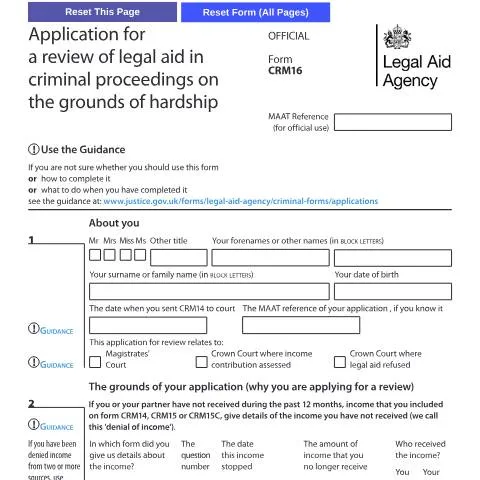
When Financial Hardship Threatens Access to Criminal Defence: Understanding CRM16 Applications
Criminal proceedings can drain household finances faster than most people anticipate. Legal aid contributions, whilst calculated on current income, may become unaffordable when circumstances change dramatically—job loss, illness, or unexpected financial obligations can transform a manageable monthly payment into an impossible burden. The CRM16 form provides a vital lifeline for defendants facing this predicament, enabling them to seek a formal review of their legal aid contribution on grounds of genuine financial hardship.
This Legal Aid Agency mechanism acknowledges that rigid financial assessments cannot always accommodate life's unpredictable turns. Whether someone has lost employment after their initial CRM14 application, faces mounting care costs for a disabled family member, or discovers that their partner's income has ceased, the CRM16 process offers structured relief. The form's design reflects the complexity of modern financial circumstances, distinguishing between temporary cash flow problems and substantive hardship that genuinely threatens a defendant's ability to maintain basic living standards whilst meeting legal aid obligations.
Eligibility Framework: Who Can Apply and When
The CRM16 hardship review operates within specific parameters that distinguish it from initial legal aid applications or standard contribution reviews. Applicants must have already submitted a CRM14 form and received either a Crown Court legal aid refusal based on income assessment or a contribution assessment from a magistrates' court. This prerequisite ensures the hardship review addresses changed circumstances rather than challenging the original assessment methodology.
Three distinct scenarios trigger CRM16 eligibility. Income denial cases involve situations where declared income on the original CRM14, CRM15, or CRM15C forms has since stopped or reduced significantly. This covers redundancy, reduced working hours, benefit cessation, or partner separation affecting household income. Additional outgoings cases encompass new financial obligations not covered by the standard Cost of Living Allowance—typically debt repayments, medical expenses, or care costs that have emerged since the original application.
The third scenario involves Crown Court eligibility reviews where defendants initially failed the means test but can now demonstrate that paying for their defence would cause genuine hardship. This particularly affects individuals whose income marginally exceeded thresholds but who face exceptional circumstances that weren't captured in standard assessments.
| Court Type | Review Trigger | Required Evidence | Decision Authority |
|---|---|---|---|
| Magistrates' Court | Contribution assessment causing hardship | Income/outgoings evidence | Legal Aid Agency |
| Crown Court | Legal aid refused on financial grounds | Full financial disclosure plus hardship evidence | Legal Aid Agency |
| Crown Court | Contribution assessment review | Changed circumstances documentation | Legal Aid Agency |
Documenting Income Loss: The Critical Evidence Trail
Section 2 of the CRM16 form demands precise documentation of income that has ceased or reduced since the original legal aid application. This isn't simply about stating that earnings have dropped—applicants must provide a comprehensive audit trail linking their current circumstances to previously declared income streams. The Legal Aid Agency requires specific details: which form originally declared the income, the exact question number where it appeared, cessation dates, amounts no longer received, and crucially, the underlying reasons for income loss.
Employment-related income denial typically involves redundancy, reduced hours, or dismissal. Applicants must specify whether they or their partner received the affected income and provide employment documentation. Benefit income cessation requires correspondence from DWP or local authorities explaining why payments stopped. Self-employment income reductions need business records demonstrating the downturn, whilst rental income losses require tenancy documentation or void period evidence.
The form's structure acknowledges that multiple income sources may be affected simultaneously. When someone faces redundancy whilst their partner's benefits are sanctioned, both losses must be documented separately with distinct evidence packages. The Legal Aid Agency's assessment considers the cumulative impact rather than treating each loss in isolation, recognising that multiple income streams often interconnect in household budgets.
Partner Income Complications
Partner income cessation creates particular complexity within CRM16 applications. The original CRM14 assessment included partner earnings in household income calculations, so any reduction affects the overall financial picture significantly. However, proving partner income loss requires their active cooperation in providing employment records, benefit correspondence, or business documentation. The form includes a separate partner declaration section specifically because their financial circumstances directly impact the hardship assessment.
Beyond the Cost of Living Allowance: Exceptional Outgoings
Section 3 addresses financial obligations that fall outside the Legal Aid Agency's standard Cost of Living Allowance. This allowance covers basic necessities—food, clothing, utilities, and insurance—but doesn't account for debt repayments, medical expenses, or care costs that can dominate household budgets. The CRM16 process recognises that these additional outgoings can render legal aid contributions unaffordable even when basic living costs are met.
Acceptable additional outgoings include secured debt repayments like mortgage arrears or hire purchase agreements, priority debts such as council tax or income tax liabilities, and essential care costs for disabled family members or elderly relatives. Medical expenses, including prescription costs not covered by NHS exemptions, private treatment for conditions affecting work capacity, or specialist equipment needs, also qualify for consideration.
The evidence requirements for outgoings claims are stringent. Bank statements alone don't suffice—applicants must provide loan agreements, credit card statements, court orders for debt repayments, or care assessment documents. This evidential threshold prevents speculative claims whilst ensuring genuine hardship cases receive appropriate consideration. The Legal Aid Agency particularly scrutinises discretionary spending that might be reduced before claiming hardship relief.
Timing and Frequency Considerations
The form requires precise timing information for all outgoings—weekly, fortnightly, monthly, or annual payment frequencies. This granularity enables accurate comparison with legal aid contribution schedules and ensures that temporary payment holidays or irregular expenses don't skew the hardship assessment. Seasonal variations, such as higher heating costs during winter months, can be factored into the overall calculation when properly documented.
Professional Involvement: The Solicitor's Essential Role
CRM16 applications cannot proceed without solicitor completion and submission—this isn't a form that defendants can submit directly to the Legal Aid Agency. Section 8 requires detailed solicitor information, including their LAA Provider Account Number, which links the application to the firm's legal aid contract. This professional gateway ensures that hardship claims undergo preliminary legal assessment before reaching the Agency's caseworkers.
For magistrates' court cases and Crown Court eligibility reviews, solicitors must complete detailed cost projections in Section 9. These calculations demonstrate the financial burden that full private funding would impose, supporting the hardship argument with concrete figures. The cost analysis distinguishes between solicitor and advocate fees, preparation time, hearing attendance, and potential disbursements including expert witness fees or forensic costs.
Grade of fee earner classifications significantly impact cost calculations. Senior solicitors command higher hourly rates than trainee solicitors or paralegals, so firms must accurately categorise who will handle different case aspects. The Legal Aid Agency uses these projections to assess whether private funding costs would indeed cause disproportionate hardship relative to the defendant's financial circumstances.
Crown Court Advocate Costs
Crown Court cases require separate advocate cost calculations covering brief fees, refresher rates, and potential disbursements. Brief fees encompass preparation work, client conferences, and the first trial day, whilst refreshers cover subsequent hearing days. These calculations become particularly significant in complex cases where trial length uncertainty makes private funding costs unpredictable, strengthening hardship arguments for defendants with limited financial resources.
Processing Pathways: From Submission to Decision
Once submitted through the solicitor, CRM16 applications enter the Legal Aid Agency's assessment process where caseworkers evaluate both the evidence quality and the hardship claim's merit. The Agency cross-references information against original CRM14 data and any subsequent CRM15 or CRM15C submissions to identify inconsistencies or verify claimed changes in circumstances.
Assessment timescales vary depending on case complexity and evidence completeness. Straightforward income denial cases with clear employment termination documentation typically process within 4-6 weeks. Complex outgoings cases involving multiple debt arrangements or care cost assessments may require 8-12 weeks, particularly when the Agency seeks additional evidence or clarification from third parties.
The Agency's decision-making framework considers both immediate hardship and longer-term sustainability. A temporary income reduction might not justify contribution reduction if alternative income sources are readily available, whereas permanent disability affecting earning capacity would likely support hardship relief. The assessment also weighs the defendant's efforts to mitigate their financial difficulties—actively seeking employment, negotiating with creditors, or accessing available benefits.
Decision Outcomes and Appeals
CRM16 decisions can result in contribution reduction, complete contribution waiver, or hardship claim rejection. Partial relief might involve reducing monthly contribution amounts or extending payment periods to make obligations more manageable. Complete waivers typically require demonstration that any contribution would prevent the defendant from meeting basic living needs or essential family obligations.
Rejected applications include reasons explaining why the Agency concluded that hardship wasn't sufficiently demonstrated. Common rejection grounds include inadequate evidence, alternative income sources not fully explored, or discretionary spending that could be reduced before claiming hardship relief. Defendants can challenge decisions through the Legal Aid Agency's internal review process, though this requires additional evidence addressing the original rejection reasons.
Strategic Timing: When to Submit Hardship Applications
The timing of CRM16 submissions can significantly impact both the application's success and the defendant's overall case management. Submitting too early, before financial circumstances have stabilised, risks rejection based on speculative hardship claims. Conversely, delayed submissions may mean accumulating unaffordable contribution arrears that complicate the defendant's position regardless of eventual hardship relief.
Optimal timing typically occurs when changed circumstances have persisted for at least 4-6 weeks, providing sufficient evidence that the situation isn't merely temporary, but before contribution arrears become overwhelming. This timing allows for comprehensive evidence gathering whilst demonstrating genuine attempts to manage the financial difficulties independently.
For defendants facing imminent trial dates, expedited processing may be available when hardship threatens their ability to maintain legal representation. However, expedited applications require particularly robust evidence packages since caseworkers have limited time for additional information requests. The Legal Aid Agency prioritises cases where contribution difficulties might otherwise result in unrepresented defendants at trial.
Interaction with Ongoing Proceedings
CRM16 applications don't automatically suspend contribution payment obligations during assessment periods. Defendants should continue meeting existing payment schedules unless specifically advised otherwise by their solicitor or the Legal Aid Agency. However, constructive engagement with the hardship review process may influence how the Agency handles any temporary payment difficulties that arise during assessment.
The relationship between hardship applications and case progression requires careful coordination between defendant, solicitor, and court timetables. Successful hardship relief can enable continued legal representation in cases where contribution difficulties might otherwise force defendants to represent themselves or accept inadequate legal support. This coordination becomes particularly critical in Crown Court cases where representation quality directly impacts trial outcomes and potential sentencing.
Understanding the Financial Threshold Assessment for CRM16 Hardship Reviews
The Legal Aid Agency applies specific financial criteria when evaluating CRM16 hardship applications, though these thresholds differ markedly from standard means testing used in civil legal aid. Unlike the rigid income and capital limits applied to most legal aid applications, hardship assessments adopt a more nuanced approach that considers your complete financial picture rather than applying blanket exclusions.
Your disposable income calculation for hardship purposes takes into account essential living expenses that might not feature in standard means tests. The LAA recognises that individuals facing criminal proceedings often experience disrupted income patterns—perhaps due to suspension from employment, inability to work due to bail conditions, or loss of professional licences pending case resolution. These circumstances can create genuine hardship even when your nominal income appears to exceed usual legal aid thresholds.
Essential expenditure categories typically recognised include housing costs (rent, mortgage payments, council tax), utilities, food, transport necessary for court attendance, childcare arrangements, and any court-ordered payments such as compensation or fines from previous matters. Medical expenses, particularly ongoing prescription costs or private healthcare necessitated by waiting times, may also be considered where these create demonstrable financial strain.
The assessment also examines your capital position, but again with greater flexibility than standard means testing. Property equity, savings, and investments are evaluated, but the LAA may consider circumstances where accessing this capital would cause exceptional hardship. For instance, forcing the sale of your family home during proceedings, particularly where children's stability is at stake, or requiring premature withdrawal from pension funds with significant penalties, may constitute grounds for exercising discretion.
Business owners and self-employed individuals face particular complexities in hardship assessments. The LAA must distinguish between personal and business assets, consider cash flow problems that might not reflect underlying wealth, and evaluate whether business closure would result in disproportionate hardship for employees or family members dependent on the enterprise. Seasonal variations in income, particularly relevant for agricultural workers, hospitality staff, or construction workers, receive specific consideration where these create temporary but severe financial pressure during proceedings.
Professional individuals—doctors, solicitors, accountants—may find their usual income substantially reduced through regulatory suspension or restriction of practice pending criminal proceedings. The LAA recognises that such individuals, whilst potentially having higher baseline incomes, may face complete loss of earning capacity and substantial ongoing professional costs (insurance, regulatory fees, office overheads) that continue despite income cessation.
Procedural Requirements and Evidence Standards for CRM16 Submissions
Successfully navigating the CRM16 process requires meticulous attention to procedural requirements and evidence gathering. The Legal Aid Agency operates within strict administrative frameworks, and procedural failures frequently result in application rejection regardless of underlying merit. Understanding these requirements from the outset can prevent costly delays and ensure your hardship case receives proper consideration.
The CRM16 form itself demands comprehensive financial disclosure extending beyond simple income and expenditure statements. You must provide detailed breakdowns of all income sources, including employment, benefits, investment returns, rental income, and any financial support from family or friends. The LAA requires three months of bank statements as standard, though complex cases may necessitate longer periods or additional account disclosure.
Documentary evidence requirements vary according to your circumstances but typically include payslips, P60 certificates, benefit award letters, mortgage statements, rental agreements, utility bills, and council tax demands. Self-employed applicants must provide business accounts, VAT returns where applicable, and evidence of business expenses. Professional regulatory documentation may be required where suspension or restriction affects earning capacity.
The LAA expects evidence to be current and comprehensive. Statements older than three months may be rejected unless accompanied by explanation for the delay and updated information. Where financial circumstances change during application processing, you have a positive duty to update the LAA promptly. Failure to disclose material changes, even if these strengthen your application, can result in rejection or subsequent recovery action.
Supporting statements from third parties can strengthen hardship applications significantly. Medical evidence from GPs or specialists regarding health conditions affecting work capacity, letters from employers confirming suspension or dismissal, or statements from family members regarding financial dependency relationships all provide valuable context. However, these must be specific and detailed rather than generic character references.
The application timeline requires careful management. CRM16 applications should ideally be submitted before your case reaches Crown Court, though late applications may be considered in exceptional circumstances. The LAA typically processes applications within 20 working days, but complex cases or those requiring additional information may take considerably longer. Court listing pressures mean that delayed submissions risk leaving you without representation at crucial hearings.
Where applications are refused, you have limited appeal rights. The LAA operates an internal review process, but this focuses on procedural correctness rather than re-examining the merits of hardship claims. Judicial review proceedings represent the primary route for challenging substantive decisions, though the high costs and strict time limits make this option viable only in exceptional cases with clear legal errors.
Electronic submission through the LAA portal has become standard practice, though postal applications remain acceptable. Electronic applications offer tracking facilities and faster processing, but require careful attention to file size limits and acceptable document formats. Technical failures during submission can cause significant delays, so maintaining backup copies and submission receipts is essential.
Strategic Considerations and Long-term Implications of CRM16 Applications
The decision to pursue a CRM16 hardship application carries strategic implications extending well beyond immediate legal aid eligibility. Understanding these broader consequences helps inform whether hardship applications represent the most appropriate route for securing legal representation, particularly where alternative funding mechanisms might be available or where the application process itself could impact your case strategy.
Timing considerations prove crucial in CRM16 applications. Early submission allows maximum opportunity for LAA consideration and reduces risks of proceeding unrepresented, but premature applications based on speculative hardship may face rejection if circumstances haven't crystallised sufficiently. Conversely, late applications submitted close to trial dates face expedited processing that may not allow full consideration of complex financial arrangements or gathering of optimal supporting evidence.
The financial disclosure required for CRM16 applications creates a comprehensive record of your assets and income that becomes part of the court file. This information may be discoverable in subsequent civil proceedings, family court matters, or regulatory investigations. Where your case involves allegations of financial impropriety, the detailed financial disclosure required for hardship applications could potentially provide evidence relevant to prosecution arguments about lifestyle or undisclosed assets.
Professional defendants face particular strategic considerations regarding CRM16 applications. Detailed financial disclosure may reveal information relevant to regulatory proceedings running parallel to criminal matters. Professional regulatory bodies increasingly coordinate with criminal prosecutors, and financial information disclosed for legal aid purposes might influence professional sanctions or fitness to practice assessments. Legal advisers should consider whether hardship applications might inadvertently strengthen regulatory cases or provide ammunition for subsequent civil recovery proceedings.
The interaction between CRM16 applications and Proceeds of Crime Act (POCA) proceedings requires careful navigation. Where restraint orders freeze assets or where confiscation proceedings are anticipated, hardship applications must address how legal aid funding interacts with asset preservation requirements. The LAA may be reluctant to fund defence costs where substantial assets exist but remain temporarily inaccessible, even where accessing these assets might prejudice POCA defences.
Business defendants must consider the impact of detailed financial disclosure on commercial relationships. Bank statements and business accounts disclosed for CRM16 purposes may reveal commercially sensitive information about suppliers, customers, or business strategies. Where businesses continue operating during proceedings, this disclosure might affect credit facilities, supplier relationships, or customer confidence if information becomes more widely available through court processes.
Family implications of CRM16 applications extend beyond immediate financial considerations. Detailed income and expenditure analysis may reveal information about spousal earnings, family financial arrangements, or children's financial needs that could become relevant in subsequent family proceedings. Where relationships are under strain due to criminal proceedings, financial disclosure for hardship applications might provide evidence for future divorce or child maintenance calculations.
The precedential effect of successful CRM16 applications should be considered where multiple defendants face similar charges or where ongoing investigation might lead to additional proceedings. Establishing hardship precedents may assist co-defendants or provide frameworks for future applications, but may also alert prosecutors to financial investigation opportunities or encourage more aggressive asset recovery strategies.
Post-conviction implications of CRM16 applications merit consideration even during pre-trial stages. Where convictions result in compensation orders, financial penalties, or costs awards, the detailed financial picture established through hardship applications may influence court assessments of payment capacity. Defence teams should consider whether hardship applications might inadvertently establish financial capacity that could result in higher financial penalties upon conviction.