When Property Ownership Becomes a Detective Game: Navigating Name-Based Land Searches
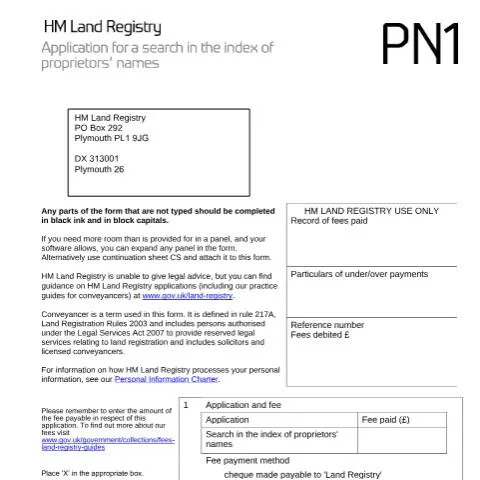
Picture this scenario: you've discovered that your late aunt may have owned property somewhere in England or Wales, but family records are incomplete. Or perhaps you're a solicitor whose client suspects their business partner registered land under a personal name rather than through the company. In situations where traditional property searches by address fall short, HM Land Registry's PN1 form becomes an invaluable investigative tool, allowing searches by proprietor's name rather than property location.
The PN1 form facilitates searches through HM Land Registry's index of proprietors' names, a comprehensive database linking individual and corporate names to their registered land holdings. Unlike standard property searches that require specific addresses or title numbers, this process works backwards from ownership to property, revealing all registered titles associated with a particular name across England and Wales.
This search mechanism proves particularly crucial in inheritance disputes, debt recovery proceedings, matrimonial cases, and corporate due diligence where establishing the full extent of someone's land holdings becomes legally significant. The results provide title numbers for all registered properties linked to the searched name, opening doors to further detailed investigation of specific holdings.
The Restricted Access Framework: Who Can Legitimately Search Names
HM Land Registry maintains strict controls over name-based searches to protect individual privacy and prevent misuse of personal property information. The entitlement to search requirements, governed by rule 11(3) of the Land Registration Rules 2003, establish clear categories of legitimate applicants.
| Applicant Category | Documentation Required | Typical Use Cases |
|---|---|---|
| Self-search | None (searching own name) | Personal property audit, mortgage applications |
| Corporate search | Company authority evidence | Asset verification, due diligence |
| Personal representative | Grant of probate/letters of administration | Estate administration, inheritance claims |
| Trustee in bankruptcy | Official appointment documentation | Asset recovery, creditor proceedings |
| Otherwise interested parties | Legal justification statement | Litigation support, professional investigations |
For searches against private individuals' names, non-professional applicants must complete an additional Index of Proprietors' Names ID form, providing enhanced identity verification. This dual-form requirement serves as a safeguard against unauthorised fishing expeditions whilst maintaining legitimate access for proper legal purposes.
Conveyancers, solicitors, and licensed professionals benefit from streamlined procedures, reflecting their regulated status and professional indemnity obligations. Their signatures carry enhanced weight in establishing search legitimacy, often eliminating additional verification requirements.
Strategic Preparation: Optimising Search Parameters and Documentation
Success in name-based land searches heavily depends on meticulous preparation and understanding of how HM Land Registry's indexing system operates. The database searches for exact name matches, making precision in spelling and formatting absolutely critical.
Name formatting requirements demand forename-surname order using the full legal name as it appears on official documents. Shortened versions, nicknames, or alternative spellings require separate PN1 forms, as the system won't identify "Robert Smith" when searching for "Bob Smith" or capture maiden names when searching married names.
Address information in panel 6, whilst not affecting the actual search parameters, provides crucial context for interpreting results. Including every known address helps distinguish between multiple individuals sharing identical names and assists in identifying relevant properties from the search results.
The search reveals all title numbers associated with the specified name, but interpreting which properties actually belong to your target individual requires careful cross-referencing with address and timeline information.
Documentary preparation varies significantly based on your relationship to the searched name. Personal representatives must provide death certificates or certified copies of probate grants, whilst bankruptcy trustees need official appointment documentation. For "otherwise interested" applications, prepare detailed explanations of your legal interest, as vague justifications frequently trigger additional queries from Land Registry staff.
Managing Multiple Name Variations
Individuals often appear in land registers under various name formats throughout their lifetime. Women may hold properties under maiden names, married names, or combinations thereof. Business owners might register properties personally rather than corporately, or use trading names versus legal company names.
Each potential name variation requires a separate PN1 form and fee, making comprehensive searches potentially expensive but thorough. Professional searchers typically prioritise the most recent known legal name whilst flagging likely alternatives for subsequent searches based on initial results.
The Digital Submission Process: From Application to Results
HM Land Registry processes PN1 applications through their established postal and digital channels, with professional users benefiting from direct debit arrangements and key number systems that expedite processing.
Fee payment mechanisms reflect the applicant's relationship with Land Registry. Professional users with established accounts can charge fees directly through pre-arranged agreements, whilst occasional users typically pay by cheque made payable to 'Land Registry'. Current fee structures are available through the gov.uk fees collection, though specific amounts vary based on processing complexity.
The application journey begins with completing panel 3's sender information, which becomes the primary contact point for any queries or clarifications. Professional users should include their key numbers to ensure proper account handling, whilst private applicants must provide comprehensive contact details including email addresses for modern communication preferences.
Processing timelines depend on search complexity and current Land Registry workloads. Simple searches against common names may take longer due to extensive results requiring careful verification, whilst unusual names typically process more quickly but may return no matches.
Understanding Search Results and Follow-up Actions
Search results arrive as lists of title numbers associated with the searched name, requiring further investigation to determine property details. Each title number represents a separate registered property or land parcel, which may range from residential homes to commercial premises, agricultural land, or development sites.
Recipients typically purchase official copies of registers and title plans for relevant title numbers, transforming the name search into a comprehensive property portfolio analysis. This two-stage process ensures privacy protection whilst providing thorough investigation capabilities for legitimate users.
Professional Integration: How Conveyancers Maximise PN1 Efficiency
Legal professionals incorporate PN1 searches into broader investigative strategies, particularly during complex transactions, litigation support, and asset tracing procedures. Their regulated status provides enhanced access whilst imposing professional responsibilities for appropriate use.
Conveyancers often coordinate multiple PN1 searches with other Land Registry products, creating comprehensive due diligence packages. Practice Guide 74 provides detailed guidance on integrating name searches with title investigations, boundary disputes, and commercial property transactions.
The conveyancer certification system allows legal professionals to confirm facts such as death or bankruptcy status without requiring clients to obtain separate official documentation. This streamlined approach reduces delays whilst maintaining evidentiary standards through professional indemnity coverage.
Strategic Timing and Coordination
Professional users often time PN1 searches to coordinate with other investigative procedures. In estate administration, name searches might precede detailed probate property valuations. In commercial transactions, they may form part of vendor due diligence or purchaser protection strategies.
The ability to expand form panels or attach continuation sheets (CS) enables comprehensive applications covering complex scenarios. Large estates or corporate structures may require extensive documentation and multiple related searches submitted simultaneously for efficient processing.
Regulatory Safeguards and Data Protection Implications
The PN1 process operates within strict data protection frameworks established by the Data Protection Act 2018 and UK GDPR requirements. HM Land Registry's Personal Information Charter governs how personal data within applications and results is processed, stored, and potentially disclosed.
Public inspection rights under section 66 of the Land Registration Act 2002 mean that PN1 forms themselves become part of the public record, though applicants can request exemptions for prejudicial information using Form EX1. This transparency balances public access with individual privacy protection.
The fraud warning accompanying every PN1 form reflects serious criminal penalties for dishonest applications. Section 1 of the Fraud Act 2006 establishes maximum penalties of ten years imprisonment or unlimited fines for fraudulent statements, emphasising the importance of accurate, honest applications.
Failure to complete forms with proper care may result in loss of protection under the Land Registration Act 2002 if mistakes occur in the register as a result.
These regulatory frameworks create a balanced system enabling legitimate investigations whilst deterring abuse and protecting individual privacy rights. The escalating penalties reflect parliament's recognition of land registry information's sensitive nature and potential for misuse.
Advanced Scenarios: Complex Searches and Specialist Applications
Sophisticated PN1 applications often involve intricate legal scenarios requiring careful strategy and documentation. Matrimonial proceedings may require searches against both maiden and married names, whilst corporate investigations might encompass director names alongside company names.
International elements add complexity when overseas entities or individuals hold UK property. Names may appear in various formats depending on registration circumstances, requiring searches against anglicised versions, original foreign spellings, and transliterated variations.
Trust arrangements create particular challenges as properties may be registered in trustee names rather than beneficial owner names. Successful searches require understanding of trust structures and identifying all relevant trustee combinations across potentially decades of ownership changes.
Coordination with Other Registry Services
PN1 searches integrate with broader Land Registry services including title investigations, boundary enquiries, and historical research. Professional users often combine name searches with local land charges searches, planning enquiries, and environmental reports to create comprehensive property intelligence.
The results inform strategies for subsequent applications, whether for first registrations of previously unregistered land, boundary determinations, or adverse possession claims. This integrated approach maximises the value of registry services whilst ensuring compliance with all relevant procedures.
Maximising Search Value: Interpretation and Strategic Follow-up
Receiving PN1 results marks the beginning rather than the end of the investigative process. Title numbers require interpretation within broader legal and factual contexts to determine their relevance to your specific objectives.
Common complications include multiple individuals sharing identical names, properties held in joint names where only one name matches your search, and historical ownership changes that may not reflect current interests. Cross-referencing with address information, transaction dates, and other available records helps distinguish relevant from irrelevant matches.
Professional searchers develop systematic approaches to result analysis, prioritising likely matches based on geographical proximity, property types, and transaction timing. This targeted approach manages costs whilst ensuring comprehensive coverage of genuinely relevant holdings.
The strategic value extends beyond immediate property identification to broader asset mapping, risk assessment, and legal strategy development. Understanding someone's complete property portfolio informs negotiation strategies, security assessments, and litigation planning in ways that piecemeal property searches cannot achieve.
For estate planning professionals, PN1 searches provide verification tools ensuring comprehensive asset identification and proper succession planning. The ability to confirm that all properties have been identified and appropriately addressed becomes crucial for effective estate administration and beneficiary protection.
Understanding Search Results and Index Limitations
When your PN1 search returns results, interpreting the information requires understanding the structure and limitations of HM Land Registry's proprietors' index. The search results will typically show the proprietor's name as recorded on the register, the title number, and the property address. However, several factors can affect the completeness and accuracy of these results.
The proprietors' index only includes names of current registered proprietors, not historical owners who may have sold or transferred their interest. If you're researching previous ownership, you'll need to examine individual title registers rather than relying solely on the PN1 search. Additionally, the index reflects names exactly as they appear on the register at the time of registration, which may not account for subsequent name changes due to marriage, divorce, or deed poll.
Corporate entities present particular challenges in proprietor searches. Companies may appear under their full registered name, trading names, or abbreviated versions. Subsidiary companies and holding companies are listed separately, even when part of the same corporate group. If searching for properties owned by a business, consider variations in how the company name might be recorded, including the presence or absence of "Limited," "Ltd," "PLC," or other corporate designators.
Trusts and estates add another layer of complexity to search results. Properties held in trust may be registered in the names of trustees rather than beneficiaries, and the index won't necessarily indicate the trust relationship. Similarly, properties in deceased estates may remain registered in the name of the deceased person until probate is completed and the property is transferred to beneficiaries or sold.
The geographical scope of your search results depends on the area covered by the particular Land Registry office that maintains the index. England and Wales are divided into different registration districts, and a PN1 search typically covers one specific district. If the person or entity you're researching owns property across multiple districts, you may need to submit separate searches to different Land Registry offices.
Joint ownership scenarios can produce varied results depending on how names were originally registered. Properties owned as joint tenants or tenants in common may list all proprietors' names, but the order and format can vary. Some entries may show "and another" or similar abbreviations when multiple owners are involved, particularly in older registrations where full details weren't always recorded comprehensively.
Strategic Applications for Professional and Personal Use
PN1 searches serve diverse purposes across various professional and personal scenarios, each requiring tailored approaches to maximise effectiveness. Legal professionals frequently use proprietor searches during litigation preparation, particularly in boundary disputes, adverse possession claims, or when identifying parties for service of legal documents. In such cases, the search helps establish current ownership and can reveal patterns of property acquisition that may be relevant to the legal matter at hand.
Property developers and investors rely on PN1 searches for market intelligence and acquisition strategies. By searching prominent local developers or property companies, they can identify recent acquisitions, assess competition, and spot emerging development opportunities. This intelligence proves particularly valuable in areas undergoing regeneration or where planning permissions suggest future development potential.
Due diligence professionals use proprietor searches as part of comprehensive background checks on individuals or companies. When assessing the financial standing of a potential business partner or client, property ownership can provide insights into wealth, stability, and geographic interests. However, it's crucial to remember that the absence of registered property doesn't necessarily indicate limited means, as wealth may be held in other forms or jurisdictions.
Debt recovery specialists and enforcement agents employ PN1 searches to locate assets for potential recovery action. If someone owes money and attempts to avoid payment, identifying their property interests can inform enforcement strategies. However, this application must comply with data protection requirements and legitimate interest provisions under UK GDPR.
Genealogical researchers find proprietor searches valuable when tracing family property history or establishing inheritance rights. Properties that have remained in families for generations may reveal patterns of ownership that support genealogical research. However, researchers should be aware that property records alone don't establish family relationships and should be corroborated with other sources.
Local authorities and statutory bodies use proprietor searches for various regulatory and planning purposes. When serving notices under planning legislation, environmental regulations, or compulsory purchase procedures, identifying current proprietors ensures proper legal compliance. Similarly, utility companies may use such searches when establishing easements or addressing access rights for infrastructure projects.
Academic researchers studying property markets, urban development patterns, or social mobility may employ PN1 searches to gather data on ownership concentration, foreign investment patterns, or the relationship between property ownership and other demographic factors. Such research must comply with research ethics guidelines and data protection principles.
Data Protection Compliance and Ethical Considerations
Conducting PN1 searches involves processing personal data about property owners, triggering obligations under the Data Protection Act 2018 and UK GDPR. Understanding these requirements is essential for lawful and ethical use of the proprietors' index, whether you're conducting searches for professional or personal purposes.
The lawful basis for processing personal data through PN1 searches typically relies on legitimate interests, though this requires careful assessment. You must demonstrate that your interest in obtaining the information is legitimate, that processing is necessary to achieve that interest, and that your interests aren't outweighed by the rights and freedoms of the data subjects (property owners). Simply being curious about someone's property holdings doesn't constitute a legitimate interest.
Professional users must often rely on more specific lawful bases. Legal professionals may process data for legal claims or compliance with legal obligations. Property professionals might rely on legitimate interests for due diligence, while journalists could invoke freedom of expression provisions. However, each situation requires individual assessment, and professional codes of conduct may impose additional restrictions.
Transparency obligations under data protection law can create practical challenges when using PN1 searches. Generally, you should inform individuals when processing their personal data, but this may not always be practicable when conducting property searches. The law recognises exceptions where providing information would involve disproportionate effort or could prejudice legitimate purposes, but these exceptions require careful consideration.
Data minimisation principles require that you only search for and retain information that's adequate, relevant, and limited to what's necessary for your purposes. This means avoiding speculative searches or retaining search results longer than needed. If you're conducting searches for a specific transaction or investigation, clearly define your parameters and disposal schedule in advance.
Special category data considerations may apply in certain circumstances. While property ownership information isn't inherently special category data, it might reveal information about someone's religion (through religious organisation ownership), political opinions (through political party connections), or other protected characteristics. Additional safeguards may be necessary in such cases.
Cross-border data transfers become relevant if search results are shared with parties outside the UK. Post-Brexit, transfers to EU countries require adequacy decisions or appropriate safeguards, while transfers to other countries need careful assessment of adequacy and protection measures.
Record-keeping obligations require maintaining documentation of your processing activities, including the purposes for PN1 searches, lawful bases relied upon, and retention periods applied. This documentation proves essential if challenged about your processing activities or if conducting data protection impact assessments for systematic searching activities.
Individual rights under data protection law can affect how you use PN1 search results. Property owners have rights to access, rectification, erasure, and objection regarding their personal data. While HM Land Registry maintains the official records, users of search results may face requests to delete or correct information derived from those searches, particularly if errors have been introduced during processing or analysis.