When Detention Meets the Right to Liberty: Understanding Immigration Bail Applications
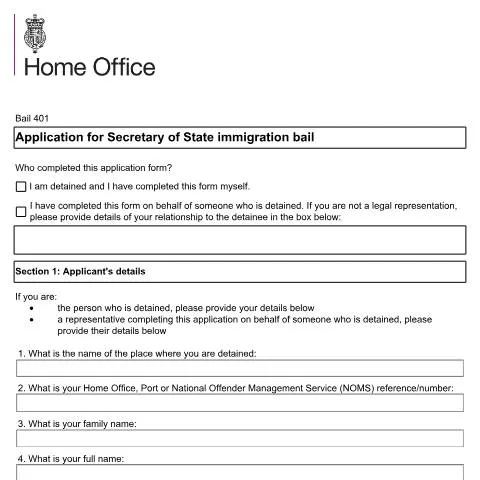
Being held in immigration detention represents one of the most challenging situations an individual can face within the UK's immigration system. Yet even in detention, the fundamental right to liberty remains protected through the immigration bail process. The Application for Secretary of State immigration bail (Bail 401) serves as the formal gateway for detained individuals seeking temporary release whilst their immigration matters are resolved.
This application process operates within a complex legal framework where Article 5 of the European Convention on Human Rights intersects with UK immigration law. Unlike criminal bail, immigration bail doesn't presuppose wrongdoing but rather addresses the administrative need to detain whilst considering factors such as public safety, flight risk, and the likelihood of removal from the UK.
The significance of this form extends far beyond mere paperwork. For many detained individuals, it represents the difference between continued confinement and the opportunity to rebuild their lives whilst pursuing their immigration case from the community. Understanding how to navigate this process effectively can prove decisive in securing release.
The Detained Population: Who Finds Themselves Behind These Walls
Immigration detention in the UK encompasses a diverse population, each with distinct circumstances that led to their confinement. Asylum seekers may find themselves detained upon arrival, particularly if they lack documentation or if their credibility is initially questioned. The Dublin Regulation cases—those potentially returnable to another EU country—frequently face detention whilst transfer arrangements are considered.
Failed asylum seekers awaiting removal constitute another significant group. These individuals may have exhausted their appeals process or face removal to countries they fled, creating complex human rights considerations that influence bail decisions. Overstayers—those who remained beyond their visa validity—represent perhaps the largest category, ranging from students who couldn't extend their leave to visitors who missed departure dates.
Foreign national ex-offenders present unique challenges within the detention estate. Having completed criminal sentences, they face immigration detention pending deportation. Their applications must address both their criminal history and rehabilitation efforts, requiring careful presentation of changed circumstances and community ties.
| Category | Common Detention Reasons | Bail Considerations |
|---|---|---|
| Fresh asylum seekers | Late claims, credibility concerns, documentation issues | Community support, legal representation quality |
| Failed asylum seekers | Exhausted appeals, removal directions issued | Fresh evidence, human rights barriers to removal |
| Overstayers | Visa expiry, breach of conditions | Length of residence, family connections |
| Ex-offenders | Deportation following sentence completion | Rehabilitation evidence, risk assessment |
Vulnerable Groups Within Detention
Certain detainees require particular consideration due to their vulnerability. Pregnant women, despite policy presumptions against detention, may still find themselves confined and require urgent bail applications highlighting their medical needs. Victims of torture or trafficking carry psychological scars that detention can exacerbate, making their cases particularly compelling for immediate release.
Young adults aged 18-25, whilst not technically children, often lack the life experience and support networks that strengthen bail applications. Their cases require careful development of education or employment prospects that demonstrate integration potential and reduce perceived flight risk.
Navigating the Application Maze: Essential Components and Strategic Considerations
The Bail 401 form's structure reflects the Home Office's systematic approach to assessing release applications. Section 1 captures basic biographical information, but even these seemingly straightforward details require careful attention. The detention facility name and reference numbers enable tracking, whilst multiple names or spellings must be declared honestly to avoid later credibility issues.
Nationality declarations carry particular weight, especially for those claiming statelessness or holding disputed citizenship. The arrival date in the UK becomes crucial for establishing length of residence—a key factor in demonstrating community ties. Travel document availability often determines removal prospects, directly influencing bail likelihood.
The Address Requirement: More Than Just a Place to Stay
Question 13's address requirement represents far more than accommodation logistics. The Home Office assesses whether proposed addresses offer genuine support networks or merely convenient solutions. Supported accommodation through charities may appear less stable than family homes but can demonstrate organised support systems.
Private rental arrangements require landlords willing to accept immigration bail conditions, including potential visits from immigration enforcement. The Right to Rent checks complicate matters further, as many detainees lack permission to rent privately. The form's guidance notes acknowledge these challenges, directing applicants toward specialist accommodation applications where exceptional circumstances exist.
Legal Representation: Professional Guidance in Complex Terrain
Whilst self-representation remains possible, the complexity of immigration bail makes legal assistance invaluable. Representatives must understand both immigration law and the specific detention centre's practices. Different Immigration Removal Centres have varying approaches to bail applications, with some requiring detailed submissions whilst others prefer concise presentations.
The representative's details in Section 1 enable direct communication with the Home Office, streamlining correspondence and ensuring urgent matters receive prompt attention. However, poor legal representation can prove counterproductive, with inadequately prepared applications reinforcing detention justifications rather than challenging them.
Financial Guarantees and the Economics of Freedom
Immigration bail's financial conditions serve multiple purposes within the Home Office's risk assessment framework. Unlike criminal bail, these amounts aren't typically paid upfront but represent potential liabilities should conditions be breached. The psychological impact of financial risk aims to encourage compliance whilst providing the state with enforcement mechanisms.
Personal financial capacity varies enormously within the detained population. Asylum seekers, prohibited from working, typically lack significant assets or savings. Long-term UK residents may possess property or established bank accounts, strengthening their applications but creating complex asset verification requirements.
The Role of Financial Supporters
Financial condition supporters represent perhaps the most powerful element of successful bail applications. These individuals—family members, friends, or community supporters—pledge specific amounts whilst demonstrating the detainee's community connections. Section 3 captures supporter details, but the form's limited space requires careful prioritisation of information.
Supporters must possess both financial capacity and immigration status security. British citizens or settled persons make the strongest supporters, whilst those with temporary status may raise additional concerns. The relationship quality matters more than its formal nature—close family friends can prove more valuable than distant relatives lacking genuine commitment.
| Supporter Type | Typical Pledge Amount | Required Documentation |
|---|---|---|
| Immediate family (spouse/parent) | £1,000-£5,000 | Bank statements, passport, relationship proof |
| Extended family | £500-£2,000 | Financial records, identification, family connection evidence |
| Community supporters | £200-£1,000 | Character references, organisational backing, financial capacity |
| Religious organisations | £500-£3,000 | Official letters, trustee approval, charitable registration |
Financial Documentation Requirements
The Home Office's financial verification process can prove intrusive and time-consuming. Supporters must provide bank statements, wage slips, and asset documentation sufficient to demonstrate pledge capacity. Self-employed supporters face particular scrutiny, requiring detailed business records and tax returns to establish income reliability.
International supporters present additional complications, with overseas bank statements requiring translation and verification procedures that can delay applications significantly. Currency conversions and international transfer capabilities must be demonstrated clearly to satisfy Home Office requirements.
Crafting Compelling Arguments: The Art of Persuasive Bail Applications
Section 4 represents the application's heart—the space for presenting compelling arguments for release. Unlike other sections' structured questions, this open-ended section requires strategic thinking and persuasive writing. The Home Office caseworker reading this section holds considerable discretionary power, making presentation quality crucial.
Successful applications typically address the Hardial Singh principles—the legal framework governing detention lawfulness. These principles require detention to serve a genuine purpose, be for a reasonable period, and consider the detainee's individual circumstances. Applications should demonstrate how continued detention fails these tests whilst release addresses any legitimate concerns.
Building the Case for Release
Medical evidence provides particularly compelling bail grounds. Physical health conditions requiring specialist treatment unavailable in detention create strong arguments, especially when community treatment options exist. Mental health impacts of detention—documented through medical reports—can prove decisive in vulnerable cases.
Family separation arguments require careful development beyond emotional appeals. British citizen children's welfare, elderly relatives requiring care, or family members facing hardship due to detention create tangible impacts that caseworkers can assess. Educational disruption, employment loss, or housing insecurity provide concrete examples of detention's broader consequences.
Community ties demonstrate flight risk mitigation whilst evidencing integration. Employment offers, voluntary work commitments, or educational placements show purposeful community engagement. Religious or cultural community membership provides additional stability indicators, particularly when supported by character references from respected community figures.
Addressing Detention Justifications
Effective applications must directly confront the reasons for initial detention. If arrested for working illegally, the application should address future compliance through reporting conditions or employment restrictions. Those detained for removal resistance must demonstrate willingness to engage with immigration processes whilst maintaining their legal challenges.
Previous immigration history requires honest acknowledgment and contextualisation. Late asylum claims need explanation—was legal advice unavailable, or did circumstances change? Visa overstaying might result from administrative delays or changed personal circumstances requiring detailed explanation.
Electronic Monitoring: Modern Technology Meets Ancient Concepts of Liberty
The form's electronic monitoring section reflects the Home Office's increasing reliance on technology-assisted supervision. Electronic tags enable community residence whilst maintaining surveillance capabilities, addressing flight risk concerns through location tracking rather than physical confinement.
Consent to electronic monitoring, whilst seemingly straightforward, carries significant implications. Tagged individuals face movement restrictions, curfew requirements, and technological surveillance that impacts daily life considerably. Understanding these implications before consenting prevents later compliance difficulties that could result in re-detention.
The two-day arrangement period mentioned in the form can prove frustrating for those expecting immediate release. Tagging companies require advance notice, equipment availability, and address verification before installation. This delay, whilst administratively necessary, prolongs detention despite bail approval—a reality applicants should anticipate.
Living Under Electronic Supervision
Tagged individuals must maintain equipment functionality, report technical issues promptly, and comply with movement restrictions precisely. Curfew violations, even for medical emergencies, can trigger immediate re-detention unless pre-approved through proper channels. Employment requiring travel or irregular hours needs careful coordination with monitoring companies.
Social stigma associated with visible tags creates additional challenges. Employers may react negatively, whilst community members might make assumptions about criminal history. Understanding these realities helps applicants make informed consent decisions and prepare for supervised release challenges.
After Submission: The Decision-Making Process and Its Aftermath
Once submitted, Bail 401 forms enter the Home Office's administrative machinery, where caseworkers balance multiple factors against policy guidance and legal requirements. Processing times vary significantly depending on case complexity, supporting documentation quality, and current workloads within the relevant immigration team.
Initial decisions typically arrive within two to four weeks, though urgent cases—particularly those involving vulnerable detainees or compelling medical circumstances—may receive expedited consideration. The decision notification includes not only the grant or refusal determination but also specific conditions attached to any approved bail.
Understanding Bail Conditions
Successful applications result in detailed condition schedules that govern daily life whilst on bail. Reporting requirements specify frequency and location—typically weekly or fortnightly visits to designated reporting centres. Residence restrictions may limit movement beyond specified geographical boundaries or require permission for overnight absences.
Work restrictions often prohibit employment without specific Home Office permission, creating financial hardship whilst maintaining compliance expectations. Educational activities typically receive more favourable consideration, particularly for young adults or those pursuing qualifications relevant to their immigration cases.
Contact restrictions may prohibit communication with certain individuals, particularly in national security cases or where witness intimidation concerns exist. Understanding these limitations before release prevents inadvertent violations that could trigger immediate re-detention.
When Applications Fail
Refusal decisions require careful analysis to understand rejection reasoning and identify appeal prospects. Common refusal grounds include inadequate address arrangements, insufficient community ties, or concerns about compliance with immigration processes. Each ground suggests specific strategies for strengthened repeat applications.
The right to request reconsideration within existing applications provides opportunities to address identified weaknesses without starting entirely fresh processes. Additional evidence, improved address arrangements, or enhanced financial support can transform previously unsuccessful applications into approved releases.
Fresh applications following refusals must demonstrate material change in circumstances rather than merely repeating previous arguments. New medical evidence, changed family circumstances, or additional community support can justify reconsideration of previously rejected cases.
Beyond the Form: Long-term Implications and Strategic Considerations
Immigration bail represents more than temporary release—it provides crucial preparation time for substantive immigration applications. Those on bail can access legal advice more easily, gather supporting evidence more effectively, and maintain family relationships whilst pursuing their cases.
However, bail conditions can significantly impact immigration case preparation. Reporting requirements consume time and resources, whilst work restrictions limit income generation for legal fees. Electronic monitoring may prevent attendance at legal appointments or limit access to community support services.
Successful bail compliance demonstrates reliability to immigration decision-makers, potentially influencing substantive application outcomes. Conversely, condition breaches can prejudice future applications and strengthen removal directions. Understanding these long-term implications helps frame bail decisions within broader immigration strategies.
The interplay between bail conditions and human rights protections creates ongoing legal developments that affect individual cases. Recent court decisions on detention length, vulnerable person protection, and family life considerations continue evolving the landscape within which these applications operate. Staying informed about these developments, typically through qualified legal representation, ensures applications reflect current best practices and legal requirements.
For many detained individuals, the Bail 401 form represents hope made tangible—a structured pathway from confinement toward community life. Whilst the process demands careful preparation, honest disclosure, and realistic expectations, it embodies the principle that liberty should remain the norm, with detention justified only when absolutely necessary. Understanding this form's requirements and strategic implications can prove decisive in securing that fundamental right to freedom whilst immigration matters remain unresolved.