When Pig Health Concerns Trigger Laboratory Investigation
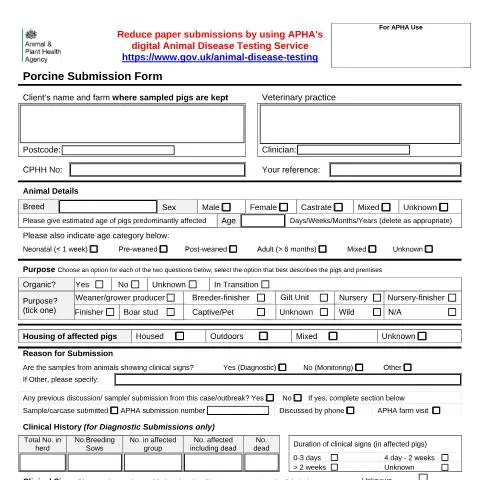
Pig keepers across England, Scotland and Wales face a critical moment when their animals develop unexplained symptoms or mortality patterns. The Animal and Plant Health Agency's Porcine Submission Form becomes the gateway to professional diagnostic services that can determine whether a routine health issue or a notifiable disease threatens the herd. This two-page document, referenced as APHA3_Pig (Rev. 09/25), serves as the essential bridge between field observations and laboratory confirmation.
The form distinguishes itself from general livestock health reporting by focusing specifically on diagnostic testing requirements rather than disease notification. While farmers might report suspected notifiable diseases through separate channels, this submission form coordinates the scientific investigation process, ensuring samples reach the right laboratory with complete contextual information.
Navigating the Digital Transition and Submission Pathways
APHA actively encourages users to migrate from paper submissions to their digital Animal Disease Testing Service platform, accessible through the GOV.UK portal. This digital-first approach reflects the agency's commitment to streamlined processing and reduced administrative burden. However, the paper form remains valid for situations where digital access proves challenging or when complex cases require detailed annotation.
The submission pathway varies significantly depending on the urgency and nature of the case. Diagnostic submissions follow different protocols than monitoring samples, with the former typically requiring expedited processing when clinical signs suggest serious disease. The form explicitly captures this distinction in the "Reason for Submission" section, where practitioners must indicate whether samples derive from clinically affected animals or routine surveillance activities.
Understanding APHA's Role in the Submission Process
The Animal and Plant Health Agency operates as an executive agency of the Department for Environment, Food and Rural Affairs, extending its services across England while also supporting Scottish and Welsh governments alongside the Food Standards Agency. This multi-jurisdictional responsibility means the submission form must accommodate varying regulatory frameworks while maintaining consistent diagnostic standards.
Decoding the Client and Veterinary Practice Requirements
The form's opening section establishes a crucial three-way relationship between the pig keeper, the attending veterinary practice, and APHA's diagnostic services. The client details must specify not just the name but the precise farm location where affected pigs are housed, as this information determines jurisdictional responsibilities and potential movement restrictions.
The CPHH (County Parish Holding Herd) number serves as a unique identifier linking the submission to official livestock databases. This alphanumeric code, typically format CPH XX/XXX/XXXX, enables APHA to cross-reference holding histories, previous submissions, and any ongoing disease investigations. Practitioners unfamiliar with their client's CPHH number can obtain it from the keeper's livestock movement records or directly from the Rural Payments Agency.
Veterinary Practice Accountability
The veterinary practice section requires both practice details and the individual clinician's name, establishing professional accountability for the submission. This dual identification system ensures APHA can communicate results effectively while maintaining professional standards through veterinary oversight. The "Your reference" field allows practices to link submissions to their internal case management systems, facilitating follow-up and billing procedures.
Animal Demographics and Production System Classification
The animal details section demands precision that reflects modern pig production's complexity. Age categorisation extends beyond simple numerical values to encompass production stages: neonatal (under one week), pre-weaned, post-weaned, and adult (over six months). This granular classification influences diagnostic test selection, as certain pathogens show age-related susceptibility patterns.
| Age Category | Typical Health Concerns | Common Diagnostic Tests |
|---|---|---|
| Neonatal (< 1 week) | Colibacillosis, Clostridial diseases | Bacterial culture, toxin detection |
| Pre-weaned | Rotavirus, Coccidiosis | Parasitology, virology |
| Post-weaned | PRRS, Streptococcal infections | Serology, PCR testing |
| Adult (> 6 months) | Reproductive disorders, Respiratory disease | Comprehensive screening |
Production System Context
The form's production system classification captures critical epidemiological factors. Organic status affects permitted treatments and may influence disease patterns, while the transition period presents unique challenges. The purpose categorisation—from weaner/grower operations to breeding facilities—determines appropriate diagnostic approaches and regulatory considerations.
Housing classification between indoor, outdoor, and mixed systems provides essential context for interpreting results. Outdoor systems face different pathogen pressures than intensive indoor operations, while mixed systems may experience unique transmission dynamics that influence sampling strategies.
Clinical Assessment Framework for Diagnostic Submissions
The clinical history section applies exclusively to diagnostic submissions, distinguishing them from routine monitoring samples. This detailed framework captures the epidemiological picture essential for accurate interpretation of laboratory findings.
Practitioners must quantify the outbreak's scale through specific metrics: total herd size, number of breeding sows, affected animals, and mortality figures. These parameters enable APHA to assess the outbreak's severity and potential implications for disease control measures.
Clinical Signs Documentation
The form provides a comprehensive checklist of clinical signs ranked by diagnostic importance. Primary signs like abortion, stillbirth, and respiratory symptoms receive prominent positioning, while the ranking system guides practitioners toward the most diagnostically relevant observations. The emphasis on lameness and muscle/skeletal disorders reflects growing concerns about welfare-related conditions in modern pig production.
- Abortion and reproductive signs: Critical for identifying notifiable diseases like Classical Swine Fever
- Respiratory symptoms: Essential for distinguishing between endemic and exotic disease agents
- Gastrointestinal signs: Particularly relevant for young pig populations
- Nervous system involvement: May indicate serious viral infections requiring immediate attention
Laboratory Test Selection and Diagnostic Strategy
The second page transforms into a sophisticated test ordering system, categorised by pathogen type and diagnostic methodology. This systematic approach ensures comprehensive investigation while avoiding unnecessary testing that might delay results or inflate costs.
Serology Packages and Pathogen Screening
The serology section reflects APHA's standardised approach to common pig pathogens. Porcine Reproductive and Respiratory Syndrome (PRRS) testing appears prominently, acknowledging this disease's significant economic impact on UK pig production. The Lawsonia PCR option addresses proliferative enteropathy, while Mycoplasma testing covers respiratory disease complexes.
Abortion serology packages provide targeted investigation for reproductive failures, with separate protocols for Porcine A (PRRS, Leptospira, swine influenza) and Porcine B (additional coverage for Porcine A plus erysipelas and porcine parvovirus). This tiered approach allows practitioners to select appropriate investigation depth based on clinical presentation and economic considerations.
Virology and Advanced Diagnostics
The virology section encompasses both routine screening and exotic disease investigation. Pooled Polymerase Chain Reaction (PCR) testing offers cost-effective screening for multiple animals, while individual PCR provides definitive pathogen identification. The inclusion of rotavirus testing acknowledges its importance in young pig diarrhoea, while the comprehensive enteric disease panel addresses complex digestive disorders.
Parasitology testing ranges from routine faecal examination to sophisticated techniques like Trichinella detection, reflecting both welfare concerns and public health responsibilities. The option for histopathology examination provides definitive tissue-based diagnosis when gross pathology proves insufficient.
Sample Management and Laboratory Logistics
The sample identification section establishes traceability from field collection through laboratory processing to result reporting. Each sample requires unique identification linking it to specific animals and collection dates, enabling APHA to maintain chain of custody and ensure accurate result attribution.
The form accommodates multiple sample types from single or multiple animals, reflecting the complexity of modern diagnostic investigations. Blood samples for serology, tissue samples for histopathology, and faecal samples for parasitology may all contribute to a comprehensive diagnostic picture.
Anonymous Surveillance and Research Applications
A specific checkbox addresses samples collected for anonymous surveillance or test validation purposes. This provision supports APHA's broader epidemiological monitoring responsibilities while ensuring appropriate consent for research applications. Samples designated for surveillance contribute to national disease monitoring programmes without identifying specific holdings or owners.
Data Protection and Information Governance
The form concludes with essential data protection information, reflecting compliance with the Data Protection Act 2018 and UK GDPR requirements. APHA's handling of personal data extends beyond immediate diagnostic needs to encompass epidemiological surveillance, disease control measures, and research activities.
The Animal and Plant Health Agency Personal Information Charter, accessible through GOV.UK, provides detailed information about data processing, retention periods, and individual rights. This transparency reflects the agency's commitment to responsible data stewardship while fulfilling its statutory responsibilities for animal and plant health protection.
Multi-Government Collaboration
APHA's role as an executive agency serving multiple governments—supporting Scottish and Welsh administrations alongside the Food Standards Agency—creates unique data sharing requirements. The form's design accommodates these complex relationships while ensuring consistent diagnostic standards across jurisdictions.
Results from diagnostic submissions may inform policy decisions, trade negotiations, and international disease reporting obligations. This broader context emphasises the importance of accurate, complete form submission that supports both immediate clinical needs and wider animal health objectives.
Record Keeping Requirements and Documentation Standards
Maintaining comprehensive records alongside your pig diagnostic test submission is not merely administrative housekeeping—it's a legal requirement under the Animal Health Act 1981 and associated regulations. The Animal and Plant Health Agency (APHA) mandates that pig keepers maintain detailed health records for a minimum of three years from the date of any diagnostic testing.
Your record-keeping system must capture several critical data points beyond what appears on the diagnostic submission form itself. Document the clinical history leading to the test request, including onset dates of symptoms, affected animal identification numbers, and any preliminary treatments administered. Note environmental factors such as recent changes in housing, feed suppliers, or biosecurity breaches that might influence diagnostic outcomes.
For post-mortem submissions, maintain photographic evidence where possible, particularly of gross lesions or abnormal findings. These images, whilst not required on the submission form, provide valuable context for laboratory diagnosticians and may be requested during follow-up investigations. Store digital images with clear filename conventions including the animal identification number, date, and brief description.
Cross-reference your diagnostic submissions with your medicine book records, as required under the Veterinary Medicines Regulations 2013. This creates an audit trail linking clinical observations, veterinary consultations, treatment decisions, and laboratory confirmations. Such comprehensive documentation proves invaluable during farm assurance scheme inspections or official disease investigations.
Consider implementing a standardised template for recording clinical observations in the days preceding sample collection. Include parameters such as rectal temperature, appetite scores, respiratory rate, and behavioural changes. This systematic approach ensures consistency across different staff members and provides diagnosticians with quantifiable data rather than subjective descriptions.
Understanding Laboratory Turnaround Times and Priority Classifications
Diagnostic turnaround times vary significantly based on the test type, sample condition, and urgency classification you select on your submission form. Understanding these timeframes enables better farm management decisions and appropriate client communication for veterinary practitioners.
Routine bacteriology typically requires 48-72 hours for preliminary results, with full antimicrobial sensitivity testing extending to 5-7 days. However, fastidious organisms like Mycoplasma hyopneumoniae may require 2-3 weeks for definitive culture results. PCR-based tests generally provide faster turnaround—often within 24-48 hours for common respiratory pathogens or enteric diseases.
Histopathology processing follows a standardised timeline: fixation (minimum 24 hours), processing and embedding (24 hours), sectioning and staining (24 hours), then microscopic examination and reporting (24-48 hours). Rush processing is available for suspected notifiable diseases, reducing this timeline to 48-72 hours total, but requires specific justification on your submission form.
Serology turnaround depends on the test methodology. ELISA-based assays typically complete within 3-5 working days, whilst virus neutralisation tests may require 7-14 days. Bulk milk or meat juice testing for herd health monitoring often receives priority scheduling, with results available within 48 hours when submitted through established surveillance programmes.
Peak laboratory periods significantly impact processing times. Expect delays during autumn months when respiratory disease submissions increase, or following bank holidays when sample backlogs accumulate. Plan accordingly for routine monitoring samples, submitting these during quieter periods to ensure timely results.
Emergency classifications should be reserved for genuine urgent situations—suspected notifiable diseases, sudden high mortality events, or cases where immediate treatment decisions await laboratory confirmation. Inappropriate use of emergency classifications may result in additional charges and delays processing of genuinely urgent submissions.
Cost Implications and Financial Planning for Diagnostic Testing
Understanding the financial implications of diagnostic testing enables informed decision-making about sample submission strategies and helps justify testing costs to farm businesses or clients. Diagnostic costs vary considerably based on test complexity, sample type, and turnaround requirements.
Basic post-mortem examinations typically cost £80-120 per carcase, excluding additional testing. Histopathology adds £25-40 per organ system examined, whilst bacteriology ranges from £15-30 for routine culture to £60-80 for comprehensive antimicrobial sensitivity testing including extended panels for resistant organisms.
PCR testing costs vary by pathogen complexity and multiplexing capabilities. Single-target PCR assays typically cost £20-35, whilst comprehensive respiratory panels testing for multiple pathogens simultaneously may cost £80-150. Consider the cost-effectiveness of panel testing versus individual assays when multiple pathogens are suspected.
Serology pricing depends on test methodology and throughput. Individual pig serology typically costs £8-15 per sample per pathogen, whilst bulk tank or meat juice testing may cost £25-45 per sample but covers entire herd populations. Calculate cost-per-pig-tested when comparing individual versus pooled sampling strategies.
Additional charges apply for expedited processing, weekend collections, or samples requiring special handling. Emergency processing typically incurs 50-100% surcharges over standard rates. Factor these costs into your budget when planning urgent submissions.
Many laboratories offer account facilities for regular clients, enabling monthly invoicing rather than payment per submission. This arrangement simplifies financial planning and may qualify for volume discounts on routine surveillance testing. Establish credit accounts early in the relationship to streamline the submission process.
Consider the broader economic impact of diagnostic testing beyond immediate laboratory costs. Early disease detection through strategic testing may prevent larger economic losses from disease spread, reduced growth rates, or increased mortality. Document these cost-benefit relationships to justify diagnostic expenditure to farm management or advisory committees.
Some diagnostic costs may qualify for tax relief under farming expense provisions. Maintain detailed records of diagnostic expenditure, linking tests to specific health management strategies or disease prevention programmes. Consult with agricultural accountants to maximise available tax efficiencies whilst ensuring compliance with HMRC requirements.