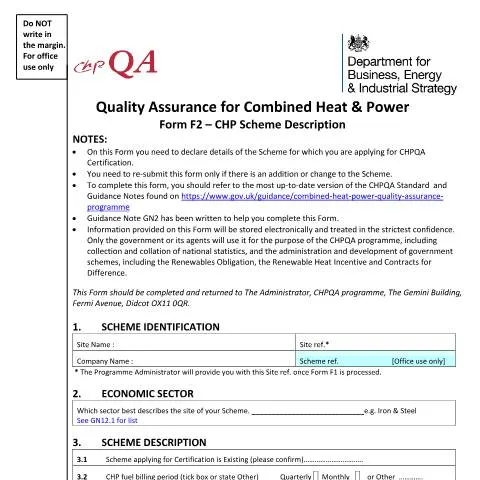
Understanding the CHP Scheme Description Form F2 and F2(S)
The Combined Heat and Power Quality Assurance (CHPQA) Programme plays a crucial role in the UK’s energy landscape, facilitating the certification of CHP schemes that optimize energy generation and usage. The CHP Scheme Description Form F2 is essential for stakeholders involved in the operation or development of CHP schemes. This form serves as a comprehensive document for describing the technical and operational aspects of a CHP system, enabling the scheme to be evaluated for certification.
Who Needs to Submit the CHP Form F2?
The primary candidates for submitting the CHP Scheme Description Form F2 are operators or owners of existing or new CHP systems seeking certification or re-certification through the CHPQA programme. Below is a breakdown of potential submitters:
- Industry Operators: These include manufacturers in sectors such as iron and steel, food processing, or any sector utilizing CHP systems to improve energy efficiency.
- Energy Providers: Companies looking to enhance their energy generation capabilities while adhering to government regulations.
- Consultants: Professionals providing expert advice on CHP system design and operational improvements.
- Academic Institutions: Research entities studying the efficiency and operational impacts of CHP installations.
It is crucial to note that each submission is tied to specific site and scheme references, ensuring that applications are processed efficiently and accurately.
Decoding the CHP Form F2: Section by Section
Completing the CHP Scheme Description Form F2 requires careful attention to detail in each section. Let’s break down the form into key components:
1. Scheme Identification
This initial section demands basic information including the site name and company name. The site reference will be provided after processing a different preliminary form (Form F1), which is essential to obtain prior to filling out Form F2.
2. Economic Sector Classification
Here, applicants must classify the economic sector their CHP scheme operates within, using the provided options (e.g., Iron & Steel). This classification aids in aligning the scheme with relevant industry standards and regulations.
3. Scheme Description and Operational Data
In Section 3, applicants must specify if the scheme is existing or new and detail the CHP fuel billing period. This section also requires a number of attachments:
- Scheme Line Diagram: A visual representation outlining the key components of the CHP system.
- Energy Flow Diagram: Illustrates energy inputs and outputs within the CHP system.
- Annual and Daily Heat Profiles: These profiles provide insight into the heat demand of the system.
- Heat Load Duration Curve: Required for schemes with heat rejection facilities, showcasing heat demand over time.
4. Equipment and Monitoring Details
This section requires a detailed list of all equipment used within the scheme, including prime movers and boilers. Each item must be appropriately tagged and referenced:
| Tag Number | Manufacturer | Model/Type | Year Commissioned | Capacity (kW) | Power (kWe) |
|---|---|---|---|---|---|
| 001 | Manufacturer A | Model X1 | 2020 | 500 | 400 |
| 002 | Manufacturer B | Model Y2 | 2021 | 600 | 500 |
Monitoring arrangements are also vital as they contribute to the verification of energy output, ensuring compliance with the CHPQA standards.
5. Capacity and Energy Consumption
Here, operators must list the total power capacities and define the various equipment types essential for the operation of the scheme. This includes identifying parasitic plant equipment, which supports the primary operations but isn't always immediately visible in the main process.
6. Quality Index Definition
The Quality Index (QI) is a critical component in assessing the efficiency of the CHP scheme. Operators must provide definitions that will be used for calculating the QI based on both power and heat efficiencies.
Important Considerations when Completing Form F2
Given the complexity of CHP systems, several considerations should be made when completing the form:
- Accuracy: Ensure all figures are accurate and supported by calculations where necessary.
- Supporting Documents: Attach all required diagrams and additional sheets, as requested within the form.
- Confidentiality: Be aware that the information provided will be treated confidentially under the Data Protection Act 2018.
The Role of the CHP Scheme Description Form in the Regulatory Framework
The CHP Scheme Description Form F2 is not just a standalone document; it functions within a larger regulatory framework established by the Department for Business, Energy & Industrial Strategy (BEIS) and the Department for Energy Security and Net Zero. This framework aims to ensure that CHP systems contribute positively to the UK’s energy efficiency and sustainability goals.
The CHPQA programme is part of the UK government's commitment to promoting low-carbon energy solutions and aligning with international climate objectives. The certification process recognizes schemes that demonstrate efficiency, thus promoting innovation and investment in energy technologies.
Tracking Your Application: What Happens Next?
Once the CHP Scheme Description Form F2 is submitted, it enters a review process initiated by the CHPQA administrators. Operators can expect the following steps:
- Initial Review: The form and accompanying documents will undergo a preliminary check for completeness.
- Site Assessment: Depending on the application, there may be a need for a site visit or further technical assessment.
- Certification Decision: The outcome will be communicated to the applicant, detailing whether the scheme meets the required standards for certification.
- Issuance of Certificate: If approved, a CHPQA certificate will be issued, which is vital for compliance and operational support.
Tracking your application can generally be done by contacting the CHPQA administrators directly or through official channels set up by the department.
What If You Need to Amend Your Submission?
Should there be any changes to the CHP scheme after submission of Form F2, it is imperative to resubmit the form. Amendments can arise from:
- Updates in operational technology or equipment.
- Changes in energy demand profiles or supply agreements.
- Regulatory changes impacting operational parameters.
Keeping the CHPQA informed of such changes ensures compliance and maintains the integrity of the certification process.
Key Dates and Timelines: Understanding the CHPQA Process
The application for CHP certification can be time-sensitive. It is essential to be aware of the following timelines:
- Submission Deadlines: While there are no fixed deadlines for submitting Form F2, it is recommended to apply well in advance of any operational changes.
- Processing Times: The review process can vary in length; therefore, maintaining contact with the CHPQA administrators can provide insights into expected timelines.
- Renewal Requirements: Certification may require periodic reassessment, necessitating subsequent submissions of updated Form F2.
Engaging proactively with the CHPQA programme not only helps in ensuring compliance but also promotes the efficient operation of CHP systems across the UK.
Your Rights and Responsibilities as an Applicant
When completing the CHP Scheme Description Form F2, it’s important for applicants to understand their rights and responsibilities:
- Right to Data Protection: Information submitted is protected under the Data Protection Act 2018, ensuring confidentiality and limited use for governmental purposes.
- Obligation to Provide Accurate Information: Providing false or misleading information can have serious repercussions, including withdrawal of certification.
- Responsibility for Compliance: Operators must ensure that all aspects of their CHP scheme adhere to relevant regulations and standards post-certification.
The Importance of the CHP Form F2 in Broader Energy Policies
The CHP Scheme Description Form F2 is a pivotal aspect of the UK’s strategy towards a sustainable energy future. By fostering high-efficiency energy generation methods, the UK aims to:
- Reduce overall carbon emissions.
- Enhance energy security by diversifying energy sources.
- Support economic growth through green technologies.
The integration of CHP systems into the energy mix is aligned with broader national goals of achieving net-zero emissions by 2050, making the role of Form F2 not only administrative but a key component of environmental policy in the UK.
Understanding the CHP Scheme: Key Features and Benefits
The CHP (Combined Heat and Power) Scheme, established to promote energy efficiency and reduce carbon emissions, provides significant advantages to both businesses and local authorities. This initiative allows installations to generate electricity and useful heat simultaneously, which can lead to substantial cost savings on energy bills. Participants in the scheme can benefit from various mechanisms, including the Feed-in Tariff (FiT) and Renewable Heat Incentive (RHI), both of which incentivize the production of renewable energy. To make the most of these benefits, understanding the specific eligibility criteria and operational requirements is crucial.
Eligibility for participating in the CHP Scheme depends on several factors, including the size of the installation and the type of fuel used. The eligible installations must meet certain performance standards to qualify for financial support. For example, the heat generated must be used directly within the installation or supplied to a third party. Moreover, the scheme encourages the use of low-carbon technologies, which is evaluated through a detailed assessment process. This ensures that only installations that truly contribute to reducing greenhouse gas emissions participate in the programme.
Completing Form F2 and F2(S): Common Pitfalls and Best Practices
Completing the CHP Scheme Description Form F2 and the accompanying F2(S) can be daunting for applicants. Understanding common pitfalls can save time and prevent delays in your application process. One of the most frequent issues is incomplete information; applicants must ensure that all fields are accurately filled, including technical specifications of the CHP installation, expected operational hours, and the projected heat and power output. Missing details can lead to rejection or requests for additional information.
Another common oversight is underestimating the importance of supporting documentation. Along with the forms, it’s essential to provide relevant documents such as schematics of the installation, maintenance schedules, and certificates of compliance with environmental standards. These documents substantiate the claims made in the forms and demonstrate the installation's fitness for the CHP Scheme.
Best practices suggest maintaining clear and organized records during the application process. This not only aids in submitting a comprehensive application but also simplifies any future audits or inquiries from HMRC or other regulatory bodies. Additionally, consulting with an expert in CHP technology or a compliance advisor can provide tailored guidance throughout the application process, increasing the chances of success.
Long-term Considerations for CHP Installation Maintenance and Compliance
Once your CHP installation is operational and you've successfully completed the Form F2 and F2(S), the focus shifts to long-term maintenance and compliance with the scheme's ongoing requirements. Regular maintenance is crucial for ensuring optimal efficiency and longevity of the system. Most manufacturers recommend establishing a maintenance schedule that includes routine inspections, performance testing, and timely replacement of parts. Not only does this prolong the life of the installation, but it can also help in maintaining compliance with the CHP Scheme, as regular assessments can demonstrate adherence to performance standards.
In addition to physical maintenance, staying informed about legislative changes or updates to the CHP Scheme is vital. The regulatory landscape can shift, impacting eligibility and operational requirements. Subscribing to industry newsletters or joining professional networks can help you keep abreast of such changes. This proactive approach not only aids in compliance but can also identify new funding opportunities, technological advances, or collaborative projects that enhance the viability of your CHP installation.
Furthermore, consider the environmental impact of your operation. The CHP Scheme emphasizes reducing carbon emissions; thus, maintaining records of your installation’s outputs and energy savings can be beneficial for compliance verification and public relations. Engaging in sustainability reporting and showcasing your commitment to energy efficiency can enhance your organization's reputation, opening doors for potential partnerships with other eco-conscious businesses.