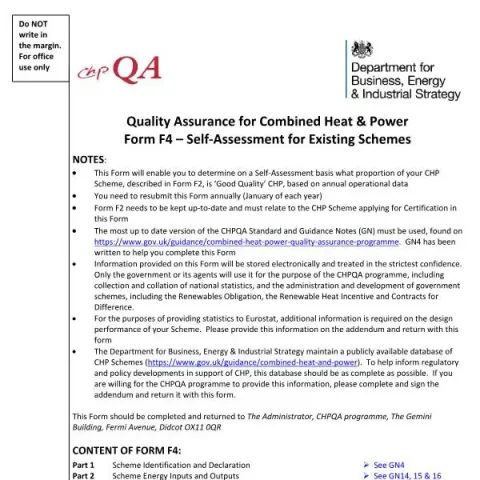
Understanding the CHP Scheme Self-Assessment Form F4 and F4(S)
In the landscape of energy management, the Combined Heat and Power (CHP) systems play a pivotal role in enhancing efficiency and reducing emissions. The CHP Scheme Self-Assessment Form F4 and F4(S) emerges as an essential tool for energy producers to evaluate their CHP systems' quality and compliance. This document, administered by the Department for Business, Energy & Industrial Strategy, is integral to the CHP Quality Assurance (CHPQA) programme, which seeks to ensure that CHP systems operate at high efficiency levels.
The Regulatory Framework Behind the CHPQA Programme
Established as a response to the UK's commitment to reducing carbon emissions and improving energy efficiency, the CHPQA programme is grounded in legislative frameworks and government initiatives. The Department for Business, Energy and Industrial Strategy (BEIS) oversees the CHPQA programme, which aligns with the UK government’s broader sustainability and energy strategies. The programme is encapsulated by various guidelines and standards, detailed within the CHPQA Standard, which are regularly updated to reflect advancements in technology and policy.
- Data Protection Compliance: The processing of information within this form adheres to the Data Protection Act 2018 and UK GDPR regulations. Personal data provided is treated with confidentiality, ensuring only necessary access by relevant government authorities.
- Annual Submission Requirement: The necessity to submit the form annually, by January, reinforces the commitment to continuous monitoring and improvement of CHP systems.
The Importance of Accurate Self-Assessment
Submitting the CHPQA Form F4 is not merely a bureaucratic requirement but a crucial step for operators to validate their CHP systems' efficiency. This form enables operators to determine the proportion of their CHP scheme classified as 'Good Quality' based on operational data collected over the year. Operators should take this responsibility seriously, as inaccuracies can lead to compliance issues and potential penalties.
Elucidating the Structure of the CHPQA Form F4
The CHPQA Form F4 consists of several parts, each requiring careful attention. Understanding the structure of the form helps operators prepare effectively and avoid common pitfalls. Below, we break down the form's sections and their significance.
Part 1: Scheme Identification and Declaration
This section mandates the operator to provide specific details about the CHP scheme, including:
- Site Name and Reference: Essential for identifying the operational site.
- Company Name and Scheme Reference: Operators must reference the scheme number provided after processing Form F2.
- Declaration of Truthfulness: The Responsible Person (RP) must confirm the accuracy of the information. Any discrepancies could result in significant repercussions, including disqualification from potential government incentives.
Part 2: Documentation of Energy Inputs and Outputs
Accurate reporting of energy inputs and outputs is crucial. This section requires operators to detail:
- Fuel Inputs: Record all energy inputs derived from fuels consumed during the reporting period. Operators must ensure these figures are based on gross calorific values without adjustment for uncertainties.
- Operational Period: Clearly define the hours of operation for the CHP scheme during the reporting period.
Failure to accurately report these figures can skew the assessment of the CHP's quality, potentially affecting the scheme's classification and future funding opportunities.
Parts 3-5: Efficiency Criteria and Calculations
The subsequent parts delve into the technical details of efficiency and calculations:
- Power Efficiency: Operators must assess specific criteria to ensure their CHP system meets the efficiency thresholds set by the CHPQA standards.
- Quality Index: The calculation of the Quality Index allows operators to benchmark their performance against established standards.
- CHPQPO and CHPQPC Calculations: These calculations are pivotal for understanding the operational performance of the CHP scheme. They involve technical parameters that require precise input.
Navigating the Submission Process
Once the form is completed, operators must submit it to the CHPQA programme administrator. The correct submission address is:
The Administrator, CHPQA programme, The Gemini Building, Fermi Avenue, Didcot OX11 0QR
Operators are advised to retain copies of all submitted documentation for their records. This not only serves as a reference but also protects against disputes regarding submitted information.
Tracking Your Submission and Following Up
After submission, it is vital for operators to track the status of their form. The CHPQA programme provides methods for tracking applications and inquiries. If no confirmation is received within a reasonable timeframe (generally two weeks), it is prudent to follow up with the administrator to ensure the form has been processed correctly.
Addressing Potential Challenges
Despite careful preparation, challenges may arise during the self-assessment process. Here are some scenarios operators might face:
What If Information Is Missing or Incorrect?
If operators discover that they have submitted incorrect information or omitted details, it is critical to notify the CHPQA administrator immediately. Rectifying mistakes early can mitigate potential penalties and ensure compliance with the programme regulations.
Handling Refusals and Appeals
In instances where a CHP scheme is denied certification, operators can appeal the decision. A structured appeal process typically exists, which allows operators to challenge decisions made by the CHPQA programme. This process often requires a clear presentation of the reasons for the appeal and any supporting documentation.
The Broader Implications of Submission
Completing the CHPQA Form F4 does not merely fulfil a regulatory obligation; it can unlock several significant benefits for operators:
- Access to Government Incentives: A successful self-assessment can lead to eligibility for various government incentives, including Renewable Obligation Certificates (ROCs) and Contracts for Difference (CfD), which can substantially enhance the financial viability of CHP operations.
- Improved Operational Efficiency: Regular assessments compel operators to evaluate their systems critically, fostering an environment of continuous improvement.
- Contribution to National Energy Statistics: Information provided is used to inform national statistics and energy policies, making each operator a stakeholder in the UK's energy future.
Key Takeaways for Operators
Individuals and companies operating within the CHP sector must prioritize their submissions and ensure that they comply with all aspects of the CHPQA programme. Key actions include:
- Thoroughly review the CHPQA guidance notes (GN) to ensure compliance.
- Maintain meticulous records of all operational data and calculations to facilitate accurate reporting.
- Be proactive in communication with the CHPQA administrator to resolve any issues swiftly.
By adhering to these guidelines, operators can not only ensure compliance but also enhance the efficiency and sustainability of their CHP systems, contributing positively to the UK's energy landscape.
In conclusion, the CHP Scheme Self-Assessment Form F4 and F4(S) serves as a vital component of energy management practices in the UK. By understanding its role, structure, and implications, operators can navigate the complexities of energy regulation effectively.
Understanding the CHP Scheme: An Overview
The CHP (Combined Heat and Power) Scheme is a key initiative in the UK aimed at promoting efficient energy use and reducing carbon emissions. The CHP Scheme allows businesses and organisations to generate their own energy through the use of combined heat and power technology, which captures and utilises both the heat produced during electricity generation and the electricity itself. Understanding how the CHP Scheme operates is crucial for entities looking to apply for the Self-Assessment Form F4 and F4(S).
Fill in your form directly online
No printing: type your details into the boxes of the official form, tick, then download the PDF ready to send.
- 1Type into the form boxes
- 2Tick in one click
- 3Save and download the PDF
Under the CHP Scheme, eligible organisations can receive incentives for the energy they generate and use. These incentives are primarily delivered through the Renewable Heat Incentive (RHI), which financially supports the generation of renewable heat. Companies involved in CHP operations must ensure they comply with certain technical criteria, operational parameters, and sustainability requirements. The CHP system must demonstrate a minimum efficiency to qualify for any financial benefits.
Entities must constantly evaluate their operations and their compliance with regulatory bodies like Ofgem, which oversees the administration of the CHP and RHI schemes. Failure to adhere to the operational standards can lead to penalties or loss of eligibility, further underscoring the importance of being thoroughly informed about the regulations that govern CHP operations.
Completing the F4 and F4(S) Forms: Key Considerations
When filling out the Self-Assessment Forms F4 and F4(S), it is crucial to pay attention to specific details that can influence the outcome of your assessment. Both forms require comprehensive data regarding the operational aspects of your CHP systems, including the type of fuel used, energy output, and operational hours. Accuracy in reporting is not only vital for compliance but also ensures that your claims for financial benefits are processed without delays.
It is recommended to keep meticulous records of your energy production and usage, as HMRC may request supporting documentation to validate the information provided in your forms. Documents such as fuel purchase invoices, production logs, and maintenance records should be easily accessible. Additionally, consider the following points:
- Engagement with Professionals: If your organisation lacks the expertise to navigate the complexities of the forms, seeking the assistance of a tax professional or consultant familiar with the CHP Scheme can be invaluable. They can offer insights into optimising your submissions and ensuring compliance with HMRC requirements.
- Regular Updates: The regulations surrounding the CHP Scheme are subject to change. Stay informed about the latest updates from HMRC and Ofgem to ensure your operations and filings are aligned with current legal frameworks.
- Understanding Deadlines: Pay close attention to the submission deadlines for the F4 and F4(S) forms. Failing to meet these deadlines can result in financial repercussions, including fines or disqualification from receiving future incentives.
Navigating Appeals and Disputes: Your Rights and Resources
In the event of a disagreement with HMRC regarding your Self-Assessment Forms F4 and F4(S), it is essential to understand your rights and the procedures available to you for appeals and dispute resolutions. The process can be intricate, but awareness of the steps can empower you to contest decisions that may not align with your understanding of the regulations or the information you provided.
If you receive a decision from HMRC that you disagree with, you have the right to appeal within 30 days of the date of the decision letter. Your appeal should clearly outline the reasons for your disagreement and provide any supporting evidence that substantiates your claim. It is advisable to include any relevant documentation that may assist in the review process.
HMRC offers several avenues for resolution, ranging from informal discussions to more formal appeal processes. For complex disputes, you may also consider engaging with the Tax Tribunal, which can provide an impartial review of your case. It’s worth noting that the Tax Tribunal process can be time-consuming and may require legal representation, so weigh the costs and benefits carefully.
Additionally, resources such as the HMRC website and advisory bodies can offer guidance on the appeal process, and you may also find it beneficial to connect with industry networks or forums where others share their experiences and recommendations. Familiarizing yourself with your rights during this process can mitigate stress and increase the likelihood of a successful resolution.