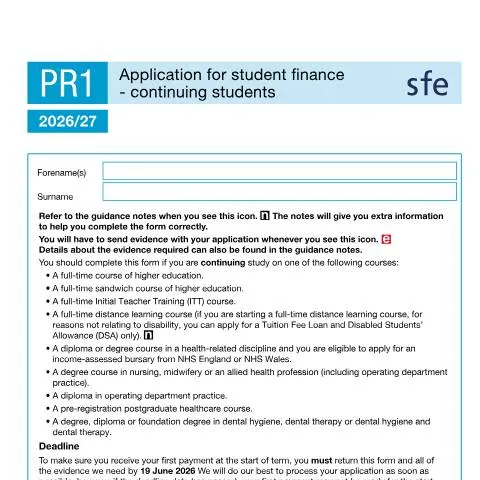
The Continuing Student Finance Application: A Critical Gateway for Your Next Academic Year
As the academic calendar progresses and another year draws to a close, thousands of students across England face a crucial administrative milestone that could determine their financial stability for the coming academic year. The Student Loans Company's PR1 application form for continuing students represents far more than a routine renewal—it's a comprehensive financial lifeline that requires strategic timing, meticulous completion, and a thorough understanding of evolving eligibility criteria.
For the 2026-27 academic year, this application carries particular significance as it bridges students between their current funding arrangements and their future educational financing needs. Unlike first-time applicants who navigate the system with fresh uncertainty, continuing students must demonstrate their ongoing eligibility whilst adapting to potential changes in their personal circumstances, course requirements, or household income situations.
The stakes are unmistakably high: miss the 19 June 2026 deadline, and your first payment may not arrive when term begins. Submit your application more than nine months after your academic year starts, and you risk losing your entire entitlement to student finance. This isn't merely administrative efficiency—it's financial survival in an increasingly expensive higher education landscape.
Decoding Eligibility: Who Must Navigate This Application Process
The PR1 form casts a deliberately wide net across the higher education spectrum, encompassing students whose circumstances might otherwise seem disparate. Understanding whether you fall within its scope requires careful examination of both your course type and your academic progression status.
Full-time higher education students form the primary cohort, but the definition extends beyond traditional undergraduate degrees. Students pursuing full-time sandwich courses—those incorporating substantial work placements—must complete this same application despite their hybrid academic structure. The inclusion of sandwich courses reflects the Student Loans Company's recognition that these programmes, whilst involving periods of employment, maintain their educational character and deserve continued financial support.
Initial Teacher Training participants represent another significant group, acknowledging the critical role these programmes play in addressing national teaching shortages. Whether pursuing a PGCE, School Direct programme, or undergraduate teacher training course, ITT students must demonstrate their continuing commitment through this application process.
Distance learning students face particular complexities within this system. Those continuing distance learning programmes enjoy full access to student finance, but new distance learning students encounter restrictions unless disability-related circumstances necessitate this mode of study. For new distance learners without disability grounds, only Tuition Fee Loans and Disabled Students' Allowances remain available—a policy reflecting concerns about potential abuse of more flexible learning arrangements.
Healthcare students occupy a special position within this framework, reflecting both the national importance of these professions and their unique funding structures. Students pursuing nursing, midwifery, or allied health profession degrees can access standard student finance, whilst those eligible for NHS bursaries from NHS England or NHS Wales face different application requirements that must be carefully coordinated.
| Course Type | Eligibility Status | Special Considerations |
|---|---|---|
| Full-time higher education | Fully eligible | Standard application process |
| Sandwich courses | Fully eligible | Include placement details |
| Initial Teacher Training | Fully eligible | Specify ITT programme type |
| Distance learning (continuing) | Fully eligible | Standard application process |
| Distance learning (new, non-disability) | Limited eligibility | Tuition Fee Loan and DSA only |
| Healthcare with NHS bursary | Fully eligible | Coordinate with NHS funding |
Timing Strategies: The June Deadline and Its Cascading Consequences
The 19 June 2026 deadline operates as more than a simple cut-off date—it represents a carefully calculated balance between administrative processing requirements and student financial needs. This timing allows the Student Loans Company sufficient processing window to complete income assessments, verify supporting evidence, and coordinate payment schedules with higher education institutions across the country.
Students who meet this deadline can reasonably expect their first maintenance payment to arrive as term begins, typically during the first week of the academic year. This synchronisation proves crucial for students who depend on maintenance funding for accommodation deposits, textbooks, or basic living expenses during the transition between summer employment and term-time study.
However, the consequences of missing this deadline extend beyond simple payment delays. Late applications enter a different processing queue where they compete for administrative attention alongside urgent cases, appeals, and complex assessments. While the Student Loans Company commits to processing applications "as soon as possible," this guarantee loses its precision for late submissions.
The nine-month absolute deadline represents a harder boundary with more severe consequences. Applications submitted beyond this point risk complete rejection, leaving students potentially liable for full tuition fees and without maintenance support. This policy reflects the administrative reality that processing extremely late applications could interfere with preparations for the following academic year.
For students facing genuine emergencies or exceptional circumstances that prevent timely submission, early communication with the Student Loans Company becomes essential. While formal extensions remain rare, demonstrating proactive engagement and providing evidence of mitigating factors may influence processing decisions.
The Five-Step Framework: Navigating Sectional Requirements
The PR1 application employs a structured five-step approach designed to guide students through increasingly complex layers of information gathering and financial assessment. This framework acknowledges that not every student requires the same level of detail—those seeking only tuition fee loans face simpler requirements than students applying for income-assessed maintenance support.
Step One establishes the foundation through sections 2-4, covering personal details, course information, and basic loan requests. Students applying solely for tuition fee loans can complete their application at this stage, reflecting the non-means-tested nature of tuition fee support. The loan request section on pages 10 and 11 allows students to specify their desired borrowing levels, providing crucial control over their future debt accumulation.
Step Two introduces household income assessment through sections 5 and 6, fundamentally changing the application's complexity. Students choosing this route must provide comprehensive financial information about their family circumstances, recognising that higher maintenance support comes with greater scrutiny of financial need. Care leavers receive particular attention within this framework, with recommendations to follow income-assessed routes even when entitled to maximum non-means-tested support, ensuring access to additional bursaries and grants.
Step Three addresses students with dependants through section 8, acknowledging the additional financial pressures faced by student parents and those supporting adult dependants. This section opens access to Childcare Grants, Adult Dependants' Grants, and Parents' Learning Allowances—funding streams that can significantly impact family financial stability during study periods.
Steps Four and Five complete the assessment process through detailed income verification and formal declarations. Section 9 requires students to provide comprehensive details about their family financial circumstances, whilst section 10 may require parents or partners to provide their own income information directly to the Student Loans Company.
Financial Products Decoded: Understanding Your Funding Portfolio
The range of financial support available through the PR1 application reflects the diverse needs of the modern student population, but understanding the distinctions between different funding types proves crucial for optimising your financial package.
Tuition Fee Loans represent the most straightforward element, covering course fees up to the maximum annual limit regardless of household income. These loans are paid directly to your institution, removing the administrative burden of fee payment whilst ensuring your place remains secure. For most students, accepting the full tuition fee loan makes financial sense given the income-contingent repayment terms and the inflation protection this provides against fee increases.
Maintenance Loans operate on a more complex sliding scale, with maximum amounts available to students from lower-income households. The maintenance loan calculation considers household income, study location, and living arrangements to determine entitlement levels. Students living away from home in London receive higher maximum amounts, reflecting the capital's elevated living costs, whilst those studying from the family home receive reduced support acknowledging lower accommodation expenses.
Students whose courses began before August 2016 retain access to Maintenance Grants—non-repayable support that doesn't count towards future debt accumulation. These grants, whilst no longer available to new students, continue providing valuable support to continuing students who qualified under previous funding regimes.
Special Support Loans serve students aged 60 or over, recognising the unique circumstances faced by mature learners who may have limited earning years ahead to repay traditional maintenance loans. These loans carry the same income-contingent repayment terms but acknowledge the different financial planning horizons of older students.
Beyond basic loans and grants, the application opens access to targeted support schemes designed for specific circumstances. Childcare Grants provide up to £174.22 per week for one child or £298.69 for two or more children, covering registered childcare costs during study and examination periods. Parents' Learning Allowances offer up to £1,766 annually for course-related costs faced by student parents, whilst Adult Dependants' Grants provide up to £3,190 for students supporting adult family members.
Disabled Students' Allowance: Specialised Support Requirements
DSA represents a unique element within the student finance system, providing non-repayable support for additional costs arising from disabilities, mental health conditions, or specific learning difficulties. Continuing DSA recipients benefit from streamlined reapplication processes—completing only the PR1 form rather than submitting fresh DSA applications.
First-time DSA applicants must complete both the PR1 application and the separate DSA slim form, initiating a more comprehensive assessment process that may include needs assessments and specialist equipment evaluations. The DSA system recognises that disability-related costs extend beyond simple financial support, encompassing specialist equipment, non-medical helper support, and additional travel expenses.
Income Assessment Complexities: Household Financial Scrutiny
The household income assessment process represents perhaps the most challenging aspect of the PR1 application, requiring detailed financial disclosure that many families find intrusive or complex. Understanding this process proves essential for students seeking maximum financial support whilst avoiding processing delays caused by incomplete or inaccurate information.
The Student Loans Company employs a sophisticated income assessment methodology that considers multiple income sources and family structures. Parental income remains relevant for most undergraduate students under 25, unless they qualify for independent status through marriage, having dependent children, or meeting specific estrangement criteria. The assessment considers both parents' incomes where applicable, even in cases of divorce or separation where students may have limited contact with one parent.
Students in relationships face additional complexity through partner income assessment, where long-term cohabitation or marriage brings another person's financial circumstances into the calculation. The definition of "partner" extends beyond formal marriage to include civil partnerships and cohabiting relationships, requiring careful consideration of relationship status and duration.
The income assessment timeline typically focuses on the previous tax year's earnings, but the system includes provisions for current year assessments where family circumstances have changed significantly. Job losses, reduced working hours, or other substantial income changes may warrant current year assessment, though this requires additional evidence and extends processing times.
Fill in your form directly online
No printing: type your details into the boxes of the official form, tick, then download the PDF ready to send.
- 1Type into the form boxes
- 2Tick in one click
- 3Save and download the PDF
Self-employed family members face particular challenges within this system, as their income assessment requires detailed business accounts and tax return information. The Student Loans Company may request additional evidence including profit and loss statements, business bank statements, or accountant confirmations to verify declared income levels.
Evidence Requirements and Documentation Standards
The PR1 application's evidence requirements reflect the Student Loans Company's need to verify the substantial financial commitments they're making whilst balancing administrative efficiency with fraud prevention. Understanding these requirements prevents processing delays and ensures smooth application progression.
Identity verification remains fundamental, typically requiring certified copies of passports, driving licences, or other photographic identification. EU students may need additional documentation confirming their settlement status or pre-settled status under the EU Settlement Scheme, reflecting post-Brexit immigration requirements.
Income evidence varies significantly based on employment type and family structure. Employed parents typically provide P60 certificates or recent payslips, whilst self-employed individuals must submit tax calculations (SA302) alongside tax year overviews from HMRC. Students claiming independent status based on estrangement may require supporting letters from social services, educational welfare officers, or other professional sources.
Students with children must provide birth certificates or adoption certificates, whilst those claiming Adult Dependants' Grants need evidence of the dependant's circumstances and care requirements. Medical evidence may support DSA applications or justify special circumstances claims affecting income assessments.
The Student Loans Company operates strict policies regarding document authenticity, requiring original documents or certified copies from approved sources. Photocopies, smartphone photographs, or uncertified documents frequently cause processing delays as additional verification becomes necessary.
Processing Pathways and Application Monitoring
Once submitted, PR1 applications enter sophisticated processing systems designed to handle hundreds of thousands of applications whilst maintaining accuracy and security standards. Understanding this process helps students monitor their applications effectively and respond promptly to any additional requirements.
Initial processing focuses on completeness checking, where administrative staff verify that all required sections have been completed and necessary evidence provided. Incomplete applications trigger automatic correspondence requesting missing information, but these delays can extend processing times significantly, particularly during peak application periods.
Income assessment represents the most complex processing stage, involving detailed calculations based on household financial information and comparison with eligibility thresholds. Complex family circumstances, multiple income sources, or current year assessments may require specialist review, extending processing beyond standard timescales.
Students can monitor their application progress through their online student finance accounts, which provide real-time updates on processing status, payment schedules, and any outstanding requirements. The system generates automatic notifications when applications progress through different stages or when additional information becomes necessary.
Quality assurance processes may result in random application reviews or targeted checks where unusual circumstances arise. These reviews, whilst potentially causing delays, ensure system integrity and protect against fraudulent claims that could undermine the entire student finance system.
Payment authorisation represents the final processing stage, where approved funding amounts are scheduled for transfer to students' bank accounts and institutional fee accounts. The timing of these payments follows predetermined schedules aligned with term dates, though students can typically expect confirmation several weeks before money arrives.
For students requiring urgent assistance with their applications or facing exceptional circumstances, the Student Loans Company operates dedicated support channels through the 0300 100 0607 helpline and comprehensive online resources at gov.uk/studentfinance. Early engagement with these support channels proves crucial when problems arise, as proactive communication often enables faster resolution than reactive problem-solving after deadlines pass.