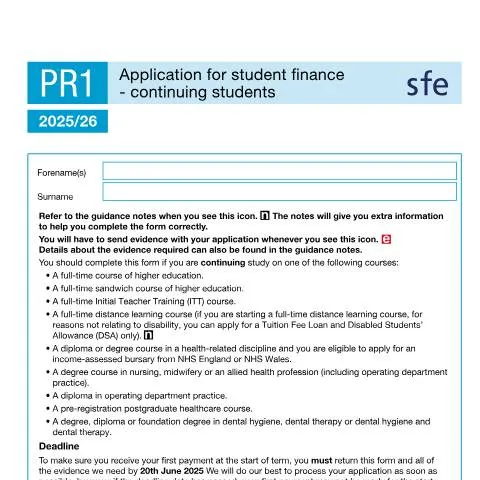
Who Qualifies as a Continuing Student for 2025/26 Academic Year
The Student Loans Company's continuing student application process serves a specific cohort often overlooked in mainstream guidance: students already enrolled in higher education who need to secure funding for their subsequent academic year. Unlike fresh applicants navigating university choices, continuing students face the critical task of maintaining their financial support whilst managing ongoing academic commitments.
The PR1 form targets students progressing through various educational pathways, from traditional undergraduate degrees to specialised healthcare programmes. This includes those on full-time sandwich courses where industrial placements interrupt conventional academic timelines, and students pursuing Initial Teacher Training routes that blend theoretical study with practical classroom experience.
Healthcare students represent a particularly complex category, with eligibility extending to:
- Nursing and midwifery degree programmes
- Allied health professions including operating department practice
- Pre-registration postgraduate healthcare courses
- Dental hygiene, dental therapy, and combined dental programmes
Students on health-related courses eligible for NHS England or NHS Wales income-assessed bursaries must still complete the PR1 form, as the Student Loans Company coordinates with healthcare funding bodies to prevent duplication or gaps in support.
Distance learning students face restricted access compared to campus-based peers. Those continuing distance learning courses can access the full range of student finance, but new distance learning students—unless studying remotely due to disability—are limited to Tuition Fee Loans and Disabled Students' Allowance only.
The Critical June Deadline and Its Cascading Consequences
The 20th June 2025 deadline functions as the Student Loans Company's primary processing trigger, determining whether students receive their first payment when term begins. This date represents more than administrative convenience; it reflects the complex verification processes required to assess household income, validate academic progression, and coordinate payments with universities.
Students submitting applications after 20th June enter a secondary processing queue where payment timing becomes uncertain. The Student Loans Company acknowledges this reality with careful language: they will "do their best to process your application as soon as possible," but cannot guarantee term-time readiness.
| Submission Period | Payment Likelihood | Processing Priority |
|---|---|---|
| Before 20th June 2025 | First payment ready for term start | Standard processing |
| After 20th June 2025 | Delayed first payment possible | Secondary queue |
| More than 9 months after academic year start | Application may not be processed | Risk of losing full entitlement |
The nine-month threshold represents a hard cut-off where administrative efficiency meets practical limits. Students missing this extended deadline face potential loss of full entitlement, meaning they cannot retrospectively claim support for earlier study periods.
Navigating the Five-Step Application Framework
The Student Loans Company structures the PR1 form around a five-step progression designed to minimise unnecessary completion whilst ensuring comprehensive assessment for complex cases. This approach recognises that student circumstances vary dramatically, from simple tuition fee loan requests to intricate household income assessments involving multiple dependants.
Universal Requirements: Steps 1 and 5
All continuing students must complete sections 2-4, covering personal details, course information, and basic financial circumstances. Students applying solely for Tuition Fee Loans can bypass section 4 entirely, streamlining their application to essential verification data only.
The loan request sections on pages 10-11 require students to specify desired amounts rather than accepting automatic calculations. This approach gives students control over their borrowing levels but demands understanding of maximum entitlements and repayment implications.
Income Assessment Pathways: Steps 2 and 4
Students seeking income-assessed support enter a more complex process requiring sections 5-9 completion. The Student Loans Company distinguishes between students aged under and over 60, with older students automatically assessed for Special Support Loans instead of standard Maintenance Loans.
Section 9 determines whether parental or partner income information is required, triggering section 10 completion by relevant parties. This creates potential coordination challenges where students depend on others to provide financial documentation and signatures.
Dependants and Special Circumstances: Step 3
Students with children or adult dependants must complete section 8 to access additional support including:
- Childcare Grant for registered childcare costs
- Parents' Learning Allowance for course-related expenses
- Adult Dependants' Grant for financially dependent adults
Single independent students without dependants can bypass this step entirely, jumping directly to final declarations and signatures.
Understanding Available Finance Categories and Start Date Dependencies
The Student Loans Company operates different funding regimes based on course commencement dates, creating a complex landscape where students starting in different years access different support packages. This system reflects policy changes over time whilst protecting existing students' entitlements.
Post-August 2016 Starters: Current Regime
Students who began courses on or after 1st August 2016 access the current system featuring:
- Tuition Fee Loans covering full course fees regardless of amount
- Maintenance Loans with higher borrowing limits but income-assessed components
- Special Support Loans for students aged 60+ replacing Maintenance Loans
This regime eliminated maintenance grants, replacing them with increased loan entitlements that students must eventually repay through the income-contingent system.
Transitional Arrangements: September 2012 to July 2016
Students from this intermediate period retain access to the previous system including:
- Maintenance Grants providing non-repayable support
- Special Support Grants for specific circumstances
- Lower maximum Maintenance Loan amounts
These students benefit from protected entitlements ensuring they don't lose access to grant funding when continuing their studies.
Disabled Students' Allowance: Continuation Versus New Applications
The DSA system operates on different principles from mainstream student finance, focusing on individual needs assessment rather than annual reapplication. Students who received DSA in previous years need only complete the PR1 form to continue their support, avoiding repeated needs assessments and specialist equipment evaluations.
First-time DSA applicants face a dual-form process requiring both the PR1 continuing student form and the separate DSA slim application. This approach ensures existing DSA recipients maintain uninterrupted support whilst new applicants receive thorough needs assessment.
The DSA slim form triggers specialist assessment processes including:
- Study needs assessment by qualified assessors
- Specialist equipment recommendations
- Non-medical helper requirements evaluation
- Travel and accommodation needs analysis
Students can request DSA slim forms through the PR1 application or download directly from the government student finance portal, providing flexibility in application timing.
Personal Details and Identity Verification Requirements
Section 2 of the PR1 form establishes student identity through multiple verification layers, with the Customer Reference Number serving as the primary link to existing Student Loans Company records. This number connects current applications to previous academic years, enabling continuity of assessment and preventing duplicate registrations.
The National Insurance number requirement serves dual verification purposes: confirming identity with the Department for Work and Pensions whilst enabling HM Revenue and Customs to manage future repayment collection. Students must provide valid NI numbers as the Student Loans Company actively verifies these against government databases.
Contact Information and Communication Preferences
The form captures comprehensive contact details recognising that continuing students often change accommodation between academic years. The Student Loans Company requires current addresses for payment processing and correspondence, with particular attention to term-time versus holiday addresses for students maintaining dual residences.
Students living in university accommodation face additional complexity as their addresses change annually, requiring careful coordination between the Student Loans Company, universities, and accommodation providers to ensure payment delivery.
Evidence Requirements and Documentation Standards
The PR1 form employs a systematic evidence framework where specific icons indicate mandatory supporting documentation. This approach moves beyond simple form completion to comprehensive verification, reflecting the Student Loans Company's responsibility for public fund stewardship.
Evidence requirements vary significantly based on claimed circumstances, with household income assessment demanding the most extensive documentation. Students claiming independent status must provide evidence supporting their classification, whilst those with dependants need proof of relationships and financial responsibilities.
Timing and Submission Coordination
The Student Loans Company processes applications holistically, meaning incomplete evidence submissions delay entire applications regardless of form completion quality. Students must coordinate evidence collection with form completion, ensuring all required documents accompany their submission.
Missing evidence triggers correspondence delays where the Student Loans Company requests additional information, potentially pushing students past optimal processing windows. The accompanying guidance notes provide detailed evidence specifications, but students often underestimate collection timescales for complex financial documentation.
Data Sharing and Privacy Implications
The PR1 form operates within extensive data sharing arrangements enabling the Student Loans Company to coordinate student support with universities, government departments, and healthcare funding bodies. Students consent to information sharing that extends beyond immediate application processing to include bursary and scholarship assessment by their institutions.
The Student Loans Company shares personal, financial, and course details with universities to enable institutional bursary calculations, creating integrated support packages combining government loans with institutional awards. This coordination prevents gaps in support but requires comprehensive data sharing consent.
Students must understand that their information flows between multiple organisations including:
- Their university or college for bursary assessment
- HMRC for repayment collection coordination
- DWP for National Insurance number verification
- NHS funding bodies for healthcare course coordination
The Privacy Notice on page 14 of the accompanying guidance provides detailed information about data processing, retention, and sharing arrangements, enabling informed consent to these comprehensive data flows.
Household Income Assessment and Evidence Requirements
The household income assessment forms a critical component of your student finance application, directly influencing the maintenance loan amount you'll receive. For continuing students in 2025-26, understanding what constitutes household income and providing accurate evidence remains essential for timely processing.
Your household income typically includes your parents' or partner's gross annual income from the previous tax year (2023-24 for 2025-26 applications). This encompasses employment income, self-employment profits, rental income, investment returns, and certain state benefits. Crucially, the Student Loans Company uses gross income figures before tax deductions, which often causes confusion among applicants who mistakenly provide net income figures.
If your parents are married, in a civil partnership, or living together as a couple, both incomes must be declared. For divorced or separated parents, only the income of the parent you primarily live with (or lived with before starting university) is assessed. Where that parent has a new partner they live with, the partner's income is also included in the assessment.
Self-employed parents present particular complexities. Their income assessment typically relies on the most recent Self Assessment tax return (SA100), specifically the profit figures from their SA103 (self-employment) pages. However, if business circumstances have changed significantly—such as during economic downturns or following major contract losses—you may need to provide additional evidence of current trading conditions through recent accounts or bank statements.
The evidence requirements vary depending on your parents' employment status. Employed parents must provide their P60 certificate from the relevant tax year, along with payslips covering the assessment period. Where P60s are unavailable, a P11D (if applicable) and comprehensive payslip series may suffice, though this can extend processing times.
For parents receiving certain state benefits, specific evidence rules apply. Benefits like Jobseeker's Allowance, Employment and Support Allowance, or Universal Credit require official award notices or benefit statements covering the assessment period. These documents must clearly show the benefit type, amount, and duration to satisfy SLC requirements.
Investment income requires careful documentation. This includes dividend certificates, interest statements from savings accounts, and rental income records. Property rental income should be supported by rental agreements and, ideally, annual income summaries. Parents with complex investment portfolios may need to provide additional supporting documentation, particularly for offshore investments or foreign income sources.
Pension income, whether from occupational schemes or private pensions, must be declared using annual pension statements or P60s where the pension provider operates PAYE. State Pension income is included in the assessment and should be evidenced through official DWP correspondence showing annual entitlement.
Current Year Income assessments offer an alternative where household circumstances have changed significantly since the previous tax year. This might apply following redundancy, business closure, retirement, or other substantial income reductions. However, Current Year Income applications require extensive documentation proving the change and projecting income for the current academic year, making them considerably more complex to process.
Fill in your form directly online
No printing: type your details into the boxes of the official form, tick, then download the PDF ready to send.
- 1Type into the form boxes
- 2Tick in one click
- 3Save and download the PDF
Special Circumstances and Independent Student Status
Certain continuing students may qualify for independent student status, fundamentally altering their student finance assessment. Understanding these criteria and the application process can significantly impact your funding entitlement, particularly regarding maintenance loan amounts.
Age-based independence applies automatically if you're 25 or over on the first day of the first academic year of your course. For continuing students, this means if you were under 25 when you started but turn 25 during your studies, your status doesn't automatically change mid-course. However, you should contact SLC to discuss whether reassessment is possible.
Marriage or civil partnership can establish independent status, but the relationship must have existed before the start of your course. Getting married during your studies doesn't automatically change your status for funding purposes, though it may affect future year assessments. Evidence required includes marriage or civil partnership certificates, and your partner's income will be assessed instead of your parents'.
Having dependent children creates independent status, requiring birth certificates or adoption papers as evidence. This applies whether you're the biological parent, adoptive parent, or have legal guardianship responsibilities. Step-children may qualify in certain circumstances, particularly where you have primary care responsibilities.
Previous employment-based independence requires evidence of full-time employment for at least three years before starting your course. This employment must have been your main activity—not undertaken alongside full-time education. Acceptable evidence includes P45s, employment contracts, payslips, and employer references covering the qualifying period. Self-employment can count, but requires comprehensive business records and tax returns demonstrating sustained trading activity.
Care leaver status provides independent student status with additional support entitlements. Qualifying care experience includes time in local authority care, kinship care arrangements, or residential care facilities. Evidence requirements typically involve care records from local authorities, though obtaining these can sometimes prove challenging if records are incomplete or authorities have reorganised.
Estrangement from parents represents a particularly sensitive category. This applies where you have no contact with your parents and cannot reasonably be expected to resume contact. Evidence might include court orders, social services records, or professional statements from counsellors, social workers, or other qualified professionals who understand your circumstances. SLC handles these applications with particular care, recognising the sensitive nature of family breakdown.
Orphan status applies where both parents have died, requiring death certificates as evidence. Where one parent has died and the surviving parent cannot be traced or has abandoned you, additional evidence may be needed to demonstrate the circumstances.
Students whose parents live abroad face specific assessment challenges. EU/EEA parents may have their income assessed using equivalent foreign documentation, though exchange rate calculations and document translation can complicate processing. Parents in non-EU countries may face different assessment criteria, and some students might qualify for independent status if parental income assessment proves impractical.
The application process for independent status typically requires Form PN1 (Student Finance England) or equivalent forms for other UK nations. Supporting evidence must be comprehensive and clearly demonstrate qualification criteria. Processing times for independent status applications often extend beyond standard applications due to the additional verification required.
Course Changes, Transfers, and Intercalation Procedures
Course modifications during your studies can significantly impact your student finance arrangements, requiring specific procedures to maintain funding continuity. Understanding these processes helps avoid funding gaps and ensures compliance with SLC regulations.
Course transfers between institutions require formal notification to SLC before the transfer takes effect. The receiving institution must confirm your acceptance and provide course details including start date, duration, and qualification type. Your funding entitlement may be recalculated based on the new course structure, particularly if fees or course length differ from your original programme.
Internal course changes within the same institution—such as switching from single to joint honours, or changing subject combinations—typically require less documentation but still need formal approval. Your institution's student finance office should coordinate with SLC, but you remain responsible for ensuring notifications are submitted promptly.
Year abroad programmes integrated into your degree structure usually maintain funding eligibility, though the maintenance loan may be adjusted. Students studying at overseas partner institutions might receive reduced maintenance support, reflecting potentially lower living costs. Erasmus+ or similar exchange programmes often have specific funding arrangements that supplement rather than replace student loans.
Intercalation—taking a year out during medical, dental, or veterinary courses—requires careful planning regarding student finance. Intercalated years for academic purposes (such as completing additional degrees or research projects) may qualify for continued funding, while those for personal reasons typically don't. Medical students undertaking intercalated BSc programmes should confirm funding arrangements early, as these can vary between institutions and programme types.
Course extensions due to academic requirements—such as failed modules requiring repeat study—can affect your funding entitlement. SLC applies specific rules regarding "gift years" and repeat study, potentially limiting funding for extended periods. Students facing academic difficulties should seek advice from their institution's student support services to understand funding implications before making decisions about repeat study.
Part-time study transitions require separate applications under different funding schemes. Students reducing from full-time to part-time study cannot simply adjust their existing application—they must apply for part-time funding, which operates under different eligibility criteria and payment structures.
Suspension of studies ("taking a year out") affects your funding timeline and may impact future entitlement. Students planning study breaks should notify SLC promptly to avoid overpayments and understand how the suspension affects their overall funding package. Medical suspensions may be treated differently from voluntary breaks, particularly where supported by medical evidence.
Graduate entry programmes present unique considerations for students already holding degrees. Funding eligibility depends on your previous study history and the relationship between your completed and proposed qualifications. Graduate entry medicine, dentistry, and veterinary programmes typically maintain funding eligibility, while other graduate courses may not.
Distance learning components within traditional courses usually don't affect funding, but wholly distance learning programmes may have different eligibility criteria. The COVID-19 pandemic accelerated online learning adoption, but funding rules haven't always kept pace with delivery method changes.
When processing course changes, maintain detailed records of all communications with SLC and your institution. Processing delays can occur where information conflicts between different sources, so ensuring consistency across all notifications helps prevent complications. Contact SLC's dedicated phone lines for course change queries rather than using general enquiry numbers, as specialist advisors better understand the specific requirements and can provide more targeted guidance.