Third Country Seed Import Regulations: Understanding the 2kg Threshold
When commercial seed shipments arrive at UK ports from countries outside the European Union, a critical administrative boundary emerges at the 2 kilogram mark. Beyond this threshold, importers must navigate the Animal and Plant Health Agency's consent framework, designed to safeguard British agriculture from potentially harmful plant diseases and invasive species. This regulatory checkpoint represents more than bureaucratic procedure—it forms part of the UK's phytosanitary defences, protecting domestic crops worth billions of pounds annually.
The consent form system applies specifically to third countries—nations outside the EU trading bloc—where seed certification standards may differ significantly from UK requirements. Whether importing heritage vegetable varieties from Japan, specialist grass seeds from New Zealand, or experimental crop cultivars from Canada, quantities exceeding 2kg trigger mandatory APHA oversight through this consent mechanism.
Regulatory Foundation and Post-Brexit Implications
The 2011 Seed Marketing Regulations, referenced prominently on the consent form, establish the legal framework governing seed imports into the UK. These regulations underwent significant revision following Brexit, as the UK developed independent phytosanitary protocols previously managed at EU level. The 2kg threshold reflects a risk-based approach: smaller quantities typically serve research or personal use, whilst larger shipments indicate commercial intent requiring enhanced scrutiny.
Under the current framework, the Animal and Plant Health Agency assumes responsibility for evaluating seed imports against multiple criteria. These include species-specific disease risks, the exporting country's certification systems, and the intended use of imported material. The consent process enables APHA inspectors to assess each shipment's potential impact on UK plant health before authorising entry.
Third country status encompasses a diverse range of nations, from established agricultural exporters like Australia and the United States to emerging markets in Africa and Asia. Each presents unique phytosanitary challenges, with varying standards for seed testing, treatment protocols, and certification procedures. The consent form serves as a standardised gateway for managing this complexity.
Identifying Your Obligations: Who Must Complete the Consent Process
The consent requirement applies to any individual or organisation importing seeds exceeding 2kg from third countries, regardless of commercial intent. This broad scope captures various stakeholder categories, each with distinct compliance considerations.
Commercial seed importers represent the largest user group, including agricultural suppliers, garden centres, and specialist seed merchants. These businesses typically handle multiple shipments annually, requiring systematic consent management. Research institutions importing experimental varieties for breeding programmes also fall within scope, as do agricultural colleges conducting educational trials.
Individual gardeners and smallholders importing larger quantities—perhaps rare varieties unavailable domestically—must equally comply with consent requirements. This includes hobby breeders sourcing parent stock for plant development projects, or community groups importing seeds for conservation initiatives.
| Importer Category | Typical Quantities | Common Seed Types | Specific Considerations |
|---|---|---|---|
| Commercial Suppliers | 10kg-1000kg+ | Vegetable, flower, grass seeds | Regular import schedules |
| Research Institutions | 2kg-50kg | Experimental cultivars | Scientific protocols required |
| Agricultural Colleges | 5kg-100kg | Educational varieties | Teaching programme alignment |
| Private Individuals | 2kg-10kg | Rare/heritage varieties | Personal use documentation |
Navigating the Consent Form Structure
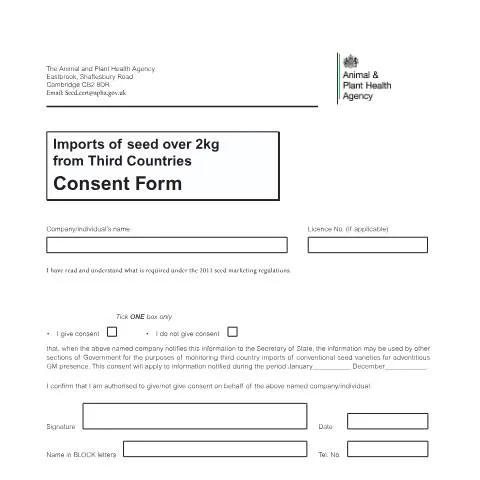
The APHA consent form employs a deliberately streamlined design, focusing on essential compliance elements rather than exhaustive detail collection. The primary section requires importers to confirm their understanding of the 2011 Seed Marketing Regulations—a critical acknowledgement demonstrating awareness of ongoing obligations beyond initial import approval.
The form's central feature presents three distinct consent options, marked by tick boxes requiring single selection. This choice mechanism reflects different import scenarios and risk profiles, though the specific options aren't detailed on the visible portion of the form. Importers must carefully consider their circumstances before selection, as incorrect categorisation may delay processing or require resubmission.
Contact details prominently feature the dedicated email address [email protected], establishing the primary communication channel for consent-related enquiries. This centralised approach ensures consistent handling across APHA's regional offices whilst maintaining clear audit trails for each import application.
Critical Form Completion Elements
Beyond the visible consent declaration, comprehensive form completion typically requires detailed seed specifications, including botanical names, quantities, country of origin, and intended use. Importers must provide accurate supplier information, including foreign certification details where applicable.
The form demands precise quantity declarations, as variations from consented amounts may trigger additional inspections or require amended applications. Seasonal considerations also influence processing, with spring planting periods generating higher application volumes and potentially extended processing times.
Understanding Third Country Certification Requirements
Seeds originating from third countries must typically arrive with official phytosanitary certificates issued by the exporting nation's plant protection organisation. These certificates confirm the seed lot's health status and compliance with importing country requirements. However, certification standards vary significantly between countries, creating complexity for UK importers.
Established agricultural exporters like Canada, Australia, and New Zealand maintain certification systems closely aligned with international standards, facilitating smoother consent processing. Emerging markets may require additional documentation or enhanced testing protocols, potentially extending approval timeframes.
The consent process enables APHA to evaluate each country's certification reliability whilst maintaining flexibility for legitimate trade. This risk-based approach balances plant health protection with commercial accessibility, though importers must factor potential delays into their supply planning.
Documentation Standards and Verification
Official phytosanitary certificates must accompany all third country seed imports, bearing original signatures and official stamps from recognised plant protection authorities. Electronic certificates gain increasing acceptance, though verification procedures may require additional processing time.
Seed testing reports often supplement basic certification, particularly for species with elevated disease risks. These reports detail pathogen screening results, genetic purity assessments, and germination rates, providing APHA inspectors with enhanced decision-making information.
Processing Timelines and Administrative Procedures
APHA consent processing operates within established service standards, though actual timelines depend on various factors including seasonal demand, documentation completeness, and risk assessment complexity. Standard applications typically receive responses within 10-15 working days, assuming complete documentation submission.
Complex cases requiring enhanced risk evaluation may extend beyond standard timelines, particularly when involving novel species or countries with limited certification history. Importers should factor these potential delays into shipping schedules, especially for time-sensitive agricultural seasons.
The consent process includes multiple checkpoints, from initial application review through final approval or conditional consent. Each stage generates audit trails enabling importers to track progress through the dedicated email channel or direct contact with assigned case officers.
Expedited Processing Considerations
Urgent agricultural requirements—such as emergency crop replacement following disease outbreaks—may qualify for expedited processing through direct APHA consultation. However, such arrangements require compelling justification and typically involve enhanced documentation requirements.
Regular importers with established compliance histories may benefit from streamlined processing, particularly when importing familiar seed types from approved suppliers. Building positive relationships with APHA staff through consistent compliance facilitates smoother future transactions.
Post-Consent Obligations and Compliance Monitoring
Consent approval triggers ongoing obligations extending beyond initial import authorisation. Importers must maintain detailed records of seed distribution, usage patterns, and any observed plant health issues arising from imported material. These records support APHA's broader disease surveillance programmes whilst demonstrating continued compliance.
The 2011 Seed Marketing Regulations impose specific labelling requirements for imported seeds, including country of origin declarations and any treatment notifications. Commercial distributors must ensure retail packaging complies with these standards, whilst private importers must maintain accurate usage records.
Inspection protocols may apply to consented imports, with APHA officers conducting random checks at ports of entry or destination facilities. These inspections verify documentation accuracy, assess seed condition, and confirm compliance with approved usage parameters.
Compliance Monitoring and Enforcement
Non-compliance with consent conditions may result in enforcement action ranging from formal warnings through to import licence suspension for serious breaches. APHA maintains comprehensive databases tracking importer performance, influencing future application assessments.
Regular compliance reviews enable importers to address minor issues before they escalate to enforcement action. Proactive communication with APHA staff helps maintain positive relationships whilst ensuring continued market access for legitimate trade activities.
Data Protection and Information Management
The consent form explicitly references the Data Protection Act 2018, reflecting APHA's commitment to lawful personal data processing. Importers' information receives protection under established privacy frameworks, with data usage restricted to legitimate plant health protection purposes.
APHA's Personal Information Charter, accessible through the main government website, details specific data handling procedures, retention periods, and individual rights regarding personal information. This transparency enables importers to understand how their consent applications contribute to broader plant health databases whilst maintaining appropriate privacy protections.
Information sharing with other government departments occurs within strict legal frameworks, typically involving customs authorities for import verification or trading standards for retail compliance monitoring. Such sharing supports coordinated regulatory oversight whilst respecting individual privacy rights.
The electronic submission system maintains comprehensive audit trails, enabling APHA to track application processing whilst providing importers with transparent progress updates. This systematic approach supports both regulatory efficiency and stakeholder confidence in the consent process.
Phytosanitary Requirements and Plant Health Documentation
Beyond the basic import licence, seed imports exceeding 2kg from third countries must satisfy rigorous phytosanitary standards to prevent the introduction of plant pests and diseases. The Animal and Plant Health Agency (APHA) enforces these requirements under the Plant Health (England) Order 2015 and equivalent regulations across the devolved nations.
Every consignment requires a phytosanitary certificate issued by the National Plant Protection Organisation (NPPO) of the exporting country. This certificate must be original—photocopies or electronic versions are not acceptable for customs clearance. The certificate validates that seeds have been officially inspected and found free from quarantine pests listed in the UK's plant health legislation.
Certain seed categories face additional restrictions. Forest reproductive material from non-EU countries requires registration under the Forestry (Reproductive Material) Regulations 2002, whilst seeds of Solanaceae species (potato, tomato, aubergine families) undergo enhanced scrutiny due to bacterial wilt risks. Seeds from regions with known outbreaks of Ralstonia solanacearum may face temporary import suspensions.
The certificate must specify the botanical name, country of origin, quantity, and declare freedom from specific pests relevant to that species. For composite seed mixtures, each component species requires individual certification. Treatment declarations are mandatory where seeds have undergone fumigation, heat treatment, or chemical processing—methods and dates must be clearly documented.
APHA inspectors at designated Border Control Posts (BCPs) conduct documentary checks, identity verification, and may perform physical examinations. High-risk consignments undergo laboratory testing, potentially delaying clearance by several weeks. Importers should factor these timeframes into their supply chain planning, particularly for time-sensitive planting seasons.
Customs Procedures and Duty Calculations for Seed Imports
Seed imports over 2kg trigger specific customs obligations managed through the Customs Handling of Import and Export Freight (CHIEF) system, transitioning to the Customs Declaration Service (CDS). Understanding commodity codes and applicable duty rates is essential for accurate cost planning and regulatory compliance.
Seeds fall under Chapter 12 of the UK Global Tariff, with specific classifications determining duty rates. Vegetable seeds for sowing (heading 1209) typically attract lower rates than oil seeds (heading 1207), whilst flower seeds may qualify for preferential treatment under certain trade agreements. The eight-digit commodity code determines exact obligations—for example, tomato seeds (12092100) face different requirements than lettuce seeds (12092900).
Most seed imports benefit from zero or reduced tariffs under the UK's autonomous liberalisation measures, but importers must still complete full customs declarations. Value declarations must include the seed cost, insurance, freight charges (CIF value), and any royalty or licence fees. Under-declaring values risks penalties and delays, whilst accurate documentation facilitates smooth clearance.
Temporary storage arrangements allow seeds to enter approved facilities whilst customs formalities complete. This proves particularly valuable for large consignments requiring laboratory testing or when import licences are pending final approval. Storage facilities must hold HMRC authorisation and maintain detailed inventory records.
VAT obligations apply to commercial seed imports, with the standard rate of 20% calculated on the duty-inclusive value. However, zero-rating applies to seeds sold to agricultural producers for food production, provided proper VAT registration and end-use declarations are maintained. This distinction significantly impacts pricing for commercial seed suppliers versus retail garden centres.
Post-Brexit customs procedures have introduced additional complexity for goods previously moving freely from EU countries. Seeds from EU member states now require full import declarations, though simplified procedures may apply under the Northern Ireland Protocol for movements involving Northern Ireland.
Quarantine Pest Risks and Enhanced Border Controls
The UK maintains heightened vigilance against quarantine pests that could devastate domestic agriculture and natural ecosystems. Seed imports represent a significant pathway for pest introduction, necessitating comprehensive risk assessment and targeted control measures coordinated between APHA, HMRC, and port health authorities.
Priority quarantine organisms include bacterial pathogens like Clavibacter michiganensis subsp. michiganensis affecting tomatoes, fungal diseases such as Tilletia indica (Karnal bunt of wheat), and viral infections including Tomato brown rugose fruit virus (ToBRFV). Seeds from regions where these organisms are endemic face enhanced scrutiny and may require pre-export testing or treatment.
The Emergency Plant Health Response framework enables rapid implementation of import restrictions when new pest threats emerge. Recent examples include temporary measures against specific regions following detection of new bacterial strains or fungal races. Importers should monitor APHA's plant health portal for updates, as restrictions can be imposed with minimal notice.
Laboratory testing protocols vary by commodity and risk level. High-risk seeds may undergo molecular diagnostics, including PCR testing for bacterial pathogens and ELISA assays for viral detection. Testing typically takes 10-15 working days, though complex cases requiring cultural isolation may extend to four weeks. Costs are borne by importers, with fees ranging from £150-£500 per test depending on methodology.
Seeds failing phytosanitary inspection face several outcomes: re-export to origin country, destruction under official supervision, or treatment where technically feasible. Heat treatment facilities operate at major ports, though not all seed types tolerate high-temperature protocols. Chemical treatments are increasingly restricted due to environmental and residue concerns.
Containment growing represents an alternative for certain high-value seeds where direct import proves impossible. Under strict APHA supervision, seeds may be grown in quarantine glasshouses, with resulting plants subjected to intensive monitoring before release. This process typically spans one to two growing seasons, making it suitable only for breeding programmes or rare genetic material.
The Plant Health (Phytosanitary Conditions) (England) Order 2019 and equivalent devolved legislation establish specific requirements for different commodity groups. Importers should familiarise themselves with relevant schedules detailing prohibited genera, required treatments, and approved entry points. Non-compliance risks prosecution under plant health legislation, with penalties including unlimited fines and imprisonment for serious breaches.