When Court Bailiffs Become Essential: The Personal Service Imperative
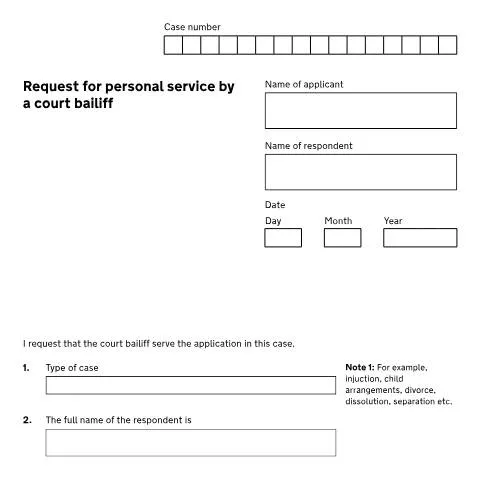
In the labyrinth of civil and family proceedings, there comes a moment when standard postal service simply won't suffice. When a respondent has repeatedly evaded court papers, moved without forwarding addresses, or when the gravity of proceedings demands absolute certainty of delivery, the Form D89 emerges as a crucial tool. This request for personal service by a court bailiff transforms what might otherwise be an insurmountable procedural hurdle into a manageable administrative step, ensuring that justice cannot be derailed by evasion or circumstance.
The bailiff service represents more than mere delivery – it provides evidential certainty that papers have reached their intended recipient. Unlike standard postal methods where delivery can be disputed, a bailiff's personal service creates an unassailable record, complete with detailed circumstances of delivery, physical descriptions, and witness statements where necessary. This level of certainty becomes particularly vital in urgent applications such as injunctions, where the respondent's knowledge of proceedings can be legally critical.
Form D89 serves cases spanning the entire spectrum of HM Courts & Tribunals Service jurisdiction: from high-stakes domestic violence injunctions to complex child arrangement orders, from divorce proceedings where assets are at risk of dissipation to enforcement actions where conventional service has repeatedly failed. The form's comprehensive approach reflects the serious nature of bailiff service – this is not a routine administrative task but a specialised intervention requiring careful justification and detailed preparation.
Navigating the Complexities of Personal Service Requests
The decision to request bailiff service rarely emerges in isolation. Typically, applicants have already attempted standard service methods, perhaps multiple times, only to encounter returned mail, vacant properties, or deliberate avoidance. The threshold for bailiff service varies considerably depending on case type and urgency. Emergency applications, particularly those involving personal safety such as non-molestation orders, may warrant immediate bailiff service without prior service attempts. Conversely, routine financial proceedings might require evidence of failed postal service attempts before courts will authorise the additional expense of personal service.
Understanding when bailiff service becomes necessary requires careful assessment of several factors. Urgency of proceedings plays a crucial role – applications with imminent hearing dates or time-sensitive remedies naturally justify expedited service methods. The respondent's behaviour pattern provides another key indicator; individuals who have previously engaged with legal proceedings but suddenly become uncontactable often require personal service to prevent deliberate delay tactics.
Geographic considerations also influence service strategy. Urban areas with frequent address changes, transient populations, or complex multi-occupancy buildings present particular challenges for standard postal service. Rural locations, while often having stable addresses, may involve significant travel for bailiffs, affecting both timing and cost considerations. The form's address section specifically requests England and Wales locations, reflecting the territorial jurisdiction of HM Courts & Tribunals Service bailiffs.
Identifying Appropriate Cases for Bailiff Service
Domestic violence proceedings represent perhaps the most common application for bailiff service. When seeking non-molestation orders or occupation orders, applicants often face respondents who deliberately avoid service to delay protective measures. The urgency inherent in such cases, combined with potential safety risks, makes bailiff service not just appropriate but often essential.
Child arrangement cases present unique challenges, particularly when one parent has relocated without notice or is actively avoiding court involvement. International relocation cases, where time is critical to prevent unlawful removal, frequently require bailiff service to ensure urgent applications reach the respondent before travel plans can be executed.
Financial proceedings, including divorce settlements and property disputes, may necessitate bailiff service when significant assets are involved and delay could prejudice the applicant's position. Business dissolution cases, where company directors might be avoiding personal liability, often require the certainty that only personal service can provide.
Decoding the Intelligence Requirements: Beyond Basic Demographics
Form D89's detailed information requirements reflect the investigative reality of bailiff work. The physical description section extends far beyond simple height and hair colour, requesting distinguishing marks, ethnicity, and clothing preferences. This level of detail acknowledges that bailiffs often work with incomplete addresses or shared accommodations where identification becomes paramount.
The vehicle details section serves multiple purposes beyond simple identification. Vehicle information helps bailiffs locate individuals who may not be present at registered addresses during standard working hours. Company vehicles can indicate workplace locations, while vehicle modifications or distinctive features provide additional identification tools. The registration number, when current, allows bailiffs to track movements and establish patterns that inform optimal service timing.
Timing preferences require strategic consideration rather than mere convenience. The form asks for "best times for service" – a question that demands understanding of the respondent's lifestyle, work patterns, and social habits. Shift workers, parents with school-age children, or individuals with regular medical appointments all present distinct timing opportunities that can mean the difference between successful service and wasted visits.
The Critical Safety Assessment Framework
The comprehensive safety questions in sections 10 and 11 reflect hard-learned lessons about bailiff security. Each question addresses specific risk categories that influence both service approach and bailiff safety protocols. Violence history encompasses not just criminal convictions but behavioural patterns that might not have resulted in formal charges. The distinction between general violence and threats specific to the current proceedings helps bailiffs assess whether risks relate to the individual's general temperament or particular hostility toward these legal proceedings.
Police involvement questions seek to understand ongoing law enforcement interest in the property or individual. This information helps coordinate service attempts with police availability and may influence whether bailiffs request police accompaniment. Social services involvement often indicates complex family situations that may affect service timing and approach, particularly in child arrangement cases where social workers might be conducting concurrent assessments.
| Risk Category | Service Implications | Typical Precautions |
|---|---|---|
| Violence History | May require police escort | Morning service, two-person teams |
| Firearms Involvement | Specialist bailiff teams | Police notification protocols |
| Mental Health Issues | Timing considerations | Medical professional consultation |
| Dangerous Animals | Property access strategies | Animal control coordination |
| Substance Abuse | Optimal service windows | Sobriety assessment protocols |
Strategic Completion: Maximising Service Success Probability
Completing Form D89 effectively requires thinking like a bailiff. The most successful applications provide information that enables bailiffs to develop comprehensive service strategies rather than merely attempting obvious approaches. Address intelligence should extend beyond the basic postal address to include access codes, intercom details, landlord information, and known associates at the property.
Workplace information, while not explicitly requested on the form, can be included in additional details sections. Many respondents who avoid home service can be located at employment addresses, particularly for non-confrontational proceedings where workplace service presents no professional embarrassment. Educational institutions, regular medical appointments, or social venues provide additional location opportunities that thoughtful applicants might include.
The photograph requirement deserves particular attention. While not mandatory, recent photographs significantly improve service success rates, particularly in multi-occupancy buildings or when respondents share common names. The form specifically requires photographs containing only the respondent, excluding family members or others who might be inadvertently identified. Mobile phone photographs, while acceptable, should be clear enough for identification purposes and printed at reasonable resolution.
Refuge Considerations and Sensitive Circumstances
The refuge question (section 7) addresses situations where respondents have sought sanctuary due to domestic violence or other threats. This information is crucial for bailiff safety and service strategy. Confirmed refuge residence may require coordination with refuge management and potentially modified service approaches to maintain resident safety and privacy.
When respondents are known to be in refuges, bailiffs may need to coordinate service timing with refuge security protocols. Some refuges maintain strict visitor policies that could affect service attempts, while others may facilitate service for legitimate legal proceedings. The "do not know" option acknowledges that applicants may suspect refuge residence without confirmation, prompting bailiffs to investigate discreetly.
Financial Considerations and Fee Structures
Bailiff service represents a significant cost escalation from standard postal service, with fees reflecting both the specialised nature of the service and the time investment required. The current fee structure, detailed in leaflet EX50, varies depending on case complexity and geographic factors. Urban service requests typically incur lower costs than rural locations requiring extensive travel, while high-risk service requests may attract additional charges for security measures.
Help with Fees applications (EX160) can significantly reduce bailiff service costs for eligible applicants. The means-tested system considers not just current income but also savings, investments, and benefit entitlements. Applicants receiving certain benefits may qualify for complete fee remission, while those on low incomes might secure partial remission. The online Help with Fees system provides immediate assessment for many applications, generating reference numbers that can be included directly on Form D89.
Payment timing requires careful coordination with case management. While some courts accept payment promises with email contact details, urgent applications may require immediate payment to avoid service delays. Fee account arrangements benefit regular users such as solicitors or local authorities, providing streamlined payment processing without individual transaction delays.
Professional Account Considerations
Legal professionals utilising PBA (Payment by Account) arrangements must ensure adequate account balances before submitting service requests. Failed payment attempts can significantly delay service, potentially undermining urgent applications. The reference system allows firms to track multiple concurrent applications while maintaining internal billing accuracy.
Solicitors should note that PBA payments create immediate cost commitments, unlike some other court fee scenarios where payment timing provides flexibility. This immediacy reflects the resource commitment required for bailiff service preparation and deployment.
Submission Channels and Case-Specific Routing
Form D89 submission follows case-specific routing that reflects the distributed nature of HM Courts & Tribunals Service administration. Active cases should have D89 forms submitted to the court currently managing proceedings, maintaining continuity with existing case files and judicial oversight. This routing ensures that service requests are processed by staff familiar with case history and any special circumstances that might affect service approach.
Divorce and dissolution cases follow distinct routing to the centralised HMCTS Divorce and Dissolution service in Harlow. This centralisation reflects the volume-based processing model adopted for matrimonial proceedings, where specialist teams handle service requests alongside other procedural matters. The Harlow centre maintains dedicated bailiff coordination resources and established protocols for relationship breakdown cases.
Fill in your form directly online
No printing: type your details into the boxes of the official form, tick, then download the PDF ready to send.
- 1Type into the form boxes
- 2Tick in one click
- 3Save and download the PDF
Urgent applications may warrant telephone contact with the receiving court to ensure immediate processing. While Form D89 itself must be submitted in writing, preliminary telephone contact can alert court staff to time-sensitive situations requiring expedited processing. This approach proves particularly valuable for injunction applications where delay could compromise applicant safety or case effectiveness.
Electronic Submission Possibilities
While Form D89 traditionally requires paper submission, some courts now accept scanned copies via secure email systems for urgent applications, with original documents following by post. This hybrid approach balances speed with administrative requirements, though applicants should confirm electronic acceptance with specific courts rather than assuming universal availability.
Understanding Bailiff Deployment and Service Execution
Once Form D89 is processed and fees are paid, the bailiff deployment process begins with risk assessment and resource allocation. High-risk cases identified through the form's safety questions may require specialist bailiff teams or police coordination, potentially extending deployment timeframes but ensuring appropriate safety measures.
Standard service attempts typically occur during business hours on weekdays, though evening and weekend service may be arranged for respondents with non-standard schedules. The timing information provided in section 6 directly influences deployment scheduling, with bailiffs attempting to maximise success probability through strategic timing.
Service attempts follow structured protocols designed to balance persistence with proportionality. Initial visits establish whether the address is current and whether the respondent is avoiding service or genuinely absent. Subsequent attempts may involve different timing, approaches, or locations based on intelligence gathered during initial visits.
Failed service attempts generate detailed reports that inform ongoing case management. These reports may identify alternative addresses, suggest modified approaches, or recommend additional investigative steps. In some cases, failed personal service attempts may support applications for alternative service methods such as deemed service or service by advertisement.
Documentation and Evidence Standards
Successful bailiff service generates comprehensive documentation including service certificates, photographic evidence where appropriate, and detailed circumstance reports. This documentation serves multiple purposes: providing legal proof of service, supporting any disputed service claims, and informing future service attempts if further proceedings become necessary.
The evidentiary standard for bailiff service exceeds simple delivery confirmation. Bailiffs must be prepared to give evidence about service circumstances, respondent identification, and any relevant interactions. This potential testimony requirement influences service approach and documentation standards throughout the process.
Managing Complex Service Scenarios and Alternative Strategies
When Form D89 reveals particularly challenging service circumstances, courts may recommend modified approaches or alternative service methods. Chronic avoidance cases might benefit from surveillance-based service, where bailiffs observe properties to establish occupancy patterns before attempting service. Commercial premises service may require coordination with security services or building management to ensure access and appropriate service conditions.
International complications arise when respondents are suspected of foreign travel or residence despite UK addresses. While Form D89 covers England and Wales service only, intelligence about international movement may influence service timing or support applications for alternative service methods covering overseas respondents.
Multi-location strategies become relevant when respondents maintain multiple addresses or divide time between locations. Form D89 allows for single address specification, but additional intelligence about alternative locations can be included in supplementary information sections, enabling bailiffs to develop comprehensive location strategies.
The interplay between bailiff service and other enforcement mechanisms requires careful coordination. Respondents facing both service of proceedings and enforcement actions may modify behaviour patterns in response to enforcement activity, creating opportunities for strategic service timing that leverages enforcement presence.