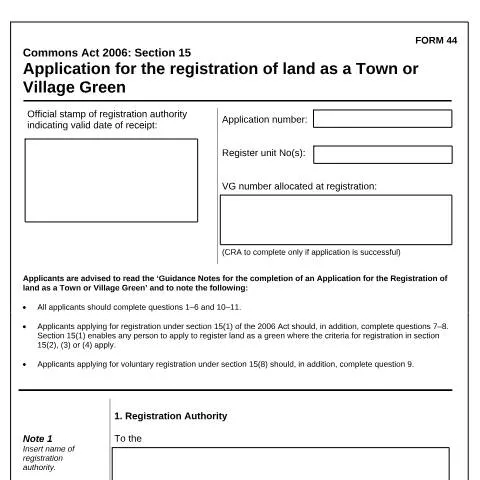
Understanding the Complex Landscape of Town and Village Green Applications
Across England and Wales, thousands of pieces of land hold special status as town or village greens, protected spaces where local communities have exercised recreational rights for generations. The process of securing this protection begins with Form 44, a detailed application that can transform how a piece of land is used and preserved for future generations. Whether you're a resident concerned about development threats to your local playing field, a parish council seeking to protect community space, or even a landowner wishing to voluntarily register your land, understanding this application process is crucial.
The Commons Act 2006 fundamentally reformed how town and village greens are registered, replacing a patchwork of historical legislation with clear statutory criteria. Section 15 of the Act establishes the framework that Form 44 implements, requiring applicants to demonstrate either historical use by local inhabitants or voluntary registration by landowners. This isn't simply about preserving pretty countryside – it's about legal protection that can prevent inappropriate development and ensure public access rights are maintained.
The stakes are often high. Once land is registered as a town or village green, it gains significant legal protection. Development becomes extremely difficult, and the community's rights to use the land for recreation become permanently enshrined. However, the application process is rigorous, often contested, and requires substantial evidence to succeed.
Navigating the Statutory Criteria Under Section 15
Form 44 accommodates several different routes to registration, each with distinct requirements and evidential thresholds. The qualifying criteria determine which sections of the form you'll need to complete and what evidence you must provide.
Section 15(2): Current Recreational Use
This provision applies where local inhabitants have used the land as of right for lawful sports and pastimes for at least twenty years, and this use continues at the time of application. The key elements are:
- Twenty-year period: The use must span an unbroken period ending when the application is made
- As of right: Use must be without permission, secrecy, or force
- Local inhabitants: Users must come from a defined locality or neighbourhood
- Lawful sports and pastimes: Activities like dog walking, children's play, informal games, or community events
Section 15(3): Historical Use with Recent Cessation
Where recreational use has ceased within the past twenty years, this provision allows registration if local inhabitants used the land as of right for twenty years ending when use stopped. This is particularly relevant where landowners have recently blocked access or development has commenced.
Section 15(4): Use Interrupted by Development
This addresses situations where use ceased due to development or other circumstances, but the twenty-year qualifying period was completed before cessation. The application must be made within five years of when use ended.
Section 15(8): Voluntary Registration
Landowners can voluntarily register their land without demonstrating historical recreational use. This might seem counterintuitive, but some owners seek the protection that green status provides against future development pressure, or wish to formalise existing community use.
| Criteria | Use Required | Time Limit | Key Evidence |
|---|---|---|---|
| Section 15(2) | Ongoing 20+ years | None | Current witness statements |
| Section 15(3) | 20 years, ceased recently | 20 years from cessation | Historical evidence of cessation |
| Section 15(4) | 20 years, ceased for development | 5 years from cessation | Planning records, site changes |
| Section 15(8) | None required | None | Landowner consent only |
Assembling Your Evidence Portfolio
The success of most village green applications hinges on the quality and quantity of evidence submitted alongside Form 44. Registration authorities scrutinise applications carefully, often appointing independent inspectors to examine the case. Your evidence package must be comprehensive, credible, and compelling.
Witness Statements: The Foundation of Your Case
Personal testimony from local residents forms the backbone of most applications. Effective witness statements should be detailed, specific, and cover the full twenty-year period where possible. Each statement should address:
- Personal details: Full name, address, and connection to the locality
- Period of knowledge: Specific years of observation, ideally spanning decades
- Nature of use: Detailed descriptions of activities witnessed
- Frequency and intensity: How often the land was used and by how many people
- Seasonal variations: Different uses throughout the year
- Changes over time: Evolution of use patterns or physical changes to the land
The most persuasive statements come from long-term residents who can describe use spanning the entire qualifying period. However, shorter-term residents can still provide valuable corroborating evidence for recent years.
Documentary Evidence: Supporting Your Claims
While witness statements provide the personal testimony, documentary evidence adds objective credibility. Useful documents might include:
- Historical maps: Ordnance Survey maps showing public footpaths or the absence of boundaries
- Aerial photographs: Demonstrating wear patterns, informal paths, or evidence of recreational use
- Planning applications: Particularly relevant for Section 15(4) applications where development triggered cessation
- Parish council minutes: References to the land in local government discussions
- Newspaper articles: Reports of community events or campaigns
- Insurance claims: Accidents or incidents on the land that demonstrate public use
Completing Form 44: Section-by-Section Guidance
Form 44 requires precision and completeness. Missing information or errors can delay processing or provide grounds for rejection. Each section serves a specific legal purpose and must be completed according to the statutory requirements.
Registration Authority and Contact Details
Questions 1-3 establish the administrative framework for your application. The registration authority is typically the county council or unitary authority covering the land. If you're uncertain which authority has jurisdiction, contact the relevant council's legal department.
Multiple applicants are permitted and often strengthen an application by demonstrating community support. However, ensure all named applicants understand their legal responsibilities, as they may face costs if the application fails and a costs order is made.
If instructing a solicitor, complete question 3 carefully. All official correspondence will be directed to the named legal representative, potentially causing delays if contact details change.
Defining the Land: Precision is Essential
Question 5 requires a precise description of the land you're seeking to register. The accompanying map must be at a scale of at least 1:2,500 and show the land clearly marked in colour. This isn't merely administrative detail – the exact boundaries determine what land gains protection if registration succeeds.
Common errors include:
- Maps at insufficient scale or poor quality
- Boundaries that include private gardens or other inappropriate land
- Descriptions that conflict with the mapped area
- Failure to account for existing public highways within the claimed area
Consider whether your claimed area is realistic. Courts have rejected applications where the claimed green includes areas never used for recreation, or where boundaries appear drawn to maximise land area rather than reflect actual use patterns.
Establishing Locality or Neighbourhood
Question 6 addresses a crucial legal requirement: demonstrating that users come from a defined locality or neighbourhood within a locality. This isn't simply about geography – it's about establishing a community with sufficient connection to the land to justify registration.
Administrative areas like parishes provide clear boundaries, but you can also define neighbourhoods by reference to housing estates, villages, or other recognisable communities. If your locality isn't easily defined administratively, provide a clear map showing the neighbourhood boundaries and explain why this constitutes a coherent community.
The Registration Process: From Submission to Decision
Once submitted, your application enters a formal legal process governed by statutory procedures. Understanding this process helps manage expectations and identify when intervention might be necessary.
Initial Processing and Consultation
Registration authorities must acknowledge receipt and assign an application number for tracking purposes. The authority then undertakes extensive consultation, notifying:
- All identified landowners, lessees, tenants, and occupiers
- The relevant parish or community council
- Any other persons the authority considers appropriate
Notices are also published locally and on the authority's website. This consultation period typically lasts six weeks, during which objections can be submitted.
Objections and Counter-Evidence
Landowners and other interested parties frequently object to village green applications, particularly where valuable development land is involved. Common objections include:
- Challenging whether use was as of right rather than by permission
- Disputing the extent or continuity of recreational use
- Questioning whether users constitute inhabitants of a qualifying locality
- Arguing that activities weren't lawful sports and pastimes
Robust objections often trigger the appointment of an independent inspector to conduct a public inquiry or hearing. This quasi-judicial process allows detailed examination of evidence from both sides.
Inspector Inquiries: Preparing for Scrutiny
Public inquiries resemble court proceedings, with formal procedures for evidence presentation and cross-examination. Inspectors are typically barristers or solicitors with specialist knowledge of commons law.
If your application proceeds to inquiry, consider whether legal representation is necessary. While not mandatory, the technical nature of commons law and the adversarial process often favour professionally represented parties.
Strategic Considerations for Different Applicant Types
The approach to completing Form 44 and supporting your application varies significantly depending on your circumstances and objectives.
Fill in your form directly online
No printing: type your details into the boxes of the official form, tick, then download the PDF ready to send.
- 1Type into the form boxes
- 2Tick in one click
- 3Save and download the PDF
Community Groups and Residents' Associations
Local groups often drive village green applications, mobilising community support and coordinating evidence gathering. Early organisation is crucial – start collecting witness statements well before submitting your application, as memories fade and residents move away.
Consider establishing a dedicated committee to manage the application, with clear roles for evidence coordination, legal liaison, and community communication. Budget for potential costs, including legal fees if the application becomes contested.
Parish and Town Councils
Local councils possess both the authority to make applications and valuable resources for evidence gathering. Council records may contain historical references to the land, and councillors can often identify long-term residents willing to provide witness statements.
However, councils must follow proper procedures when deciding to submit applications, including public consultation and formal resolution. Political considerations shouldn't override legal requirements.
Individual Applicants
Private individuals can submit applications, but should carefully consider their financial exposure. If the application fails and attracts a costs order, individual applicants bear personal liability. Consider whether a community group or parish council might be more appropriate applicants.
Landowner Applications Under Section 15(8)
Voluntary registration offers landowners a unique opportunity to protect land while potentially gaining tax advantages. However, consider the implications carefully – registration creates permanent restrictions on land use and development potential.
Ensure all co-owners and secured lenders consent to registration, as their interests will be affected. The application process for voluntary registration is simpler, focusing on proving ownership rather than historical use.
Post-Decision Procedures and Long-term Implications
The conclusion of the application process marks either the beginning of enhanced protection or the need to consider alternative strategies.
Successful Registration: Managing Your New Village Green
Registration creates a permanent legal status that's extremely difficult to reverse. The land becomes subject to specific management obligations and protective restrictions. Development becomes virtually impossible except in exceptional circumstances requiring government consent.
Consider establishing formal management arrangements through a village green management committee or transferring responsibility to the parish council. Regular maintenance, insurance, and public safety become ongoing responsibilities.
Dealing with Rejected Applications
Application failure doesn't necessarily end your options. Consider whether:
- Appeal grounds exist: Procedural errors or misapplication of legal tests
- Alternative applications might succeed under different criteria
- Planning protection could be sought through local plan designations
- Restrictive covenants or other legal mechanisms might provide protection
Time limits may apply to any follow-up action, so seek advice promptly if considering appeals or alternative strategies.
The Form 44 application process represents more than administrative procedure – it's about preserving community spaces and recreational rights for future generations. Success requires careful preparation, comprehensive evidence, and often considerable persistence through complex legal processes. Whether representing community interests or individual concerns, understanding both the technical requirements and strategic considerations will significantly improve your prospects of achieving lasting protection for valued local spaces.