Understanding the Official Voter Registration Form in Scotland
The official form designed by the Electoral Registration Office and the Ministry of Housing, Communities & Local Government, identified by the code ITR-S, serves as a crucial tool for residents of Scotland to register to vote. This form ensures eligible individuals can participate in democratic processes such as local elections, Scottish Parliament elections, and UK general elections. It is essential for anyone living in Scotland and wishing to exercise their voting rights to understand how to complete this form correctly and the importance of providing accurate information.
Who Should Fill Out the Register to Vote Form?
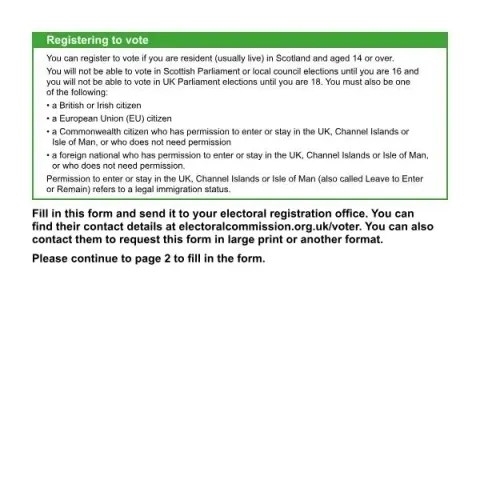
This form is intended for residents of Scotland who are aged 14 or over. While individuals aged 14 and 15 can register, they will be unable to vote in Scottish Parliament or local council elections until they turn 16, and in UK Parliament elections until they reach 18. Eligibility to register also depends on citizenship and immigration status:
- British or Irish citizens
- European Union (EU) citizens
- Commonwealth citizens with permission to stay in the UK, Channel Islands, or Isle of Man, or those who do not require permission
- Foreign nationals with legal permission to stay in the UK, Channel Islands, or Isle of Man
Legal immigration status, often referred to as Leave to Enter or Remain, is necessary for eligibility. If you are unsure whether you qualify, it is advisable to consult the guidance provided by the electoral authorities or seek legal advice.
How to Complete the Voter Registration Form
The form can be completed either online via the official government website or by submitting a paper copy to your local electoral registration office. When filling out the form, you should provide:
- Your full name and current address, including postcode
- Details of any previous addresses within the last 12 months, especially if you have recently moved
- Your contact details, such as phone number and email address (optional but recommended for quicker communication)
- Your National Insurance number (if aged 16 or over), which can be found on payslips or official correspondence
- Date of birth and nationality, with options to specify if these are unknown
If you have changed your name recently, providing previous name details can help verify your identity. Additionally, if you do not know certain details, such as your National Insurance number, the form advises on alternative proof or evidence that may be required.
Important Considerations When Filling Out the Form
Accuracy is vital when completing your registration form. Providing false information can lead to legal penalties, including a fine or imprisonment. The declaration section requires your signature and date, confirming that the information provided is true to the best of your knowledge.
For those who wish to vote by post or proxy, a separate application must be completed. The form also includes options regarding the open register, which can be used for purposes like direct marketing. If you prefer not to include your details in this register, you can opt out by ticking the relevant box.
Fill in your form directly online
No printing: type your details into the boxes of the official form, tick, then download the PDF ready to send.
- 1Type into the form boxes
- 2Tick in one click
- 3Save and download the PDF
Submitting the Form and Additional Guidance
The completed form should be sent to your local electoral registration office. Contact details for these offices can be found at electoralcommission.org.uk/voter. If you require assistance with filling out the form, or if you need it in a different format such as large print, support is available through your electoral registration office.
It is recommended to submit your registration well before any upcoming elections to ensure your name is included on the electoral register. Registration is a legal requirement, and failure to do so can result in penalties, including fines. Remember, registering to vote is a vital step in exercising your democratic rights and contributing to your community.