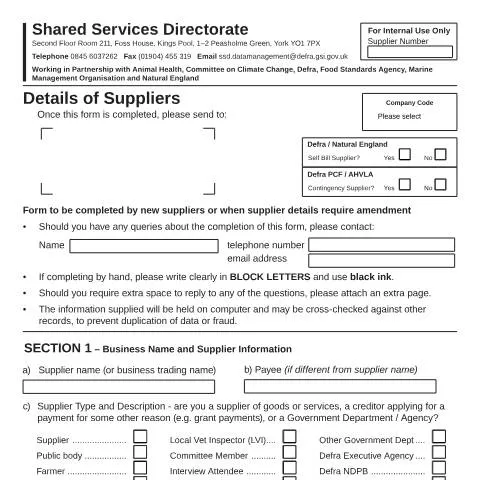
The Importance of the A/AP201 Form in Veterinary Practices
In the landscape of veterinary practice, maintaining clear and accurate supplier information is crucial. The A/AP201: Details of Suppliers for Official Veterinarian Practices form serves as a pivotal tool for ensuring that all suppliers associated with veterinary services are properly recorded and verified. This form is essential for both new suppliers and existing ones that require amendments to their details, ensuring compliance with departmental regulations and financial processes.
Navigating the Regulatory Framework Behind A/AP201
The A/AP201 form is governed under the auspices of the Department for Environment, Food & Rural Affairs (DEFRA) and its Animal and Plant Health Agency. It is designed to align with the statutory requirements set forth to enhance food safety, animal health, and biosecurity within the UK. Since its inception, this form has evolved in response to changing regulatory needs, reflecting the importance of accurate supplier information in managing public health and agricultural standards.
Historically, the necessity for such documentation arose from the need to mitigate risks associated with animal diseases and to streamline payment processes for suppliers involved in veterinary practices. This aligns with the UK Government's commitment to uphold rigorous standards in animal health and welfare.
Key Regulatory Milestones
- The Animal Health Act 1981: Laid the groundwork for animal health regulations.
- The Veterinary Surgeons Act 1966: Established qualifications and standards for those practicing veterinary medicine.
- DEFRA's Strategic Framework: Continuously adapts the supply chain protocols to current challenges in animal health.
Who Needs to Complete the A/AP201 Form?
The A/AP201 form is not just a bureaucratic necessity; it directly affects various stakeholders in the veterinary field. It's imperative for:
- New Suppliers: Any entity wishing to provide goods or services to veterinary practices must complete this form to establish their credentials.
- Existing Suppliers: Those with changes in business structure, contact details, or other relevant information must submit an updated form to ensure accuracy in records.
Specific categories of suppliers that must engage with this form include:
- Private Veterinary Practitioners
- Government Agencies and Departments
- Local Authorities
- Non-Governmental Organizations (NGOs) involved in veterinary services
Moreover, certain exceptions exist. For instance, suppliers engaged solely in consultancy without the provision of goods or services may not be required to submit this form. However, it is always advisable to check with DEFRA for clarification.
Key Sections of the A/AP201 Form Explained
The A/AP201 form is structured into several critical sections, each designed to capture specific information that is vital for record-keeping and compliance:
Section 1: Business Name and Supplier Information
This section mandates that suppliers provide their full business name and any alternate payee names if applicable. It also requires selecting the type of supplier, whether they are a private entity, government agency, or a farmer.
- Supplier Type and Description: This classification helps categorize the supplier accurately and is essential for processing payments.
- Small Business Declaration: Suppliers must confirm if they qualify as a small business based on criteria such as employee count and annual turnover.
Section 2: Taxation Details
Here, suppliers must disclose their VAT registration status and any pertinent tax numbers, including their Unique Tax Reference (UTR) if applicable. This information is crucial for financial audit trails and compliance with HMRC regulations.
Section 3: Address and Contact Details
Accurate address and contact information ensures that all communication regarding orders and payments is seamless. This includes providing separate addresses for purchase orders and remittance if necessary.
Section 4: Payment Details
To facilitate efficient transactions, suppliers must provide their bank details, including the account holder's name, account number, and sort code. Completing this section accurately is vital to ensuring prompt payments.
Completing the A/AP201: Practical Tips for Accuracy
When filling out the A/AP201 form, precision is key. Here are practical steps suppliers can take to ensure they complete the form correctly:
- Use Block Letters: Whether filling the form by hand or electronically, clarity is paramount. Use block letters and black ink for handwritten submissions.
- Review All Sections: Ensure that every part of the form is filled out completely, especially sections regarding taxation and payment details, as missing information can lead to delays.
- Attach Additional Pages if Needed: If there is insufficient space for any answers, additional pages should be attached, clearly referencing the relevant section of the form.
Submission Process: How and Where to Send the Form
Once the A/AP201 form is duly completed, it needs to be submitted to the designated department for processing. Here’s how to do it:
- By Post: Send the completed form to the Shared Services Directorate at the address specified at the top of the form. Ensure that you include the correct return address to avoid any misplacement.
- Electronically: Some local offices may allow for electronic submissions. Always check with the relevant department to see if this option is available and ensure compliance with data protection regulations.
Understanding the Processing Timeline
The timeframe for processing the A/AP201 form can vary. Typically, once received, the information is entered into the internal database within an estimated time frame of 10 working days. However, during peak periods, this may extend. Suppliers are encouraged to follow up via the provided contact details if they do not receive confirmation of their submission within this period.
Implications of Accurate Supplier Data
The information provided on the A/AP201 form carries significant implications for both the supplier and the veterinary practices that rely on their services. Accurate supplier data ensures that payments are processed without delay, which is crucial in maintaining the operational flow of veterinary services. Errors or omissions can lead to:
- Payment Delays: Inaccurate bank details or contact information can cause significant delays in payment cycles.
- Compliance Issues: Incomplete tax information may trigger audits or compliance checks by HMRC, leading to further complications.
- Reputational Risks: For government suppliers, maintaining accurate records is not just a legal requirement but also a matter of trust and integrity in public service.
Case Studies: Real-Life Impacts of A/AP201 Submissions
Understanding the A/AP201 form’s impact can be further enhanced by examining real-life scenarios where accurate or inaccurate submissions have made a difference.
Case Study 1: Timely Payments Enhance Service Delivery
A local veterinary practice, dependent on a range of suppliers for medications and surgical supplies, found themselves in a precarious position when one of their supplier's A/AP201 forms contained outdated bank information. The delay in processing this update caused a ripple effect, leading to a shortage of critical supplies during a high-demand period. Once the issue was rectified, the practice implemented a review process for all supplier documentation to prevent future occurrences.
Case Study 2: Regulatory Scrutiny Due to Tax Misreporting
In another instance, a supplier incorrectly reported their VAT status on the A/AP201 form, which led to an HMRC investigation. This resulted in significant penalties and compliance checks that strained the supplier's resources. Following this incident, they adopted a meticulous approach to completing all regulatory forms, reinforcing the importance of accuracy in supplier information.
Final Steps: What Happens After Submission?
After the A/AP201 form is submitted, it follows a defined path through the administrative channels:
- Verification: The submitted information is cross-checked against existing records to ensure there are no discrepancies.
- Database Entry: Upon verification, the data is entered into the internal supplier database, which facilitates future interactions and transactions.
- Confirmation: Suppliers will receive a confirmation once their details are updated or if any additional information is required.
Overall, the A/AP201 form plays a critical role in the stable functioning of veterinary practices in the UK, establishing a framework for accountability and transparency between suppliers and government entities.
Understanding the Role of Official Veterinarians in Animal Welfare
Official Veterinarians (OVs) play a crucial role in ensuring the welfare of animals in the UK. They are responsible for enforcing animal health regulations and welfare standards, particularly in sectors such as livestock and food production. OVs are often employed by local authorities or private veterinary practices that have been designated by the Animal and Plant Health Agency (APHA). Their duties include conducting inspections, issuing health certificates, and monitoring compliance with animal welfare laws.
To become an Official Veterinarian, one must possess certain qualifications and experience. Typically, candidates must be registered with the Royal College of Veterinary Surgeons (RCVS) and have relevant veterinary experience, particularly in farm animal practice. Moreover, OVs are required to undertake ongoing professional development to stay updated on the latest regulations and best practices in animal welfare.
It's essential for OVs to maintain effective communication with suppliers of animal products. This includes not only livestock producers but also feed suppliers and veterinary pharmaceutical companies. Understanding the supply chain is critical to ensuring that all participants comply with health and safety standards. For example, OVs must verify that suppliers adhere to best practices in animal husbandry and that products are traceable, contributing to overall food safety.
Suppliers’ Compliance and Quality Assurance for Veterinarian Practices
When sourcing products and services, Official Veterinarians must ensure that suppliers comply with relevant regulations and best practices. The Food Standards Agency (FSA) and the Veterinary Medicines Directorate (VMD) provide guidelines that suppliers must adhere to in order to maintain the highest standards of animal health and welfare.
Quality assurance schemes are fundamental in the veterinary supply chain. Suppliers should participate in recognized quality assurance programs that dictate standards for sourcing, processing, and distributing animal products. For instance, food suppliers should be able to provide documentation proving that their products have been sourced sustainably and ethically. This often involves regular audits and inspections, which serve to reinforce consumer confidence and ensure compliance with safety standards.
It is also vital for OVs to regularly assess and review their suppliers. This can be achieved through routine inspections, feedback from clients, and monitoring the suppliers’ compliance with health regulations. Should a supplier fail to meet the expected standards, OVs may need to seek alternative sources to ensure the welfare of animals and maintain compliance with legal requirements.
Furthermore, OVs are encouraged to engage in collaborative approaches with suppliers to ensure a mutual understanding of quality standards and compliance expectations. Establishing strong relationships with suppliers can enhance the overall efficiency of veterinary practices and contribute to better outcomes for animal health and welfare.
Financial Considerations for Veterinary Practices and Supplier Relationships
The financial dynamics of veterinary practices, especially those involving Official Veterinarians, can be complex. Budget constraints may limit the options available for sourcing quality supplies and services. As such, OVs must navigate these financial challenges while ensuring that they do not compromise on the quality of care provided to animals.
Practices need to maintain a balanced budget, which includes careful consideration of supplier contracts. It is essential to negotiate terms that ensure both competitive pricing and quality. This requires OVs to have a sound understanding of the financial health of their suppliers, as well as the prevailing market conditions affecting the prices of veterinary products and services.
Moreover, understanding the potential for bulk purchasing discounts can significantly increase a practice’s profitability. OVs might explore group purchasing organizations that allow for collective buying power, thereby reducing costs for essential supplies.
Insurance is another financial consideration. OVs should ensure they have appropriate insurance coverage for their practices, which may include public liability insurance and professional indemnity insurance. These insurances not only protect the veterinarian in the case of litigation but may also be a requirement for certain suppliers or contracts.
Further, the financial implications of complying with government regulations must be taken into account. For instance, ensuring compliance with the Veterinary Medicines Regulations (VMR) may require additional training for staff, as well as investments in record-keeping and reporting systems to align with the standards set forth by the VMD. All these factors contribute to the overall financial management of a veterinary practice and underscore the importance of strategic supplier relationships.