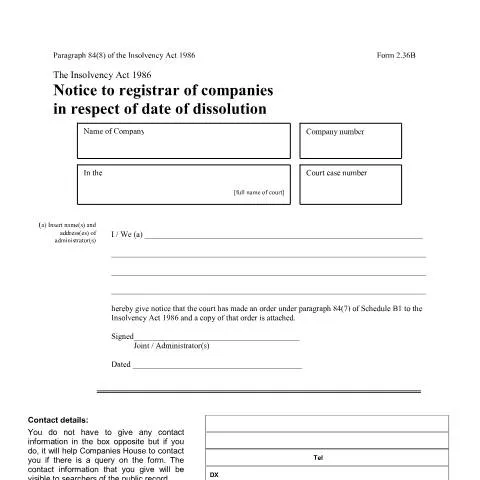
Navigating the Notice to Registrar for Dissolution Date: A Practical Guide
When a company in the UK faces dissolution, a crucial administrative step involves notifying the Companies House of the dissolution date. This action is encapsulated in the official document known as Form 2.36B. This guide aims to demystify this important notice, highlighting its significance, procedural details, and practical tips for effective use.
Understanding the Context: Why Dissolution Matters
Dissolution is a formal process that marks the end of a company’s legal existence. The reasons for bankruptcy can vary, from financial difficulties to a strategic decision by the stakeholders. Understanding the implications of dissolution is key:
- Legal Commitments: Upon dissolution, the company ceases to exist and is no longer liable for debts or obligations.
- Stakeholder Interests: Employees, creditors, and shareholders may have vested interests that need to be addressed prior to dissolution.
- Regulatory Compliance: Filing the appropriate notices ensures that all legal requirements are met, thus avoiding penalties.
What the Document Encompasses
The Notice to Registrar in Respect of Dissolution Date serves multiple purposes:
- It informs the registrar about the dissolution date as stipulated by court orders under the Insolvency Act 1986.
- The document must contain specific details about the company, including its name and registration number.
- A declaration by the administrator regarding the court order is needed to validate the notice.
Who Should File the Notice?
This documentation should be filed by the appointed administrator or liquidator overseeing the company's dissolution. Here are specific scenarios where filing is essential:
- If the company has undergone a formal administration process and is transitioning to dissolution.
- When stakeholders decide that the company can no longer fulfill its obligations.
- If a court order has been issued that impacts the dissolution timeline.
Key Components of Form 2.36B
Understanding what to include in the notice is crucial for ensuring compliance with the Companies House requirements. Here are the essential fields:
| Field | Description |
|---|---|
| Name of Company | The full registered name of the company as per Companies House records. |
| Company Number | The unique registration number assigned to the company. |
| Administrator Details | Name(s) and address(es) of the appointed administrator(s). |
| Court Case Number | The reference number of the court case related to the dissolution. |
| Signature and Date | Signature of the administrator(s) along with the date of filing. |
Interconnections with Other Documents
Filing the notice of dissolution is not an isolated process. It interacts with various other documentation and procedures:
- Insolvency Practitioners: They may have to file additional reports or notifications during the dissolution process.
- Creditors' Meetings: Documentation related to creditor meetings may need to be submitted alongside the dissolution notice.
- Final Accounts: Before dissolution, final accounts may need to be prepared and submitted to relevant stakeholders.
Step-by-Step Process for Filing the Notice
Adhering to a systematic approach can simplify the filing of Form 2.36B:
- Gather Necessary Information: Compile the company’s name, registration number, administrator details, and court case information.
- Draft the Notice: Complete Form 2.36B ensuring all fields are filled accurately.
- Attach Required Documentation: Include a copy of the court order that verifies the dissolution date.
- Submit the Notice: Send the completed form to Companies House at the designated address.
- Keep Records: Maintain a copy of the filed notice and any correspondence for future reference.
Common Misinterpretations to Avoid
Completing this notice can sometimes lead to misunderstandings. Here are common pitfalls:
- Misidentifying the Company: Ensure that the correct company name and number are used, as mistakes can lead to delays or rejections.
- Overlooking Attachments: Failing to attach the court order may invalidate the notice.
- Incorrect Signatures: Form should be signed by the designated administrator(s), or it may not be accepted.
Limitations and Scope of the Document
While the Form 2.36B serves as an essential notice for dissolution, it has its limitations:
- This document does not address the underlying reasons for dissolution, which may require separate legal consideration.
- It is strictly a notification and does not cover any financial settlements or obligations post-dissolution.
- Filing the notice does not exempt the company from any outstanding legal actions unless specified by a court order.
The Importance of Follow-Up Actions
After filing the notice, it is vital to engage in follow-up actions to ensure compliance and closure:
Fill in your form directly online
No printing: type your details into the boxes of the official form, tick, then download the PDF ready to send.
- 1Type into the form boxes
- 2Tick in one click
- 3Save and download the PDF
- Monitor Communication: Stay vigilant for any correspondence from Companies House regarding the filed notice.
- Final Tax Returns: Ensure the company’s final tax obligations are settled with HMRC prior to dissolution being finalized.
- Clear Company Assets: Any remaining assets should be dealt with before formal dissolution, as these may have implications for creditors and stakeholders.
Conclusion: Ensuring a Smooth Dissolution Process
Utilizing the Notice to Registrar in Respect of Dissolution Date (Form 2.36B) effectively is critical to navigating the dissolution of a company in the UK. By understanding its components, interrelations, and procedural steps, administrators can better ensure compliance and protect the interests of all stakeholders involved.
Understanding the Importance of Giving Notice for Dissolution
When a company in the UK approaches dissolution, ensuring compliance with the proper protocols is paramount. The notice to the registrar concerning the dissolution date is not merely a procedural formality; it serves multiple essential functions:
- Legal Compliance: Failing to provide adequate notice can lead to complications, such as penalties or refusal of the dissolution request. Compliance with the Companies Act 2006 and related regulations is essential.
- Protection of Stakeholders: By notifying relevant parties, including creditors and shareholders, the company ensures that all stakeholders are adequately informed of its intent to dissolve, fostering transparency and accountability.
- Public Record Maintenance: The dissolution notice contributes to the accuracy of the Companies House registry, ensuring that the public record reflects the current status of the business. This is vital for potential investors and other entities that may engage with the company in the future.
Steps to Effectively Notify the Registrar
Notifying the registrar about the proposed dissolution date involves a series of well-defined steps. These should be meticulously followed to avoid any administrative issues:
- Prepare Required Documentation: Gather all necessary documents, including the company's financial statements, records of shareholder approval, and any other relevant paperwork that demonstrates the dissolution's legitimacy.
- Complete the Form DS01: The primary form for dissolution is the DS01. This form must be duly completed, including details such as the company name, registration number, and the proposed dissolution date. Attention to detail is crucial, as inaccuracies can lead to delays.
- Obtain Consent from Shareholders: Before submitting the notice, ensure that the majority of shareholders (usually at least 75%) have consented to the dissolution. This consensus must be documented, as it may be requested by the registrar.
- Submit the DS01 Form: Once completed, the DS01 form should be submitted to Companies House, along with the appropriate fee. This submission can be done electronically or via post, depending on your preference and the company’s registration details.
- Monitor the Process: After submission, keep an eye on the progress of your application. Companies House will typically provide confirmation once the application has been processed. If there are issues or queries, be ready to respond promptly to avoid setbacks.
Common Challenges and How to Overcome Them
As with any administrative process, notifying the registrar regarding the dissolution date can pose challenges. Here are some common issues that may arise and strategies for mitigating them:
- Insufficient Shareholder Agreement: If not all shareholders agree to the dissolution, it can complicate the process. To prevent this, engage in open discussions with shareholders early on and consider holding a vote to ensure consensus.
- Incomplete or Incorrect Forms: Mistakes in the DS01 form can lead to delays. To counter this, double-check all details before submission and consider having another party review the form for accuracy.
- Notification Delays: If the notice isn't submitted on time, it could affect the intended dissolution date. To mitigate this, plan ahead and allow ample time for the completion and submission of all necessary documents.