When Pet Food Crosses International Borders: The Critical Role of Health Certificates
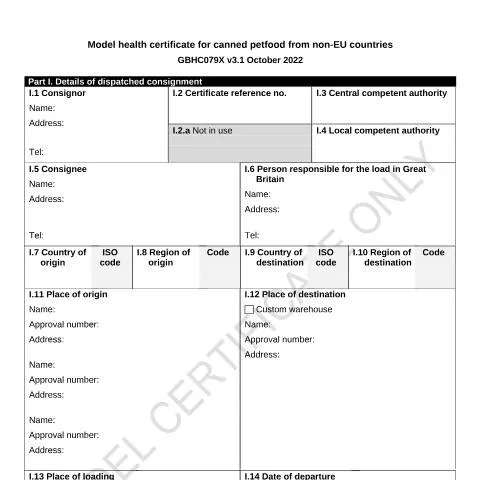
Every shipment of canned pet food arriving in Great Britain from non-EU countries must navigate a complex web of veterinary certification requirements. The model health certificate GBHC079X represents far more than bureaucratic paperwork—it serves as the legal gateway determining whether thousands of tins of pet food can lawfully enter the UK market or face immediate rejection at border control points.
This standardised document bridges the gap between international trade realities and domestic animal health protection. When a consignment of canned pet food manufactured in countries like Thailand, Brazil, or the United States arrives at Dover or Felixstowe, customs officers and veterinary inspectors rely entirely on the accompanying health certificate to verify that the products meet Great Britain's stringent safety standards derived from retained EU regulations.
The certificate's reference code GBHC079X specifically applies to canned pet food from non-EU countries, distinguishing it from other categories of animal by-products or fresh pet food imports. This distinction matters enormously, as different product types trigger entirely different certification pathways and regulatory requirements under the Animal and Plant Health Agency's oversight.
Decoding the Certificate's Legal Architecture
The GBHC079X certificate operates within a framework established by Regulation (EC) No 1069/2009 and Commission Regulation (EU) No 142/2011, both retained in UK law following Brexit. These regulations create the legal foundation for classifying animal by-products into three distinct categories, with pet food typically falling under Category 3—the lowest risk classification.
Part I of the certificate captures the commercial reality of international pet food trade. Every field from I.1 through I.28 serves a specific regulatory purpose, creating an unbreakable chain of traceability from the manufacturing plant in the country of origin to the final destination warehouse in Great Britain. The consignor details in section I.1 must match exactly with the approved establishment records held by both the exporting country's competent authority and the UK's import systems.
The certificate reference number in section I.2 becomes the unique identifier linking the physical consignment to all subsequent regulatory actions. If contamination issues arise months later, this number enables rapid tracing back to the original batch records, manufacturing dates, and source materials used in production.
| Certificate Section | Critical Information | Regulatory Impact |
|---|---|---|
| I.11 Place of origin | Establishment approval number | Determines manufacturing plant's compliance status |
| I.19 Commodity code | HS code 23.09 | Triggers specific import duty and inspection protocols |
| I.25 Commodity certified for | Pet food vs. technical use | Defines permitted end-use and distribution channels |
| I.28 Species identification | Scientific names and batch numbers | Enables species-specific risk assessment |
The Veterinary Certification Process: Beyond Rubber-Stamping
Part II of the certificate transforms from administrative form-filling into professional veterinary attestation. The undersigned official veterinarian assumes legal responsibility for verifying compliance with multiple layers of EU-derived regulations that Great Britain continues to apply post-Brexit.
Section II.1 requires the veterinarian to confirm that the manufacturing establishment operates under continuous official supervision. This means regular inspections, HACCP compliance verification, and ongoing monitoring of the facility's adherence to Article 24 requirements of Regulation 1069/2009. The veterinarian cannot simply visit once and sign—they must have confidence in the establishment's systematic compliance.
The extensive list in section II.2 details exactly which animal by-products may legally comprise canned pet food ingredients. Each subcategory represents different risk profiles and sourcing requirements:
- Category 1: Carcases and parts from animals slaughtered for human consumption but diverted for commercial reasons—the highest quality source material
- Category 2: Animal parts rejected as unfit for human consumption but showing no disease signs—requiring more stringent processing
- Category 3: Specific animal by-products like poultry heads, hides, feathers, and blood from healthy animals—standard pet food ingredients
The veterinarian must verify that only these approved categories entered the manufacturing process. Any deviation—such as inclusion of mechanically separated meat from prohibited sources or processing aid materials not listed in the certificate—would render the entire consignment non-compliant and subject to rejection or destruction.
Manufacturing Standards and Establishment Approval Requirements
The certificate's effectiveness depends entirely on the approved establishment system operating in the country of origin. Section I.11 requires multiple approval numbers because modern pet food manufacturing often involves several facilities: raw material processing plants, mixing facilities, canning operations, and packaging centres.
Each facility must hold valid approval from the exporting country's competent veterinary authority. In practice, this means regular official inspections covering:
- Structural requirements: Segregated areas for different risk categories, appropriate drainage systems, pest control measures
- Operational procedures: Temperature control during processing, cleaning and disinfection protocols, staff training records
- Record-keeping systems: Batch tracking from raw materials through finished products, complaint handling procedures, recall capabilities
The approval number system enables the Animal and Plant Health Agency to pre-assess facilities before any products reach UK borders. If an establishment loses its approval due to non-compliance issues, all certificates referencing that approval number become automatically invalid, even for consignments already in transit.
Border Control Procedures and Entry Point Requirements
Section I.16 identifies the designated Border Control Post (BCP) where the consignment must present for official controls. Great Britain operates BCPs at major ports including Dover, Felixstowe, Portsmouth, and several airports handling cargo flights. The choice of entry point significantly impacts logistics costs and processing times.
Upon arrival, the certificate undergoes documentary checks before any physical inspection begins. Officials verify that:
- The certificate version matches current requirements (GBHC079X v3.1 as of October 2022)
- All mandatory fields contain complete, legible information
- The signing veterinarian appears on the competent authority's authorised signatory list
- Consignment details match the accompanying commercial documentation
Identity checks follow, comparing the actual products against certificate descriptions. Inspectors examine packaging labels, batch codes, net weights, and temperature conditions during transport. Any discrepancies between the physical consignment and certificate details trigger enhanced scrutiny or potential rejection.
Physical sampling occurs based on risk assessment principles. High-risk consignments—those from establishments with compliance histories, novel ingredients, or unusual processing methods—face mandatory laboratory testing. Samples undergo microbiological analysis, chemical residue testing, and species verification using DNA techniques.
Temperature Control and Product Integrity
Section I.21 requires specification of transport temperature conditions: ambient, chilled, or frozen. This seemingly simple choice carries profound implications for product safety and shelf-life. Canned pet food typically travels at ambient temperature, but any deviation during transit could indicate container integrity failures or inadequate logistics management.
The certificate creates legal accountability for maintaining appropriate conditions throughout the supply chain. If temperature monitoring records show deviations, inspectors may require additional testing or reject the entire consignment despite otherwise satisfactory documentation.
Certificate Validity Periods and Regulatory Updates
The GBHC079X model certificate undergoes periodic revision to reflect evolving regulatory requirements, scientific understanding of food safety risks, and international trade developments. Version 3.1, issued in October 2022, incorporates post-Brexit adjustments to ensure continued alignment with Great Britain's independent regulatory framework.
Each certificate remains valid only for the specific consignment it accompanies. Unlike some other official documents, health certificates cannot be photocopied, amended, or reused for subsequent shipments. Every new consignment requires a fresh certificate signed by an authorised official veterinarian in the country of origin.
Importers must monitor regulatory updates affecting certificate requirements. Changes in approved establishment lists, modified processing standards, or enhanced testing requirements can render existing certificates obsolete overnight. The Food Standards Agency publishes guidance updates, but responsibility for compliance ultimately rests with importers and their overseas suppliers.
Responding to Certificate Deficiencies
When certificates contain errors, omissions, or inconsistencies, correction procedures depend on the nature of the problem. Minor administrative errors—incorrect postal codes, typographical mistakes in non-critical fields—may permit correction through official amendments if the signing veterinarian remains available.
Substantive errors affecting product safety or traceability typically require complete certificate replacement. This process can delay consignment release for days or weeks, particularly when overseas veterinary authorities face heavy workloads or holiday periods.
Commercial Implications and Supply Chain Management
The certificate system creates significant commercial pressures throughout the pet food supply chain. Importers must build certificate procurement time into their logistics planning, typically adding 5-10 working days to order cycles compared to domestic sourcing.
Relationships with overseas suppliers become more complex when certificate compliance enters the equation. Manufacturers must maintain approved establishment status, train staff in certificate completion procedures, and establish relationships with authorised veterinarians willing to sign certificates promptly.
The commodity code specification in section I.19 (HS code 23.09) determines import duty rates and potential quota restrictions. Pet food importers must navigate both veterinary certification requirements and customs valuation procedures, creating dual compliance obligations that increase operational complexity.
Critical consideration: Certificate deficiencies discovered at UK borders can trigger consignment detention, storage costs, and potential destruction orders. These financial risks make certificate accuracy essential for viable commercial operations.
Technical Use Designations and Market Restrictions
Section I.25 offers a crucial distinction between pet food and technical use classifications. Products certified for technical use face different regulatory pathways but cannot enter retail pet food distribution channels without additional processing and re-certification.
This classification affects the entire downstream supply chain. Retailers, distributors, and online marketplaces must verify that products carry appropriate pet food certification before offering them to consumers. The certificate becomes the fundamental proof of product suitability for its intended use.
Enforcement authorities conduct regular market surveillance, testing retail products and tracing back to import certificates. Products found in the market without proper certification face immediate withdrawal orders and potential prosecution of the responsible parties under food safety legislation.
The certificate system ultimately serves Great Britain's broader animal health protection strategy, ensuring that imported pet food meets the same safety standards applied to domestically manufactured products while facilitating legitimate international trade in this essential commodity category.
Common Certification Challenges and Troubleshooting
Pet food exporters frequently encounter specific hurdles when navigating the model health certificate process, particularly when dealing with multi-ingredient products or complex supply chains. Understanding these common pitfalls can save considerable time and prevent costly shipment delays.
Ingredient traceability issues represent one of the most frequent stumbling blocks. When your pet food contains multiple animal-derived components sourced from different establishments, each facility must be individually listed and approved. For instance, if your dry dog food contains chicken meal from one approved plant, fish meal from another, and beef tallow from a third facility, all three establishments require separate listing on the certificate. The APHA will not accept generic descriptions such as "various approved establishments" – specific facility numbers and addresses are mandatory.
Temperature control documentation often creates confusion, particularly for products requiring specific storage conditions during transport. Frozen raw pet foods must maintain continuous cold chain documentation from production through to border inspection. This includes not just the final transport temperature logs, but evidence of proper storage at each stage of the supply chain. Semi-moist products containing preservatives may have different requirements, and the certificate must accurately reflect these specifications.
Labelling compliance discrepancies between the physical product and certificate details frequently trigger rejections at border inspection points. The product name on your commercial packaging must exactly match the description provided on the health certificate. Minor variations in spelling, ingredient order, or product designations (such as "complete" versus "complementary" food) can result in detention. Always cross-reference your final packaging against the certificate details before submission.
Batch coding and lot numbering systems require particular attention when dealing with products manufactured across multiple production runs. If your certificate covers a shipment containing products from different manufacturing dates, ensure the batch identification system clearly corresponds to the production records submitted with your application. Some importing countries require individual batch certificates, while others accept consolidated shipment certificates – verify requirements specific to your destination market.
Third-party laboratory testing results must align precisely with the certificate declarations. If your product underwent additional testing for specific pathogens or nutritional content, these results should be referenced appropriately within the certificate framework. Discrepancies between laboratory reports and certificate statements often emerge during detailed inspections, particularly for premium or therapeutic pet food products making specific health claims.
Processing method descriptions require technical accuracy that matches your actual production procedures. Terms like "heat-treated," "extruded," or "freeze-dried" carry specific regulatory meanings that must correspond to your documented manufacturing processes. Vague descriptions or incorrect terminology can invalidate the entire certificate, especially when importing countries have specific processing requirements for pathogen reduction.
Regulatory Updates and Brexit Implications
The UK's departure from the European Union fundamentally transformed pet food certification requirements, creating new compliance pathways that continue to evolve. These changes affect both exports to EU member states and third countries, requiring exporters to navigate an increasingly complex regulatory landscape.
Northern Ireland Protocol considerations create unique certification scenarios for businesses operating across different parts of the UK. Pet food manufactured in Northern Ireland and destined for Republic of Ireland markets may follow different certification pathways compared to products moving from England, Scotland, or Wales to EU destinations. The APHA provides specific guidance for these cross-border movements, but requirements can vary depending on the final destination country and product categories involved.
New bilateral trade agreements have introduced alternative certification frameworks for certain markets. Recent agreements with countries like Japan, Australia, and New Zealand include specific provisions for pet food trade that may offer streamlined certification processes compared to standard third-country procedures. However, these agreements often contain phase-in periods and product-specific conditions that require careful monitoring.
Digital certification initiatives are gradually replacing paper-based systems in many jurisdictions. The UK government has been piloting electronic health certificates (eHCs) for various animal product categories, including pet food exports to selected destinations. While not yet universally available, these digital systems promise faster processing times and reduced administrative burden. Exporters should monitor APHA announcements regarding eHC availability for their specific product categories and destination markets.
Mutual recognition agreements (MRAs) with key trading partners are reshaping certification requirements for established export markets. These agreements may allow for simplified certification procedures, reduced inspection frequencies, or alternative compliance pathways. However, MRAs typically include reciprocal obligations and may require additional facility registrations or quality system certifications beyond standard health certificate requirements.
Emerging regulatory trends reflect increasing focus on sustainability and animal welfare throughout the supply chain. Some importing countries are beginning to incorporate environmental and welfare criteria into their pet food import requirements, potentially affecting future certificate templates. Exporters should anticipate these developments by maintaining comprehensive records of their sourcing practices and production methods.
Border inspection protocol changes have altered the practical aspects of certificate presentation and verification. Enhanced digital systems at many ports of entry now cross-reference certificate data against multiple databases in real-time, making accuracy and consistency more critical than ever. Any discrepancies between certificate information and accompanying commercial documentation are immediately flagged for manual inspection.
Regulatory enforcement variations between different UK ports of exit can create operational challenges for multi-location exporters. While APHA maintains consistent national standards, local interpretation of specific requirements may vary slightly between inspection points. Establishing relationships with local APHA offices at your primary export locations can help identify any location-specific considerations or processing preferences.
Advanced Compliance Strategies for Complex Operations
Sophisticated pet food operations often require nuanced approaches to health certificate management, particularly when dealing with diverse product portfolios, multiple manufacturing sites, or innovative ingredients. Developing robust compliance frameworks becomes essential for maintaining consistent export capabilities across varied operational scenarios.
Multi-site manufacturing coordination presents unique certification challenges when your company operates production facilities across different regions. Each site requires individual APHA approval and facility registration, but certificate applications can reference multiple approved locations within a single submission for related products. Coordinating production schedules, ingredient sourcing, and quality control systems across sites ensures consistency in certificate applications and reduces the likelihood of compliance gaps.
Supply chain mapping becomes particularly crucial when incorporating novel ingredients or alternative protein sources. Insect-based proteins, algae-derived nutrients, or laboratory-cultured ingredients may require additional documentation beyond standard animal-derived component requirements. The APHA evaluates these ingredients on a case-by-case basis, often requiring detailed manufacturing process descriptions and safety assessments that extend beyond conventional certificate templates.
Seasonal production variations require strategic certificate planning, especially for products incorporating seasonal ingredients or those manufactured during specific periods. Fresh ingredient availability, particularly for premium natural pet foods, may necessitate flexible certificate arrangements that accommodate ingredient substitutions within approved parameters. Establishing framework agreements with the APHA for seasonal variations can streamline the certification process during peak production periods.
Private label manufacturing arrangements introduce additional complexity layers, particularly regarding facility ownership, quality system responsibility, and certificate holder designations. When manufacturing pet food for third-party brands, clear agreements regarding certification responsibilities, facility access for inspections, and liability allocation become essential. The certificate must accurately reflect the actual manufacturer while acknowledging brand ownership arrangements where relevant.
Regulatory sandbox participation offers opportunities for innovative companies to test new products or processes under relaxed regulatory frameworks. The UK government occasionally establishes regulatory sandboxes for emerging technologies in food and feed sectors, potentially including novel pet food ingredients or manufacturing methods. Participation requires detailed proposals and ongoing collaboration with regulatory authorities, but can provide pathways for products that don't fit standard certification frameworks.
Risk-based inspection strategies increasingly influence certificate processing and approval timelines. Companies with strong compliance histories and robust quality systems may qualify for expedited processing or reduced inspection frequencies. Conversely, facilities with previous non-compliance issues may face enhanced scrutiny and additional requirements. Maintaining detailed compliance records and proactively addressing any identified issues helps establish positive regulatory relationships that benefit long-term operations.
International standard alignment strategies can simplify certification across multiple export markets. Implementing internationally recognised quality systems like ISO 22000 or HACCP frameworks often satisfies baseline requirements for multiple importing countries, reducing the need for market-specific adaptations. While additional requirements may still apply for specific destinations, strong foundational systems provide efficient platforms for market-specific compliance additions.