When Charity Accounts Need Professional Scrutiny: The Independent Examiner's Critical Role
Every registered charity in England and Wales faces a crucial moment each year when their financial stewardship comes under external review. For charities with gross income between £25,000 and £1 million, this scrutiny takes the form of an independent examination—a process that sits between basic trustee oversight and full statutory audit. The independent examiner's report template (SORP FRS 102) serves as the formal vehicle through which qualified professionals communicate their findings to trustees, regulators, and the public about a charity's financial governance.
This examination process represents far more than a bureaucratic exercise. It forms a cornerstone of public trust in the charitable sector, providing assurance that donated funds are properly accounted for and that trustees are fulfilling their legal obligations under the Charities Act 2011. The template itself reflects years of regulatory evolution, incorporating the latest Statement of Recommended Practice (SORP) based on Financial Reporting Standard 102, which governs how UK charities should present their accounts.
Understanding the Independent Examination Threshold and Regulatory Framework
The requirement for independent examination stems directly from section 145 of the Charities Act 2011, which mandates external scrutiny for charities whose gross income exceeds £25,000 in any financial year. This threshold serves as a regulatory gateway, distinguishing smaller community groups from more substantial charitable operations that handle significant public funds.
Charities operating below this threshold may opt for a simpler receipts and payments account, reviewed only by their trustees. However, once the £25,000 barrier is crossed, the legal landscape shifts dramatically. The charity must prepare accrued accounts following SORP guidelines and submit them for independent examination within ten months of their financial year-end.
| Annual Gross Income | Required Scrutiny Level | Regulatory Framework |
|---|---|---|
| Under £25,000 | Trustee oversight only | Basic receipts and payments acceptable |
| £25,000 - £250,000 | Independent examination | SORP-compliant accounts required |
| £250,000 - £1,000,000 | Independent examination by qualified professional | Enhanced examiner qualifications mandatory |
| Over £1,000,000 | Statutory audit | Full auditing standards apply |
The template's structure reflects these regulatory nuances, with specific provisions for charities whose income exceeds £250,000, requiring examiners to demonstrate membership of recognised professional bodies such as the Institute of Chartered Accountants or Association of Chartered Certified Accountants.
Who Qualifies as an Independent Examiner and Professional Requirements
The selection of an appropriate independent examiner represents a critical decision that trustees cannot take lightly. The Charity Commission's guidance emphasises that independence forms the bedrock of credible examination, meaning examiners must maintain complete arm's length relationships with the charity they're scrutinising.
For charities with gross income between £25,000 and £250,000, the examiner need not hold formal accounting qualifications, provided they possess sufficient practical experience in accounting matters. This might include retired bookkeepers, experienced treasurers from other charities, or individuals with substantial business financial management backgrounds. However, they must never be trustees, employees, close relatives of trustees, or have any financial interest in the charity's activities.
The qualification landscape changes significantly for larger charities. When gross income exceeds £250,000, the examiner must hold membership of a listed professional body recognised by the Charity Commission. These include:
- Institute of Chartered Accountants in England and Wales (ICAEW)
- Association of Chartered Certified Accountants (ACCA)
- Chartered Institute of Management Accountants (CIMA)
- Chartered Institute of Public Finance and Accountancy (CIPFA)
- Institute of Chartered Accountants of Scotland (ICAS)
- Chartered Accountants Ireland
This professional requirement reflects the increased complexity and public interest in larger charitable operations, where substantial sums of donated money require more sophisticated financial oversight.
Navigating Section A: The Heart of Professional Opinion
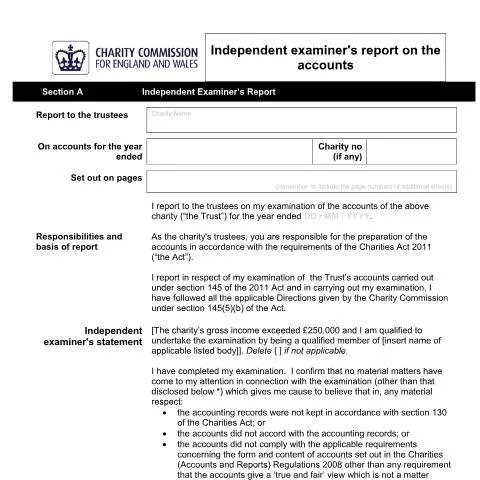
Section A of the template contains the substantive independent examiner's report, structured to address specific legal requirements while providing clear communication about the examination's scope and findings. The examiner must complete every relevant field, creating a comprehensive record of their professional opinion.
The opening section establishes fundamental parameters: charity name, financial year-end, charity registration number, and page references for the accounts under examination. These details might seem mundane, but they create essential legal linkages between the report and the specific financial statements being examined.
Responsibilities and Basis of Report
This section articulates the division of responsibilities between trustees and examiner. Trustees bear legal responsibility for preparing accounts that comply with the Charities Act 2011, while the examiner's role involves providing independent verification that these responsibilities have been properly discharged.
The reference to "all applicable Directions given by the Charity Commission under section 145(5)(b)" acknowledges the regulator's authority to issue detailed guidance about examination procedures. This includes CC32 guidance, which provides comprehensive direction about examination scope, methodology, and reporting requirements.
The Independent Examiner's Statement
The statement section represents the examination's core findings, structured around three specific areas of potential concern:
- Accounting records compliance with section 130 of the Charities Act
- Consistency between accounts and underlying records
- Regulatory compliance with Charities (Accounts and Reports) Regulations 2008
Notably, the template explicitly excludes consideration of whether accounts provide a "true and fair view"—a key distinction between independent examination and statutory audit. This limitation reflects the examination's more focused scope, concentrating on compliance and consistency rather than comprehensive financial assessment.
Section B Disclosures: When Concerns Must Be Highlighted
Section B serves as the template's safety valve, providing space for examiners to highlight material matters of concern that trustees and regulators need to understand. This section remains blank in straightforward examinations but becomes crucial when significant issues emerge.
The Charity Commission's CC32 guidance provides detailed direction about when disclosures become necessary. Common triggers include:
- Inadequate accounting records that prevent proper examination
- Transactions that appear to benefit trustees inappropriately
- Evidence of financial mismanagement or internal control failures
- Significant uncertainties about the charity's ability to continue operating
- Non-compliance with specific legal requirements affecting charitable status
When completing Section B, examiners must balance transparency with proportionality, ensuring that disclosed concerns genuinely warrant public attention without creating unnecessary alarm about minor administrative issues.
Submission Procedures and Regulatory Compliance Deadlines
The completed independent examiner's report forms part of the charity's annual return package, which must reach The Charity Commission within ten months of the financial year-end. This deadline applies regardless of the charity's specific year-end date, creating a firm regulatory framework that trustees ignore at their peril.
Late submission triggers automatic penalties, starting with formal warnings and potentially escalating to regulatory investigation if delays become habitual. The Commission maintains detailed records of submission patterns, using persistent non-compliance as evidence of trustee incompetence that might warrant more serious regulatory intervention.
Digital Submission via the Online Filing System
Most charities now submit their annual returns digitally through The Charity Commission's online portal, which accepts PDF uploads of signed independent examiner reports. The system performs automatic validation checks, flagging incomplete sections or formatting issues that could delay processing.
Digital submission offers several advantages: immediate confirmation of receipt, automatic deadline tracking, and integration with the charity's regulatory record. However, the examiner's signature must remain authentic—digital signatures are acceptable only if they meet recognised electronic signature standards.
Paper Submission Procedures
Smaller charities or those with limited digital capacity may still submit paper returns by post. The Charity Commission processes these submissions manually, potentially creating longer processing times and increased risk of postal delays affecting compliance deadlines.
Paper submissions require particular attention to legibility and completeness, as processing staff cannot easily request clarification of unclear entries. Trustees should retain photocopies of all submitted documents, creating audit trails that support potential appeals or regulatory queries.
Post-Submission Processing and Regulatory Follow-Up
Once The Charity Commission receives the independent examiner's report, it undergoes systematic review as part of the charity's annual return assessment. This process varies significantly depending on the charity's risk profile, regulatory history, and any concerns highlighted in Section B disclosures.
Low-risk charities with clean examination reports typically receive routine processing, with their accounts becoming publicly available through the Commission's online charity register within several weeks of submission. This public accessibility serves transparency objectives, allowing donors and beneficiaries to scrutinise financial stewardship.
Regulatory Queries and Follow-Up Actions
When examination reports raise concerns or appear incomplete, The Charity Commission's compliance team may initiate follow-up correspondence with trustees. This might involve requests for additional information, clarification of disclosed concerns, or explanation of apparent regulatory non-compliance.
Trustees should respond promptly and comprehensively to such queries, recognising that delayed or inadequate responses may escalate regulatory concern and potentially trigger more intrusive investigation. The Commission maintains detailed case management systems that track trustee responsiveness as an indicator of governance quality.
In cases where Section B disclosures reveal serious concerns about financial management or trustee conduct, the Commission may initiate formal regulatory case work. This could involve detailed investigation, trustee interviews, and potentially protective measures such as freezing bank accounts or appointing interim managers.
Distinguishing Independent Examination from Related Processes
Trustees often confuse independent examination with other forms of financial scrutiny, creating compliance risks and potentially inappropriate examiner appointments. Understanding these distinctions proves crucial for proper regulatory compliance and effective financial governance.
Independent examination differs fundamentally from statutory audit in scope, methodology, and professional requirements. Auditors must comply with International Standards on Auditing, conducting comprehensive risk assessment and detailed substantive testing. Independent examiners follow more limited procedures focused on compliance verification rather than comprehensive financial validation.
Similarly, independent examination should not be confused with management letter services that accountants might provide alongside examination work. While examiners may informally advise trustees about financial management improvements, their formal report must focus strictly on regulatory compliance rather than broader governance recommendations.
Internal Financial Reviews and Trustee Oversight
Some charities commission internal financial reviews or enhanced trustee oversight procedures alongside independent examination. While such practices demonstrate good governance, they cannot substitute for the regulatory requirement for independent examination by appropriately qualified external professionals.
The key distinction lies in independence and regulatory recognition. Internal reviews, however thorough, lack the arm's length perspective that independent examination provides. Similarly, trustee financial oversight, while essential for ongoing governance, cannot provide the external validation that builds public confidence and satisfies regulatory requirements.
Addressing Examination Challenges and Resolving Compliance Issues
When independent examinations reveal problems or trustees struggle to secure appropriate examiner services, several resolution pathways exist. The Charity Commission recognises that smaller charities particularly may face practical difficulties in meeting examination requirements, especially in rural areas where qualified professionals are scarce.
Trustees facing examiner recruitment difficulties should start their search early, ideally six months before their submission deadline. Professional bodies maintain member directories that can help identify suitable candidates, while charity networks often share examiner recommendations among similar organisations.
If examination reveals serious accounting deficiencies that prevent completion of the standard report, examiners must communicate clearly with trustees about remedial actions required. This might involve reconstructing incomplete records, implementing better bookkeeping systems, or seeking specialist accounting support to bring records into compliance.
When Section B disclosures become necessary, trustees should work closely with examiners to ensure that disclosed concerns are accurately described and that any mitigating circumstances receive appropriate explanation. The goal should be transparency and accuracy rather than minimising disclosed problems.
For charities struggling with examination costs, some examiner services operate pro bono schemes for smaller charities, while local accountancy firms may offer reduced rates for charitable work. However, trustees must ensure that any cost arrangements do not compromise examiner independence or create conflicts of interest that could undermine the examination's credibility.
The independent examiner's report template ultimately serves as more than an administrative requirement—it represents a crucial link in the chain of accountability that maintains public confidence in charitable work. Proper completion and submission of this template demonstrates trustees' commitment to transparent financial stewardship and regulatory compliance, supporting the broader charitable sector's reputation for integrity and effectiveness in pursuing public benefit.