The SORP 2005 Legacy: Understanding a Charity Reporting Framework in Transition
Despite the Charity Commission's move to more recent Statement of Recommended Practice (SORP) guidelines, the 2005 SORP framework continues to surface in charity administration, particularly for organisations completing retrospective filings or operating under specific transitional arrangements. The Trustees' Annual Report template based on SORP 2005 represents a structured approach to charity transparency that predates current reporting standards, yet remains relevant for understanding the evolution of charity governance requirements in England and Wales.
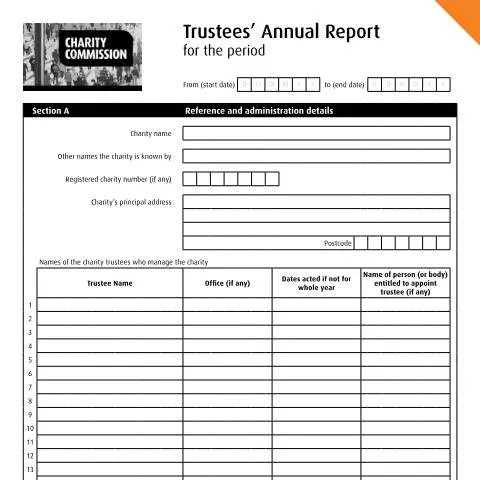
This template, bearing the reference code TAR and dated March 2012, reflects the Charity Commission's commitment to standardised reporting formats that enable trustees to demonstrate accountability while providing the public with meaningful insight into charitable activities. The document's four-section structure — covering administration details, governance arrangements, objectives and activities, and achievements — creates a comprehensive framework for annual disclosure.
Navigating the Administrative Foundation: Section A Complexities
Section A establishes the charity's administrative identity through multiple interconnected fields that require careful attention to detail. The charity name field must reflect the organisation's registered name precisely as recorded with the Charity Commission, while the other names section accommodates trading names, abbreviations, or historical designations that may appear on correspondence or promotional materials.
The registered charity number field, when applicable, serves as the primary identifier linking the organisation to its official Commission records. Charities registered before certain dates or operating under specific exemptions may lack this number, requiring trustees to indicate this status clearly rather than leaving the field blank.
Trustee Information Requirements
The trustee table extends to accommodate up to twenty individuals, reflecting the reality that many charities operate with substantial governing bodies. Each trustee entry requires:
- Full legal name as it appears on official identification
- Office designation such as Chair, Vice-Chair, Treasurer, or Secretary
- Service dates when trustees served partial years due to appointment or resignation
- Appointing authority for trustees selected by external bodies rather than internal election
The distinction between trustees who manage the charity and those who serve in advisory capacities becomes crucial here. Custodian trustees, for instance, may hold property on behalf of the charity without participating in day-to-day governance decisions, requiring separate documentation in the designated section.
Professional Advisory Networks
The advisers section, while optional, provides transparency regarding professional relationships that may influence charity operations. Independent examiners, solicitors, investment managers, and specialist consultants all merit inclusion when their involvement extends beyond routine service provision. This information helps stakeholders understand the charity's professional support structure and potential conflicts of interest.
Governance Architecture: Decoding Constitutional Frameworks
Section B delves into the charity's structural DNA, beginning with trust documentation that defines the organisation's legal foundation. The type of governing document field distinguishes between trust deeds, constitutional documents, memoranda and articles of association, or royal charters — each carrying different implications for governance procedures and regulatory oversight.
Constitutional structure significantly impacts operational flexibility and compliance requirements. Charitable companies limited by guarantee operate under Companies House oversight alongside Charity Commission regulation, while unincorporated associations and trusts face different reporting thresholds and liability frameworks.
Trustee Selection Mechanisms
The trustee selection methods section addresses a fundamental governance question: how does the charity ensure continuity while maintaining independence? Election processes, appointment procedures, and co-option arrangements each reflect different philosophical approaches to charity governance.
| Selection Method | Governance Implications | Transparency Considerations |
|---|---|---|
| Member election | Democratic accountability to membership base | Voting procedures and eligibility criteria |
| Trustee co-option | Board autonomy in recruitment | Skills-based selection processes |
| External appointment | Stakeholder representation | Appointing body relationships |
| Ex-officio positions | Institutional continuity | Role-based rather than personal selection |
Extended Governance Disclosures
The optional governance information section encourages trustees to elaborate on policies addressing trustee induction, training programmes, organisational structure, network relationships, related party dealings, and risk management frameworks. These elements, while not mandatory under SORP 2005, demonstrate sophisticated governance thinking that builds stakeholder confidence.
Risk management procedures deserve particular attention, as they reveal trustees' understanding of operational, financial, regulatory, and reputational challenges facing the charity. The Charity Commission increasingly expects trustees to demonstrate proactive risk identification and mitigation strategies, even when reporting under earlier SORP versions.
Charitable Purpose in Practice: Objectives and Activities Alignment
Section C transforms legal charitable objects into accessible public language, bridging the gap between constitutional formality and practical understanding. The summary of objects must reflect the charity's governing document accurately while avoiding legal jargon that obscures meaning for ordinary readers.
The activities summary requires trustees to demonstrate how their work delivers public benefit in accordance with their stated objects. This connection between purpose and practice forms the cornerstone of charity accountability, particularly given the Charity Commission's public benefit guidance that applies regardless of the SORP version in use.
Statutory Declaration Requirements
Trustees must include a statutory declaration confirming their regard for Charity Commission guidance on public benefit. This requirement, embedded within the activities section, acknowledges that charity law extends beyond constitutional compliance to encompass ongoing demonstration of charitable purpose.
The declaration encompasses consideration of:
- Benefit delivery to identifiable sections of the public
- Removal or mitigation of barriers to benefit access
- Balance between private benefit and public good
- Alignment between charitable objects and practical activities
Enhanced Activity Reporting
Optional additional details allow charities to expand on specific aspects of their work, including grantmaking policies, programme-related investments, and volunteer contributions. These elements provide context for stakeholders seeking to understand the charity's operational model and resource utilisation.
Grantmaking policies deserve particular attention for charities distributing funds to other organisations. Transparency regarding selection criteria, monitoring procedures, and impact assessment helps demonstrate responsible stewardship while supporting sector-wide learning about effective charitable intervention.
Impact Measurement Under SORP 2005: Achievement Documentation
Section D challenges trustees to articulate their charity's achievements during the reporting period, moving beyond activity descriptions to demonstrate tangible outcomes. The SORP 2005 framework predates many contemporary impact measurement methodologies, yet still requires trustees to evidence their charity's effectiveness.
Achievement summaries should balance quantitative data with qualitative insights, recognising that charitable impact often extends beyond easily measurable outputs. Educational charities might report examination pass rates alongside personal development outcomes, while community organisations could combine service user numbers with testimonials demonstrating life changes.
Performance Indicators and Limitations
The SORP 2005 era preceded widespread adoption of logic models, theory of change frameworks, and sophisticated outcome measurement systems now commonplace in charity reporting. Trustees using this template must therefore adapt contemporary impact thinking to fit earlier reporting expectations.
Effective achievement reporting under this framework typically includes:
- Contextual information explaining operating environment challenges
- Output data demonstrating activity levels and reach
- Outcome evidence showing changes in beneficiary circumstances
- Stakeholder feedback providing external validation of impact claims
- Learning insights acknowledging areas for improvement or adaptation
Submission Pathways and Regulatory Integration
The Trustees' Annual Report template forms part of a broader annual return process that varies depending on charity size, structure, and registration date. Charities with annual income exceeding £25,000 must submit annual returns to the Charity Commission, incorporating this narrative report alongside financial statements and, where applicable, independent examination or audit reports.
Submission timing aligns with the charity's financial year-end, with returns due within ten months of the accounting period closure. Late submission triggers regulatory correspondence and may result in the charity's removal from the register if non-compliance persists, emphasising the importance of timely completion.
Digital Transition Considerations
While the template's March 2012 date suggests paper-based completion, the Charity Commission has progressively digitised its processes. Charities may need to transfer information from this template format into online submission systems, requiring careful attention to field mapping and character limits that may not align with the original design.
The transition from SORP 2005 to subsequent versions affects charities differently depending on their size and complexity. Smaller charities may find limited practical difference in reporting requirements, while larger organisations face more substantial changes in accounting treatment and disclosure expectations.
Legacy Framework Implications for Contemporary Practice
Understanding SORP 2005 reporting requirements remains relevant for several contemporary scenarios. Charities conducting historical analysis, preparing for regulatory investigations, or managing transitional arrangements may need to reference this framework alongside current standards.
The template's structure also provides insight into charity reporting evolution, demonstrating how regulatory expectations have developed to emphasise impact measurement, risk management, and stakeholder engagement more explicitly than previous generations of guidance.
Comparative Analysis with Current Standards
Contemporary charity reporting under SORP (FRS 102) incorporates more sophisticated requirements for:
- Strategic reporting that connects activities to long-term objectives
- Risk disclosure that addresses operational, financial, and regulatory challenges
- Going concern assessment that evaluates organisational sustainability
- Related party disclosure that identifies potential conflicts of interest
- Reserves policy explanation that justifies financial resource retention
These enhanced requirements reflect broader trends in corporate governance and public accountability that have influenced charity regulation since the SORP 2005 era.
Professional Support and Compliance Assurance
Completing the Trustees' Annual Report template effectively often requires professional guidance, particularly for charities navigating complex governance arrangements or significant operational changes during the reporting period. Independent examiners, charity accountants, and governance consultants provide valuable expertise in translating trustee knowledge into compliant reporting language.
The template's design assumes familiarity with charity law and governance principles that may challenge volunteer trustees without extensive sector experience. Professional support becomes particularly valuable when addressing governance issues, related party transactions, or significant changes in charitable activities that require careful explanation.
Trustees should ensure their professional advisers understand both SORP 2005 requirements and any transitional arrangements affecting their specific charity. This dual expertise helps avoid compliance gaps while positioning the organisation for future reporting under current standards.
The Charity Commission's guidance notes, while updated since this template's publication, provide ongoing support for trustees seeking to understand their reporting obligations. Regular consultation of current guidance helps ensure that reports prepared using historical templates remain compliant with evolving regulatory expectations, maintaining the transparency and accountability that underpins public trust in charitable organisations.
Adapting Your SORP 2005 Template for Different Charity Sizes and Structures
The beauty of SORP 2005 lies in its scalability, allowing charities of vastly different sizes to comply with the same fundamental framework whilst tailoring their annual reports to their specific circumstances. Understanding how to adapt your template effectively can mean the difference between a perfunctory compliance exercise and a compelling narrative that truly serves your stakeholders.
Small Charities: Maximising Impact with Limited Resources
For charities with annual income below £500,000, the SORP 2005 template can feel overwhelming at first glance. However, the reporting requirements are deliberately proportionate. Your trustees' annual report need not be a weighty tome—indeed, conciseness often serves your readers better than verbose explanations.
Focus your structure and objectives section on clarity rather than complexity. A small local hospice, for instance, might describe its objects simply: "To provide palliative care and support to terminally ill patients and their families within a 15-mile radius of our facility." This straightforward approach immediately tells readers what you do and where you operate, without unnecessary legal jargon that might obscure your message.
When describing your activities, small charities can leverage their intimate knowledge of beneficiaries to provide compelling, specific examples. Rather than stating "We supported 150 families this year," explain how your support manifested: "We provided weekly home visits to 150 families, offering practical assistance with benefits applications, emotional support through trained volunteers, and emergency financial grants averaging £180 per family during crisis periods."
Your achievements section might focus on qualitative rather than quantitative measures. A small youth charity might highlight that "Three of our young people secured apprenticeships with local employers following our employability programme" rather than getting lost in statistical comparisons that favour larger organisations.
Medium-Sized Charities: Balancing Detail with Accessibility
Charities with income between £500,000 and £5 million face unique challenges in their annual reporting. You're large enough to have complex programmes and multiple funding streams, yet small enough that stakeholders expect personal, accessible communication rather than corporate-style documentation.
Your template should accommodate programme-specific reporting whilst maintaining overall coherence. Consider structuring your activities section by outcome areas rather than funding sources. A regional disability charity might organise content around "Independent Living Support," "Employment Services," and "Community Advocacy," even though each programme receives funding from multiple sources including local authorities, grant-making trusts, and individual donations.
Medium-sized charities often benefit from incorporating case studies that demonstrate the interconnectedness of their work. Your template might include a standardised case study format: beneficiary background, intervention provided, outcomes achieved, and broader lessons learned. Ensure your case studies comply with data protection requirements—anonymised details or composite examples often work better than identifiable individual stories.
Financial review sections for medium-sized charities require particular attention to reserves policy and going concern assessments. Your template should prompt trustees to explain not just what your reserves level is, but why it's appropriate for your particular risk profile and operating model. A charity heavily dependent on government contracts needs different reserves than one with diversified income streams.
Large Charities: Managing Complexity Without Losing Focus
For charities with income exceeding £5 million, your SORP 2005 template must accommodate substantial complexity whilst remaining genuinely useful to readers. Large charities often operate across multiple geographical areas, serve diverse beneficiary groups, and manage intricate governance structures that smaller organisations never encounter.
Your structure might benefit from a tiered approach: executive summary highlighting key achievements and challenges, followed by detailed programme reports, then technical sections addressing governance and financial management. This allows different stakeholder groups to engage at their preferred level of detail—major donors might read everything, whilst service users focus on programme outcomes.
Large multi-site charities face particular challenges in demonstrating impact coherently. Your template should standardise impact measurement across locations whilst allowing for local variation. A national homelessness charity might measure "move-on to sustainable accommodation" consistently, but recognise that achievement timescales vary between urban and rural areas due to housing market differences.
Subsidiary and partnership relationships require careful explanation in large charity reports. Your template should include standard sections explaining how you work with trading subsidiaries, joint ventures, and strategic partnerships, ensuring readers understand the complete picture of your charitable activities rather than just the parent charity's direct work.
Navigating Common Compliance Pitfalls in SORP 2005 Reporting
Even well-intentioned charities can stumble over seemingly minor aspects of SORP 2005 compliance, leading to qualified audit opinions or Charity Commission inquiries that could easily be avoided. Understanding these common pitfalls—and building safeguards into your template—protects your charity's reputation and ensures your annual report serves its intended purpose.
Public Benefit Reporting: Beyond Tick-Box Compliance
The public benefit requirement catches many charities off-guard, not because they don't provide public benefit, but because they fail to articulate it clearly within the SORP framework. Your template must prompt trustees to explain not just what you do, but how your activities demonstrably benefit the public or a sufficient section of the public.
A common error involves conflating charitable objects with public benefit demonstration. Your governing document might state that you "advance education," but your annual report must explain how your specific educational activities benefit the public. A charity providing expensive private tutoring exclusively to wealthy families would struggle to demonstrate public benefit, regardless of how educational their activities might be.
Your template should include prompts for trustees to address potential public benefit concerns proactively. If your charity charges fees, explain your fee remission policy and how many beneficiaries receive free or subsidised services. If you serve a geographically restricted area, demonstrate why this restriction serves the wider public interest rather than merely private convenience.
Religious charities face particular public benefit challenges under SORP 2005. Your template should prompt explanation of how worship and religious advancement activities benefit the wider community, not just congregation members. This might include community facility provision, interfaith dialogue, or charitable activities flowing from religious motivation.
Related Party Transactions: Transparency Without Paranoia
SORP 2005 requires disclosure of material transactions with related parties—trustees, key management personnel, and their connected persons. Many charities either over-disclose trivial matters or under-disclose significant relationships, both approaches undermining stakeholder confidence.
Your template should establish clear thresholds for related party disclosure. Transactions below certain materiality levels—perhaps £1,000 for smaller charities or £10,000 for larger ones—might not warrant individual mention, though you should still maintain internal records for audit purposes.
More importantly, your template should prompt explanation of the decision-making process around related party transactions. Simply stating "Trustee X's company provided £15,000 of printing services" leaves readers wondering whether this represented value for money or potential conflicts of interest. Better disclosure might read: "Following competitive tender process involving three suppliers, printing services were provided by ABC Print Ltd (a company in which Trustee Sarah Johnson holds a minority shareholding) at a cost of £15,000. Trustee Johnson took no part in the procurement decision and the successful tender represented the lowest compliant bid."
Grants and Donations: Demonstrating Due Diligence
Grant-making charities often struggle with SORP 2005 requirements around institutional grant policies and individual grant monitoring. Your template must demonstrate that trustees exercise proper oversight over charitable funds, whether distributed to other organisations or individuals.
For institutional grants, your template should prompt description of your grant-making policy, application assessment procedures, and monitoring arrangements. Vague statements like "We support organisations aligned with our charitable objects" don't satisfy SORP requirements. Instead, explain your eligibility criteria, assessment process, and how you monitor grant recipients' use of funds.
Individual grants present different challenges, particularly around privacy and dignity considerations. Your template might include anonymised case examples demonstrating your assessment criteria and outcomes achieved, whilst protecting beneficiary identities. A hardship fund might explain: "We provided emergency grants averaging £240 to 89 individuals facing temporary financial crisis, with 78% reporting that our intervention prevented homelessness or utility disconnection."
Overseas grant-making requires additional disclosure under SORP 2005, reflecting both regulatory requirements and public interest in international charitable activities. Your template should prompt explanation of how you satisfy yourself that overseas partners use funds appropriately, particularly in countries where regulatory oversight might be limited.
Maximising Stakeholder Engagement Through Strategic Template Design
An effective SORP 2005 template serves multiple masters: satisfying regulatory requirements, informing diverse stakeholder groups, and advancing your charity's mission through compelling storytelling. The most successful annual reports achieve this balance through thoughtful template design that recognises different stakeholder needs and reading preferences.
Donor Stewardship Through Transparent Impact Reporting
Major donors increasingly expect sophisticated impact reporting that goes beyond simple output measures to demonstrate genuine outcome achievement. Your SORP 2005 template should accommodate this expectation whilst maintaining accessibility for smaller supporters who might be overwhelmed by excessive detail.
Consider incorporating a standardised impact measurement framework throughout your template. Logic models work particularly well, showing inputs (funding and resources), activities (what you do), outputs (immediate results), outcomes (medium-term changes), and impacts (long-term effects). A homelessness charity might report: inputs (£2.3 million funding, 47 staff), activities (street outreach, temporary accommodation, resettlement support), outputs (1,240 people contacted, 340 accommodated, 180 resettled), outcomes (78% maintained accommodation after six months), impacts (reduced rough sleeping in target area by 23%).
Your template should also accommodate different types of evidence that donors value. Quantitative data provides credibility, but qualitative feedback demonstrates human impact. Service user testimonials, staff observations, and partner organisation feedback all contribute to a compelling impact narrative when properly integrated into your reporting framework.
Financial transparency builds donor confidence, but raw figures often confuse rather than inform. Your template should translate financial information into donor-friendly formats. Instead of stating "Programme costs £847,000," explain "Your donations funded 12 months of intensive support for 89 homeless individuals, at an average cost of £9,517 per person—less than many local authorities spend on temporary accommodation for just three months."
Beneficiary Voice: Ensuring Authentic Representation
SORP 2005 doesn't explicitly require beneficiary involvement in annual reporting, but best practice increasingly recognises service users as legitimate stakeholders whose perspectives enhance report credibility and usefulness. Your template design should facilitate authentic beneficiary voice without tokenism or exploitation.
Consider establishing a beneficiary advisory group that reviews draft annual reports before publication. Their feedback often identifies jargon, assumptions, or omissions that charity staff overlook. A mental health charity discovered that their clinical language around "treatment compliance" was perceived as patronising by service users, who preferred "collaborative care planning."
Your template might include dedicated sections written by or with beneficiaries. This could range from simple quotes within programme descriptions to substantial sections authored by service user representatives. Ensure any beneficiary contributions are genuinely voluntary and that contributors understand how their words will be used.
Visual representation matters enormously in beneficiary engagement. Stock photography of anonymous individuals often alienates the very people your charity serves, whilst photography of actual beneficiaries raises consent and dignity issues. Consider alternatives like beneficiary-created artwork, infographics designed with service user input, or photography that focuses on environments and activities rather than identifiable individuals.
Professional Stakeholder Communication: Funders, Regulators, and Partners
Statutory funders, grant-making trusts, and regulatory bodies approach your annual report with specific information needs that your template should anticipate and address systematically. These professional stakeholders often have limited time but require substantial detail, creating a tension that skilled template design can resolve.
Local authority commissioners typically focus on contract compliance, value for money, and service quality indicators. Your template should present this information clearly, ideally in standardised formats that facilitate comparison across reporting periods. Table formats work well for performance indicators, showing targets, achievements, and variance explanations in easily digestible formats.
Grant-making trusts often seek evidence that their funding achieved intended outcomes and that your charity learned from both successes and failures. Your template should include reflective sections where trustees honestly assess what worked well, what proved challenging, and how you've adapted your approach accordingly. This demonstrates the learning culture that sophisticated funders increasingly expect.
Regulatory stakeholders, including the Charity Commission, focus particularly on governance arrangements, risk management, and compliance with charitable purposes. Your template should present this information systematically, using clear headings and cross-references that help busy regulators locate relevant information quickly. Consider including a compliance checklist that maps your report content against specific regulatory requirements.
Partnership organisations—other charities, public sector bodies, and private sector collaborators—use annual reports to assess your suitability for joint working and strategic alliances. Your template should highlight your collaborative capabilities, partnership successes, and strategic priorities that might align with potential partners' interests. This positions your annual report as a business development tool rather than merely a compliance document.