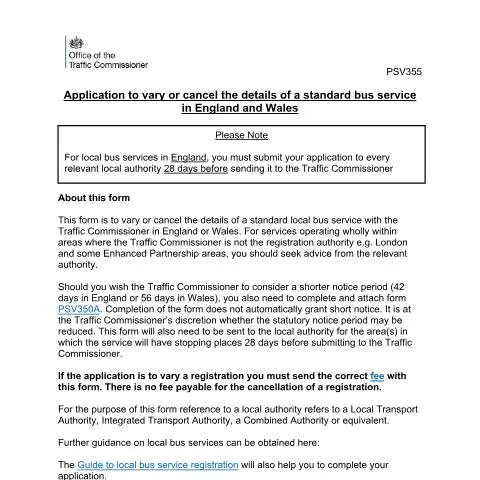
Who Must Navigate the Complex World of Local Bus Service Modifications
When a bus operator in England or Wales needs to alter their service patterns, adjust timetables, or discontinue routes entirely, form PSV355 becomes their essential gateway through the regulatory maze. This document serves operators holding PSV operator's licences or community bus permits who must formally notify Traffic Commissioners of any changes to their registered local bus services.
The scope extends beyond simple route operators to encompass various business models. Standard commercial operators running urban and rural services fall under this requirement, as do community transport organisations operating under Section 19 or Section 22 permits. However, the regulatory landscape becomes more intricate when considering geographical boundaries and local authority arrangements.
Operators must carefully assess whether their services fall within Traffic Commissioner jurisdiction. Services operating wholly within London or certain Enhanced Partnership areas require different notification procedures to local transport authorities rather than Traffic Commissioners. This geographical complexity means operators serving multiple areas may need to navigate different regulatory frameworks simultaneously.
The timing requirements create additional layers of complexity. In England, operators must provide local authorities with 28 days' advance notice before submitting to Traffic Commissioners, who then require a further 42 days' notice. Welsh services need only notify Traffic Commissioners with 56 days' notice, creating different operational timelines across the border.
Understanding the Dual Nature of Variations and Cancellations
Form PSV355 serves two distinct purposes within the same document framework, creating different procedural pathways depending on the operator's intentions. Variation applications require comprehensive documentation and fee payment, while cancellation requests follow a streamlined process without financial obligations.
Variation applications encompass seven specific categories of change, each triggering different documentation requirements. Route modifications demand detailed route description sheets and accompanying maps, ensuring Traffic Commissioners can assess the operational and safety implications. Similarly, changes to bus stops or stopping places require geographical precision through mapping and location descriptions.
More subtle modifications like stopping arrangements or reversing manoeuvres still require detailed explanations, as these operational changes can significantly impact passenger safety and traffic flow. Timetable variations, perhaps the most common modification type, must include comprehensive scheduling details rather than simple frequency adjustments.
| Modification Type | Required Documentation | Fee Required |
|---|---|---|
| Route changes | Route description sheet + map | Yes |
| Bus stop modifications | Route description sheet + map | Yes |
| Timetable adjustments | Detailed timetable | Yes |
| Service cancellation | Basic notification | No |
Cancellation applications bypass the complexity of variation procedures but still require precise timing coordination. Operators must consider passenger impact, alternative service provision, and local authority consultation requirements even when discontinuing services.
The Critical Timeline: From Local Authority Consultation to Implementation
The regulatory timeline for service modifications creates a carefully orchestrated sequence of notifications and approvals, designed to ensure adequate consultation and operational preparation. This process begins well before Traffic Commissioner involvement, particularly for English operators who must navigate the dual-notification system.
English operators initiate the process by submitting complete applications to every relevant local authority 28 days before approaching Traffic Commissioners. This preliminary consultation allows local transport authorities to assess implications for their transport strategies, passenger needs, and potential service gaps. The term "relevant local authority" encompasses Local Transport Authorities, Integrated Transport Authorities, Combined Authorities, and equivalent bodies, requiring operators to identify all jurisdictions their services touch.
Following local authority notification, operators must wait the full 28-day period before submitting to Traffic Commissioners, who then impose their own 42-day consideration period. This creates a minimum 70-day timeline from initial local authority submission to service implementation in England. Welsh operators benefit from a more streamlined 56-day process directly to Traffic Commissioners.
However, operators facing urgent operational needs can request shortened notice periods using form PSV350A. This additional form doesn't guarantee approval but allows Traffic Commissioners discretionary powers to reduce statutory notice periods. The decision criteria typically include operational necessity, passenger impact, and consultation adequacy, with approval never automatic.
The implementation date becomes legally binding once approved, creating contractual obligations for service delivery. Operators cannot specify vague timing like "ASAP" or dates preceding application submission, ensuring regulatory certainty for passengers and local authorities alike.
Precision Requirements for Route Descriptions and Geographic Details
The geographic precision demanded by PSV355 reflects the operational reality of public transport regulation, where minor location variations can significantly impact passenger accessibility and safety assessments. Traffic Commissioners require exact location identification using multiple reference points to eliminate ambiguity in service registration.
Start and end point specifications must include comprehensive location details: street names, bus stations, railway stations, schools, or other identifying landmarks, combined with village, town, or city names. Where available, NaPTAN codes (National Public Transport Access Nodes) provide standardised location references that integrate with national transport databases.
Services with multiple start or end points require separate documentation detailing each variation, creating comprehensive route matrices for complex services. This documentation burden reflects the regulatory need to understand complete service patterns rather than simplified route descriptions.
Route description sheets must accompany geographic modifications, providing turn-by-turn navigation details that Traffic Commissioners use for safety assessments and traffic impact evaluation. These descriptions serve multiple regulatory purposes: enabling Traffic Commissioner site visits, supporting local authority planning, and creating legal service definitions for enforcement purposes.
Mapping requirements extend beyond simple route illustration to include stopping place locations, reversing points, and potential traffic conflict areas. The quality and accuracy of submitted maps directly impact processing timelines, as incomplete or unclear documentation triggers regulatory queries and delays.
Documentation Assembly and Supporting Evidence Requirements
The documentary foundation of successful PSV355 applications extends far beyond the basic form completion, requiring operators to compile comprehensive evidence packages that demonstrate operational competence and regulatory compliance. Supporting documentation varies significantly depending on modification type and operational complexity.
Timetable modifications demand detailed scheduling information that goes beyond simple departure times. Traffic Commissioners expect comprehensive timetables showing journey times, frequency patterns, peak and off-peak variations, and connection opportunities with other services. This granular detail enables assessment of operational feasibility and passenger service quality.
When Traffic Regulation Orders influence service changes, operators must provide complete TRO documentation including implementation dates, affected road sections, and operational constraints. This information allows Traffic Commissioners to understand external factors driving service modifications and assess whether proposed changes adequately address regulatory requirements.
For route modifications involving new infrastructure or stopping places, operators may need to provide evidence of local authority consultation outcomes, passenger demand assessments, or accessibility compliance documentation. These requirements reflect the interconnected nature of public transport planning and regulation.
Community bus operators face additional documentation requirements related to their permit conditions, volunteer driver arrangements, and community benefit demonstrations. These operators must show continued compliance with their original permit criteria despite service modifications.
Electronic vs Postal Submission Considerations
The submission method choice between electronic and postal delivery creates different procedural requirements and processing timelines. Electronic submissions to [email protected] offer faster transmission but require careful attention to attachment formatting and size limitations.
Email submissions benefit from immediate delivery confirmation and reduced postal delays, particularly important given strict statutory notice periods. However, operators must ensure all supporting documentation converts properly to electronic format, with maps and route descriptions remaining legible and professionally presented.
Payment details require separate attachment for electronic submissions, reflecting data protection requirements and financial security protocols. This separation prevents inadvertent disclosure of sensitive financial information while maintaining audit trails for fee processing.
Postal submissions to the Leeds office provide traditional documentary security but introduce potential delays from postal service timing. Operators choosing postal submission must account for delivery times within their statutory notice calculations, particularly during holiday periods or industrial action affecting postal services.
Fee Structures and Financial Obligations in Service Modifications
The financial framework surrounding PSV355 applications creates clear distinctions between different types of service changes, reflecting administrative costs and regulatory complexity. Variation applications require fee payment, while cancellation requests proceed without charge, acknowledging the different administrative burdens involved.
Fee calculations depend on modification complexity rather than simple flat rates, though specific amounts aren't detailed within the form itself. Operators must contact Traffic Commissioners directly for current fee schedules, as these charges may vary based on service scope, geographic coverage, and administrative complexity.
Payment timing becomes critical for processing schedules, as incomplete fee submission can delay application processing beyond statutory notice periods. This creates potential operational disruption if operators fail to submit correct payments with their initial applications.
For operators managing multiple service modifications simultaneously, fee obligations multiply accordingly. Each separate route registration requires individual variation applications and associated fees, creating significant financial considerations for operators restructuring extensive service networks.
Community bus operators benefit from the same fee structure as commercial operators, with no special concessions despite their non-profit status. This reflects the equal administrative burden their applications create regardless of operational model.
Regulatory Consequences and Compliance Enforcement
The enforcement framework surrounding PSV355 creates serious legal obligations for operators, with false information provision or form modification constituting criminal offences carrying prosecution risks and operational sanctions. Traffic Commissioners possess extensive powers to investigate compliance failures and impose penalties ranging from formal warnings to vehicle impoundment.
Vehicle impoundment represents the most severe immediate sanction, potentially removing entire fleet assets from service pending investigation outcomes. This enforcement tool particularly impacts smaller operators who may lack backup vehicle capacity to maintain services during impoundment periods.
Prosecution procedures follow standard criminal law frameworks, with operators facing magistrates' court proceedings and potential fines, director disqualification, or operational licence curtailment. These consequences extend beyond immediate financial penalties to create lasting reputational damage affecting future licence applications and commercial relationships.
The regulatory emphasis on information accuracy reflects public safety considerations inherent in passenger transport services. Traffic Commissioners must rely on operator-provided information for safety assessments, route approvals, and operational oversight, making information integrity fundamental to the entire regulatory system.
Compliance monitoring continues throughout service operation, with Traffic Commissioners conducting spot checks, investigating passenger complaints, and reviewing operational performance against registered parameters. Operators who fail to operate services as registered face additional enforcement action even after successful application approval.
Strategic Considerations for Multi-Area and Cross-Border Operations
Operators managing services across multiple local authority boundaries or spanning the England-Wales border face compound regulatory complexity requiring careful strategic planning and documentation coordination. Cross-border services must satisfy different statutory notice periods and consultation requirements simultaneously.
English portions of cross-border services require the full local authority consultation process, while Welsh sections follow direct Traffic Commissioner notification. This creates timing challenges where operators must coordinate different regulatory timelines to achieve unified implementation dates across their entire service network.
Enhanced Partnership areas add another layer of complexity, as these zones may have transferred regulatory authority from Traffic Commissioners to local transport authorities. Operators must identify current regulatory arrangements for each area their services traverse, as incorrect submissions to wrong authorities create delays and potential compliance issues.
London's unique regulatory environment completely excludes Traffic Commissioner jurisdiction, requiring separate notification procedures to Transport for London or relevant London boroughs. Services extending into London must split their regulatory approach accordingly, managing different approval processes for different route sections.
The interconnected nature of modern bus networks means single route modifications can trigger cascading effects across multiple registrations. Operators must assess whether changes to one service require corresponding modifications to connecting services, feeder routes, or integrated timetables, potentially multiplying their regulatory obligations.