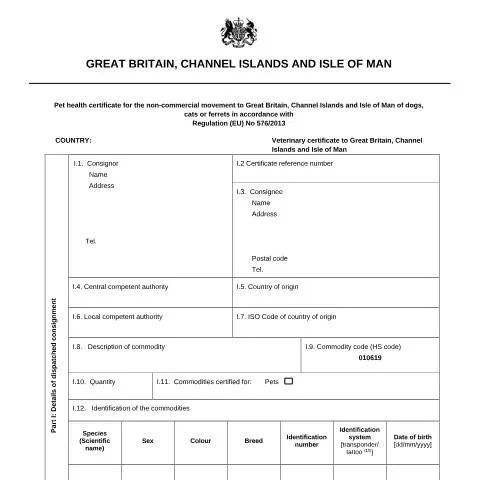
The Essential Gateway for Pet Travel: Understanding Great Britain's Health Certification Requirements
When planning to travel with your beloved companion animal to Great Britain, the Channel Islands, or the Isle of Man, the Pet health certificate for non-commercial movement issued under Regulation (EU) No 576/2013 becomes your pet's passport to entry. This comprehensive veterinary document represents far more than a simple administrative formality—it serves as the cornerstone of the UK's biosecurity framework, designed to prevent the introduction of rabies and other serious animal diseases whilst facilitating legitimate pet travel.
The Animal and Plant Health Agency (APHA) oversees this critical certification process, ensuring that every dog, cat, or ferret entering British territories meets stringent health standards. Unlike commercial animal movements, this certificate specifically addresses the non-commercial movement of companion animals, recognising the unique circumstances surrounding pet travel with their owners or authorised representatives.
The certification process involves multiple layers of veterinary verification, from rabies vaccination records to parasite treatments, each serving a specific purpose in maintaining the UK's exceptionally high animal health standards. Understanding the intricacies of this certificate proves essential for anyone planning to relocate, travel for extended periods, or participate in international competitions with their pets.
Who Qualifies for This Certification and Under What Circumstances
The Great Britain pet health certificate applies to a carefully defined category of animal movements. Non-commercial movement specifically means that your pet accompanies you or an authorised representative within five days of your own travel, with no intention of sale or ownership transfer during the journey.
The certificate covers three species exclusively: dogs (Canis lupus familiaris), cats (Felis catus), and ferrets (Mustela putorius furo). Each animal must be individually identified through an ISO 11784/11785 compliant microchip or, for animals microchipped before 3 July 2011, a clearly legible tattoo applied before that date.
Standard Travel Scenarios
Most pet owners qualify under the basic provision allowing movement of five animals or fewer. This covers typical family situations, holiday travel, or relocation with multiple pets. The animals need not belong to a single owner, provided each meets the non-commercial criteria.
Competition and Exhibition Exemptions
Groups exceeding five animals qualify under specific circumstances relating to competitions, exhibitions, or sporting events. These animals must be:
- More than six months old at the time of travel
- Registered to participate in the specific event, or registered with an organisation that conducts such events
- Accompanied by documentary evidence of registration or participation
- Travelling for training purposes directly related to the competition
This provision recognises the legitimate needs of dog show participants, agility competitors, and breed enthusiasts who regularly travel internationally with larger groups of animals.
Authorised Representative Travel
The certificate accommodates situations where pets travel without their owner through three distinct arrangements:
| Travel Arrangement | Requirements | Documentation Needed |
|---|---|---|
| Owner accompanies pets | Owner travels within 5 days | Owner declaration only |
| Authorised representative | Written authorisation from owner | Signed authorisation letter |
| Commercial carrier representative | Contracted by owner for transport | Transport contract and designation |
The Rabies Protection Framework: Vaccination and Antibody Testing
The certificate's most critical component addresses rabies prevention through a sophisticated two-tier system that varies according to the country of origin. This framework reflects the UK's commitment to maintaining its rabies-free status while acknowledging differing risk levels across global regions.
Primary Vaccination Requirements
Every animal must receive rabies vaccination when at least 12 weeks old, with a mandatory 21-day waiting period before travel eligibility begins. This waiting period allows sufficient time for protective antibodies to develop following primary vaccination.
The vaccination must comply with Annex III of Regulation (EU) No 576/2013, using vaccines approved by the country of origin's veterinary authority. Subsequent revaccinations must occur within the validity period of the preceding vaccination to maintain continuous protection—typically annually, though some vaccines provide longer coverage periods.
Country-Specific Pathways
The certificate establishes two distinct pathways based on the country classification system outlined in Implementing Regulation (EU) No 577/2013:
Listed Countries (Annex II)
Animals from countries listed in Annex II—generally those with effective rabies control programmes—require only current vaccination records. These include most EU member states, certain Commonwealth countries, and selected other territories with demonstrated rabies control effectiveness.
Non-Listed Countries
Animals from countries not appearing in Annex II must undergo additional antibody titre testing. This involves:
- Blood sampling by an authorised veterinarian at least 30 days after primary vaccination
- Laboratory testing demonstrating antibody levels of 0.5 IU/ml or greater
- A three-month waiting period from the sampling date before travel eligibility
- Testing at an EU-approved laboratory or equivalent facility recognised by the destination country
This additional requirement recognises higher rabies risk in certain regions whilst providing a scientific pathway for safe animal movement.
Parasite Treatment Protocols and Regional Variations
Beyond rabies prevention, the certificate addresses specific parasitic threats through targeted treatment requirements that vary by destination within the British Isles. These protocols reflect localised risk assessments and the particular vulnerability of island ecosystems.
Echinococcus multilocularis Treatment for Great Britain
Dogs destined for Great Britain specifically require treatment against Echinococcus multilocularis, the causative agent of alveolar echinococcosis. This tapeworm poses significant public health risks and could establish itself in British fox populations if introduced.
Treatment must be administered by a veterinarian using an approved anthelmintic effective against E. multilocularis. The timing proves critical—treatment must occur not less than 24 hours and not more than 120 hours (five days) before entry into Great Britain.
Acceptable treatments typically include praziquantel-based products, though specific formulations and dosages must comply with the treating country's veterinary medicine regulations. The treating veterinarian records the exact product name, manufacturer, batch number, and treatment date on the certificate.
Channel Islands and Isle of Man Variations
Interestingly, the Echinococcus treatment requirement applies specifically to Great Britain, with the Channel Islands and Isle of Man potentially maintaining different protocols. This reflects their distinct administrative status and specific risk assessments conducted by their respective veterinary authorities.
The Certification Process: From Application to Approved Document
Obtaining the Great Britain pet health certificate requires careful coordination between pet owners, authorised veterinarians, and competent authorities in the country of origin. The process typically spans several weeks to months, depending on the animal's vaccination history and country-specific requirements.
Initial Veterinary Assessment
The process begins with consultation with a veterinarian authorised by the competent authority in your country of origin. Not every veterinary practitioner can issue these certificates—authorisation typically requires specific training in export health certification and ongoing oversight by the national veterinary authority.
During the initial assessment, the veterinarian reviews your pet's medical history, confirms identification (microchip or tattoo), and develops a timeline for any required vaccinations or treatments. This proves particularly important for animals requiring antibody titre testing, as the three-month waiting period significantly impacts travel planning.
Documentation Assembly
The certificate requires supporting documentation beyond veterinary records:
- Owner declaration confirming the non-commercial nature of travel and responsibility arrangements
- Evidence of travel plans demonstrating the five-day accompaniment requirement
- Competition registration (if applicable for groups exceeding five animals)
- Identification records linking microchip numbers to individual animals
- Laboratory results for antibody titre testing where required
Official Certification and Endorsement
Once the veterinarian completes the certificate, it typically requires endorsement by the competent authority—the government department responsible for animal health in your country. This might be a ministry of agriculture, department of primary industries, or equivalent agency.
Endorsement timelines vary significantly between countries, ranging from same-day service in well-equipped facilities to several weeks in locations with limited administrative capacity. Planning ahead proves essential, particularly during peak travel seasons when processing delays commonly occur.
Validity Periods and Certificate Lifecycle Management
Understanding the various validity periods associated with the pet health certificate prevents costly travel disruptions and ensures continuous compliance with entry requirements. The certificate incorporates multiple overlapping timeframes, each serving specific regulatory purposes.
Overall Certificate Validity
The completed certificate remains valid for four months from the date of issue or until the rabies vaccination expires, whichever occurs first. This period recognises that pets may not travel immediately after certification whilst ensuring that health attestations remain current.
Importantly, the four-month period begins from the date the authorised veterinarian signs the certificate, not from any endorsement date or intended travel date. This distinction proves crucial when planning extended trips or managing multiple travel segments.
Component Validity Periods
Different elements within the certificate maintain distinct validity periods:
| Component | Validity Period | Renewal Requirements |
|---|---|---|
| Rabies vaccination | As per manufacturer recommendations (typically 1-3 years) | Revaccination within validity period |
| Antibody titre test | Lifetime (if vaccination maintained) | None, provided continuous vaccination |
| Parasite treatment | 24-120 hours before travel | New treatment for each journey |
| Microchip identification | Lifetime | None (unless chip fails) |
Managing Certificate Renewal
Pets requiring regular travel benefit from strategic certificate management. The antibody titre test, once completed successfully, remains valid for the animal's lifetime provided rabies vaccination continues without gaps. This eliminates the need for repeated titre testing on subsequent journeys from non-listed countries.
However, each journey requires a fresh certificate, as the parasite treatment component demands timing specific to each travel instance. Forward-thinking pet owners often coordinate vaccination schedules to maximise certificate validity periods whilst minimising veterinary visits.
When Things Go Wrong: Lost Certificates, Errors, and Entry Refusal
Despite careful planning, certificate-related problems occasionally arise during travel. Understanding common issues and their resolution pathways helps minimise stress and potential delays at borders.
Lost or Damaged Certificates
Certificates lost or damaged during travel cannot be replaced at the destination. The original issuing veterinarian must provide a duplicate, which may prove challenging if you're already abroad. Some practical approaches include:
- Carrying certified photocopies as backup (though these won't be accepted for entry)
- Photographing all certificate pages and storing them securely online
- Maintaining contact details for the issuing veterinarian and competent authority
- Understanding the process for emergency veterinary certification in your departure country
Certificate Errors and Amendments
Errors in pet health certificates often prove more serious than simple administrative mistakes. Common problems include:
Identification discrepancies where microchip numbers don't match scanning results frequently cause entry refusal. These typically result from transcription errors or chip migration, requiring veterinary verification and potential certificate reissuance.
Date inconsistencies particularly affect vaccination timelines and parasite treatment windows. Border control officers scrutinise these carefully, as incorrect dates may indicate non-compliance with waiting periods or treatment protocols.
Missing signatures or endorsements render certificates invalid regardless of their technical accuracy. Both the authorised veterinarian and competent authority must provide required signatures and official stamps.
Border Control Challenges
Entry refusal typically occurs when border control officers identify discrepancies or non-compliance with certificate requirements. Understanding your rights and options proves valuable:
Animals refused entry may face quarantine at approved facilities whilst issues are resolved. Quarantine costs fall to the pet owner and can prove substantial, particularly for extended periods. Some borders offer temporary holding facilities for minor documentary issues that can be resolved quickly.
In extreme cases, refused animals may be returned to their country of origin at the owner's expense. This typically applies when fundamental requirements—such as rabies vaccination waiting periods—haven't been met and cannot be resolved through quarantine.
Strategic Planning for Seamless Pet Travel
Successful pet travel to Great Britain requires understanding the certificate process within broader travel planning context. Experienced pet travellers develop systematic approaches that account for multiple variables and potential complications.
Timeline Development
Comprehensive timeline planning begins with identifying your pet's current health status and required procedures. Animals with current rabies vaccination from listed countries may need only 4-6 weeks for certificate processing, whilst those requiring titre testing from non-listed countries typically need 4-6 months minimum.
Consider building buffer time into your schedule, particularly around holiday periods when veterinary services and government offices may operate reduced hours. Professional pet transport services often recommend starting the process 6-12 months before intended travel, regardless of apparent requirements.
Cost Management Strategies
Pet health certification involves multiple cost components that vary significantly by location and service provider. Typical expenses include:
- Veterinary consultation and examination fees
- Rabies vaccination (if required)
- Blood sampling and laboratory titre testing
- Parasite treatment products and administration
- Certificate preparation and veterinary time
- Government endorsement fees
- Potential expedited processing charges
Some countries maintain fixed fee schedules for government services, whilst others allow veterinarians discretionary pricing for professional services. Obtaining quotes from multiple authorised veterinarians helps identify competitive options, though the lowest price doesn't always represent the best value when considering experience and reliability.
Multiple Pet Considerations
Travelling with multiple pets introduces additional complexity beyond simple multiplication of individual requirements. Each animal needs separate identification, vaccination records, and certificate sections, but certain efficiencies emerge:
Blood sampling for titre testing can often be coordinated on the same day, reducing veterinary visit frequency. Parasite treatments typically use the same products, allowing bulk purchasing advantages. Certificate preparation becomes more efficient when handling multiple animals simultaneously.
However, managing multiple pets also increases risk—if one animal's documentation proves inadequate, it may affect the entire group's travel plans. Some experienced travellers stagger their pets' preparation timelines to avoid simultaneous problems.
The Great Britain pet health certificate represents a sophisticated balance between facilitating legitimate pet travel and protecting the UK's exceptional animal health status. Success requires understanding both the detailed technical requirements and the broader strategic considerations that ensure smooth implementation. Whether relocating permanently, travelling for extended periods, or participating in international competitions, proper certificate management opens the door to stress-free pet travel whilst contributing to the continued protection of British animal populations.