When Waterways Meet Red Tape: Understanding Part F3 of Flood Risk Activities Applications
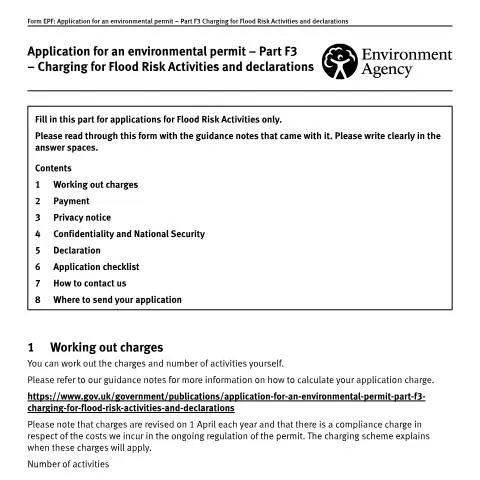
Behind every riverside development, flood defence installation, or waterway modification in England lies a complex web of environmental permitting requirements. The Application for a flood risk activities environmental permit (charges and declarations): part F3 represents the final, crucial stage of this process – where calculations turn into commitments and paperwork transforms into legally binding obligations.
Unlike the technical assessments and detailed project descriptions found in earlier parts of the environmental permit application, Part F3 cuts to the financial and legal heart of the matter. This Environment Agency form serves as both calculator and contract, requiring applicants to demonstrate not only their understanding of applicable charges but their commitment to regulatory compliance through formal declarations.
The stakes are considerable. Flood risk activities can fundamentally alter how water moves through our landscape, affecting everything from agricultural drainage to urban flood defences. A single miscalculation in Part F3 can delay projects worth millions, whilst errors in the declaration sections may trigger enforcement action or permit refusal. For developers, consultants, and landowners operating near England's 40,000 kilometres of main rivers, mastering this form is essential.
Decoding the Charging Framework: More Than Simple Arithmetic
The charging structure for flood risk activities reflects the Environment Agency's risk-based approach to regulation. Rather than applying blanket fees, the system recognises that a small agricultural culvert poses fundamentally different risks to a major flood storage area or tidal barrier.
Part F3 requires applicants to calculate their own charges, a responsibility that initially appears straightforward but conceals significant complexity. The form references guidance notes that detail how different activities attract different fee levels, but these calculations often require specialist knowledge to interpret correctly.
| Activity Type | Complexity Level | Typical Considerations |
|---|---|---|
| Temporary works | Low to Medium | Duration, flood zone location, seasonal restrictions |
| Permanent structures | Medium to High | Hydraulic impact, flood storage compensation, maintenance access |
| Channel modifications | High | Morphological effects, habitat impacts, downstream consequences |
The annual revision of charges on 1 April adds another layer of timing consideration. Applications submitted late in the financial year may face different fee structures by the time they reach determination, though the Environment Agency typically honours the rates applicable when applications are received.
Compliance charges represent an often-overlooked aspect of the charging regime. These ongoing fees reflect the Environment Agency's regulatory oversight costs throughout the permit's lifetime, covering everything from routine inspections to incident response. Part F3 requires acknowledgment of these future obligations, not just the upfront application costs.
Professional Guidance Versus Self-Assessment
The form explicitly advises contacting local Environment Agency teams or General Enquiries (03708 506 506) when uncertain about charge calculations. This seemingly helpful suggestion reflects a deeper truth: many applications require specialist input to avoid costly errors.
Environmental consultants frequently encounter scenarios where multiple activities within a single project attract separate charges, or where phased developments require careful sequencing to optimise fee structures. The apparent simplicity of the charging boxes in Part F3 belies these underlying complexities.
Payment Pathways: Three Routes, Different Implications
Part F3 offers three payment methods, each with distinct procedural requirements and timing implications that can significantly affect application processing speeds.
Credit or debit card payments provide the fastest route to application acknowledgment. The Environment Agency's willingness to accept telephone payments using Visa, MasterCard, or Maestro cards reflects recognition that many applicants prefer immediate transaction completion. However, this method requires the named cardholder or written authorisation, adding complexity for corporate applications where finance departments handle payments.
The form's emphasis on destroying card details after processing addresses data protection concerns, though applicants should note that payment confirmation may take several working days to appear in application tracking systems.
Electronic Transfers: Precision Required
BACS transfers suit larger applications or organisations with established payment procedures, but demand careful attention to reference formatting. The requirement for "FRAP/Permit reference" format (such as FRAP/AB1234CD) may seem trivial, but incorrect references routinely delay application processing.
International applicants face additional considerations. Sterling-denominated payments are mandatory, with IBAN (GB23NWBK60708010014411) and SWIFT/BIC (NWBKGB2L) codes required for overseas transfers. Currency fluctuations between application submission and payment can create discrepancies requiring resolution before permit determination proceeds.
The separate email notification requirement to [email protected] often catches applicants unprepared. This dual-channel approach – bank transfer plus email confirmation – reflects the Environment Agency's need to match payments with applications promptly, but creates an additional failure point where missed emails can stall processing.
Cheque Payments: Traditional But Restrictive
Cheque payments remain available but carry the most restrictions. The prohibition on post-dated cheques reflects the Environment Agency's need for immediate funds availability, whilst the requirement for "A/c Payee" markings provides additional security.
The Sheffield address (Flood Permitting, NPS Sheffield, Quadrant 2, 99 Parkway Avenue, Parkway Business Park, Sheffield S9 4WF) serves as the central processing point for cheque payments, with typical clearing times adding 5-10 working days to acknowledgment schedules.
Privacy and Data Protection: Beyond Tick-Box Compliance
Section 3 of Part F3 represents more than standard privacy boilerplate – it establishes the legal framework governing how personal information flows through the environmental permitting system throughout the permit's entire lifecycle.
The Environment Agency's role as data controller carries specific obligations under the Data Protection Act 2018 and UK GDPR. The form's privacy notice explains that personal information processing relies on two lawful bases: official authority as environmental regulator and legal obligations under the Environmental Permitting Regulations.
This dual justification matters because it affects how long personal data can be retained and under what circumstances it may be disclosed. Information collected for regulatory compliance may be held longer than data processed purely for administrative purposes.
Information Categories and Their Uses
Part F3 distinguishes between different categories of personal information based on the applicant's role:
- Individual applicants, directors, and company secretaries must provide name, address, and email address
- Agents, consultants, and responsible employees face identical information requirements
- Applicants specifically must declare any relevant convictions or bankruptcy proceedings
The conviction and bankruptcy disclosure requirements extend beyond the immediate application process. This information may influence permit conditions, monitoring requirements, or the Environment Agency's assessment of operator competence throughout the permit's duration.
Post-permit data usage encompasses compliance monitoring and potential enforcement action. Personal information collected during the application process may later support prosecution cases, regulatory notices, or permit variation proceedings.
National Security and Confidentiality: Protecting Sensitive Infrastructure
Section 4's treatment of confidentiality and national security considerations reflects the critical infrastructure implications of many flood risk activities. Projects affecting strategic flood defences, critical utilities, or sensitive locations may require special handling procedures that extend beyond standard application processing.
The Environment Agency maintains protocols for applications involving nationally significant infrastructure, defence installations, or facilities with security classifications. Whilst Part F3 itself doesn't detail these procedures, applicants working on sensitive projects should engage with Environment Agency security advisors early in the application process.
Commercial confidentiality claims require careful justification. The presumption toward transparency in environmental regulation means that technical information, environmental assessments, and monitoring data typically enter the public domain unless specific exemptions apply.
Declaration Dynamics: Legal Commitments and Their Consequences
Section 5's declaration requirements transform application submissions from administrative exercises into legally binding commitments. The specific wording of these declarations has been carefully crafted to ensure enforceability whilst providing clarity about applicant obligations.
Unlike simple accuracy confirmations found in many forms, environmental permit declarations typically encompass:
- Accuracy of technical information submitted
- Completeness of environmental assessments
- Commitment to comply with permit conditions
- Authority to make legally binding commitments on behalf of the applicant organisation
False declarations can trigger enforcement action independent of any operational non-compliance. The Environment Agency's prosecution guidelines recognise that misleading application information undermines the entire regulatory system, warranting serious sanctions even where no environmental harm results.
Corporate Authority and Personal Liability
Corporate applicants must ensure that declaration signatories possess appropriate authority. Directors and company secretaries typically have clear authority, but applications signed by employees or consultants may require supporting documentation demonstrating delegated authority.
Personal liability for corporate directors extends beyond the immediate application. Environmental permits create ongoing obligations that may persist beyond individual tenure in director roles, particularly regarding historical contamination or long-term monitoring commitments.
Application Orchestration: Checklists and Coordination
Section 6's application checklist serves multiple purposes beyond simple completeness verification. For complex applications involving multiple parts of the EPF series, the checklist ensures proper coordination between technical assessments, environmental statements, and financial commitments.
The Environment Agency's application processing procedures rely heavily on complete submission packages. Missing elements from Part F3 can stall entire applications, even where technical assessments are comprehensive and environmental impacts are clearly acceptable.
Common coordination challenges include:
- Mismatches between activities described in technical parts and those charged for in Part F3
- Inconsistent applicant details across multiple form parts
- Declaration signatures that don't match corporate authority structures
- Payment references that don't align with application numbering systems
Professional application coordinators often maintain detailed tracking spreadsheets to ensure consistency across all submission elements, recognising that administrative errors can prove as problematic as technical deficiencies.
Submission Strategies and Processing Realities
The final sections of Part F3 – contact information and submission addresses – reflect the Environment Agency's hybrid approach to application handling. Whilst technical assessments increasingly rely on digital platforms and electronic consultation, the charging and payment elements retain significant paper-based components.
The Sheffield address for cheque payments contrasts with local office involvement in charge verification, creating a distributed processing model where different application elements flow through different channels. Understanding these pathways helps applicants track progress and identify potential bottlenecks.
Application acknowledgment procedures vary by payment method and submission route. Electronic submissions with card payments typically generate automated acknowledgments within 24 hours, whilst postal submissions with cheque payments may require 2-3 weeks for initial processing confirmation.
The National Permitting Service's role in fee verification adds a quality control layer that can identify calculation errors before payment processing. However, this verification step can extend acknowledgment timescales, particularly for complex applications involving multiple activity types or unusual circumstances.
Seasonal variations in processing times reflect both application volumes and Environment Agency resource allocation. Applications submitted during peak periods (typically spring months when construction activity increases) face longer processing times, whilst winter submissions often benefit from faster handling.
For time-critical projects, early engagement with Environment Agency teams can identify potential processing challenges before formal submission. Pre-application discussions, whilst not mandatory, often prevent calculation errors and procedural complications that could otherwise delay permit determination.
Understanding Permit Variations and Modifications During the Application Process
The Environment Agency recognises that flood risk activities may evolve during the permit application process, particularly for complex schemes involving multiple phases or changing site conditions. Part F3 applications can accommodate variations through specific procedures designed to maintain regulatory oversight whilst providing flexibility for legitimate project adjustments.
Pre-determination variations allow applicants to modify their proposals before the Environment Agency reaches a final decision. These changes must be submitted in writing, clearly identifying which aspects of the original F3 application require amendment. Minor modifications—such as adjusting the precise coordinates of flood defence structures by small margins or updating contact details—typically incur no additional charges. However, substantial changes that alter the fundamental nature or scale of the proposed activities may require a fresh application or supplementary fees.
The Environment Agency assesses whether variations constitute material changes by examining factors including: increased flood risk to third parties, additional environmental impacts, changes to the duration or intensity of activities, and modifications affecting statutory consultation requirements. Where variations involve new activities not covered in the original application, applicants must demonstrate these fall within the scope of the existing assessment or provide additional supporting information.
Post-determination modifications require a separate permit variation application once the original permit has been granted. These applications follow distinct procedures under the Environmental Permitting Regulations, with specific forms and fee structures. Permit holders must not commence modified activities until the variation is formally approved, as unauthorised departures from permit conditions constitute regulatory breaches.
Time-sensitive projects may benefit from submitting parallel applications for alternative scenarios, though this approach requires careful coordination to avoid conflicting assessments. The Environment Agency provides pre-application advice services to help applicants structure complex proposals effectively, though these services attract separate charges beyond the standard F3 application fees.
Enforcement Actions and Compliance Monitoring Post-Permit
The Environment Agency maintains robust enforcement powers to ensure flood risk activities comply with permit conditions throughout their operational lifespan. Understanding these mechanisms proves crucial for permit holders seeking to avoid regulatory breaches and associated penalties.
Routine compliance monitoring involves scheduled inspections, data review, and stakeholder feedback assessment. Environment Agency officers possess statutory powers to enter premises, examine records, and take samples during reasonable hours. Permit holders must provide reasonable assistance during inspections and maintain accessible records demonstrating compliance with all permit conditions.
The inspection frequency depends on the risk profile assigned to each permitted activity. High-risk operations—such as major flood defence construction in sensitive environmental areas—may face quarterly visits, whilst lower-risk maintenance activities might be inspected annually or on a reactive basis following complaints or incidents.
Breach identification triggers include: failure to submit required monitoring reports, exceedance of permitted parameters, unauthorised modifications to approved activities, and complaints from affected parties. The Environment Agency operates a 24-hour incident hotline (0800 80 70 60) where members of the public can report suspected breaches, and these reports often initiate formal investigations.
Enforcement responses follow a proportionate approach, escalating from informal advice through formal notices to prosecution. Enforcement notices specify required remedial actions and compliance deadlines, whilst stop notices can immediately halt activities causing serious environmental harm or flood risk. Non-compliance with statutory notices constitutes criminal offences punishable by unlimited fines in magistrates' courts or Crown Court proceedings.
Civil sanctions under the Regulatory Enforcement and Sanctions Act 2008 provide alternatives to prosecution, including fixed monetary penalties, variable monetary penalties, and restoration notices requiring environmental remediation. These sanctions can be imposed without court proceedings but remain subject to appeal procedures through independent tribunals.
Permit holders can mitigate enforcement risks through proactive compliance management, including regular self-monitoring, prompt incident reporting, and early engagement with Environment Agency officers when potential issues arise. The regulator generally responds positively to voluntary disclosure and remedial action, often resulting in reduced penalties or alternative resolution approaches.
Integration with Other Regulatory Frameworks and Cross-Boundary Considerations
Flood risk activities rarely operate in isolation from other regulatory requirements, creating complex compliance landscapes that F3 permit applicants must navigate carefully. Understanding these intersections prevents regulatory conflicts and ensures comprehensive legal compliance.
Planning permission interactions frequently arise where flood risk activities involve physical development or material changes to land use. The Town and Country Planning framework operates independently from environmental permitting, meaning projects typically require both planning consent and environmental permits. However, the National Planning Policy Framework requires planning authorities to consider flood risk and environmental impacts, creating potential for conflicting decisions.
The Environment Agency participates as a statutory consultee in planning applications affecting flood risk, providing technical advice on flood zones, climate change allowances, and sustainable drainage requirements. This dual role can create apparent conflicts where the same organisation assesses planning implications and environmental permits for identical projects, though different legal tests and policy frameworks apply to each determination.
Water Resources Act licensing may apply where flood risk activities involve water abstraction, impoundment, or discharge. These activities require separate licences from the Environment Agency, with distinct application procedures and charging regimes. Applicants must carefully sequence their applications to avoid delays, as environmental permits cannot authorise activities requiring but lacking water resource consents.
Cross-border implications emerge where flood risk activities affect or occur near England-Wales or England-Scotland boundaries. Natural Resources Wales regulates equivalent activities in Wales under similar but distinct legislation, whilst the Scottish Environment Protection Agency governs Scottish activities. Cross-boundary projects may require permits from multiple regulators, with coordination mechanisms to ensure consistent approaches.
European legislation continues influencing UK flood risk regulation through retained EU law provisions. The Water Framework Directive requirements, now incorporated into domestic legislation, mandate that permitted activities must not cause deterioration in water body status or prevent achievement of good ecological status. This creates additional assessment burdens beyond basic flood risk considerations.
Marine and coastal activities face additional complexity where flood defences intersect with Marine Management Organisation licensing requirements. Activities below mean high water spring tides typically require marine licences alongside environmental permits, with potential for conflicting conditions or assessment conclusions.
Local authority responsibilities under the Flood and Water Management Act 2010 create further coordination requirements. Lead Local Flood Authorities manage local flood risk and sustainable drainage approval, whilst highway authorities control highway drainage and watercourse interactions. Effective project delivery requires early engagement with all relevant authorities to identify potential conflicts and establish cooperative working arrangements.