Understanding the Emergency Proxy Voting Application in Wales for Individuals with Disabilities
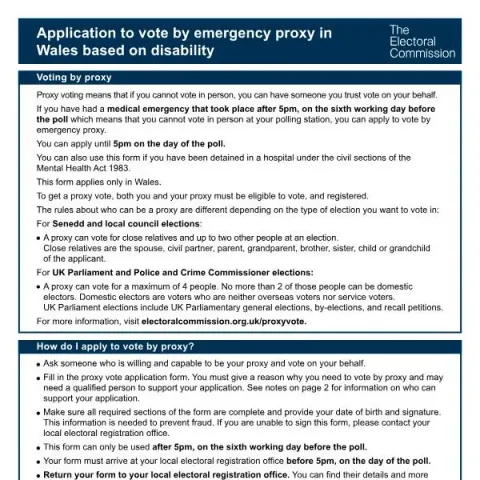
The "Application to vote by emergency proxy in Wales based on disability" is a formal process designed to assist voters who are unable to cast their vote in person during an election due to medical emergencies or hospitalisation under the Mental Health Act 1983. Managed by the Ministry of Housing, Communities & Local Government, this form ensures that eligible voters with disabilities or health issues can still exercise their democratic rights through a trusted proxy.
Purpose of the Emergency Proxy Application
This application form allows voters in Wales who face unforeseen medical emergencies or are detained in hospital to appoint a proxy to vote on their behalf at the upcoming poll. The process is intended to provide a quick and accessible solution for voters who, due to their health condition, cannot attend their polling station in person on election day.
It is important to note that the form can be submitted only after 5pm on the sixth working day before the election, and must arrive at the local electoral registration office before 5pm on the day of the poll. This strict deadline ensures that the proxy vote is registered in time for the election.
Eligibility Criteria and Conditions
To qualify for an emergency proxy vote, applicants must meet specific criteria:
- They must have experienced a medical emergency after 5pm on the sixth working day before the poll, preventing them from voting in person.
- Alternatively, they may be detained in hospital under the civil sections of the Mental Health Act 1983.
- Both the applicant and the proxy must be registered and eligible voters.
Furthermore, the rules differ depending on the type of election:
- For Senedd and local council elections: A proxy can vote for up to three people, including close relatives (spouse, civil partner, parent, grandparent, brother, sister, child, or grandchild).
- For UK Parliament and Police and Crime Commissioner elections: A proxy can vote for up to four people, with no more than two being domestic electors.
Supporting Documentation and Supporting Persons
Applicants may need support to complete their application, especially if they are unable to sign the form. Support can be provided by:
- A registered medical practitioner, nurse, or health professional.
- A registered social worker.
- The manager or authorised representative at the hospital where the applicant is being treated.
- The manager of the residential care home or the warden of the premises where the applicant resides.
In cases where the applicant is registered blind due to disability, they can complete Part 2B of the form without additional support. Also, if the applicant receives specific disability-related benefits, such as the higher rate of mobility component of disability living allowance, they can complete Part 2C without support.
Submitting the Application
Once completed, the application must be sent to the local electoral registration office responsible for the applicant's area. It is crucial to ensure that all sections are filled accurately, including date of birth and signature, to prevent delays or rejection due to fraud prevention measures.
The local electoral office will review the application and notify the applicant whether it has been accepted or rejected. If approved, the office will inform the proxy of the voting arrangements, including the date, time, and location of the polling station.
Post-Submission Process and Voting Instructions
After approval, the proxy must attend the designated polling station to vote on behalf of the applicant. The voter must communicate their voting preferences to their proxy, who will then cast the vote accordingly.
Fill in your form directly online
No printing: type your details into the boxes of the official form, tick, then download the PDF ready to send.
- 1Type into the form boxes
- 2Tick in one click
- 3Save and download the PDF
It is essential for the applicant to specify how they want their proxy to vote, whether for a particular candidate, party, or outcome. The proxy is responsible for voting in accordance with these instructions at the polling station.
Data Privacy and Security
The application process involves the collection of personal data, which is managed in accordance with the Data Protection Act 2018 and UK GDPR. The Electoral Registration Officer acts as the data controller, ensuring that all personal information is processed securely and lawfully. Applicants can refer to the electoral office’s privacy notice for further details on how their data is handled.
Summary
The emergency proxy voting application form is a vital tool for voters in Wales experiencing sudden health issues or hospitalisation, enabling them to participate in elections despite their circumstances. It is designed to be accessible, with clear instructions on eligibility, supporting documentation, and submission deadlines, ensuring that every eligible voter has the opportunity to exercise their democratic rights, even in emergencies.