Understanding the Application to Vote by Emergency Proxy in Wales Based on Occupation, Service or Employment
The application form EP-WORK-W is an official document issued by the Ministry of Housing, Communities & Local Government for eligible voters in Wales who are unable to vote in person due to their occupation, service, or employment commitments. This process allows voters to appoint a trusted individual to cast their vote on their behalf in specific elections, ensuring their democratic rights are preserved even when personal circumstances prevent physical attendance at polling stations.
What Is an Emergency Proxy Vote and Who Can Use This Form?
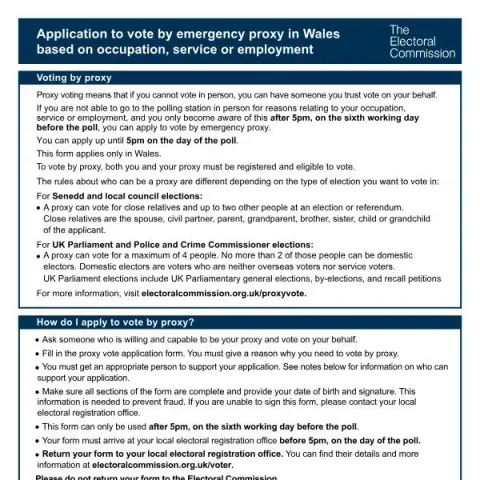
An emergency proxy vote is a special arrangement that enables voters to delegate their voting rights to someone else when they cannot attend the polling station on election day. This situation typically arises when an individual becomes aware of their inability to vote in person after the sixth working day before the poll, specifically after 5pm, and before the close of voting on the day of the election.
This form is exclusively applicable in Wales and is designed for voters whose absence from the polling station is due to their occupation, service, or employment commitments. Both the applicant and their proxy must be registered and eligible voters, adhering to the specific rules that vary depending on the election type.
Who Can Be a Proxy and What Are the Rules?
| Election Type | Proxy Voting Limit | Restrictions |
|---|---|---|
| Senedd and Local Council Elections | Up to 3 people (including close relatives) | Proxy can vote for close relatives and up to two other individuals; close relatives include spouse, civil partner, parent, grandparent, brother, sister, child, or grandchild. |
| UK Parliament and Police & Crime Commissioner Elections | Maximum of 4 people | No more than 2 domestic electors; domestic electors are voters who are neither overseas nor service voters. |
It is important to note that both the applicant and proxy must meet the eligibility criteria, and the proxy must vote at the designated polling station on behalf of the applicant.
How to Complete the Application Form
Step 1: Gather Necessary Details
- Your personal information, including full name, address, date of birth, and contact details (phone number and email, optional).
- Details of the proxy, including their full name, address, relationship to you (if any), and contact information.
- The specific election or elections for which you are requesting a proxy vote, with the relevant dates.
Step 2: Provide Employment and Reason
Complete only one of the following sections based on your employment situation:
- Self-Employed: Specify your job title and explain why your occupation prevents you from voting in person.
- Employed: Provide your employer’s name and address, your job title, and the reason related to your employment that prevents voting in person.
Step 3: Obtain Support
Your application must be supported by an appropriate person, such as an employer or a knowledgeable individual who is not related to you. This supporter must complete the relevant declaration and be over the age of 16 or 18, depending on the election type.
Submitting the Application
Once completed, the form must be sent to your local electoral registration office. It is essential to ensure that the form arrives before 5pm on the day of the poll to be valid. The address of your local electoral registration office can be found on the electoral registration website or through the electoral commission’s resources.
Applicants are advised not to send this form to the Electoral Commission directly, but exclusively to their local electoral registration office. If you are not already registered to vote, you must register at least 12 working days before the election, which can be done online through the government’s voter registration portal.
Fill in your form directly online
No printing: type your details into the boxes of the official form, tick, then download the PDF ready to send.
- 1Type into the form boxes
- 2Tick in one click
- 3Save and download the PDF
After Submission: What Happens Next?
The electoral registration office will review your application and notify you whether it has been accepted or rejected. If approved, they will inform your designated proxy of the voting arrangements, including the date, time, and polling station details.
It is crucial that you communicate your voting preferences to your proxy, including how you wish them to vote, whether for specific candidates, parties, or outcomes. The proxy must then attend the polling station and vote on your behalf in accordance with your instructions.
Privacy and Data Protection
The personal information provided in your application is protected under the Data Protection Act 2018 and the UK GDPR. The electoral registration officer acts as the data controller, ensuring that your data is processed securely and lawfully. For further details, you can consult the privacy notice available through the electoral registration office or the electoral commission’s website.