Understanding the Application for Proxy Voting in Wales Based on Disability
The process of voting is a fundamental aspect of democratic participation, but for individuals with disabilities, physical or mental health challenges can sometimes prevent them from voting in person at the polling station. To address this, the UK government provides a specific application process for proxy voting in Wales, allowing a trusted person to vote on behalf of a voter who cannot attend in person due to disability or detention under the Mental Health Act 1983. This article offers a comprehensive overview of the official form (PR-DIS-W), its purpose, eligibility criteria, supporting documentation, and the steps involved in submitting an application.
What is the Purpose of the PR-DIS-W Form?
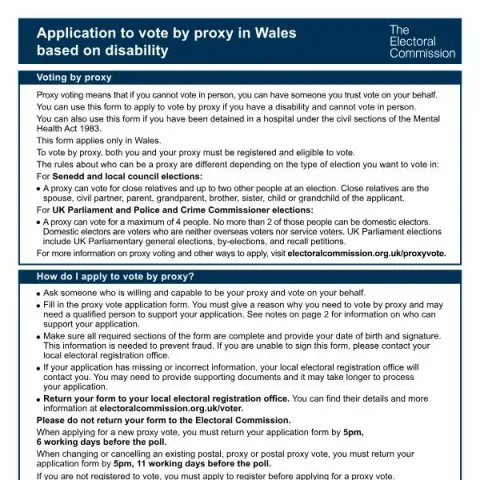
The official form PR-DIS-W is designed for voters in Wales who are unable to vote in person because of a disability or because they are detained in a hospital under civil sections of the Mental Health Act 1983. Its primary purpose is to facilitate proxy voting, enabling voters to appoint a trusted individual to cast their vote at elections, including those for the Senedd, local councils, UK Parliament, and Police and Crime Commissioner elections.
Who Can Use This Form?
This form is exclusively applicable in Wales and is intended for voters who meet specific criteria:
- Individuals with disabilities that prevent them from attending the polling station.
- Persons detained under civil sections of the Mental Health Act 1983.
Both the applicant and their proxy must be registered and eligible voters. The rules regarding who can act as a proxy vary depending on the type of election:
- For Senedd and local council elections: A proxy can vote for up to three people, including close relatives and two others.
- For UK Parliament and Police and Crime Commissioner elections: A proxy can vote for a maximum of four people, with no more than two being domestic electors.
How to Complete and Submit the Application
Step 1: Choose a Suitable Proxy
Identify someone willing and capable of voting on your behalf. This person must be registered and eligible to vote.
Step 2: Fill Out the Form
Complete all relevant sections of the PR-DIS-W form, providing accurate personal details such as your date of birth and signature. If you are unable to sign, contact your local electoral registration office for assistance. It is important to specify the reason for your need to vote by proxy and, if applicable, support your application with a qualified person, such as a registered health professional or social worker.
Step 3: Supporting Documentation
You may need to provide supporting documents if your application is incomplete or contains incorrect information. This could include evidence of your disability or detention status. If your application is supported by a healthcare professional or other authorized individual, ensure their details are correctly entered.
Step 4: Return the Form
Send the completed form to your local electoral registration office. It is crucial to adhere to deadlines:
- For a new proxy vote: by 5pm, six working days before the poll.
- For changing or cancelling an existing proxy vote: by 5pm, eleven working days before the poll.
If you are not yet registered to vote, you must register online at gov.uk/register-to-vote before applying for a proxy vote. The registration deadline is midnight, twelve working days before the election.
What Happens After Submission?
Once your application is received, your local electoral registration office will review and confirm whether it has been accepted or rejected. If approved, your proxy will receive a poll card indicating where and when to vote on your behalf. You should communicate your voting preferences (such as candidate or party choices) to your proxy in advance.
Fill in your form directly online
No printing: type your details into the boxes of the official form, tick, then download the PDF ready to send.
- 1Type into the form boxes
- 2Tick in one click
- 3Save and download the PDF
If your proxy cannot attend the polling station, they may apply for a postal vote on your behalf, provided they do so before the deadline. On polling day, if you are able, you can still go to vote in person unless your proxy has already cast your vote or has applied for a postal vote.
Supporting Persons and Additional Support
The application can be supported by various qualified individuals, including:
- Registered medical practitioners, such as doctors, dentists, opticians, pharmacists, osteopaths, chiropractors, or psychologists.
- Registered nurses or health professionals.
- Registered social workers.
- Hospital managers or authorized representatives.
- Managers of residential care homes or the wardens of premises for disabled or pensionable-age residents.
If your disability involves blindness, and you are registered as blind with your local authority, you do not need support for your application but must complete the relevant section (2B). Similarly, if you receive specific disability benefits, such as higher rate mobility components of disability living allowance or personal independence payment, you may not need additional support but must complete section 2C.
Privacy and Data Protection
The personal information provided in the application is processed in accordance with the Data Protection Act 2018 and UK GDPR. The Electoral Registration Officer acts as the data controller, ensuring your data is used solely for the purpose of managing your proxy voting application and related electoral processes.