Understanding the AD07 Document: A Guide to Discontinuance of Overseas Branch Registers
When navigating the complexities of corporate structure and compliance in the UK, understanding the specifics of various documents is paramount. One such important document is the AD07, which serves as a notice of discontinuance for an overseas branch register. This document is crucial for companies that wish to formally end their overseas register activities. In this comprehensive guide, we will break down the contents, procedures, and implications of the AD07 document, ensuring that you have a thorough understanding of its use and importance.
The Essence of the AD07: What It Covers
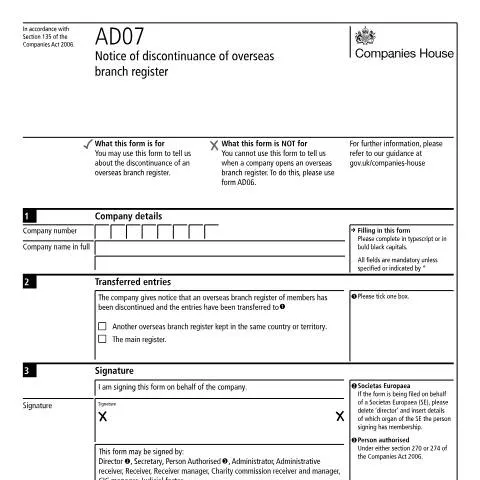
The AD07 document, officially referred to as the Notice of Discontinuance of Overseas Branch Register, allows companies to inform Companies House about the cessation of their overseas branch register. It is important to note that this form is exclusively for discontinuance; it cannot be used when establishing an overseas branch register. To initiate a new branch register, one must utilize the AD06 form instead.
- Purpose: The primary function of the AD07 is to officially document the closure of an overseas branch register.
- Limitations: This document does not facilitate the opening of a new overseas branch register; that process requires the separate AD06 form.
- Legal Framework: This process is governed by Section 135 of the Companies Act 2006, which outlines the legal basis for both the establishment and closure of overseas registers.
Why Discontinue an Overseas Branch Register?
Companies may find the need to discontinue an overseas branch register for several reasons:
- Operational Efficiency: Businesses may consolidate their operations, opting to manage all registrations through their main register.
- Regulatory Compliance: Companies may face regulatory changes in foreign jurisdictions that render their overseas register impractical or burdensome.
- Cost Reduction: Maintaining an overseas register can incur additional costs, from compliance to administrative overhead. Discontinuance may be part of a broader cost-reduction strategy.
Key Elements of the AD07 Document
Understanding the vital components of the AD07 is instrumental in ensuring that the document is correctly filled out and submitted. Here are the essential elements you will encounter:
- Company Details: The name and registration number of the company must be accurately presented, matching the information held on the public register. This crucial step helps avoid discrepancies that could lead to rejection or delays.
- Signature Requirements: The document requires a signature from an authorized individual. This could be a director, secretary, or another designated person. This provision ensures that the discontinuance is formally sanctioned.
- Transfer of Entries: If applicable, the AD07 may include details about any transferred entries, specifying whether they have been moved to another overseas register or back to the main register.
Completing the AD07: A Step-by-Step Approach
When preparing to complete the AD07 document, consider the following steps to ensure accuracy and compliance:
- Gather Information: Collect all necessary details regarding your company, including its name, registration number, and the specifics related to the overseas branch register.
- Check Compliance: Verify that the decision to discontinue the overseas branch register complies with both internal company policies and external legal obligations.
- Sign the Document: Ensure that an authorized individual completes the signature section, which is pivotal for the validity of the submission.
- Submit the Document: You may opt to upload the completed AD07 online or send it via post to the appropriate Companies House address.
- Retain a Copy: Always keep a copy of the submitted form for your records, as it serves as proof of compliance and may be necessary for future reference.
Navigating Common Misinterpretations of the AD07
As with any official document, misunderstandings can lead to significant issues during the submission process. Here are some common misinterpretations regarding the AD07 and guidance on how to avoid them:
- Believing AD07 Allows for Opening a Register: One of the most frequent errors is assuming that the AD07 can also serve as a means to open a new overseas branch register. This is false; you must use the AD06 form for that purpose.
- Mismatched Information: Failing to ensure that the company name and number on the AD07 align with public records can result in rejection. This is vital for maintaining accurate corporate records.
- Overlooking Signature Requirements: Submissions without appropriate signatures are invalid. Ensure that the document is signed by an authorized individual to avoid complications.
The Importance of Accurate Record-Keeping
Accurate record-keeping is not just a regulatory necessity; it also fosters good governance. Here’s why maintaining precise records of your AD07 submissions is critical:
- Regulatory Compliance: Keeping records of your actions in relation to the overseas branch register can help demonstrate compliance with corporate governance standards and legal requirements.
- Future Reference: Should any disputes arise or if you need to refer back to the discontinuance, having a clear record can simplify resolving such issues.
- Facilitating Audits: When your company undergoes audits, accurate records of all submissions, including the AD07, will be necessary for clarity and transparency.
Interconnections With Other Companies House Documents
The AD07 doesn’t exist in a vacuum; it interacts with various other forms and processes within Companies House. Understanding these interconnections is crucial for navigating corporate compliance effectively:
| Document | Purpose | Notes |
|---|---|---|
| AD06 | Establish an overseas branch register | Used when opening a new overseas register. |
| Form CH01 | Change of director details | May be necessary if director changes affect the authority to sign the AD07. |
| Form TM01 | Terminate a director | Relevant if the signatory on the AD07 is leaving the company. |
Conclusion: Making Informed Decisions with the AD07
The AD07 document is a critical component of the corporate landscape for UK companies engaged in international operations. It not only formalizes the cessation of an overseas branch register but also reflects a company’s commitment to regulatory compliance and operational efficiency. By understanding how to navigate the intricacies of the AD07, companies can make informed decisions that align with their strategic objectives. Whether it be ensuring legal adherence, optimizing administrative procedures, or maintaining clear records, the AD07 serves as a fundamental tool in the corporate governance toolkit.
Understanding the Process of Discontinuing an Overseas Branch Register
Filing a notice of discontinuance for an overseas branch register is a significant step for any business looking to streamline its administrative responsibilities. The AD07 form must be filled out precisely to ensure compliance with the regulations set by Companies House. To successfully navigate this process, it’s vital to understand the prerequisites, deadlines, and implications of discontinuing an overseas branch register.
Before beginning the process, ensure that the branch has ceased all activities. This includes clearing any outstanding debts and resolving any legal matters. Companies House requires that the registered office of the overseas branch is also updated in compliance with the dissolution. Failure to do so can lead to penalties or complications in future filings.
When filling out the AD07 form, there are specific sections that require extra attention. For example, you’ll need to provide detailed information regarding the reasons for discontinuance, including any financial implications. Furthermore, you may need to include supporting documentation, such as financial statements or resolutions passed by the board of directors. This documentation serves to validate the claims made in the form and can expedite the review process.
Upon submission, the notice will be processed, and you should receive confirmation from Companies House. It’s important to keep a record of this confirmation, as it may be needed for future reference, particularly concerning tax liabilities or when dealing with creditors.
Post-Discontinuance Obligations and Considerations
Once you’ve successfully submitted the AD07 form and received confirmation of the discontinuance of your overseas branch register, it’s crucial to understand your ongoing obligations. Even after the branch has been officially dissolved, there can be lingering responsibilities regarding tax filings, employment obligations, and stakeholder communications.
For instance, the business might still be liable for any unpaid taxes that were incurred while the overseas branch was operational. This can include both local and international tax implications, depending on the jurisdictions involved. Therefore, it's advisable to consult the HM Revenue and Customs (HMRC) to ensure that all tax obligations are fulfilled, even after discontinuance. A thorough review of your National Insurance contributions associated with overseas employees may also be warranted.
Additionally, if your overseas branch had employees, it's essential to address their rights and severance packages. While the company might be winding down operations, former employees could still have claims for unpaid wages, holiday pay, or redundancy payments. Therefore, it’s prudent to maintain open communication with affected employees to settle any outstanding matters amicably.
In some cases, stakeholders such as suppliers or customers may require formal notification or documentation post-discontinuance, particularly if the branch was engaged in ongoing contracts or agreements. A transparent communication strategy can help mitigate potential disputes and ensure all parties are clear about the branch's operational status.
Common Pitfalls to Avoid When Filing AD07
Filing the AD07 form to discontinue an overseas branch register is straightforward, but there are common pitfalls that businesses should be aware of to avoid complications.
One frequent mistake is incomplete information on the AD07 form. Ensure that all required sections are filled in accurately, including the company number, the overseas branch’s details, and the effective date of discontinuance. Inaccuracies or missing details can delay the processing time or result in rejection of the application, forcing you to resubmit.
Another common issue arises when businesses fail to provide adequate supporting documentation. As mentioned earlier, documents such as board resolutions or financial statements are essential to support your submission. Neglecting to include these documents can lead to questions from Companies House, further delaying the process.
Finally, failing to keep track of the timeline can result in missed deadlines. The notice of discontinuance should be filed as soon as possible after the decision to close the branch has been made. Keeping a calendar with reminders for essential dates will help ensure that the process is executed smoothly and on time.
In summary, while the procedure for filing the AD07 form seems deceptively simple, attention to detail, thorough documentation, and timely action are critical to avoid complications and ensure a hassle-free discontinuance of your overseas branch register.