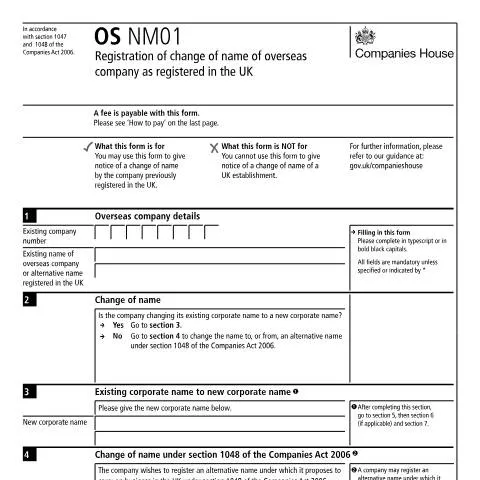
When Overseas Companies Need to Update Their UK Registration Identity
Foreign companies operating in the United Kingdom face a particular administrative challenge when their corporate identity changes. Whether due to a rebranding exercise, merger activity, or regulatory requirements in their home jurisdiction, these overseas entities must formally notify Companies House of any name modifications to maintain compliance with UK company law. The OS NM01 form serves as the official mechanism for this notification process, though its application involves several distinct scenarios that company officers must navigate carefully.
This registration requirement stems from sections 1047 and 1048 of the Companies Act 2006, which establish that overseas companies registered in the UK cannot simply adopt new trading names without proper documentation. The implications extend beyond mere paperwork—failure to update registration details can affect the company's legal standing, contractual relationships, and ability to conduct business through UK establishments.
Distinguishing Between Corporate Names and Alternative Trading Identities
The OS NM01 form addresses two fundamentally different types of name changes, each governed by separate statutory provisions. Understanding this distinction proves crucial for selecting the correct pathway through the form and avoiding processing delays.
Corporate Name Changes Under Section 1047
Section 3 of the form handles situations where an overseas company formally changes its legal corporate name—the official designation under which it was originally incorporated in its home jurisdiction. This typically occurs following:
- Board resolutions approving rebranding initiatives
- Merger or acquisition activities requiring name harmonisation
- Regulatory compliance in the company's country of incorporation
- Strategic repositioning requiring a complete corporate identity overhaul
When completing this section, companies must provide the new corporate name exactly as it appears in their home jurisdiction's corporate registry. Any discrepancies between the UK registration and the overseas corporate records can trigger queries from Companies House, potentially delaying the name change approval.
Alternative Names Under Section 1048
Section 4 addresses alternative trading names—identities under which the overseas company proposes to conduct business in the UK without changing its core corporate designation. This provision offers considerable flexibility for companies seeking to:
| Change Type | Description | Common Scenarios |
|---|---|---|
| Corporate to Alternative | Registering a UK-specific trading name | Market localisation, brand adaptation |
| Alternative to Corporate | Reverting to the original corporate name | Ending localised branding campaigns |
| Alternative to New Alternative | Changing between different trading names | Rebranding UK operations specifically |
The alternative name system proves particularly valuable for multinational corporations seeking to maintain consistent branding across different markets while preserving their original corporate identity for legal and regulatory purposes.
Navigating Name Restrictions and Government Approvals
Not all proposed company names receive automatic approval. Section 5 of the OS NM01 form specifically addresses situations where the proposed name contains sensitive or restricted words requiring government department consent. This checkpoint prevents companies from inadvertently adopting names that could mislead the public or conflict with regulatory frameworks.
Sensitive words typically include terms suggesting:
- Government affiliation or royal patronage
- Professional regulation (solicitor, chartered, etc.)
- Financial services authority
- International or global scope beyond the company's actual reach
Companies House maintains detailed guidance on restricted expressions, though the specific approval requirements can vary depending on the nature of the business and the particular words involved. When approval becomes necessary, companies must attach copies of the relevant government department's response to their OS NM01 submission.
The approval process can extend the overall timeline for name changes significantly. Companies planning time-sensitive rebranding exercises should factor in potential delays of several weeks while government departments review applications and provide their determinations.
Multiple UK Establishments and Consolidated Reporting
Overseas companies operating through multiple UK establishments face additional administrative requirements when changing their registered names. Section 6 of the form provides a mechanism for consolidated reporting, allowing companies to update all establishment records simultaneously rather than submitting separate notifications for each location.
This consolidated approach offers significant administrative efficiency for companies with extensive UK operations. Rather than preparing multiple individual submissions, companies can complete a single OS NM01 form provided they:
- Complete the establishment table with all relevant names and registration numbers
- Ensure consistency across all establishment records
- Verify that each establishment requires the same type of name change
However, companies must exercise caution when utilising this consolidated reporting option. Any discrepancies between establishment records or variations in the required changes may necessitate separate submissions to avoid processing complications.
Establishment Record Coordination
The establishment table requires precise completion, as Companies House cross-references the provided information against existing records. Common coordination challenges include:
- Variations in how establishment names appear on different documents
- Outdated registration numbers from previous administrative changes
- Timing differences between establishment registrations
Companies uncertain about their establishment details should verify current records through the Companies House public register before completing the OS NM01 form to ensure accuracy and prevent submission rejection.
Authentication Requirements and Authorised Representatives
Section 7 establishes the authentication framework for OS NM01 submissions, determining who may legally authorise name change notifications on behalf of overseas companies. This authentication requirement serves as a crucial safeguard against unauthorised corporate changes while ensuring proper accountability for the submitted information.
The form restricts authentication authority to three specific roles:
- Directors of the overseas company
- Company secretaries (where appointed)
- Permanent representatives designated for UK operations
Notably, the authentication process requires only the printed name of the authorising individual—no physical signature is necessary. However, the authenticating person assumes legal responsibility for the accuracy of all information provided in the form, making careful review essential before submission.
Public Record Implications
Information provided in the authentication section becomes part of the public record, accessible to anyone searching Companies House databases. This transparency requirement means that authenticating individuals should consider the implications of their details appearing in public searches, particularly regarding personal privacy and potential commercial sensitivities.
Fee Structure and Payment Processing
Companies House charges a £30 fee for processing OS NM01 submissions, regardless of whether the change involves corporate names, alternative names, or multiple establishments. This standardised fee structure simplifies budgeting for name change procedures, though companies should note that additional costs may arise if government department approvals become necessary.
Payment methods remain traditional, with Companies House accepting cheques or postal orders made payable to 'Companies House'. This payment approach reflects the form's physical submission requirements, as electronic payment options typically accompany online filing systems not available for this particular document.
Companies should ensure that payment accompanies their OS NM01 submission, as incomplete fee payments can delay processing significantly. The £30 fee covers the name change registration but does not include any costs associated with obtaining government department approvals for restricted names.
Submission Procedures and Processing Expectations
The OS NM01 form requires physical submission to Companies House, either by post or through their document upload facility where available. This submission method contrasts with many other Companies House procedures that offer full electronic filing options, reflecting the specialized nature of overseas company registrations and the need for careful document verification.
Before submission, companies should utilise the form's built-in checklist to verify completeness:
- Company name and number accuracy against existing registrations
- Appropriate section completion (3 or 4) based on change type
- Sensitive word approvals (if applicable)
- Establishment details (if multiple locations involved)
- Proper authentication by authorised personnel
- Correct fee inclusion
Processing times vary depending on the complexity of the submission and whether additional approvals are required. Standard name changes typically process within several working days, while applications involving sensitive words or multiple establishments may require extended review periods.
Post-Submission Updates
Once processed, the name change becomes effective immediately and appears on the public register. Companies should update their corporate documentation, contracts, and operational materials accordingly. The updated registration serves as the official record for all future dealings with UK regulatory authorities and commercial partners.
Companies House provides confirmation of successful name changes through updated public records rather than separate notification letters. Companies can verify completion by searching the public register using their company number to confirm that the new name appears correctly in all relevant sections.
Timing Considerations and Strategic Planning for Name Changes
The timing of your OS NM01 submission can significantly impact your business operations and compliance obligations. Companies House processes name change notifications within 15 working days of receipt, provided all documentation is complete and accurate. However, this processing time doesn't account for potential delays if amendments are required or if your submission coincides with peak filing periods.
Consider submitting your name change notification well in advance of any critical business milestones, such as contract renewals, regulatory filings, or major commercial transactions. Many overseas companies find it advantageous to coordinate their UK name change with their home jurisdiction's process, though this isn't mandatory. If your company operates across multiple UK jurisdictions—England and Wales, Scotland, or Northern Ireland—you'll need separate registrations and potentially separate OS NM01 forms for each jurisdiction where you're registered.
The effective date of your name change is crucial for ongoing compliance. Your new name becomes effective from the date Companies House updates your registration, not from when you submit the form. This distinction matters for legal documents, contracts, and regulatory filings that may be in progress. Any documents signed or submitted between your application and the effective date should still use your current registered name to avoid potential legal complications.
Financial reporting considerations also influence optimal timing. If your name change occurs partway through your accounting period, you'll need to ensure consistency in your annual accounts and any interim reporting. HMRC may require additional documentation to link your corporation tax records to the new name, particularly if the change is substantial. Some companies prefer to time name changes to coincide with their year-end to simplify accounting and audit processes.
Seasonal factors can affect processing times and administrative efficiency. Companies House typically experiences higher volumes during the summer months and around year-end, when many companies file annual returns and accounts. Planning your OS NM01 submission for quieter periods, such as early autumn or late winter, may result in faster processing and reduced risk of administrative delays.
Common Rejection Reasons and How to Avoid Them
Understanding why Companies House rejects OS NM01 applications helps ensure your submission succeeds on the first attempt. The most frequent rejection reason involves insufficient or incorrect supporting documentation from your home jurisdiction. Companies House requires clear evidence that your name change has been properly executed according to your home country's laws, and generic certificates or translations often fail to meet this standard.
Documentation quality issues frequently arise with translations. If your home jurisdiction documents aren't in English, you must provide certified translations by qualified translators. Companies House won't accept machine translations, informal translations, or translations that appear incomplete or unclear. The translator must include their credentials and confirm their competency in both languages. Some companies mistakenly submit partial translations covering only the name change details, but Companies House typically requires complete document translations to understand the full legal context.
Timing discrepancies between your home jurisdiction change and your UK application can trigger rejections. If significant time has elapsed between your overseas name change and your OS NM01 submission, Companies House may question why the notification is late. While there's no specific deadline for notifications, unexplained delays can raise concerns about your compliance approach. Include a covering letter explaining any timing issues, particularly if regulatory or legal complexities in your home jurisdiction caused delays.
Name similarity conflicts represent another common rejection category. Even if your proposed name is acceptable in your home jurisdiction, it may conflict with existing UK company names or protected designations. Companies House maintains strict name availability rules that apply to overseas companies just as they do to domestic incorporations. Before finalising your overseas name change, check the Companies House WebCHeck service to identify potential conflicts with UK-registered entities.
Form completion errors, while seemingly straightforward, account for numerous rejections. Common mistakes include incorrect company numbers, mismatched director information, or inconsistent name spellings between the form and supporting documents. The company number field must match exactly with your existing Companies House registration—even minor variations in formatting can cause system rejections. Similarly, director names must correspond precisely with your current filing records, including any middle names or suffixes that appear in your registration.
Payment issues also lead to processing delays or rejections. The current fee for OS NM01 submissions is £40, payable by cheque made out to 'Companies House' or through the online payment system if filing electronically. Incorrect payment amounts, illegible cheques, or payment method mismatches with your filing method can halt processing. Always verify current fee levels on the Companies House website, as rates occasionally change with minimal advance notice.
Post-Approval Administrative Requirements and Ongoing Obligations
Successfully completing your OS NM01 submission marks the beginning, not the end, of your name change administrative process. Companies House will issue an updated certificate of registration reflecting your new name, typically within 15 working days of approval. This certificate serves as official proof of your name change for UK regulatory and commercial purposes, but several additional steps ensure full compliance and operational continuity.
Updating your registration details across other UK regulatory bodies requires systematic attention. HMRC must be notified of your name change for corporation tax, VAT, and PAYE purposes if applicable. While Companies House may share information with HMRC, proactive notification helps prevent correspondence delays and ensures your tax records remain current. Use HMRC's online services or contact their helplines with your updated Companies House certificate as supporting evidence.
Banking relationships require particular attention following name changes. UK banks typically freeze accounts or restrict transactions until they receive satisfactory evidence of legitimate name changes. Provide your bank with your updated Companies House certificate along with any additional documentation they request. Some banks require board resolutions or additional authorisations, particularly for accounts with multiple signatories or complex mandate arrangements. Processing times vary significantly between institutions, so initiate these updates immediately after receiving your updated certificate.
Contract and commercial relationship management becomes critical following name changes. Review all existing contracts, agreements, and ongoing commercial relationships to determine amendment requirements. While most contracts remain legally valid despite name changes, many counterparties prefer formal amendments or acknowledgements to avoid future confusion. Property leases, insurance policies, and long-term service agreements often require specific notification procedures outlined in their terms and conditions.
Professional service providers—including accountants, legal advisers, and business consultants—should be notified promptly to ensure continuity of service and accurate record-keeping. Many professional bodies maintain client registers that require updating following name changes, and delays can affect service delivery or regulatory compliance in specialised sectors.
Digital presence updates extend beyond basic website changes to encompass domain registrations, social media accounts, and online business directories. Search engine optimisation considerations may require professional attention to maintain visibility during the transition period. Some companies implement redirect strategies to preserve existing web traffic and customer recognition during name change transitions.
Ongoing compliance obligations continue unchanged despite name changes, but administrative systems must reflect your new identity. Annual confirmation statements, accounting filings, and any other Companies House submissions must use your updated name consistently. Maintain copies of both your old and new certificates of registration, as historical document requests may require reference to your former name for continuity purposes.