When Endangered Species Change Hands Without Money
Transferring protected wildlife specimens—whether a rare bird, exotic reptile, or endangered plant—triggers strict legal obligations under UK wildlife protection laws. Even when no money changes hands, the Animal and Plant Health Agency (APHA) requires formal documentation for gifts and unconditional loans involving Annex A species, the most protected category under Council Regulation (EC) No 338/97 as incorporated into UK law.
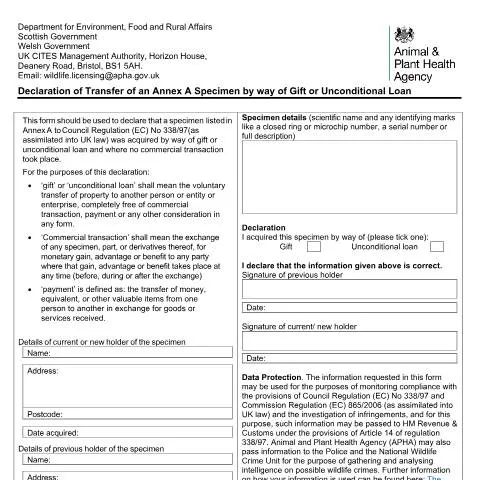
The Declaration of Transfer of an Annex A Specimen by way of Gift or Unconditional Loan serves as official notification that ownership has transferred without commercial transaction. This seemingly simple form carries significant legal weight—failing to complete it properly can result in prosecution for wildlife trafficking offences, even when the transfer was entirely innocent.
Understanding Annex A Species and Legal Definitions
Annex A encompasses the world's most endangered species, including many familiar names: African elephants, great apes, most big cats, many parrots, orchids, and cacti. These species face the strictest trade controls, requiring permits for virtually any movement or ownership transfer.
The form establishes crucial legal distinctions that determine whether this declaration applies:
| Term | Legal Definition | Practical Examples |
|---|---|---|
| Gift | Voluntary transfer completely free of commercial transaction, payment or consideration | Inheriting a parrot, receiving a cactus from a friend, donation to a zoo |
| Unconditional loan | Temporary transfer with no commercial element or expected return benefit | Lending breeding animals between conservationists, museum specimen loans |
| Commercial transaction | Exchange for monetary gain, advantage or benefit occurring before, during or after transfer | Sale, barter, payment in kind, future business considerations |
The timing element in commercial transactions proves particularly important—even deferred benefits or informal reciprocal arrangements can disqualify a transfer from gift status. A seemingly innocent arrangement where someone receives a rare bird "free" but later provides unrelated services to the giver could constitute a commercial transaction requiring different documentation.
Grey Areas Requiring Careful Consideration
Several scenarios blur the lines between gifts and commercial transactions. Covering transport costs, veterinary expenses, or care equipment might constitute "consideration" depending on circumstances. Similarly, transfers within family businesses, between conservation partners, or involving future breeding rights require careful analysis of whether any commercial element exists.
Who Must Complete This Declaration
Both parties in the transfer—the previous holder and current/new holder—must sign the declaration. This dual signature requirement reflects the shared legal responsibility for ensuring protected species transfers comply with regulations.
The previous holder bears responsibility for initiating the declaration process, as they typically possess the specimen's documentation and understand its protected status. However, new holders share equal legal obligation to ensure proper declaration, regardless of their knowledge level when receiving the specimen.
Special Circumstances Affecting Responsibility
Inheritance situations present unique challenges, as the deceased cannot sign the declaration. In such cases, estate executors typically sign on behalf of the previous holder, though APHA may require additional documentation proving the inheritance relationship and absence of commercial elements in the bequest.
For loans, both the lender (previous holder during loan period) and borrower (temporary current holder) must complete declarations when the loan commences and again when the specimen returns. This creates a paper trail documenting the entire custody chain.
Completing the Specimen Details Section
Accurate specimen identification forms the declaration's foundation. The scientific name requirement reflects international conservation treaty obligations—common names vary between regions and languages, but scientific nomenclature provides universal identification.
Beyond species identification, the form demands specific individual identification through:
- Closed rings—permanent metal or plastic bands applied to captive-bred birds when very young, containing unique alphanumeric codes
- Microchip numbers—implanted electronic identification increasingly common in reptiles and mammals
- Serial numbers—found on manufactured items like ivory carvings or turtle shell products
- Physical descriptions—detailed accounts of size, markings, distinguishing features for specimens lacking other identification
Incomplete specimen identification represents the most common declaration error. APHA requires sufficient detail to distinguish the specific individual from others of the same species—particularly crucial for enforcement and monitoring purposes.
Documentation Supporting Specimen Identity
While not explicitly requested on the form, maintaining supporting documentation proves invaluable. Photographs, veterinary records, previous permits, or breeding certificates help substantiate the specimen's identity and legal acquisition history. APHA may request such evidence during compliance investigations.
The Transfer Documentation Process
The declaration process begins when parties agree to a gift or unconditional loan arrangement. The previous holder should initiate form completion, gathering necessary specimen details and ensuring both parties understand their legal obligations.
Timing considerations prove critical—the form should be completed at or before the transfer date. Retroactive declarations, while sometimes accepted, raise compliance questions and may trigger additional scrutiny from APHA enforcement officers.
Both holders must provide complete contact details, as APHA maintains ongoing communication with specimen holders throughout the animal's or plant's lifespan. Address changes require prompt notification to maintain compliance with monitoring obligations.
The Role of Reason for Gifting
The "reason for gifting" field, while seemingly straightforward, serves important regulatory purposes. APHA uses this information to identify patterns in specimen transfers, assess conservation impacts, and detect potential commercial activities disguised as gifts.
Common acceptable reasons include:
- Conservation breeding program participation
- Family inheritance or bequest
- Downsizing collections due to age or circumstances
- Educational institution donations
- Rescue and rehabilitation transfers
Vague explanations like "no longer wanted" may prompt follow-up questions about the true motivation and whether any commercial elements influenced the decision.
Submission and APHA Processing
Completed declarations must be returned to the UK CITES Management Authority at Horizon House in Bristol. While the form doesn't specify electronic submission options, APHA increasingly accepts scanned declarations via the [email protected] email address, though original signatures may be required for verification.
APHA doesn't issue acknowledgment receipts for routine declarations, but the submission creates an official record in their specimen monitoring database. This information feeds into international CITES reporting obligations and helps track specimen movements across the UK.
Integration with Existing Permits
The declaration doesn't replace existing permit requirements—it supplements them. Specimens originally imported under CITES permits retain those documentation requirements, with the gift declaration adding another layer to the ownership history. Similarly, specimens requiring Article 10 certificates for internal EU trade (now UK domestic requirements post-Brexit) maintain those obligations alongside gift declarations.
Data Protection and Information Sharing
The form's data protection notices reveal the extensive information sharing underlying wildlife enforcement. By signing, both parties consent to APHA sharing their details with multiple agencies including HM Revenue & Customs, police forces, and the National Wildlife Crime Unit.
This information sharing reflects the serious criminal penalties associated with illegal wildlife trade. What begins as a simple gift declaration can become evidence in wildlife trafficking investigations if irregularities emerge in the specimen's history or if patterns suggest commercial activity.
The automatic mailing list enrollment ensures ongoing communication about regulatory changes, species-specific advice, and compliance requirements. However, consent withdrawal remains possible through direct contact with the CITES Management Authority.
Privacy Implications for Specimen Holders
Specimen holders should understand that their information becomes part of a permanent government database accessible to multiple enforcement agencies. This creates ongoing obligations—address changes, further transfers, and specimen status updates all require prompt notification to maintain compliance.
Consequences of Non-Compliance
Failing to complete gift declarations carries serious legal consequences under wildlife protection legislation. Prosecutors may charge undeclared transfers as illegal trade, regardless of whether money changed hands. The absence of proper documentation makes proving the innocent nature of transfers extremely difficult in enforcement proceedings.
Beyond immediate legal risks, undeclared transfers create ongoing compliance problems. Future permit applications, insurance claims, or veterinary treatments may be complicated by incomplete ownership documentation. Should the specimen die, breed, or require medical intervention, the absence of proper transfer records can trigger enforcement investigations.
APHA compliance officers increasingly cross-reference declaration records with other databases, including veterinary registrations, insurance policies, and social media activity. Inconsistencies between declared ownership and apparent possession can prompt formal investigations with significant legal and financial consequences for all parties involved.
Enforcement Trends and Priorities
Recent enforcement actions demonstrate APHA's focus on seemingly minor documentation failures that reveal larger compliance issues. Gift declarations form part of comprehensive specimen histories that enforcement officers scrutinise for patterns suggesting commercial activity or illegal importation.
The National Wildlife Crime Unit particularly targets cases where multiple "gifts" occur between the same parties, unusual specimen movements without clear conservation purposes, or declarations contradicted by evidence of financial transactions or commercial relationships.
Documentation Requirements and Evidence Standards
When declaring a gift or loan involving endangered species in the UK, robust documentation forms the cornerstone of compliance with both CITES regulations and customs procedures. The quality and completeness of your evidence package directly impacts processing times and approval likelihood.
For gifts, you must provide comprehensive provenance documentation spanning the entire ownership chain. This includes the original CITES permits under which the specimen entered the UK, any subsequent Article 10 certificates issued by the Animal and Plant Health Agency (APHA), and detailed ownership records showing lawful possession. If the specimen predates CITES implementation (generally pre-1975 for most species), you'll need credible evidence such as insurance valuations, exhibition catalogues, or sworn statutory declarations from recognised experts in the field.
The donor's documentation package requires particular attention to detail. Beyond standard identification documents, APHA may request proof of the donor's legal capacity to transfer ownership, especially for valuable specimens or those with complex histories. Corporate donors must provide company registration details and authorisation from appropriate directors. Estate executors need probate documentation, whilst trustees require evidence of their legal authority under the relevant trust deed.
Loan arrangements demand additional layers of documentation reflecting the temporary nature of the transfer. The loan agreement must explicitly state the duration, purpose, and conditions for return. APHA scrutinises these arrangements particularly closely when loans extend beyond two years or involve commercial exhibitions, as these may trigger different regulatory pathways. Insurance documentation becomes crucial, with clear statements of liability and coverage throughout the loan period.
Photographic evidence serves multiple regulatory purposes beyond simple identification. Images must show distinctive markings, any damage or restoration work, and overall condition. For worked specimens like ivory carvings or taxidermy, photographs should capture construction techniques and materials that support age claims. APHA recommends high-resolution images taken from multiple angles, with measuring scales where appropriate.
Scientific specimens require additional documentation reflecting their research value. University transfers need institutional letters confirming the academic purpose and researcher credentials. Museum loans must include curatorial statements and collection policies. Research institutions should provide ethics committee approvals where applicable, particularly for specimens used in ongoing studies or public education programmes.
Cross-Border Implications and International Coordination
Endangered species gifts and loans frequently involve international dimensions that significantly complicate the declaration process. Understanding how UK procedures integrate with global CITES frameworks prevents costly delays and potential legal complications.
When receiving specimens from EU member states, the post-Brexit landscape has fundamentally altered documentation requirements. Previously straightforward internal market transfers now require full CITES import procedures, including advance notification to APHA's Border Force liaison teams. The donor country must issue appropriate export permits, whilst you must secure UK import permits before the specimen enters British territory. This dual-permit system can extend processing times to several months, particularly during peak periods or for controversial species.
Non-EU transfers present their own complexities, with varying permit systems and documentation standards across different countries. Some nations maintain paper-based CITES systems with limited verification capabilities, whilst others employ sophisticated electronic tracking. APHA maintains country-specific guidance for major trading partners, highlighting particular requirements or restrictions. For instance, specimens from certain African countries require additional authentication procedures, whilst some Asian nations impose export quotas that affect availability.
Transit arrangements through third countries add another layer of regulatory complexity. If your specimen travels through multiple jurisdictions before reaching the UK, each transit country may impose its own documentation requirements. Some nations require separate transit permits even for sealed containers, whilst others accept CITES documentation from the origin country. Planning optimal shipping routes requires careful consideration of transit regulations alongside cost and timing factors.
Temporary exhibitions and touring displays create particularly complex scenarios requiring coordination across multiple jurisdictions. Museums and educational institutions frequently loan specimens for international exhibitions, necessitating careful planning to ensure regulatory compliance throughout the tour. Each destination country requires separate import procedures, whilst the UK expects detailed itineraries and security arrangements for returning specimens.
Digital coordination systems increasingly facilitate international transfers, though adoption varies significantly between countries. The UK participates in several electronic permit systems, including EPIX for certain European transactions and bilateral arrangements with key partners. However, many countries still rely on paper documentation, requiring physical courier services and extended processing times.
Customs valuation presents additional challenges for international transfers, particularly gifts with significant monetary value. HMRC requires accurate valuations for duty calculation purposes, even when no payment changes hands. Professional appraisals may be necessary, especially for rare specimens or those with disputed provenance. Different countries apply varying valuation methodologies, potentially creating discrepancies that require resolution before clearance.
Appeals, Disputes, and Enforcement Consequences
When endangered species declarations face rejection or regulatory challenges, understanding the appeals framework and potential consequences becomes crucial for protecting your interests and maintaining compliance.
APHA's initial decision-making process includes internal review mechanisms before formal appeals procedures commence. If your application faces rejection or conditional approval with unacceptable terms, you can request reconsideration by submitting additional evidence or clarifying misunderstood aspects of your case. This informal review process often resolves straightforward documentation issues without proceeding to formal appeals, saving considerable time and expense.
Formal appeals follow structured procedures outlined under the CITES Management Authority regulations. You must submit appeals within 28 days of receiving the adverse decision, including detailed grounds for challenge and any new evidence supporting your position. The appeals panel comprises independent experts with relevant scientific and legal expertise, ensuring decisions receive thorough technical review. However, appeals focus on procedural correctness and evidence assessment rather than policy disagreements with CITES principles.
Common appeal grounds include inadequate consideration of scientific evidence, procedural irregularities during the application process, or disproportionate conditions imposed on approvals. Successful appeals often involve cases where APHA failed to properly assess expert testimony or applied incorrect legal standards to particular circumstances. However, appeals rarely succeed on purely commercial grounds or arguments that CITES restrictions unfairly impact legitimate trade.
Enforcement consequences for non-compliance extend far beyond immediate penalties, potentially affecting future applications and professional reputation. APHA maintains detailed records of all enforcement actions, including warnings, seizures, and prosecutions. These records influence risk assessments for subsequent applications, with previous compliance issues triggering enhanced scrutiny and potentially longer processing times.
Criminal prosecution represents the most serious enforcement outcome, typically reserved for deliberate violations or repeated non-compliance. The Crown Prosecution Service applies public interest tests when considering whether to proceed with cases, balancing factors like the conservation impact, financial gain, and defendant's cooperation. Successful prosecutions can result in substantial fines, imprisonment for serious cases, and forfeiture of specimens regardless of their value or scientific importance.
Administrative penalties provide APHA with flexible enforcement tools for addressing less serious violations. These may include formal warnings, additional monitoring requirements, or restrictions on future applications. Repeat offenders face escalating consequences, potentially including temporary or permanent bans from handling CITES specimens. Professional dealers and institutions face particular scrutiny, with enforcement actions potentially affecting their operating licences and professional accreditation.
Seizure procedures follow strict legal protocols designed to protect both conservation objectives and legitimate property rights. APHA officers must demonstrate reasonable grounds for believing specimens violate CITES regulations, though the burden subsequently shifts to owners to prove lawful possession. Seized specimens receive appropriate care pending resolution, though owners bear associated costs regardless of the ultimate outcome.
International enforcement cooperation increasingly affects UK cases, particularly those involving specimens with complex international histories. APHA collaborates with overseas CITES authorities to investigate suspicious transactions and verify documentation authenticity. These investigations can extend significantly beyond initial UK procedures, potentially affecting specimens already in circulation or future trade relationships.