When Overseas Companies Must Update Their UK Establishment Records
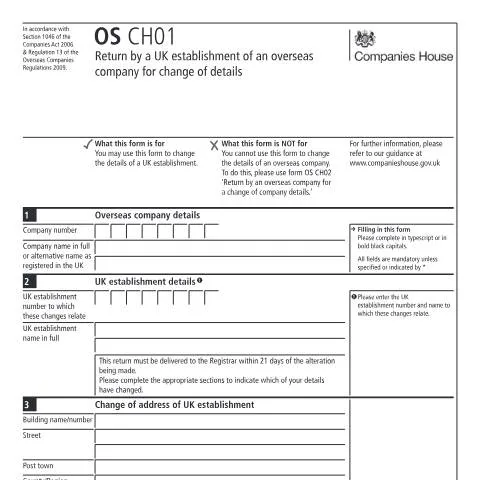
Foreign companies operating through UK establishments face a continuous obligation to maintain accurate records with Companies House. The OS CH01 form serves as the mandatory reporting mechanism whenever specific details of a UK establishment change, distinct from alterations to the overseas parent company itself. This return operates under strict statutory timelines, with companies required to file within 21 days of any alteration under Section 1046 of the Companies Act 2006 and Regulation 13 of the Overseas Companies Regulations 2009.
The distinction between establishment changes and company changes proves crucial for compliance. Whilst OS CH01 addresses modifications to the UK operational base—such as relocating premises, changing business activities, or rebranding the establishment name—it cannot handle alterations to the overseas company's fundamental details. Such changes require the separate OS CH02 form for company-level modifications.
Understanding this differentiation prevents common filing errors that can delay processing or result in rejected submissions. Companies House maintains separate registers for overseas company details and their UK establishment information, each governed by distinct reporting requirements and deadlines.
Navigating the Three Core Change Categories
The OS CH01 form accommodates three primary types of establishment modifications, each triggering specific disclosure obligations and documentation requirements.
Address Relocations and Physical Presence Requirements
Section 3 of the form handles address changes for UK establishments, requiring comprehensive location details including building identification, street address, post town, county or region, and full postcode. The form demands precise dating of when the address change occurred, as this determines the 21-day filing deadline calculation.
Companies House enforces strict rules regarding acceptable addresses. The new location must represent a physical presence—PO Box numbers alone prove insufficient unless forming part of a complete address. DX numbers or Legal Post identifiers cannot substitute for proper street addresses, reflecting the regulatory emphasis on genuine business establishments rather than mere postal arrangements.
International companies often underestimate the administrative complexity of UK address changes, particularly when coordinating with lease agreements, regulatory notifications, and customer communications. The statutory filing deadline remains fixed regardless of operational challenges, making advance preparation essential.
Business Activity Modifications and Regulatory Alignment
Section 4 addresses changes in the nature of business activities conducted through the UK establishment. This extends beyond simple descriptive updates to encompass fundamental shifts in operational focus, new service offerings, or strategic pivots affecting the establishment's commercial purpose.
The form requires detailed description of new business activities alongside precise dating of when changes took effect. Companies must consider how business modifications might trigger additional regulatory requirements—financial services activities, for instance, may necessitate separate authorisations from the Financial Conduct Authority or Prudential Regulation Authority.
Timing proves particularly sensitive for business changes, as the nature of activities can affect tax obligations, employment law compliance, and sector-specific regulations. The 21-day reporting window provides limited flexibility for companies managing complex operational transitions.
Establishment Name Changes and Brand Alignment
Section 5 covers UK establishment name modifications, whether driven by rebranding initiatives, trademark considerations, or alignment with global naming conventions. The process requires specifying both the new establishment name and the exact date of change implementation.
Name changes often coincide with broader commercial strategies, yet the statutory reporting obligation operates independently of marketing timelines or brand launch schedules. Companies must balance operational needs with compliance deadlines, particularly when coordinating name changes across multiple jurisdictions.
| Change Type | Section | Key Requirements | Common Complications |
|---|---|---|---|
| Address | 3 | Physical location, full postcode, change date | PO Box restrictions, lease timing |
| Business Activities | 4 | Detailed description, regulatory alignment | Additional authorisations, tax implications |
| Establishment Name | 5 | New name, implementation date | Trademark issues, global coordination |
Authorisation Requirements and Signature Protocols
Section 6 establishes clear signature authority for OS CH01 submissions, limiting authorisation to specific roles within the overseas company structure. Only directors, company secretaries, or permanent representatives may sign the form, reflecting Companies House's emphasis on senior-level accountability for statutory filings.
This restricted authorisation differs from many other Companies House forms that permit broader signature authority. The limitation recognises that establishment changes can carry significant commercial and regulatory implications, warranting oversight from individuals with comprehensive knowledge of company operations and strategic direction.
Permanent representatives hold particular significance in this context, as they often serve as the primary UK-based contacts for overseas companies. Their signature authority acknowledges their role in managing day-to-day establishment operations whilst maintaining connection to parent company governance structures.
Companies operating through multiple UK establishments must ensure appropriate signature authority exists for each location. The form requires identification of the specific establishment to which changes relate, preventing confusion where companies maintain several UK operational bases under different names or addresses.
Filing Mechanics and Processing Channels
Companies House provides multiple submission channels for OS CH01 forms, each offering distinct advantages depending on operational preferences and administrative capabilities. The traditional paper submission route remains available alongside electronic alternatives, though processing times and confirmation methods vary between channels.
Paper Submission Protocols
Physical form submission requires careful attention to completion standards, with Companies House specifying typescript or bold black capitals for all entries. This requirement reflects document scanning and processing needs, as unclear handwriting can trigger rejection or processing delays.
The form provides multiple regional submission addresses across England and Wales, Scotland, and Northern Ireland, allowing companies to select convenient delivery options. Each office maintains dedicated DX numbers for document exchange services, offering tracked delivery alternatives to standard postal services.
Paper submissions carry inherent risks around delivery confirmation and processing verification. Companies relying on postal submission should consider recorded delivery or courier services to maintain audit trails, particularly given the strict 21-day deadline for form submission.
Regional Processing Variations
Different Companies House offices handle submissions according to geographical responsibility, though companies can submit to any office regardless of establishment location. The Cardiff office serves as the primary centre for England and Wales companies, whilst Edinburgh handles Scottish submissions and Belfast covers Northern Ireland operations.
Processing times may vary between offices depending on workload and staffing levels, though Companies House maintains consistent standards across all locations. Companies with time-sensitive submissions might benefit from selecting offices with historically faster processing times, though such variations are typically minimal.
Documentation Standards and Completion Requirements
The OS CH01 form employs mandatory field protocols, with all sections requiring completion unless specifically marked as optional with asterisk indicators. This comprehensive completion requirement reflects the statutory nature of the information and its importance for maintaining accurate public records.
Section 1 demands precise identification details, including the complete overseas company name as registered in the UK and the assigned company number. These identifiers must match existing Companies House records exactly, as discrepancies can trigger rejection or processing delays. Companies using alternative names or trading styles must ensure consistency with their registered information.
Section 2 requires equivalent detail for the UK establishment, including the full establishment name and specific establishment number. Companies operating multiple UK establishments must exercise particular care in identifying the correct establishment for reported changes, as errors can result in incorrect record updates or compliance failures.
Date Formatting and Accuracy Requirements
All date entries follow the standard DD/MM/YYYY format, consistent with UK administrative conventions. The form provides specific date fields for each type of change, reflecting the importance of accurate timing for regulatory compliance and public record maintenance.
Date accuracy proves crucial for calculating the 21-day filing deadline, as Companies House measures compliance from the actual change date rather than internal decision dates or implementation planning periods. Companies should maintain clear documentation of when changes take effect to support accurate form completion.
Public Record Implications and Transparency Obligations
All information submitted via OS CH01 becomes part of the public Companies House register, accessible to searchers and stakeholders worldwide. This transparency obligation extends to all form sections, including presenter contact information if provided, creating permanent public records of establishment changes.
The public nature of filed information requires careful consideration of commercial sensitivity and competitive implications. Whilst companies cannot avoid disclosure of mandatory information, they should consider timing announcements and communications to align with statutory filing requirements.
Presenter information remains optional, though providing contact details can expedite processing where queries arise. Companies House staff may contact presenters directly to resolve minor issues or clarify ambiguous information, potentially avoiding formal rejection and resubmission delays.
Stakeholder Access and Commercial Implications
Public record status means that competitors, customers, suppliers, and regulatory bodies gain immediate access to establishment change information upon filing. Companies should anticipate potential enquiries or market reactions following significant changes, particularly those affecting business activities or operational locations.
Financial institutions and credit agencies routinely monitor Companies House filings for signs of operational changes that might affect creditworthiness or business relationships. Frequent address changes or business activity modifications may prompt additional due diligence requests or contract review procedures.
Compliance Monitoring and Enforcement Mechanisms
Companies House operates active monitoring systems to identify non-compliance with OS CH01 filing obligations, utilising both automated checks and manual review processes. The 21-day deadline operates as a strict statutory requirement, with limited discretion for late submissions regardless of circumstances.
Enforcement actions for non-compliance can include financial penalties, formal warnings, or administrative sanctions affecting the overseas company's UK registration status. Persistent non-compliance may trigger more serious interventions, including potential restriction of business activities or removal from the register.
The regulatory framework provides minimal flexibility for exceptional circumstances, emphasising the importance of establishing robust internal procedures to identify triggering changes and manage filing deadlines. Companies should implement systematic review processes to monitor establishment activities and identify reportable modifications promptly.
Regular compliance audits help identify potential filing gaps or delayed submissions before they attract regulatory attention. Companies operating complex UK establishment structures particularly benefit from systematic monitoring approaches that track changes across multiple locations and business activities simultaneously.
Required Supporting Documents and Evidence
When submitting form OS CH01 to change establishment details, you must provide appropriate supporting documentation to substantiate each type of change. The requirements vary significantly depending on the nature of the amendments you're making.
For name changes, Companies House requires certified copies of the resolution or other corporate documents from the overseas company's jurisdiction that authorised the change. If the name change occurred in a non-English speaking country, you'll need certified English translations prepared by a qualified translator. The translation must include a statement confirming the translator's competence and the accuracy of the translation.
When changing the registered office address of the overseas company, you must provide official documentation from the company's home jurisdiction confirming the new address. This might be a certificate from the local company registry, an extract from the commercial register, or equivalent official documentation. Some jurisdictions issue specific certificates for registered office changes, whilst others provide updated company information certificates.
For UK establishment address changes, no additional documentation is typically required beyond the completed OS CH01 form, as this represents the company's choice of UK service address rather than a corporate action in the home jurisdiction.
Changes to director or secretary details require more substantial documentation. If appointing new officers, you'll need their written consent to act, typically on form OS AP01 for directors or OS AP02 for secretaries. For resignations, while consent isn't required, you should retain evidence of the resignation in your corporate records. When changing existing officer details (such as residential addresses), no additional forms are required, but the information must be accurate and current.
Constitutional changes, such as alterations to the company's constitution or memorandum and articles, require certified copies of the amended documents. These must be accompanied by evidence that the changes were properly authorised under the company's home jurisdiction laws, such as shareholder resolutions or board minutes.
All foreign-language documents must be accompanied by certified English translations. The translator must be competent in both languages and should provide a statement confirming their qualifications and the accuracy of the translation. Companies House may reject applications where translations appear inadequate or where the translator's credentials are questionable.
Compliance Obligations and Ongoing Requirements
Filing form OS CH01 is just one part of maintaining compliance as a UK establishment of an overseas company. Understanding your ongoing obligations helps ensure you remain compliant with UK company law and avoid potential penalties or enforcement action.
Following any changes made via OS CH01, you must ensure your annual return (form OS AA01) reflects the updated information. The annual return must be filed within 28 days of the anniversary of your initial registration as a UK establishment. Discrepancies between your OS CH01 filings and annual return can trigger queries from Companies House and potentially delay processing of future submissions.
If your company carries on business in the UK beyond merely maintaining an establishment, additional compliance requirements may apply. You might need to register for Corporation Tax with HMRC, particularly if the establishment constitutes a permanent establishment for tax purposes. The tax implications of your UK presence depend on factors including the nature of your activities, the extent of your UK operations, and applicable double taxation treaties.
Changes to director details must be reflected in your People with Significant Control (PSC) register if applicable. Whilst overseas companies aren't required to maintain a PSC register in the same way as UK companies, they must provide PSC information on their annual returns. Significant changes in control or ownership may require additional notifications to Companies House.
When directors change, consider the implications for service of documents. UK law requires overseas companies to maintain a UK service address where legal documents can be served. If you're changing the individuals responsible for the UK establishment, ensure proper arrangements remain in place for receiving and handling legal correspondence.
VAT registration requirements should be reviewed following significant changes to your UK establishment. If your UK activities expand or change nature, you might cross the VAT registration threshold or become eligible for voluntary registration. Changes to your UK address might also affect your VAT obligations, particularly if you're moving between different regions with varying local requirements.
Employment law obligations apply if your UK establishment employs staff. Changes to the establishment's address or nature might affect employment contracts, workplace policies, or reporting requirements to HMRC regarding PAYE and National Insurance contributions.
Common Complications and Resolution Strategies
Processing OS CH01 applications can encounter various complications, particularly when dealing with complex corporate structures or jurisdictions with unfamiliar legal systems. Understanding common issues helps anticipate potential delays and prepare appropriate responses.
Jurisdictional complications frequently arise when the overseas company is incorporated in a country with significantly different corporate law concepts. Some jurisdictions don't have exact equivalents to UK concepts like "registered office" or "company secretary". In such cases, you may need to provide explanatory notes alongside your application, clarifying how your home jurisdiction's requirements correspond to UK terminology.
Name change applications sometimes face rejection if the proposed name conflicts with existing registered names or contains prohibited words. Companies House maintains a list of sensitive words and expressions that require approval or are prohibited entirely. If your overseas company's new name includes terms like "Royal", "Government", or sector-specific terms like "Bank" or "Insurance", additional approvals may be required before the change can be registered.
Address verification issues can delay processing, particularly for overseas registered offices. Companies House may request additional evidence that the address exists and that the company is legitimately based there. This is particularly common for addresses in jurisdictions known for incorporating companies with minimal physical presence requirements.
Officer appointment complications often stem from eligibility requirements. UK company law imposes certain restrictions on who can serve as directors, including age requirements and disqualification provisions. If appointing new directors via OS CH01, ensure they meet all eligibility criteria. Directors who are subject to disqualification orders in any jurisdiction cannot serve as directors of UK establishments.
Constitutional document issues frequently arise when overseas companies attempt to register constitutional changes that don't translate clearly into UK legal concepts. Some overseas corporate forms have governance structures that don't align neatly with UK company law expectations. In such cases, you may need to provide additional explanatory documentation or seek guidance from Companies House before submitting your application.
Translation disputes can significantly delay processing. Companies House may challenge translations that appear inconsistent or incomplete. To avoid such issues, use qualified translators with specific experience in corporate and legal translation. Consider obtaining translations from translators recognised by professional bodies or embassy services, particularly for documents from jurisdictions with complex legal terminology.
When facing rejection or queries from Companies House, respond promptly and comprehensively. Delays in addressing Companies House concerns can result in your application being abandoned, requiring you to restart the process. Keep detailed records of all correspondence and maintain copies of all supporting documents to facilitate quick responses to any queries.
If your application involves multiple simultaneous changes, consider whether submitting separate OS CH01 forms might reduce complexity and processing time. Whilst it's possible to make multiple changes on a single form, complex applications with numerous changes are more likely to encounter processing delays or require clarification.