Understanding the OS CH09: A Crucial Document for Overseas Companies
In the dynamic landscape of international business, establishing a presence in the UK comes with its own set of responsibilities and requirements. One such vital document that overseas companies must navigate is the OS CH09. It serves a very specific purpose: to update the details of a person authorized to accept service of documents on behalf of an overseas company operating in the UK. Understanding the intricacies of this form is essential for compliance and smooth operations.The Impact of the OS CH09 on Legal Proceedings
The OS CH09 is not merely a bureaucratic formality; it plays a critical role in the legal framework governing overseas businesses in the UK. By designating a person who can accept service of documents, this form ensures that legal communications are directed appropriately. Failure to maintain up-to-date details could lead to significant repercussions, including missed legal notifications, which can adversely affect a company's operations and legal standing.Who Needs to File the OS CH09?
This form is specifically tailored for overseas companies that have established a presence in the UK. If you are operating under a UK establishment and have appointed a representative to accept service of documents, it is crucial to ensure that their details are accurately reflected in the Companies House register. This includes any changes in the representative's name, service address, or any other pertinent information.Breaking Down the OS CH09: Key Sections Explained
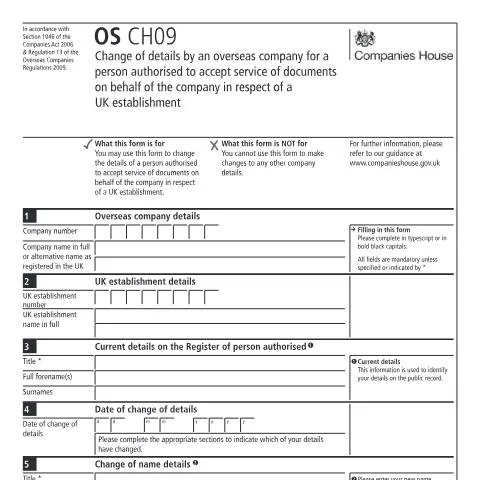
Navigating the OS CH09 can seem daunting, but understanding each section can simplify the process significantly. Here’s a detailed breakdown:- Company Details: This section requires the full company name and the registered company number. Accuracy is paramount; mismatches may lead to processing delays.
- Current Authorized Person Details: You must provide the title, forename(s), and surnames of the authorized person currently registered. This is critical for identifying the correct individual in the public record.
- Change of Details: Here, specify the exact nature of changes. Whether changing the name or the service address, clarity is essential. Remember, the service address does not have to be the personal residential address of the authorized person.
- Date of Change: This date indicates when the changes are effective. Accurate dating helps establish a clear timeline for both the company and any legal correspondences.
- Signature: The form must be signed by an authorized individual—typically a Director, Secretary, or a permanent representative of the overseas company. This signature authenticates the changes being submitted.
Preparing to Fill Out the OS CH09: Necessary Documentation
Before filling out the OS CH09, gather the necessary documentation to ensure a hassle-free experience. Here’s a checklist to prepare:- Ensure you have the company's registered name and number readily available.
- Have the current details of the authorized representative at hand, including any prior registrations.
- Prepare any legal documents that may confirm the identity changes of the authorized representative, especially for name changes.
- Double-check the new service address complies with the requirements—no PO Box numbers unless part of a full address.
Tips for Completing the OS CH09: Avoiding Common Pitfalls
Completing the OS CH09 requires attention to detail. It’s essential to navigate the process without falling into common traps. Here are some practical tips: Use Typescript: Completing the form in typescript or bold black capitals enhances legibility and prevents misunderstandings. Mandatory Fields: Pay careful attention to mandatory fields. Leaving them blank could result in rejection. If a field does not apply, indicate this clearly. Service Address Clarity: Ensure that the service address is a physical location. This is critical; any address that does not meet this criterion will not be accepted. Signature Requirements: Make certain that the form is signed by an appropriate representative of the overseas company. The wrong signatory could invalidate the form.Understanding Submission Channels: Online vs. Paper
The OS CH09 can be submitted through various channels, each with distinct advantages and considerations:| Submission Method | Pros | Cons |
|---|---|---|
| Online Submission | Quick processing, immediate confirmation | Requires a valid Companies House authentication code |
| Paper Submission | No authentication code needed, can be mailed from anywhere | Longer processing times, potential for postal delays |
What Happens After the OS CH09 is Submitted?
Once the OS CH09 is submitted and processed, updates will be reflected on the public register maintained by Companies House. However, there are a few key points to keep in mind: Public Record Implications: All information provided on the OS CH09 will become part of the public record. This includes the new details of the authorized person and their service address. Companies should be mindful of privacy concerns when submitting residential addresses. Confirmation of Updates: After submission, you should receive a confirmation from Companies House. This serves as your assurance that the changes have been accepted and recorded. Ongoing Compliance: It is the company's responsibility to ensure that the information remains current. Should there be further changes, a new OS CH09 must be filed.Exceptions and Special Cases in Filing the OS CH09
While the OS CH09 serves a defined purpose, there are exceptions and special cases that may arise. Understanding these can assist companies in navigating their obligations effectively.- Multiple Authorized Representatives: If a company has more than one authorized representative, it is crucial to specify which representative's details are changing. Failure to do so may lead to confusion.
- Changes in Legal Structure: If an overseas company undergoes a significant change, such as a merger or acquisition, it may need to reassess all filings, including the OS CH09, to ensure compliance across the board.
- Delays in Processing: Companies should be aware that processing times can vary. If updates are urgent, understanding the estimated timeframes and potential delays can aid in planning.
Final Thoughts on the OS CH09
In the realm of international business, ensuring compliance with local laws is paramount. The OS CH09 serves as more than just a form; it’s a vital component of an overseas company’s operational framework in the UK. By keeping the details of the authorized representative updated, businesses protect themselves from potential legal pitfalls and ensure smooth communication with regulatory bodies. Staying informed about the requirements and implications of submitting the OS CH09 can be the difference between seamless operations and legal complications. With careful attention to detail, proper documentation, and an understanding of the submission process, overseas companies can navigate this essential form effectively, paving the way for successful establishment and operation in the UK market.Understanding the Role of an Authorised Person for Service of Documents
In the context of UK establishment operations, the appointment of an authorised person responsible for accepting service of documents is crucial. This individual serves as the point of contact for legal and official communications. An authorised person may include a director, company secretary, or a designated representative. Their role is not only to streamline communication with regulatory bodies but also to ensure that all notices, proceedings, and other legal documents are received promptly and handled appropriately.
Furthermore, the authorised person's responsibility extends beyond simply receiving documents. They must ensure that the establishment complies with the legal requirements as outlined in various legislations, such as the Companies Act 2006 and applicable partnership laws. In the event of a legal dispute or an official inquiry, having a knowledgeable and responsive authorised person can significantly mitigate risks and contribute to effective dispute resolution.
It is also important for businesses to regularly review the suitability of the appointed authorised person. Changes in personnel, shifts in business strategy, or evolving regulatory requirements might necessitate adjusting who is authorised to accept service of documents. Regular training and clear communication about the responsibilities associated with this role can further enhance the effectiveness of the representative.
Steps to Update Authorised Person Information on OS CH09
Updating the details of an authorised person on the OS CH09 form requires careful attention to detail. To initiate the update, you must gather all necessary information, including the full name, residential address, and national insurance number of the person you are designating or removing. It's essential that the new authorised person is eligible and has the capacity to fulfil their duties effectively.
The OS CH09 form must be completed accurately. This includes providing the current details of the existing authorised person, the reason for the change, and the new person's details. If the old authorised person is being removed, ensure that you also indicate whether they have consented to their removal, as this can be a point of contention in the case of disputes.
Once completed, the OS CH09 form should be submitted to Companies House for processing. It's advisable to keep a copy for your records and to send it via a method that allows for tracking, such as recorded delivery. Upon receipt, Companies House will update their records and issue confirmation. Be aware that any changes should be reported swiftly to avoid any potential legal ramifications arising from lapses in communication or service of documents.
Common Challenges and How to Overcome Them
While the process of updating an authorised person's details may seem straightforward, businesses often encounter several challenges. One common issue is the failure to notify Companies House within the required timeframe. This can lead to complications, particularly if legal documents are served to an outdated representative. To mitigate this risk, businesses should implement reminders or a monitoring system to ensure timely updates whenever there are personnel changes.
Another challenge lies in the interpretation of what constitutes a valid authorisation. Companies must be clear on the qualifications and permissions required for a person to accept service of documents. Ambiguities in roles can lead to disputes, especially in larger organisations where responsibilities can be diffused. Setting clear internal policies and ensuring all employees understand the criteria for being an authorised person will help clarify expectations and reduce confusion.
Additionally, when appointing a new authorised person, consider their ability to manage sensitive information. Under the Data Protection Act 2018 and UK GDPR, it's vital that any individual handling personal data is well-versed in compliance obligations. By investing in training for the new representative, organisations can bolster their compliance posture and reduce the risk of mishandled data, particularly during transitions of authority.