The Financial Lifeline for Small-Scale Plant Exporters
For countless small nurseries, university research departments, and independent growers across the UK, the cost of plant health export certification can represent a significant barrier to international trade. A single phytosanitary certificate might cost upwards of £100, making small-scale exports economically unviable. The Animal and Plant Health Agency (APHA) recognises this challenge through its concessionary rates scheme, designed specifically to support micro-businesses and non-commercial exporters who might otherwise be priced out of legitimate plant export markets.
This support mechanism operates through a straightforward application process that can unlock 50% reductions on plant health export services, potentially saving qualifying businesses hundreds of pounds annually. However, the eligibility criteria are precise, and the application process requires careful attention to financial thresholds and VAT registration status.
Eligibility Thresholds: Understanding the Financial Boundaries
The concessionary rates scheme operates on two distinct qualifying pathways, each designed to capture different categories of small-scale exporters. The first pathway focuses on VAT registration status, whilst the second examines export value thresholds from the previous financial year.
VAT Registration Exemption Route
Businesses or individuals not registered for VAT purposes automatically qualify for concessionary rates, regardless of their export volumes. This pathway particularly benefits micro-enterprises whose annual turnover falls below the current VAT registration threshold of £85,000. Many specialist plant nurseries, artisanal growers, and boutique horticultural businesses operate within this bracket, making this the most commonly used qualification route.
The VAT exemption route recognises that businesses choosing to remain below the registration threshold are typically operating at smaller scales where full-price export certification costs would represent a disproportionate burden on profitability.
Low-Value Export Threshold
The alternative qualification route examines the total value of certified plant exports during the previous financial year, running from 1 April to 31 March. Exporters whose certified plant and plant product exports totalled less than £5,000 during this period qualify for concessionary rates, even if they are VAT-registered.
This threshold captures VAT-registered businesses whose plant exports represent only a small portion of their overall commercial activity. For instance, a landscape contractor primarily focused on domestic projects might occasionally export specialist plants to European clients, or a research institution might send plant specimens internationally as part of collaborative studies.
| Qualification Route | Eligibility Criteria | Typical Beneficiaries |
|---|---|---|
| VAT Exemption | Not registered for VAT | Small nurseries, independent growers, micro-businesses |
| Low Export Value | Certified exports < £5,000 (previous financial year) | Occasional exporters, research institutions, diversified businesses |
| Non-Commercial | Private individuals, universities, scientific establishments | Researchers, collectors, educational institutions |
Special Provisions for Non-Commercial Exporters
Beyond the standard commercial criteria, the scheme extends to private individuals making non-commercial exports and recognised educational or scientific institutions. This provision acknowledges that plant movement for research, conservation, or educational purposes serves broader public interests and should not be constrained by commercial certification costs.
Universities conducting botanical research, conservation organisations participating in international breeding programmes, and private collectors engaged in legitimate specimen exchanges all fall within this category. The non-commercial designation requires that exports are not conducted for profit or commercial gain, though institutions may still need to demonstrate their educational or scientific status if requested.
The £750 Annual Ceiling: Managing Concessionary Benefits
The concessionary rates scheme operates within a carefully structured annual limit designed to maintain its focus on genuine small-scale exporters. Successful applicants receive 50% reductions on standard certification fees up to a maximum benefit of £750 per financial year, representing £1,500 worth of full-price services.
This ceiling serves multiple purposes within the scheme's design. It prevents larger commercial operations from exploiting the concession whilst ensuring that genuine small-scale exporters receive meaningful support for their typical export volumes. Once the £750 benefit threshold is reached, any additional services during that financial year are charged at standard rates.
Strategic Planning for Maximum Benefit
Exporters operating near the £750 annual limit often benefit from strategic planning of their certification requirements. Since the financial year runs from April to March, businesses can time their export activities to maximise the value of their concessionary allocation.
For instance, a nursery planning £2,000 worth of certifications might schedule £1,500 worth during their peak season whilst benefiting from the 50% reduction, then manage the remaining £500 at standard rates. This approach ensures maximum utilisation of the available concession whilst maintaining export schedules aligned with growing seasons and market demands.
Navigating the Application Process: Documentation and Submission
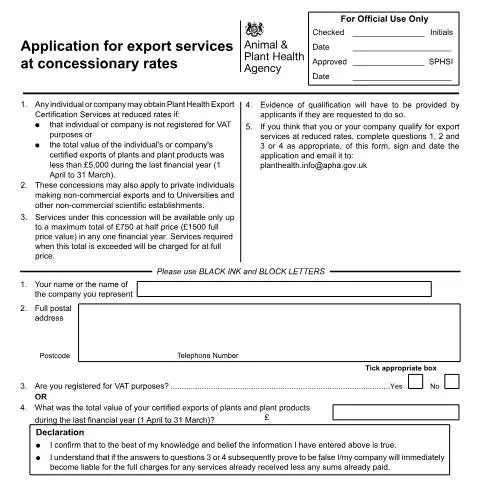
The application form itself is deliberately straightforward, reflecting APHA's commitment to reducing administrative burdens on small-scale exporters. However, the simplicity of the form belies the importance of accurate completion, as errors or inconsistencies can delay processing or result in rejection.
Essential Information Requirements
Section 1 requires the applicant's name or company name exactly as it appears on other official documentation. For sole traders, this should match the name used for any existing APHA registrations or previous export documentation. Limited companies must provide their full registered company name, whilst partnerships should specify the partnership name and trading style if different.
The postal address section demands complete accuracy, as this becomes the primary correspondence address for all future communications regarding the concession. APHA uses this address for service notifications, renewal reminders, and any queries regarding certification applications.
Critical Decision Points: VAT Status versus Export Values
The form's structure requires applicants to complete either Question 3 (VAT registration status) or Question 4 (previous year's export values), not both. This either/or approach reflects the two distinct qualification pathways, and choosing the wrong path can complicate the assessment process.
VAT-registered businesses with low export values should generally opt for Question 4, as this may provide clearer qualification evidence. Conversely, non-VAT registered entities should typically complete Question 3, as their VAT exemption provides the most straightforward qualification route regardless of export volumes.
Critical Note: The export value figure in Question 4 must reflect only certified exports during the specified financial year. Uncertified exports, domestic sales, or exports of non-plant products should not be included in this calculation.
Digital Submission and Processing Timeline
APHA requires electronic submission of completed applications to [email protected], reflecting the agency's broader digital transformation initiatives. The email submission process requires careful attention to file formats and document quality to ensure efficient processing.
Applications should be submitted as clear, legible PDF files with handwritten signatures clearly visible. Poorly scanned or illegible documents frequently result in processing delays whilst APHA requests clarification or resubmission. The requirement for black ink and block letters on the original form serves to enhance digital readability after scanning.
Processing Workflow and Response Times
Once submitted, applications enter APHA's internal assessment workflow, beginning with initial document checking for completeness and legibility. The "For Official Use Only" section on the form indicates the multi-stage approval process, involving both administrative checking and senior phytosanitary inspector (SPHSI) authorisation.
Whilst APHA does not publish specific processing timeframes for concessionary rate applications, the internal workflow suggests approval typically requires several working days. Applicants requiring urgent certification should note that concessionary rate approval must be secured before certification services can be provided at reduced rates.
Evidence Requirements and Verification Procedures
The application form includes a significant caveat regarding evidence provision: applicants may be required to provide qualification evidence if requested. This discretionary verification process allows APHA to conduct targeted checks whilst avoiding blanket documentation requirements that would burden all applicants.
Potential Documentation Requests
For VAT registration claims, APHA may request confirmation of non-registration status from HM Revenue and Customs, particularly for established businesses whose VAT exemption might seem inconsistent with their apparent scale of operations. New businesses or sole traders are less likely to face such scrutiny.
Export value claims typically require more detailed substantiation, potentially including copies of export invoices, previous phytosanitary certificates, or shipping documentation from the relevant financial year. Businesses maintaining detailed export records will find verification requests less burdensome than those with incomplete documentation.
Universities and Scientific Establishments
Educational and research institutions may need to provide evidence of their non-commercial status, particularly if their export activities could be interpreted as having commercial elements. This might include institutional registration details, charity registration numbers, or formal statements regarding the non-commercial nature of specific export activities.
Compliance Monitoring and Penalty Implications
The declaration section of the application form establishes significant legal obligations for applicants, extending beyond the initial application to ongoing compliance throughout the period when concessionary rates apply. The penalty provisions are designed to deter fraudulent applications whilst providing clear consequences for non-compliance.
Retrospective Liability for False Declarations
Applicants who provide false information regarding VAT status or export values face immediate liability for full charges on all services already received under the concession. This retrospective charging means that businesses could face substantial unexpected bills if their qualification status is subsequently challenged.
The penalty calculation requires payment of the difference between full rates and concessionary rates for all services provided, creating potentially significant financial exposure for businesses that have made extensive use of the concession based on incorrect declarations.
Ongoing Compliance Obligations
Successful applicants must maintain their qualifying status throughout the period when they utilise concessionary rates. VAT-exempt businesses that subsequently register for VAT during the financial year should notify APHA immediately, as continued use of concessionary rates after VAT registration would constitute a false declaration.
Similarly, businesses qualifying under the low export value threshold must monitor their cumulative certified export values throughout the financial year. Exceeding the £5,000 threshold during the year may affect eligibility for continued concessionary treatment, depending on the specific circumstances and timing.
Integration with Broader Plant Health Export Requirements
The concessionary rates application represents just one component of the broader plant health export framework administered by APHA. Successful applicants still must comply with all standard plant health requirements, including registration as plant exporters where applicable and adherence to specific certification protocols for their intended destination countries.
The financial concession does not alter the scientific or regulatory standards applied to export certification. Reduced-rate certificates carry identical validity and recognition internationally as those issued at standard rates, ensuring that cost savings do not compromise export credibility or market access.
Relationship with Export Registration Requirements
Many businesses qualifying for concessionary rates will also need to maintain current registration as plant exporters under separate APHA schemes. The annual registration fees for exporter status are distinct from certification costs and are not covered by the concessionary rates scheme, though some registration categories may offer their own fee reductions for small-scale operators.
Exporters should ensure their registration status remains current throughout the period when they plan to utilise concessionary certification services, as lapsed registrations can prevent access to any certification services regardless of approved fee concessions.
Eligibility Verification and Documentation Requirements
Securing concessionary rates for plant health export services requires meticulous documentation to prove your eligibility status. APHA operates a strict verification process that examines both your business credentials and the nature of your export activities.
For small and medium enterprises (SMEs), you'll need to provide your Companies House registration number alongside recent filed accounts demonstrating your turnover falls within qualifying thresholds. The current SME definition follows EU retained law, typically covering businesses with fewer than 250 employees and either turnover below £44 million or balance sheet total under £38 million. However, these thresholds can change, so verify current limits with APHA directly.
Educational institutions must submit evidence of their charitable or non-profit status through their charity registration number or articles of association. Research establishments require additional documentation proving their scientific credentials, such as UKRI recognition or membership of relevant professional bodies. Private research facilities may qualify if they demonstrate genuine scientific research purposes rather than commercial testing activities.
Developing country exporters face a more complex verification process. You'll need to provide evidence that your country appears on the current OECD Development Assistance Committee list or UN Least Developed Countries classification. This status can change periodically, affecting your ongoing eligibility. Additionally, you must demonstrate that the reduced rates genuinely support development objectives rather than simply providing commercial advantage to established businesses operating from these locations.
The documentation timeline proves crucial for maintaining uninterrupted service access. APHA typically requires renewal of eligibility evidence every three years, though they may request updates sooner if circumstances change. Keep digital copies of all submitted documents, as APHA's systems may not retain historical submissions indefinitely.
Particular attention should be paid to corporate structure documentation. If your business operates through multiple entities or has international ownership, APHA will examine the entire corporate structure to determine which entity qualifies for concessionary rates. Subsidiary companies of large corporations rarely qualify, even if the subsidiary itself appears small, as APHA considers the parent company's size and resources.
Seasonal Variations and Capacity Management
Plant health export services experience significant seasonal fluctuations that directly impact both availability and processing times for concessionary rate applications. Understanding these patterns helps you plan submissions strategically and avoid potential delays during peak periods.
Spring months (March through May) typically see the highest demand for export certificates as the growing season commences and fresh produce exports increase substantially. During these periods, APHA inspection teams operate at maximum capacity, and concessionary rate slots may become limited. Priority often goes to established clients with existing agreements, potentially leaving new applicants facing longer wait times or temporary suspension of concessionary rate availability.
Conversely, winter months (December through February) generally offer better availability for new concessionary rate applications. APHA uses these quieter periods for processing complex eligibility assessments and updating their systems. If you're planning to establish concessionary rate access, initiating the application process during these months often yields faster processing and more flexible scheduling for any required inspections.
Harvest season variations affect different product categories distinctly. Fruit exports peak during late summer and autumn, while flower and ornamental plant exports maintain more consistent year-round demand. Grain and seed exports concentrate heavily in post-harvest periods, creating intense pressure on certification services during specific windows.
APHA implements capacity management measures during peak periods that can affect concessionary rate users differently than full-rate clients. While the agency aims to maintain service levels for all users, commercial clients paying standard rates may receive priority scheduling during extreme capacity constraints. This reality makes early booking and flexible timing essential for concessionary rate users.
Geographic variations also influence service availability. Northern England and Scotland typically experience less seasonal pressure than southern regions, where proximity to major ports and higher export volumes create consistent demand. If your business can utilize multiple APHA offices or inspection points, maintaining relationships with less pressured locations can provide valuable flexibility during peak seasons.
Weather-related disruptions compound seasonal challenges unpredictably. Extended wet periods can delay field inspections for growing crop exports, while extreme weather events may force APHA to prioritize emergency certifications over routine applications. Building buffer time into your export planning becomes particularly important when relying on concessionary rate services during vulnerable periods.
Technical Compliance and Quality Standards
Accessing concessionary rates doesn't diminish the technical standards your exports must meet, but it does change how APHA approaches compliance monitoring and quality assurance processes. Understanding these technical requirements prevents costly delays and ensures your concessionary rate status remains secure.
Phytosanitary compliance forms the foundation of all plant health export services, regardless of the rate structure. Your products must meet destination country requirements exactly, with APHA conducting the same rigorous inspections for concessionary rate clients as for standard rate users. However, the inspection scheduling and follow-up procedures may differ, potentially requiring more advance planning from your side.
Laboratory testing requirements remain unchanged under concessionary rates, but the timing and coordination of these tests may require additional attention. APHA's laboratory services operate on commercial timescales, and concessionary rate users cannot expect expedited processing. Plan for standard laboratory turnaround times, which typically range from 5-10 working days for routine tests but can extend significantly during peak periods or for complex analyses.
Traceability documentation assumes heightened importance under concessionary rate arrangements. APHA may conduct more detailed audits of your supply chain documentation to ensure the reduced rates genuinely support qualifying activities. Maintain comprehensive records linking your source materials to final export products, including any intermediate processing or handling stages.
Pest risk assessment procedures apply identically across all rate structures, but concessionary rate users often benefit from educational support that APHA provides to qualifying organizations. This might include guidance on integrated pest management practices or updates on emerging pest threats relevant to your export markets. Take advantage of these educational opportunities, as they can improve your long-term compliance record and reduce inspection complications.
Quality management system requirements vary depending on your export volume and destination countries. While APHA doesn't mandate specific quality systems for concessionary rate access, maintaining robust internal procedures demonstrates professionalism and can expedite future inspections. Consider implementing basic quality management practices even if not formally required, as they often identify potential compliance issues before they affect your exports.
Treatment requirement compliance presents particular challenges under concessionary rate arrangements. Some destination countries mandate specific treatments (fumigation, heat treatment, or irradiation) that must be conducted by approved facilities. APHA maintains lists of approved treatment providers, but concessionary rate users may find limited availability at reduced cost facilities. Investigate treatment options early in your export planning, as this often represents a significant cost component that concessionary rates don't directly address.
Sampling and testing protocols follow standardized procedures regardless of rate structure, but the interpretation and communication of results may receive enhanced explanation for educational institutions and development organizations. APHA recognizes that these users often require deeper understanding of the scientific basis for requirements, and inspectors may provide additional technical context during the certification process.