When a Company Vanishes from the Register: The RT01 Pathway Back
Every year, thousands of UK companies find themselves struck off the Companies House register, often catching directors and shareholders completely off guard. Whether due to missed filing deadlines, administrative oversights, or genuine business closure, the consequences can be severe: frozen bank accounts, voided contracts, and legal limbo for all parties involved. The RT01 form represents the most straightforward route back onto the register, but success hinges on meeting strict statutory conditions and navigating a process that demands both precision and speed.
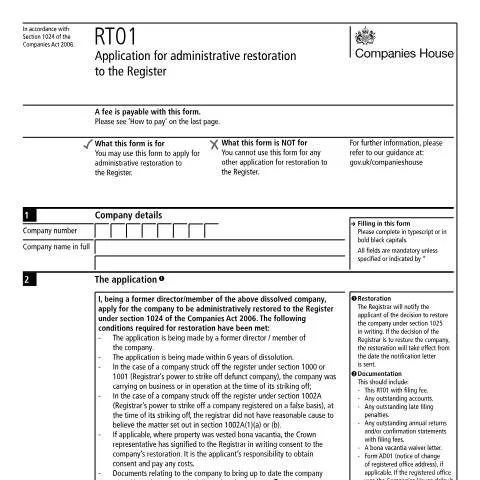
Administrative restoration under section 1024 of the Companies Act 2006 offers a lifeline for dissolved companies, provided they can demonstrate they were genuinely active at the time of striking off and that all stakeholders are prepared to regularise their position. Unlike court restoration, this administrative route keeps costs manageable and timescales predictable, making it the preferred option for most eligible companies.
The Statutory Framework: Why Companies Get Struck Off and How They Return
The Registrar's power to strike companies off the register stems from sections 1000 and 1001 of the Companies Act 2006, designed to clear defunct entities from official records. However, this administrative efficiency sometimes catches active companies in its sweep, particularly those experiencing temporary difficulties or facing director changes during critical filing periods.
Section 1000 strikes typically occur when companies fail to file their confirmation statements or annual accounts within the prescribed timeframes. The Registrar issues warning notices, but if no response materialises within two months, dissolution follows automatically. Section 1001 strikes target companies the Registrar believes have ceased trading, based on intelligence gathered from various sources including HMRC data and third-party reports.
A more serious category emerges under section 1002A, where companies were registered on a false basis—perhaps with fictitious directors or fabricated documentation. These cases require additional scrutiny during restoration applications, as the Registrar must be satisfied that the original concerns no longer apply.
The restoration framework acknowledges that striking off can be disproportionate where companies were genuinely operational. Administrative restoration provides a streamlined remedy, avoiding the expense and formality of High Court proceedings whilst maintaining appropriate safeguards for creditors and the public interest.
The Six-Year Window: Time Limits and Their Implications
The RT01 process operates within a strict six-year limitation period from the date of dissolution. This deadline is absolute—once exceeded, only court restoration remains possible, with significantly higher costs and more complex procedures. The six-year period reflects Parliament's intention to balance restoration opportunities against the need for commercial certainty.
Calculating the deadline requires careful attention to the actual dissolution date, which appears on the company's record at Companies House. This date may differ from when directors first became aware of the striking off, particularly where registered office addresses were outdated or correspondence went astray.
Establishing Eligibility: The Former Director and Member Gateway
Only former directors or members of the dissolved company may submit an RT01 application. This restriction serves multiple purposes: ensuring applications come from parties with legitimate standing, preventing frivolous or malicious restoration attempts, and maintaining continuity with the company's pre-dissolution management structure.
The definition of "former director" encompasses anyone who held office immediately before dissolution, including executive directors, non-executives, and corporate directors. Shadow directors—those who effectively controlled the company without formal appointment—cannot use the RT01 route, though they might pursue court restoration if circumstances warrant.
Former members include all shareholders on the register at dissolution, regardless of their holding size. This provision proves particularly valuable where all directors have since died or become incapacitated, allowing family members or business partners to initiate restoration proceedings.
Corporate Directors and Complex Ownership Structures
Where a dissolved company had corporate directors, the authorised representatives of those corporate entities may sign the RT01 form. However, if the corporate director has itself been dissolved or struck off, restoration becomes significantly more complex, potentially requiring multiple parallel applications.
Group company situations demand careful coordination. If a holding company was struck off before its subsidiaries, the subsidiaries may need restoring first to enable their directors to then restore the parent entity. Professional advice often proves essential in mapping these restoration sequences.
Meeting the Operational Test: Proving Business Activity at Striking Off
For companies struck off under sections 1000 or 1001, applicants must demonstrate the entity was "carrying on business or in operation" at the time of dissolution. This requirement distinguishes between companies that were genuinely dormant and those that remained active despite filing failures.
Evidence of continuing business activity might include bank statements showing transactions, supplier invoices, customer correspondence, or employment records. The test is not whether the company was profitable or successful, but whether it maintained some form of commercial or operational presence.
Companies providing services rather than trading goods often struggle to document their activity convincingly. Professional service providers should retain client correspondence, time records, and evidence of ongoing contractual obligations. Even volunteer-run organisations or dormant companies managing intellectual property may satisfy the operational test if they can demonstrate purposeful activity.
| Type of Evidence | Strength | Common Issues |
|---|---|---|
| Bank transactions | Strong | Personal use of company accounts weakens position |
| Trading invoices | Strong | Must be close to dissolution date |
| Employment records | Moderate | PAYE compliance issues may complicate |
| Property ownership | Moderate | Passive ownership insufficient alone |
| Director intentions | Weak | Must be backed by concrete actions |
The Section 1002A Exception
Companies struck off under section 1002A face a different test. Rather than proving operational status, applicants must demonstrate that the Registrar's original concerns about false registration no longer apply. This might involve providing corrected director details, evidence of genuine business premises, or documentation proving the company's legitimate purpose.
Navigating the Bona Vacantia Maze: Crown Property and Consent Requirements
When companies dissolve, their assets automatically pass to the Crown as bona vacantia (ownerless property). Before restoration can proceed, the relevant Crown representative must provide written consent, acknowledging that the company's assets will revert upon restoration.
The Treasury Solicitor handles bona vacantia matters for England and Wales, whilst the Queen's and Lord Treasurer's Remembrancer covers Scotland. Each jurisdiction maintains its own procedures and fee structures for processing waiver applications.
Obtaining bona vacantia consent often proves the most time-consuming aspect of the RT01 process. Crown representatives may require detailed asset schedules, valuations for significant property holdings, or undertakings regarding outstanding liabilities. Where assets have already been sold by the Crown, restoration may require compensation payments or complex legal arrangements.
Property Complications and Leasehold Issues
Companies holding leasehold property face particular challenges. Dissolution typically triggers lease forfeiture clauses, meaning landlords may have re-let premises or claimed damages. The bona vacantia waiver cannot restore contractual rights that have been legitimately terminated, leaving restored companies potentially without their former premises.
Freehold property presents different issues. Where the Crown has sold company property to third parties, restoration cannot disturb those transactions. The restored company may receive compensation equivalent to the sale proceeds, but cannot reclaim the original assets.
Bringing Records Current: The Documentation Mountain
Administrative restoration requires complete regularisation of the company's filing obligations. This means submitting all overdue accounts, confirmation statements, and associated penalties before the RT01 application can succeed.
Outstanding accounts must cover every period from the company's last filed accounts through to dissolution. Where the company traded for several years without filing, this can involve multiple sets of accounts, each requiring professional preparation and audit (where applicable). The accounts must reflect the company's true financial position at each year-end, not simplified "dormant company" versions.
Confirmation statements (or annual returns for older periods) must similarly bring the company record completely up to date. These forms capture changes in directors, secretaries, shareholders, and registered office addresses during the relevant periods.
Penalty Calculations and Payment Strategies
Section 453 penalties for late filing accumulate during the period between due dates and dissolution. These penalties follow a structured tariff based on company size and delay period, but can reach substantial amounts for companies with extended non-compliance.
Crucially, the RT01 form confirms that companies are not liable for penalties relating to periods where the filing deadline fell after dissolution but before restoration. This relief prevents the accumulation of penalties during the struck-off period, but does not affect penalties that accrued before dissolution.
Payment of all outstanding penalties must accompany the RT01 application—Companies House will not accept instalment arrangements or post-restoration payment plans. This requirement often forces applicants to seek emergency funding or negotiate with creditors before proceeding.
The Alternative Name Strategy: When Original Identity Is Lost
Section 66 of the Companies Act 2006 prohibits companies from registering names identical to those already on the Companies House index. If another entity has adopted the dissolved company's name during the striking-off period, restoration under the original name becomes impossible.
The RT01 form provides space for specifying an alternative name, subject to standard name approval rules under sections 54 and 55. This alternative name strategy allows restoration to proceed while preserving the company's legal identity and continuity.
Where no alternative name is specified and the original name has become unavailable, Companies House will restore the company using its company number as its name. The restored entity then has precisely 14 days to adopt a proper name through director resolution, with criminal liability attaching to failure to comply within this deadline.
Name Selection Tactics and Trademark Considerations
Selecting an appropriate alternative name requires careful consideration of business continuity, trademark implications, and customer recognition factors. The new name must comply with sensitive words restrictions and cannot suggest governmental connection or professional status without appropriate authorisation.
Companies with valuable brand recognition might consider reserving alternative names before submitting their RT01 application, though this involves additional expense and cannot guarantee availability when restoration actually occurs.
Submission Mechanics and Post-Application Management
The RT01 application must be submitted as a complete package, with all supporting documentation and fees enclosed. Partial submissions or instalment payments will result in rejection and delay, potentially jeopardising the six-year deadline where time is tight.
The restoration fee varies depending on the application's complexity and any name change requirements. Additional fees apply for each overdue filing being regularised, creating potentially substantial total costs for companies with extended non-compliance periods.
Companies House processes RT01 applications in strict chronological order, with current processing times typically ranging from 4-8 weeks for straightforward cases. Complex applications involving property issues or multiple years of missing filings may take significantly longer.
Authentication Requirements and Digital Signatures
The RT01 form requires authentication by the former director or member making the application. Unlike many Companies House forms, handwritten signatures are not required—printed names suffice for the statement of compliance section.
This authentication creates personal liability for the accuracy of statements made in the application. False declarations may result in criminal prosecution under section 1112 of the Companies Act 2006, carrying potential fines and imprisonment.
Restoration Effects and Immediate Post-Revival Actions
Successful restoration takes effect from the date Companies House sends its notification letter, not from any later date when recipients actually receive the communication. This timing proves crucial for calculating limitation periods, contractual deadlines, and compliance obligations.
The restored company is treated as though it never ceased to exist, with legal continuity preserved throughout the dissolution period. However, this legal fiction cannot reverse practical consequences that occurred during the striking-off period, such as terminated contracts, expired licences, or third-party actions taken in reliance on the dissolution.
Immediate priority actions following restoration include updating bank mandates, notifying key suppliers and customers, renewing any professional registrations or licences that lapsed during dissolution, and ensuring HMRC records reflect the company's restored status for Corporation Tax and VAT purposes.
Directors should also review the company's insurance position, as most policies will have lapsed during dissolution. Professional indemnity cover, in particular, may need backdating to ensure continuous protection for pre-dissolution activities.
Creditor Implications and Debt Recovery Rights
Restoration revives all debts and obligations that existed at dissolution, potentially exposing directors and shareholders to renewed creditor pressure. However, creditors who took steps to write off debts or claim against other parties during the dissolution period cannot simply reverse those actions.
The six-year limitation period for debt recovery continues to run during dissolution, meaning very old debts may have become statute-barred by the time restoration occurs. This provides some protection against historical creditor claims, though recent liabilities remain fully enforceable.