When Your European Licence Meets British Roads
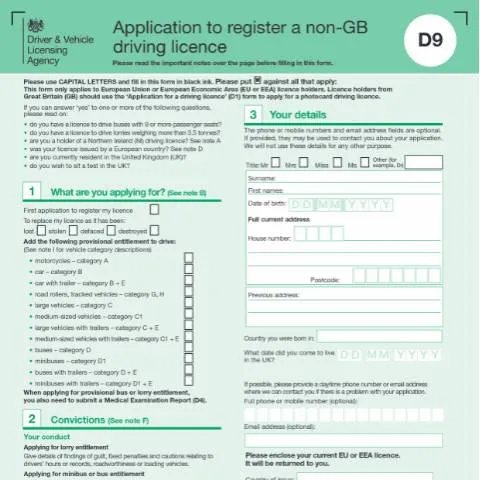
Moving to the UK with a European driving licence creates an immediate administrative challenge that many newcomers underestimate. The D9 form represents the formal gateway between your existing EU or EEA driving credentials and the British licensing system. Far from being a simple paperwork exercise, this application triggers a comprehensive assessment process that determines your ongoing mobility rights across Great Britain.
The Driver and Vehicle Licensing Agency processes thousands of these applications annually, each representing someone navigating the transition from European to British driving regulations. Whether you're a recent arrival establishing residence or someone whose circumstances have changed following Brexit, the D9 form demands careful attention to detail and thorough preparation.
The Legal Framework Behind Registration Requirements
The obligation to register non-GB licences stems from fundamental changes in UK legislation, particularly affecting Northern Ireland licence holders since April 2009. The law now requires anyone establishing residence in Great Britain who drives buses with nine or more passenger seats, or vehicles exceeding 3.5 tonnes, to complete this registration process within twelve months of taking up residence.
This legislative shift reflects broader concerns about road safety standards and the need for consistent driver monitoring across the UK. The DVLA's approach recognises that while European driving standards remain robust, the administrative oversight must align with British systems for enforcement, medical monitoring, and licence renewal procedures.
The registration process serves multiple purposes beyond simple record-keeping. It establishes your driving history within the British system, ensures continuity of medical oversight for specific conditions, and creates the administrative foundation for future licence renewals or upgrades.
Brexit Implications and Transition Arrangements
European Union and European Economic Area licence holders face different requirements depending on when they established UK residence. Those who became residents before specific transition deadlines may benefit from more lenient exchange arrangements, while recent arrivals must navigate the full registration process outlined in the D9 form.
The form explicitly states that it applies to "European Union or European Economic Area (EU or EEA) licence holders" and directs Great Britain residents to use the alternative photocard driving licence application for certain circumstances. This distinction reflects the complex interplay between residency status, licence origin, and current UK immigration policies.
Decoding Vehicle Categories and Provisional Entitlements
Section 1 of the D9 form presents an extensive matrix of vehicle categories that often confuses applicants unfamiliar with British licensing classifications. The form distinguishes between first applications and replacement applications for lost, stolen, defaced, or destroyed licences, each triggering different processing requirements.
| Category | Vehicle Type | Minimum Age | Special Requirements |
|---|---|---|---|
| A | Motorcycles | Variable | Progressive licensing system |
| B | Cars up to 3.5 tonnes | 17 (16 with conditions) | Most common category |
| C | Large vehicles | 21 | Professional use focus |
| D | Buses and coaches | 21-24 | Medical examination required |
The provisional entitlement section allows applicants to add categories beyond their current licence scope. However, this triggers additional requirements including medical examinations for bus and lorry categories. The form specifically notes that "when applying for provisional bus or lorry entitlement, you also need to submit a Medical Examination Report (D4)".
Age-Related Driving Privileges and Restrictions
British licensing incorporates numerous age-based variations that may differ significantly from your original European licence conditions. For instance, category B holders can drive cars with trailers (B + E) subject to specific weight limitations, while moped categories (p and q) have cylinder capacity restrictions that vary by engine type and design speed.
Agricultural tractors (category f) and tracked vehicles (category h) represent specialised categories often overlooked by urban applicants but crucial for rural residents. The minimum age requirements range from 16 for certain moped categories to 24 for specific bus configurations, creating a complex web of entitlements that must align with your current driving needs.
Navigating the Conviction Declaration Minefield
Section 2 addresses driving convictions with a level of detail that surprises many applicants. The form requires disclosure of all findings of guilt, fixed penalties, and cautions relating to drivers' hours, records, roadworthiness, or vehicle loading—categories that extend well beyond typical traffic violations.
The conviction table demands specific information including court details, offence descriptions, and sentence particulars. Applicants must use separate sheets if necessary, and the form emphasises that "all endorsements on your licence will be taken into account when it is decided whether to give you entitlement to drive in GB".
This comprehensive approach reflects the DVLA's commitment to road safety and the interconnected nature of European driving records. Convictions from any EU member state remain relevant to your UK driving privileges, and attempts to conceal previous violations can result in application rejection and potential fraud charges.
The Four-Year Rule and Disclosure Obligations
While many driving convictions become "spent" after specific periods, the D9 form requires disclosure of "any convictions if they were more than 4 years ago" for certain categories. This extended disclosure period applies particularly to professional driving categories and reflects the heightened safety standards expected for commercial vehicle operators.
Bus and lorry drivers face additional scrutiny, with the form explicitly requesting information about any court findings related to professional driving conduct. The Traffic Commissioner's role in determining large goods and passenger carrying vehicle entitlements adds another layer of assessment beyond standard DVLA processing.
Medical Conditions and the Health Assessment Process
The medical conditions section represents one of the most comprehensive health screenings in UK administrative forms. The extensive list covers conditions ranging from diabetes requiring insulin to chronic neurological conditions such as multiple sclerosis, motor neurone disease, and Huntington's disease.
Applicants must declare conditions affecting vision, including "visual field issued caused by any condition (apart from wearing glasses or corrective lenses)" and specify whether they affect both eyes or only the remaining eye in cases of monocular vision. The form explicitly excludes colour blindness and short or long sight from routine disclosure requirements.
Mental health conditions receive significant attention, with requirements to declare serious memory problems, persistent drug or alcohol misuse, and conditions causing excessive sleepiness such as Obstructive Sleep Apnoea Syndrome. The latter condition has become increasingly recognised as a road safety concern, with specific guidance available through the DVLA's dedicated information resources.
Immediate Notification Requirements and Ongoing Obligations
The form establishes ongoing obligations beyond the initial application, stating that applicants "must tell us immediately about a relevant condition if the condition gets worse". Failure to comply can result in fines up to £1,000 and potential prosecution under road traffic legislation.
The medical assessment process may trigger additional requirements including specialist medical reports, regular review periods, or licence restrictions. Some conditions may result in shorter licence validity periods, requiring more frequent renewal and medical reassessment.
The Application Submission Process and Documentation Requirements
Successful D9 submission requires your current EU or EEA licence, which the form explicitly states "will be returned to you" following processing. This assurance addresses common concerns about losing original documentation during the application process, though applicants should retain photocopies for their records.
The personal details section includes optional fields for phone numbers and email addresses, described as tools to "contact you about your application" if problems arise. While optional, providing contact information significantly reduces processing delays when clarification becomes necessary.
Address information requires both current and previous addresses, with specific provisions for applicants who have recently arrived in the UK. The country of birth field and UK arrival date help establish residency timelines crucial for determining application eligibility and processing requirements.
Processing Timelines and Application Tracking
The DVLA processes D9 applications according to complexity and completeness. Complete applications with clear documentation typically process faster than those requiring additional medical information or conviction verification. Applications involving provisional entitlements for commercial vehicle categories face extended processing due to medical examination requirements.
The form reference D9-1223 suggests regular updates to application procedures, with the DVLA maintaining current versions through their official distribution channels. Using outdated forms can result in processing delays or application rejection, emphasising the importance of obtaining current documentation.
Post-Application Procedures and Licence Integration
Following successful processing, applicants receive British driving licence documentation that replaces their European credentials for UK driving purposes. The new licence incorporates all validated entitlements from the original European licence, subject to UK-specific restrictions or medical conditions identified during assessment.
The integration process creates a new driver record within the DVLA system, establishing the administrative foundation for future interactions including licence renewals, address changes, and penalty point administration. This British record becomes the primary reference for all UK driving-related matters, regardless of your original licensing authority.
Licence holders must understand that their new British licence operates under UK renewal cycles and medical review requirements, which may differ significantly from their original European arrangements. Bus and lorry drivers, in particular, face more frequent medical assessments and licence reviews than standard car drivers.
The successful completion of D9 processing marks the beginning of full integration into the British licensing system, with all the rights, obligations, and administrative requirements that entails. Understanding these ongoing commitments proves as crucial as navigating the initial application process itself.
Understanding Licence Categories and Entitlements When Registering
When completing form D9, one of the most critical sections involves accurately translating your foreign driving licence categories into the corresponding UK equivalents. The DVLA must determine which vehicle types you're authorised to drive based on your original licence, and this process can be surprisingly complex depending on your country of origin.
European driving licences typically follow harmonised categories (A1, A2, A, B, C1, C, D1, D), making the conversion relatively straightforward. However, licences from countries outside the European Economic Area often use entirely different classification systems. For instance, a standard car licence in Australia or Canada might be listed as "Class C" or "Class 5", which the DVLA must interpret and match to the UK's Category B entitlement.
The challenge becomes more pronounced with commercial vehicle categories. A Heavy Goods Vehicle licence from New Zealand or South Africa may encompass different weight limits or vehicle specifications than UK Category C or C+E entitlements. Similarly, motorcycle licences from countries like India or Thailand might not directly correspond to the UK's progressive A1/A2/A system, particularly regarding engine capacity restrictions and age-related limitations.
When filling out the D9 form, you'll need to provide detailed information about each category on your foreign licence, including any restrictions or endorsements. The DVLA may request additional documentation to clarify specific entitlements, particularly for unusual or specialised vehicle categories. This might include official translations of licence details, correspondence from the issuing authority explaining local categories, or evidence of practical driving tests completed in your home country.
Be particularly careful about automatic transmission restrictions. Many countries don't distinguish between manual and automatic licences, whilst others have different approaches to this limitation. The DVLA will typically impose an automatic-only restriction (code 78) if your original test was conducted in an automatic vehicle, regardless of how your home country's licence appears.
Provisional entitlements present another consideration. Some foreign licences grant immediate access to larger vehicles upon reaching certain ages, without requiring separate tests. The UK system, however, maintains strict separation between categories, so you may find that whilst you can drive a car, you'll need to apply separately for motorcycle or lorry provisional entitlements, even if these were included in your original licence.
Medical Requirements and Health Declarations
The D9 application process includes mandatory health declarations that can significantly impact the outcome of your registration. Unlike some countries where medical fitness is assumed unless declared otherwise, the UK system requires active confirmation of your ability to drive safely, with specific attention to conditions that might affect your driving capability.
The medical section of form D9 covers a comprehensive range of conditions, from obvious impairments like visual problems or epilepsy to less apparent issues such as sleep disorders, diabetes requiring medication, or mental health conditions. The DVLA's approach reflects the Medical Standards of Fitness to Drive guidelines, which establish clear criteria for various medical conditions and their impact on driving safety.
Certain medical conditions trigger automatic referral to DVLA's medical team, regardless of how well-controlled they might be. These include any history of seizures or blackouts, insulin-treated diabetes, significant cardiovascular conditions, or conditions affecting limb function. If you have any of these conditions, expect your D9 application to take considerably longer as medical reports may be requested from your GP or specialist consultants.
The complexity increases for applicants who've been receiving medical treatment abroad. The DVLA may struggle to interpret foreign medical documentation, particularly if it's not in English or doesn't follow UK medical reporting standards. You might need to arrange for independent medical examinations with UK-registered practitioners to satisfy the DVLA's requirements, adding both time and cost to your application.
Age-related medical requirements also apply differently depending on your licence categories. Whilst standard car drivers face medical declarations at age 70, holders of lorry or bus licences must undergo regular medical examinations from age 45, with renewals required every five years initially, then annually after age 65. If your foreign licence includes these categories, you'll need to factor in these ongoing requirements when deciding whether to register your licence or pursue UK-specific qualifications instead.
Mental health declarations require particular sensitivity and accuracy. The DVLA needs to assess conditions like severe depression, anxiety disorders, or personality disorders that might affect driving judgment or reaction times. However, many common mental health conditions don't preclude driving, provided they're appropriately managed and don't involve medication that causes drowsiness or impaired concentration.
Be aware that making false declarations on form D9 constitutes an offence under road traffic legislation. The DVLA cross-references medical information with other government databases and may discover undeclared conditions through various means. It's always preferable to declare a condition and receive appropriate guidance rather than risk prosecution for providing false information.
Post-Application Process and Licence Issuance
Once your D9 form reaches the DVLA, the processing journey involves several distinct stages, each with potential complications that can extend timelines significantly beyond standard expectations. Understanding this process helps manage expectations and identify when intervention might be necessary.
Initial processing involves administrative verification of your submitted documentation. DVLA staff check that all required fields are completed, signatures are present, and supporting documents are included. Incomplete applications are typically returned within two to three weeks, but this immediate rejection can be frustrating if you've already surrendered your foreign licence or are relying on the new licence for employment purposes.
The verification stage involves checking your foreign licence against DVLA databases and international agreements. For EU licences, this process is relatively automated through established data-sharing arrangements. However, licences from countries without formal agreements require manual verification, potentially involving correspondence with foreign driving authorities. This stage alone can add months to processing times, particularly for countries with limited English-language administrative capabilities.
Medical assessments, where required, introduce additional variables into processing times. Simple medical declarations might be resolved within the standard processing period, but complex cases requiring specialist medical reports can extend processing by several months. The DVLA's medical team works with significant backlogs, and obtaining appointments with appropriate medical specialists can prove challenging, particularly in areas with limited NHS capacity.
Quality assurance checks form part of the final processing stage. The DVLA reviews applications for consistency, ensuring that granted entitlements align with provided evidence and that any restrictions or endorsements are correctly applied. This stage also involves generating your new UK licence number and updating central driving records systems.
Your new UK licence, when issued, will bear a different format than your original foreign licence. The paper counterpart system was abolished in 2015, so all entitlements and endorsements appear on the photocard licence itself. The licence number follows the UK's specific format, incorporating elements of your name and birth date, and this number becomes your permanent identifier for all future UK driving-related matters.
Importantly, the DVLA doesn't always grant identical entitlements to those held on foreign licences. Restrictions may be applied based on age, medical conditions, or uncertainty about original testing standards. Some applicants receive licences with fewer categories than expected, requiring additional UK tests to regain full entitlements. Others might find automatic transmission restrictions applied, even if their original licence carried no such limitation.
If problems arise during processing, the DVLA's customer contact options are limited but important to understand. Written correspondence remains the most reliable method for complex queries, though response times can be lengthy. Phone contact is available for urgent matters, but expect significant waiting times and limited ability to discuss complex technical issues over the phone.