When Your Water Rights Face an Expiry Deadline: The Essential Renewal Process
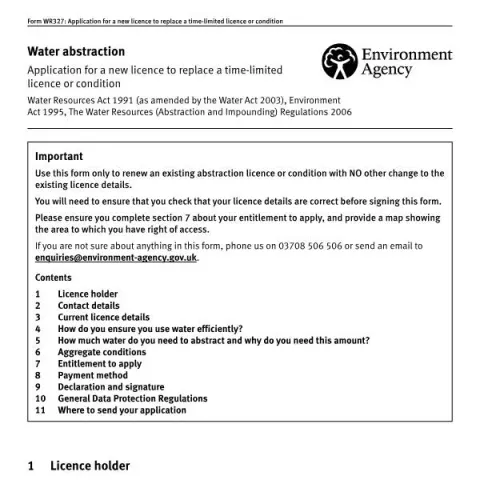
Picture this: your agricultural operation, manufacturing facility, or construction project depends on a steady water supply from a nearby river, borehole, or aquifer. Your current abstraction licence carries an expiry date that's approaching fast, and without action, your legal right to extract water will simply cease. The Form WR327 represents your lifeline—a streamlined renewal application designed specifically for licence holders who need to extend their existing water abstraction rights without making any changes to the original terms.
This isn't just another bureaucratic hurdle. Water abstraction licences protect both your commercial interests and the environment by ensuring sustainable use of precious water resources. When your time-limited licence or condition reaches its natural end, the Environment Agency requires formal confirmation that you still need the water, that you're using it efficiently, and that your legal entitlement to abstract remains valid.
The WR327 form serves a highly specific purpose: it's exclusively for straight renewals where nothing changes except the validity period. If you need to modify extraction volumes, alter abstraction points, or change the purpose of use, you'll need a different application process entirely. This distinction matters enormously—using the wrong form can delay your renewal by months.
Who Must Navigate This Renewal Pathway
The WR327 application pathway applies to a surprisingly diverse range of water users across England. Your renewal obligation kicks in if you hold any time-limited water abstraction licence or operate under temporary conditions that are due to expire.
Agricultural operators form the largest user group, particularly those running irrigation systems for crop production, livestock watering facilities, or spray irrigation for fruit orchards. Many agricultural licences were issued with fixed terms to allow the Environment Agency to review changing farming practices and seasonal water demands.
Industrial users represent another significant category. Manufacturing plants that use water for cooling systems, food processors requiring water for cleaning and production, and construction companies operating dewatering systems all commonly hold time-limited licences. Quarries and mines frequently operate under temporary abstraction conditions while their long-term water management plans are being finalised.
| Licence Type | Common Renewal Scenarios | Typical Validity Period |
|---|---|---|
| Agricultural irrigation | Seasonal crop watering, orchard maintenance | 5-15 years |
| Industrial process | Manufacturing cooling, food processing | 10-20 years |
| Construction dewatering | Temporary site drainage, foundation work | 1-3 years |
| Public water supply | Community boreholes, emergency supplies | 12-25 years |
Public bodies and utilities also use this renewal route. Parish councils managing community boreholes, housing associations operating private water supplies, and even golf courses maintaining irrigation systems all fall within the scope of WR327 renewals.
Timing Your Renewal Application: Critical Windows and Deadlines
The Environment Agency doesn't publish a universal timeline for renewal applications, but practical experience suggests submitting your WR327 form at least six months before your current licence expires. This buffer period accounts for processing delays, potential requests for additional information, and the possibility that your renewal might require more detailed assessment than initially anticipated.
Your current licence document clearly states the expiry date, usually found in the top section alongside your licence number. Some licences expire on specific calendar dates, while others end at the conclusion of defined periods like "five years from the date of issue." Don't assume you'll receive an automatic reminder—the responsibility for timely renewal rests entirely with you as the licence holder.
Processing times vary significantly depending on the complexity of your water source and local environmental pressures. Simple groundwater abstractions in low-risk areas might be renewed within 8-12 weeks, while surface water abstractions in environmentally sensitive catchments could take 4-6 months or longer. The Environment Agency prioritises applications based on environmental risk, not submission order.
If you submit your renewal application before your current licence expires, you benefit from statutory continuation—your existing abstraction rights remain valid while the renewal is being processed. However, this protection only applies if your application is complete and submitted before the expiry date. Late applications receive no such safeguard, potentially leaving you without legal authority to abstract water.
Completing the WR327: Section-by-Section Navigation
The WR327 form demands precision and consistency with your existing licence documentation. Any discrepancies between your renewal application and current licence details can trigger delays or requests for clarification.
Section 1 (Licence Holder) requires the exact name as it appears on your existing licence document. This might be your personal name, company name, or the name of an organisation. If your business has changed names since the original licence was issued, you cannot use WR327—you'll need a separate licence transfer process first.
The contact details section seems straightforward but carries hidden importance. The Environment Agency will use these details for all future correspondence about your licence, including renewal decisions, compliance matters, and emergency notifications. Providing a mobile number proves particularly valuable during flood events or drought conditions when the Agency needs to contact abstractors urgently.
Current licence details demand careful attention to the 12-character national grid reference. This isn't the same as a postcode—it's a precise geographic coordinate that pinpoints your abstraction location. The format follows the pattern "ST 12345 67890" where the letters indicate the 100km grid square and the numbers provide increasing precision. If you're unsure of the correct grid reference, online mapping tools can help, but verify this matches your licence document exactly.
Section 4's question about water efficiency measures allows you to demonstrate environmental responsibility. The Environment Agency expects concrete examples: "Irrigating between 10pm and 6am to reduce evaporation losses," "Installing soil moisture sensors to prevent over-watering," or "Conducting monthly leak detection surveys on all distribution pipework." Generic statements like "we use water efficiently" won't suffice.
Justifying Your Water Requirements: The Critical Assessment
Section 5 represents the most scrutinised part of your renewal application. The Environment Agency will compare your stated water needs against your historical abstraction returns, weather data, and any changes in your operation since the original licence was granted.
Your explanation must demonstrate both reasonable need and efficient use. For agricultural applications, this might involve calculating irrigation requirements based on crop types, soil conditions, and typical rainfall patterns. Industrial users should reference production capacity, cooling requirements, or process specifications. Construction projects need to justify dewatering volumes based on excavation plans and groundwater levels.
The Environment Agency maintains detailed records of your actual water use through mandatory quarterly returns. If your renewal application requests the same volumes as your current licence, but your returns show you've consistently used much less, expect detailed questions about why you need the full allocation. Conversely, if you've been abstracting close to your licensed limits, this supports your case for renewal at current levels.
Seasonal variation deserves particular attention. Many agricultural licences include higher summer allocations for irrigation, while some industrial processes require more water during peak production periods. Your justification should explain these patterns and relate them to your operational needs.
Legal Entitlement and Access Rights: Proving Your Authority
Section 7 addresses a fundamental legal requirement that many applicants underestimate. Water abstraction licences don't grant access rights to land—they only permit water extraction if you have legal authority to be there. The Environment Agency needs assurance that your land rights will continue for at least the duration of your renewed licence.
If you own the land outright, this section is straightforward—tick "occupier" and provide a map showing your property boundaries. However, many water abstractors operate under more complex arrangements. Tenant farmers, contractors, and utility companies often need to demonstrate their rights through lease agreements, access licences, or statutory powers.
The mapping requirement isn't optional. You must provide a clear plan showing the exact area where you have access rights, marked in a distinctive way (typically outlined in red). This map should align with your abstraction point's grid reference and show sufficient detail for Environment Agency officers to verify your access rights during site inspections.
For operators with multiple abstraction points or complex access arrangements, additional documentation becomes essential. A tenant farmer with rights across several fields, or a utility company with easements across private land, should provide detailed schedules showing access rights for each location.
Payment Methods and Processing Procedures
The Environment Agency's Abstraction Charges Scheme sets renewal application fees based on your licence type and abstraction volumes. These fees change annually and vary significantly—a small agricultural borehole might cost £135 to renew, while a large industrial surface water licence could require fees exceeding £1,500.
Online payment through the gov.uk portal offers the most efficient route, generating immediate confirmation and linking your payment directly to your application. The system requires a specific reference format: "PSCAPPWR" followed by the first five letters of your name or company, then a unique numerical identifier. For example, "PSCAPPWRSMITH001" or "PSCAPPWRACMEC002".
Traditional payment methods remain available but create additional administrative steps. Cheque payments must be made payable to "Environment Agency" and include your licence number on the reverse. Bank transfers require separate notification to link the payment to your application.
The declaration section carries legal weight—your signature confirms that all information provided is accurate and complete. False or misleading information can result in licence refusal, prosecution, or future compliance action. The Environment Agency has powers to verify details through site inspections, cross-referencing with other regulatory databases, and requesting additional evidence.
After Submission: Assessment Timeline and Decision Outcomes
Once your complete WR327 application reaches the Environment Agency, it enters a structured assessment process that balances your operational needs against environmental protection requirements. The Agency's decision-making framework considers water availability, environmental impact, and compliance with current water resources policies.
Initial processing involves technical review of your application details, verification of payment, and checks against your abstraction returns database. Applications with clear justifications, consistent historical use, and no environmental concerns typically progress smoothly through this stage.
More complex cases trigger detailed assessment procedures. The Environment Agency might request additional technical information, conduct site visits, or consult with other regulatory bodies. Applications in water-stressed catchments face particular scrutiny, especially where environmental designations or habitat protection requirements apply.
Three primary outcomes emerge from the renewal process. Straightforward approval results in a new licence with identical terms to your existing permit, simply extending the validity period. Conditional approval might impose additional monitoring requirements, seasonal restrictions, or efficiency improvements. Refusal occurs when water availability has declined, environmental impacts have increased, or your justification proves inadequate.
Successful renewals generate new licence documents that replace your existing permits entirely. These documents carry fresh validity periods, updated contact details, and current regulatory references. Your old licence becomes invalid immediately when the new permit takes effect, so ensure your records reflect this change for compliance monitoring and future renewal planning.
Monitoring and Compliance Requirements During the Renewal Process
Renewing your water abstraction licence involves demonstrating ongoing compliance with monitoring obligations established under your current licence. The Environment Agency requires detailed records of actual abstraction volumes, typically recorded through approved flow meters or measuring devices installed at specified points.
Monthly abstraction returns must be submitted via the Environment Agency's online portal, showing volumes abstracted against your licensed quantities. These returns become crucial evidence during renewal assessments, particularly where you're requesting increased abstraction limits or modified conditions. Missing or inconsistent returns can significantly delay your renewal application or result in reduced allocations.
Water quality monitoring data may also be required, especially for abstractions near sensitive environmental sites or where return flows affect watercourses. This includes temperature monitoring for cooling water abstractions, or chemical analysis where industrial processes are involved. The frequency and parameters depend on your specific licence conditions and local environmental sensitivities.
Environmental monitoring extends beyond your immediate abstraction point. For significant abstractions, you may need to demonstrate that local water levels, river flows, or wetland conditions remain within acceptable parameters. This often involves collaboration with the Environment Agency's monitoring networks or independent environmental consultants.
Fill in your form directly online
No printing: type your details into the boxes of the official form, tick, then download the PDF ready to send.
- 1Type into the form boxes
- 2Tick in one click
- 3Save and download the PDF
Compliance with abstraction timing restrictions proves particularly important during drought periods. Your renewal application must show adherence to hands-off flow conditions, seasonal restrictions, or emergency drought measures implemented during your current licence period. Non-compliance history can influence both renewal decisions and future licence conditions.
Modern digital monitoring systems increasingly replace manual recording, with telemetry systems providing real-time data to both licence holders and regulators. While not mandatory for all abstractions, these systems often support renewal applications by providing comprehensive, verifiable abstraction records that demonstrate responsible water use.
Modifications and Variations During Licence Renewal
Licence renewal presents an opportunity to modify existing conditions, though this requires careful justification and may trigger additional assessment processes. Common modification requests include increasing abstraction volumes, extending abstraction periods, adding new abstraction points, or changing the purpose of use.
Volume increases require robust justification based on demonstrated need, whether for business expansion, population growth, or operational efficiency improvements. The Environment Agency applies the same assessment criteria used for new applications, including water availability studies and environmental impact assessments. Existing licence holders don't automatically qualify for increased allocations, particularly in water-stressed catchments.
Seasonal timing modifications often reflect changing operational requirements or climate adaptation strategies. Agricultural abstractions might request earlier spring access due to changing growing seasons, while industrial users may seek extended winter abstraction periods to build strategic reserves. Each timing change requires environmental assessment to ensure continued protection of sensitive periods for fish spawning, bird nesting, or low flow conditions.
Adding new abstraction points within your existing licence area involves detailed hydrogeological assessment, particularly for groundwater abstractions. The cumulative impact of multiple abstraction points must be evaluated, considering potential interference effects and impacts on other licence holders or environmental features.
Purpose modifications require careful consideration of water use efficiency and return flow characteristics. Converting from agricultural to industrial use, for example, might involve different peak demand patterns, water quality requirements, and discharge arrangements. The Environment Agency evaluates whether proposed new uses represent efficient water utilisation and align with local water resource management objectives.
Temporary modifications during the renewal process can address urgent operational needs while permanent variations are assessed. Emergency provisions exist for drought response, though these typically involve reduced rather than increased abstraction rights.
Trading opportunities may arise during renewal, allowing licence holders to transfer unused allocations to other users within the same catchment. This market-based approach promotes efficient water allocation while maintaining overall environmental protections, though complex administrative procedures govern such transfers.
Economic Assessment and Charging Implications
Water abstraction charging significantly influences renewal decisions, with the Environment Agency's charging scheme reflecting both administrative costs and environmental impact factors. Understanding the charging structure helps licence holders evaluate the economic viability of continued abstraction versus alternative water supply options.
Standard unit charges vary by source type, with groundwater abstractions generally incurring lower charges than surface water abstractions due to different environmental risks and management costs. Tidal water abstractions attract the lowest charges, reflecting minimal resource scarcity concerns, while abstractions from highly regulated rivers face premium rates.
Volume-based charging creates direct incentives for efficient water use, with charges calculated on licensed volumes rather than actual abstraction. This encourages licence holders to request only necessary volumes and surrender unused allocations during renewal. Some licence types qualify for reduced charges, including agricultural abstractions below certain thresholds and spray irrigation during winter periods.
Environmental enhancement charges apply in catchments where abstraction pressures threaten environmental objectives. These higher charges fund habitat restoration, river enhancement projects, or alternative supply development that reduces pressure on stressed water resources. The Environment Agency publishes catchment-specific enhancement areas where these charges apply.
Multi-year charging arrangements provide cost certainty for business planning, particularly valuable for industrial or commercial operations requiring long-term financial projections. These arrangements typically involve annual charge reviews but maintain overall charging principles throughout the licence period.
Regional variations reflect different water availability and management challenges across England. Northern regions with abundant rainfall face lower charges than water-stressed southern areas, though local geological conditions and infrastructure costs also influence charging levels.
Exemptions and reductions apply to specific abstraction types, including emergency supplies during drought periods, temporary construction dewatering, and certain agricultural uses. Charitable organisations and community groups may qualify for reduced charges, though commercial activities remain subject to standard rates regardless of organisational status.
Charging appeals processes exist where licence holders dispute charge calculations or classification decisions. These appeals require detailed technical evidence and typically involve independent review of abstraction characteristics, environmental impacts, and regulatory precedents in similar cases.