Understanding Special Guardianship: When Form C13A Becomes Your Legal Lifeline
When traditional parenting arrangements break down or prove insufficient to protect a child's welfare, special guardianship emerges as a powerful legal mechanism that bridges the gap between care orders and adoption. Form C13A serves as the essential supplement to your special guardianship application, requiring you to demonstrate not just your eligibility but your comprehensive understanding of the long-term commitment you're undertaking.
Unlike straightforward custody applications, special guardianship applications through Form C13A must navigate complex legal thresholds established under Section 14A of the Children Act 1989. This isn't merely about expressing your desire to care for a child—it's about proving to HM Courts & Tribunals Service that you possess both the legal standing and practical capability to assume parental responsibility while maintaining the child's existing legal relationships with their birth family.
The form's structure reflects the court's need to assess multiple dimensions of your application simultaneously: your legal relationship to the child, your compliance with mandatory notification procedures, your motivations, and your concrete plans for the child's future. Each section builds upon the previous one, creating a comprehensive picture that judges will scrutinise when determining whether special guardianship serves the child's best interests.
Establishing Your Legal Standing: The Five Pathways to Eligibility
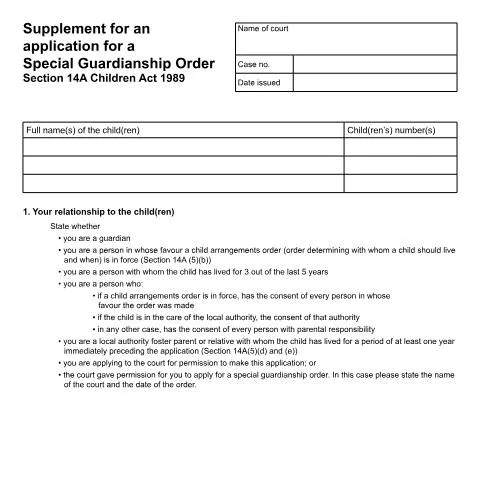
Section 1 of Form C13A requires you to identify precisely which legal pathway grants you the right to apply for special guardianship. This isn't a formality—your chosen pathway determines both your application process and the court's assessment criteria.
The most straightforward pathway applies to existing guardians or those already named in child arrangements orders. If you're currently responsible for determining where a child lives, your application builds upon established legal recognition. However, you must clearly reference the existing court order, including case numbers and dates, as the court will verify these details independently.
The three-out-of-five-years residence requirement presents more complex documentation challenges. Courts interpret "lived with" strictly, meaning occasional stays or holiday periods don't qualify. You'll need to demonstrate continuous residence covering at least 36 months within the preceding five-year period, typically through school records, medical registrations, or local authority documentation that confirms the child's primary residence.
| Applicant Category | Key Requirements | Documentation Needed |
|---|---|---|
| Current Guardian | Existing legal status | Court order confirming guardianship |
| Child Arrangements Order Holder | Active court order | Current order reference and terms |
| Three-Year Resident | 36 months in last 5 years | School records, medical registration, utility bills |
| Foster Carer/Relative | Minimum 12 months immediately preceding | Fostering agreement or family relationship proof |
| Consent-Based Applicant | All relevant parties' agreement | Written consent from those with parental responsibility |
For consent-based applications, the complexity increases significantly when multiple parties hold parental responsibility. Every person with parental responsibility must provide written consent, and courts will often require these consents to be witnessed or provided through separate legal statements. If the child is in local authority care, the authority's consent becomes mandatory, typically requiring formal committee approval that can extend your timeline considerably.
Local authority foster parents and relatives face the strictest residence requirements: the child must have lived with you for at least one year immediately preceding your application. This "immediately preceding" requirement means any gap in residence, even brief periods with other carers, can disqualify your application entirely.
The Three-Month Notification Rule: Strategic Timing and Local Authority Engagement
Section 2's notification requirement isn't merely procedural—it triggers the local authority's duty to prepare a comprehensive report that significantly influences the court's decision. You must notify the relevant local authority at least three months before submitting your application, creating a mandatory waiting period that allows thorough assessment of your circumstances.
Determining the correct local authority requires careful consideration of your specific situation. If the child is currently looked after by a local authority, that authority takes precedence regardless of where you live. For children not in care, you notify the local authority covering your normal residence area. This distinction matters because different authorities have varying resources, policies, and timescales for producing special guardianship reports.
The three-month rule contains a crucial exception for adoption-related applications. If you've notified the local authority less than three months before applying, you must declare any concurrent adoption proceedings. This information helps courts coordinate between different legal processes and avoid conflicting orders. You'll need to provide the adoption court's name and case number, demonstrating that you're managing multiple legal pathways responsibly.
During this notification period, local authorities conduct extensive assessments covering your suitability, the child's needs, and the potential impact of special guardianship on existing family relationships. Their resulting report carries significant weight in court proceedings, making your cooperation during this phase essential for application success.
Crafting Your Case: Articulating Reasons That Resonate With Family Courts
Section 3 demands more than emotional appeals—courts expect evidence-based reasoning that demonstrates why special guardianship serves the child's best interests better than alternative arrangements. Your brief statement must balance legal precision with human understanding, showing judges that you comprehend both the child's needs and the legal framework's requirements.
Effective reasoning typically addresses the inadequacy of current arrangements while proposing special guardianship as a proportionate solution. For instance, if existing child arrangements orders provide insufficient security for long-term planning, explain specifically how special guardianship's enhanced parental responsibility would address these limitations. Courts particularly value reasoning that acknowledges the child's existing family relationships while explaining why additional legal security benefits their development.
The reference to special guardianship support services isn't incidental—it demonstrates your awareness that special guardianship extends beyond legal status to encompass practical support systems. Mentioning specific support services you've requested or intend to request shows courts that you understand the long-term implications of your commitment. These might include financial support, therapeutic services, educational support, or assistance maintaining family contact arrangements.
Courts increasingly favour applications that demonstrate applicants have thoroughly considered their support needs rather than assuming they can manage independently. Your mention of support services signals realistic planning rather than naive optimism.
Avoid generic statements about loving the child or wanting to provide stability. Instead, focus on specific circumstances that make special guardianship necessary: perhaps the child's need for permanent security while maintaining birth family connections, or your ability to provide specialist care that temporary arrangements cannot accommodate. Courts want to understand why special guardianship specifically addresses the child's situation better than alternatives.
Future-Proofing Your Application: Contact Arrangements and Existing Orders
Section 4 requires you to demonstrate comprehensive forward planning that acknowledges the child's complex family relationships. Special guardianship doesn't sever birth family connections—it reconfigures them within a more stable legal framework. Your contact arrangements must reflect this nuanced approach, showing courts that you understand your role in facilitating appropriate ongoing relationships.
When detailing contact arrangements, specificity matters more than generosity. Rather than promising "regular contact," provide concrete proposals: weekly telephone calls with birth parents, monthly supervised visits with grandparents, or holiday periods with siblings placed elsewhere. Courts assess whether your proposals are realistic, sustainable, and genuinely serve the child's interests rather than adult preferences.
Existing court orders complicate contact planning significantly. If child arrangements orders, prohibited steps orders, or specific issues orders currently govern the child's life, you must explain which orders you want varied or discharged and why. This requires careful legal analysis—some orders may become redundant under special guardianship, while others might need modification rather than complete discharge.
- Child arrangements orders: May need variation if special guardianship changes residence or contact patterns
- Prohibited steps orders: Might require discharge if they prevent actions you need to take as special guardian
- Specific issues orders: Could need modification if they address matters now within your parental responsibility
The court's power to impose conditions under Section 14E(5) offers opportunities to address specific concerns or requirements. You might invite conditions requiring annual reviews, mandating specific therapeutic interventions, or ensuring particular contact arrangements continue. Suggesting appropriate conditions demonstrates your understanding of the court's supervisory role and your commitment to accountability.
Navigating the Assessment Process: What Happens After Submission
Once you submit Form C13A alongside your main application, HM Courts & Tribunals Service initiates a multi-stage assessment process that typically extends over several months. Understanding this timeline helps you maintain momentum while managing expectations about when special guardianship might be granted.
The court immediately refers your application to the relevant local authority, triggering their duty to prepare a comprehensive special guardianship report. This report examines your suitability, the child's needs, and the likely impact of special guardianship on all family members. Local authorities typically take 8-12 weeks to complete these reports, though complex cases may require longer investigation periods.
During this assessment phase, you'll likely face home visits, interviews, and requests for additional documentation. Cooperation remains essential—any reluctance to engage with assessors can raise concerns about your commitment to transparency and child protection principles. Social workers will examine your living arrangements, financial stability, support networks, and understanding of the child's needs.
The court may also appoint a children's guardian to represent the child's interests independently. This guardian conducts separate investigations and provides recommendations that carry significant weight in final hearings. Children's guardians often focus on the child's expressed wishes (where age-appropriate) and their assessment of what arrangement best serves long-term welfare.
Parallel to these assessments, the court schedules case management hearings to monitor progress and address any emerging issues. These hearings aren't final determinations but opportunities to resolve procedural matters, request additional evidence, or clarify legal questions that might affect the outcome.
Managing Complex Family Dynamics: When Multiple Parties Disagree
Special guardianship applications frequently involve contested proceedings where birth parents, extended family members, or local authorities oppose your proposal. Form C13A must anticipate these objections by demonstrating that your plans acknowledge competing interests while prioritising the child's welfare.
Birth parent opposition often centres on concerns about reduced contact or diminished parental authority. Your application strengthens significantly when you can show that special guardianship enhances rather than threatens meaningful family relationships. This might involve proposing increased contact frequency, suggesting family therapy to improve relationships, or offering reassurances about major decision consultation.
Extended family disagreements typically arise when multiple relatives believe they could provide appropriate care. Courts don't automatically favour blood relationships over established care arrangements, but they do expect thorough consideration of alternatives. Your application must acknowledge these competing claims while explaining why your specific circumstances better serve the child's interests.
Local authority opposition presents different challenges, particularly when authorities prefer alternative care arrangements or question your long-term commitment. Social services departments sometimes favour adoption for younger children or continued care orders for complex cases. Your application needs to address these professional concerns directly, perhaps by demonstrating specific expertise, showing successful management of previous challenges, or highlighting unique benefits your situation offers.
Remember that courts must consider the welfare checklist under Section 1 of the Children Act 1989, weighing factors including the child's wishes, physical and emotional needs, likely effects of change, and capability of relevant adults. Your Form C13A responses should align with these statutory criteria.
The Statement of Truth: Legal Implications and Practical Safeguards
Form C13A concludes with a statement of truth that carries serious legal consequences extending far beyond simple form completion. By signing this statement, you're declaring under penalty of contempt of court that all information provided is accurate to your knowledge and belief. This isn't merely administrative formality—it's a legal commitment that courts can enforce through imprisonment if you've knowingly provided false information.
The dual signature options reflect different levels of legal responsibility. If you sign personally as the applicant, you take full responsibility for every statement in the form. If your legal representative signs on your behalf, they're confirming their authorisation to act and their belief in the information's accuracy, but ultimate responsibility remains yours as the applicant.
Before signing, conduct thorough verification of all factual claims. Check dates against official documents, confirm case numbers with court records, and ensure your descriptions of current arrangements align with existing orders or agreements. Courts routinely verify information independently, and discrepancies between your statements and official records can undermine your entire application.
The statement of truth also extends to any continuation sheets you attach to provide additional detail. Many applicants underestimate the space required for comprehensive responses, particularly when explaining complex contact arrangements or addressing multiple existing court orders. Continuation sheets must maintain the same standard of accuracy as the main form, and each additional page increases your verification responsibilities.
Legal representatives signing on behalf of firms must indicate their position and authority clearly. Courts need to understand the professional relationship and confirm that the signatory has appropriate authority to commit their firm to the statement's accuracy. This professional accountability adds an additional layer of verification that can strengthen your application's credibility.
The practical safeguard lies in treating Form C13A as a legal document rather than an administrative exercise. Approach each section with the same care you'd apply to witness statements or court testimony, because that's effectively what you're providing. Courts rely on this information to make life-changing decisions, and your accuracy directly influences their ability to assess your application fairly and thoroughly.