When Local Authorities Seek Court Intervention: Understanding Emergency Child Protection Applications
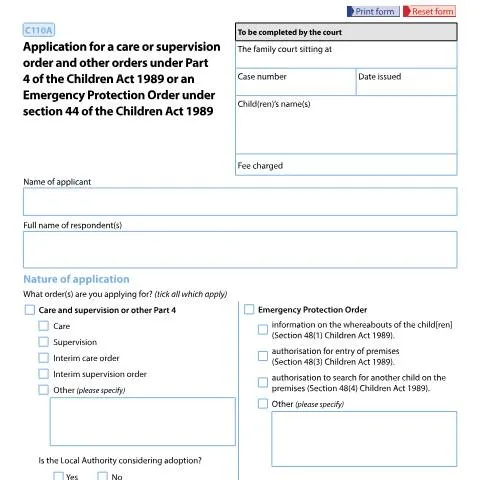
In the complex landscape of child protection law, few situations demand more immediate attention than when a child faces imminent harm. Form C110A represents one of the most critical legal instruments available to local authorities and authorised persons, enabling them to seek urgent court orders under the Children Act 1989. This application form serves as the gateway for obtaining Emergency Protection Orders (EPOs), care orders, and supervision orders when a child's safety cannot wait for standard legal processes.
The form's dual nature reflects the reality of child protection work: sometimes cases develop gradually through assessed concerns, whilst others explode into crisis requiring intervention within hours. Understanding when and how to deploy this powerful legal tool can mean the difference between a child remaining in danger and receiving immediate protection through the family court system.
The Two-Track System: Emergency Protection Versus Care Proceedings
Form C110A uniquely accommodates two distinct legal pathways, each serving different protective functions. The Emergency Protection Order route under Section 44 of the Children Act 1989 provides immediate, short-term protection lasting up to eight days, with possible extension for up to seven additional days. This mechanism operates when evidence suggests a child is likely to suffer significant harm if not immediately removed or prevented from removal from their current location.
Conversely, the care and supervision order pathway under Part 4 of the Children Act 1989 initiates longer-term proceedings aimed at establishing ongoing local authority involvement. Care orders can last until a child reaches 18, whilst supervision orders typically run for one year with possible extensions. The threshold for both requires proof that the child is suffering or likely to suffer significant harm attributable to inadequate parental care or the child being beyond parental control.
| Order Type | Maximum Duration | Primary Purpose | Threshold Test |
|---|---|---|---|
| Emergency Protection Order | 8 days + 7 days extension | Immediate protection | Likely significant harm |
| Interim Care Order | 8 weeks initially, then 4-week periods | Protection during proceedings | Significant harm threshold |
| Care Order | Until child reaches 18 | Long-term protection | Significant harm threshold |
| Supervision Order | 1 year, extendable to 3 years total | Monitored family support | Significant harm threshold |
Decoding the Applicant Categories and Their Distinct Powers
The form accommodates three categories of applicants, each with specific legal standing and procedural requirements. Local authorities represent the most common applicants, typically children's services departments acting under their statutory duties to safeguard children within their area. Their applications often follow Section 47 investigations where concerns about a child's welfare have crystallised into evidence of significant harm.
The second category comprises authorised persons, primarily NSPCC officers designated under the Children Act 1989. These applications are relatively rare but carry equivalent legal weight to local authority applications. The distinction matters procedurally because authorised persons must demonstrate they are conducting welfare enquiries that are being frustrated by unreasonable refusal of access.
Any applicant represents the broadest category, potentially including relatives, foster carers, or other individuals with sufficient interest in the child's welfare. However, such applications face higher scrutiny regarding the applicant's standing and the court's satisfaction that intervention serves the child's best interests.
The Critical Question of Parental Responsibility
Section 2 of the form demands precise identification of each child's parents and whether they hold parental responsibility. This information proves crucial because parental responsibility determines who must be served as respondents and who has standing to oppose the application. Mothers automatically hold parental responsibility, whilst fathers acquire it through marriage to the mother, joint birth registration (for births after December 2003), or court order.
The accommodation status inquiry—whether the child is already accommodated under Section 20 of the Children Act 1989—significantly influences the court's approach. Children in voluntary accommodation suggest existing local authority involvement, whilst those living with family members indicate potential emergency removal situations.
Navigating the Urgent Hearing Provisions: When Hours Count
Section 1 of the form addresses urgent hearing requests, recognising that child protection crises rarely align with court timetables. Applications seeking consideration within 48 hours trigger enhanced procedural requirements, including detailed explanation of efforts made to notify respondents and compelling justification for urgency.
The form distinguishes between different types of urgent hearings: contested interim care orders where parents actively oppose the application, Emergency Protection Orders requiring immediate intervention, and urgent preliminary case management hearings to establish procedural directions. Each category demands specific evidence and procedural handling by the court.
Practitioners must articulate not merely that the situation is serious, but why it cannot await the next available standard hearing slot. Courts scrutinise these requests carefully, balancing child protection imperatives against procedural fairness and the rights of parents to adequate notice and preparation time.
The Without Notice Application Dilemma
Section 2 addresses without notice hearings—applications heard without informing the respondents beforehand. These represent an extreme departure from natural justice principles and require exceptional justification. The form demands specific reasons why notice cannot be given, including whether abridged or informal notice might suffice as a compromise position.
Two primary grounds justify without notice hearings: impossibility of giving notice (perhaps because parents cannot be located) or situations where notice would frustrate the order's purpose (such as when parents might flee with the child). Courts approach these applications with considerable caution, recognising their potential for significant interference with family life.
Emergency Protection Order Mechanics: Powers and Limitations
The Emergency Protection Order sections of the form reveal the breadth of powers available to applicants. Beyond the basic power to remove or prevent removal of a child, applicants can seek information orders compelling disclosure of the child's whereabouts, entry warrants authorising access to premises, and search powers for other children who might be present.
Section 44(6) directions add further dimensions, enabling courts to regulate contact between children and family members during the EPO period, authorise medical examinations or assessments, and permit qualified professionals to accompany social workers during interventions. The inclusion of exclusion requirements under Section 44A allows courts to remove alleged perpetrators from the family home rather than removing the child, preserving family unity where possible.
These powers reflect legislative recognition that effective child protection often requires comprehensive intervention beyond simple removal. The ability to obtain information about a child's whereabouts proves particularly valuable when parents have concealed children following initial enquiries.
The Adoption Consideration Gateway
The form's inquiry about whether the local authority is considering adoption serves as an early warning system for care proceedings that may culminate in permanent family separation. This question triggers additional procedural requirements, including potential appointment of children's guardians and enhanced court scrutiny of the care plan.
When adoption is being considered, courts must ensure that all alternatives have been properly explored and that the local authority's plans serve the child's welfare throughout their childhood. This consideration significantly extends proceedings' duration and complexity, requiring comprehensive assessments of birth family capacity and alternative placements.
Complex Cases: International Elements and Special Circumstances
Section 5 addresses cases with international elements, reflecting globalised family structures where children, parents, or significant others may have connections to multiple jurisdictions. These cases trigger additional considerations under the Hague Convention on International Child Abduction and European regulations governing jurisdiction in family matters.
International elements might include parents from different countries, children born abroad, or situations where family members have fled to other jurisdictions. Courts must determine whether they have jurisdiction to make orders and consider whether parallel proceedings might be ongoing elsewhere. The complexity multiplies when considering enforcement of orders across borders or the risk of international child abduction.
Previous or ongoing proceedings (Section 3) require careful coordination to avoid conflicting orders or duplicated efforts. The form demands identification of existing cases, their current status, and any relevant orders already in force. This information enables courts to consolidate proceedings where appropriate and ensures consistent decision-making across different applications.
Litigation Capacity and Vulnerable Adults
Section 4 addresses factors affecting litigation capacity, recognising that parents or carers involved in child protection proceedings may themselves be vulnerable. Mental health issues, learning disabilities, domestic abuse, or substance misuse problems can significantly impact an individual's ability to participate effectively in legal proceedings.
When capacity issues are identified, courts must consider whether to appoint litigation friends, make adjustments to proceedings to accommodate difficulties, or seek expert assessments of capacity. The overriding objective remains ensuring fair proceedings whilst prioritising child welfare, but achieving this balance requires careful judicial management and often specialist input.
Procedural Precision: Avoiding Common Pitfalls in Form Completion
The form's structure demands methodical completion to avoid delays or rejection. Each child requires individual identification with precise birth dates, current accommodation status, and specific orders sought. Practitioners often underestimate the importance of accuracy in basic details, yet errors in children's names or birth dates can invalidate entire applications.
The grounds section requires careful legal analysis, distinguishing between different threshold tests for EPOs versus care orders. Emergency Protection Order grounds focus on likelihood of significant harm if the child is not removed or does not remain in current accommodation, whilst care order thresholds demand proof of actual or likely significant harm attributable to parental care standards.
Timing considerations permeate the entire form. EPO applications must demonstrate urgency through concrete evidence rather than generalised concerns. Care proceedings require consideration of whether interim orders are necessary to protect children during the substantive hearing process. The interplay between different order types demands strategic thinking about the overall case trajectory.
Evidence Requirements and Supporting Documentation
Whilst the form itself captures essential information, successful applications depend heavily on supporting evidence. Social work assessments, medical reports, police statements, and witness accounts provide the factual foundation for legal arguments. The quality and comprehensiveness of this evidence often determines whether courts grant the protective orders sought.
Practitioners must balance urgency against evidence-gathering requirements. Emergency situations may not permit comprehensive assessments, but applications must still meet legal thresholds. This tension requires careful professional judgement about when sufficient evidence exists to justify court intervention versus when additional investigation might strengthen the case.
The Court Process: From Application to Order
Once submitted, Form C110A triggers the family court's protective machinery. Urgent applications may receive same-day hearings, particularly for Emergency Protection Orders where delay could compromise child safety. The court office will contact applicants directly to arrange hearing slots, often outside normal court hours when circumstances demand immediate intervention.
Standard applications follow established case management protocols, with initial hearings typically scheduled within days rather than weeks. The court will serve the application on respondents, appoint children's guardians where necessary, and establish timetables for evidence filing and substantive hearings. Case management becomes particularly complex when multiple children are involved or when parallel proceedings exist in other jurisdictions.
The judicial approach varies significantly between Emergency Protection Order applications and care proceedings. EPO hearings focus narrowly on immediate protection needs and threshold criteria, whilst care proceedings encompass broader welfare considerations and long-term planning. Courts increasingly emphasise proportionate intervention, seeking the least intrusive measures consistent with child protection.
Post-Order Obligations and Review Mechanisms
Successful applications create ongoing obligations for local authorities and rights for families. Emergency Protection Orders include automatic review mechanisms, with courts required to discharge orders if grounds no longer exist. Care orders trigger comprehensive care planning requirements, including regular reviews and consideration of contact arrangements.
The form initiates processes that may continue for months or years, affecting fundamental aspects of family life. Understanding these long-term implications proves crucial for all participants, from local authorities developing care plans to parents seeking to address concerns that led to intervention. The initial application represents merely the beginning of complex legal and social work processes aimed at securing children's long-term welfare whilst preserving family relationships where safely possible.