Understanding the Statement of Service of Papers under the Family Law Act 1996: Form FL415
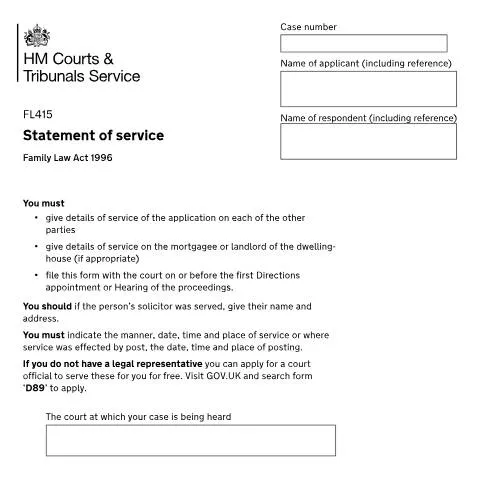
The Statement of Service of Papers (Form FL415) is a crucial document used within the UK family justice system, specifically governed by the Family Law Act 1996. Managed by HM Courts & Tribunals Service, this form serves to officially confirm that a party involved in family proceedings has properly served legal documents to the other parties involved. Proper service is a fundamental step in ensuring that all parties are aware of and can respond to proceedings, thereby safeguarding the integrity of the legal process.
Purpose and Scope of Form FL415
The primary objective of Form FL415 is to provide a detailed record of how, when, and where legal documents related to family law proceedings have been served. This includes applications such as divorce, child arrangements, or financial disputes. The form must be completed and filed with the court before the first Directions appointment or hearing, ensuring that the court has verified that all parties have been properly notified.
It is applicable in cases where service of documents is not carried out by the court itself, but rather by the parties or their representatives. Accurate completion of this form is essential to demonstrate compliance with procedural rules and to prevent delays or challenges to the proceedings.
Key Elements of the Statement of Service
Details of Service
- Identification of the parties involved, including the applicant and respondent, with reference numbers if applicable.
- Information about the person or entity served, such as their name, address, and means of identification.
- Details of how service was effected — whether by personal delivery, post, email, SMS, or via social media platforms like WhatsApp.
- The date, time, and location of service or posting.
Additional Service Information
- If service was carried out by a legal representative or a court official, their details must be included.
- When service is by electronic means, the exact date and time of sending the email or message should be recorded.
- Any prescribed forms served alongside the application should also be documented.
Filing and Legal Considerations
Once completed, the form must be filed with the relevant court before the initial hearing or directions appointment. This ensures that the court is fully informed about the service process and can proceed accordingly. Failure to file this form, or inaccuracies within it, could lead to delays or procedural challenges.
In cases where a party does not have a legal representative, they can request assistance from a court official to serve documents at no cost. To do so, they should complete and submit form D89, which is available on GOV.UK.
Statement of Truth and Declaration
Part of the form involves a declaration of truth, where the person completing the statement affirms that the information provided is accurate to the best of their knowledge. This section is critical, as making a false statement can lead to proceedings for contempt of court. The declaration must be signed and dated by the person responsible for completing the form, whether it is the applicant, their legal representative, or a court officer.
Implications for Parties and Practitioners
Accurate and timely completion of the FL415 form ensures that the legal process proceeds smoothly and that all parties' rights are protected. It also provides a clear record that can be referenced in future proceedings or if any disputes about service arise.
Legal practitioners and individuals involved in family law cases should familiarize themselves with the requirements of this form to ensure compliance with procedural rules. Proper service and documentation are essential steps in upholding the fairness and efficiency of family proceedings under UK law.