When Salmonella Strikes: The Critical Role of ZO2 General Forms in Disease Surveillance
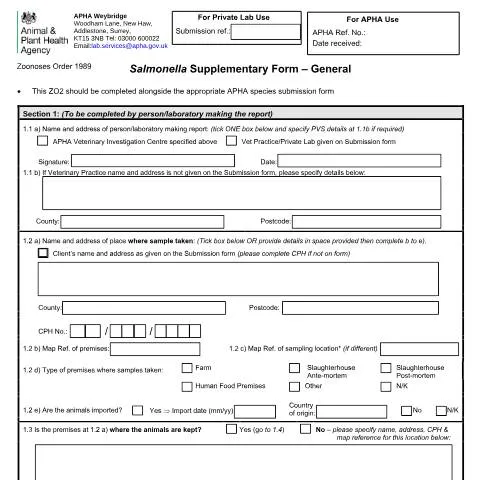
Every year, salmonella outbreaks across the UK pose significant threats to both animal welfare and public health. When veterinary professionals or laboratory technicians suspect salmonella in farm animals, slaughterhouses, or food premises, they must navigate a carefully structured reporting system managed by the Animal and Plant Health Agency (APHA). The Salmonella Supplementary Form – General (ZO2) serves as a vital component in this surveillance network, capturing essential epidemiological data that helps authorities track, contain, and investigate potential disease outbreaks.
This supplementary document operates under the Zoonoses Order 1989, working alongside APHA's primary species submission forms to provide comprehensive intelligence on salmonella incidents. Unlike standalone reporting mechanisms, the ZO2 form creates a detailed picture of each case, from the initial sample collection through to risk assessment and official response protocols.
Laboratory Networks and Veterinary Practitioners: Who Submits ZO2 Forms
The responsibility for completing ZO2 forms falls primarily upon two distinct professional groups, each bringing different perspectives to the surveillance process. Veterinary Investigation Centres specified by APHA represent the official government laboratory network, equipped with sophisticated diagnostic capabilities and direct links to disease control programmes. These centres typically handle samples from ongoing investigations, statutory surveillance schemes, or cases flagged through the National Animal Disease Information System.
Private veterinary practices and commercial laboratories form the second category of submitters. These include independent diagnostic facilities, university research laboratories, and veterinary practices with in-house testing capabilities. Private labs often process samples from routine health screening, pre-movement testing, or investigations initiated by farmers concerned about stock health.
The Client-Laboratory Relationship Dynamic
A crucial aspect of the ZO2 system involves the triangular relationship between the submitting laboratory, the veterinary practice, and the premises where animals are kept. The form specifically accommodates situations where the laboratory receiving samples differs from the veterinary practice that collected them, and where both may be distinct from the actual location of the affected animals.
This complexity becomes particularly relevant in modern agricultural supply chains, where large veterinary practices may serve multiple counties, specialist laboratories handle samples from across regions, and animals frequently move between premises. The ZO2 form captures these relationships through detailed address fields and County Parish Holding (CPH) number requirements, ensuring traceability despite geographical dispersion.
Mapping the Surveillance Landscape: From Sample Collection to Risk Assessment
The ZO2 form operates within a sophisticated surveillance framework that extends far beyond simple positive/negative reporting. Section 1 establishes the fundamental chain of custody, requiring precise identification of who collected samples, where they were taken, and the nature of the premises involved. This section distinguishes between farms, slaughterhouses (both ante-mortem and post-mortem sampling), human food premises, and other facilities.
The geographical precision demanded by the form reflects APHA's need to understand disease distribution patterns. Map references from GPS or Ordnance Survey readings provide exact locations for epidemiological mapping, while CPH numbers link cases to the official livestock registration system. This dual approach enables both immediate local response and longer-term trend analysis across regions.
Import Status and Movement Tracking
Given the international nature of modern food supply chains, the form pays particular attention to imported animals. When animals originate from overseas, submitters must provide import dates and countries of origin, enabling authorities to assess whether cases might be linked to international disease patterns or specific exporting regions. This information proves crucial when investigating whether outbreaks stem from domestic transmission or imported infection sources.
| Premises Type | Sampling Context | Typical Submission Reason |
|---|---|---|
| Farm | Live animals, environmental samples | Voluntary surveillance, clinical investigation |
| Slaughterhouse (ante-mortem) | Live animals before slaughter | Statutory monitoring, disease suspicion |
| Slaughterhouse (post-mortem) | Carcass, organ samples | Routine surveillance, pathology findings |
| Human Food Premises | Environmental, product samples | Outbreak investigation, compliance testing |
Risk Assessment Protocols: When Public Health Meets Agricultural Reality
Section 2 of the ZO2 form transforms from administrative data collection into active public health protection. This risk assessment component requires detailed evaluation of potential human exposure pathways, examining everything from recent illness among farm staff to direct sales of unpasteurised milk products.
The form systematically explores bed and breakfast operations, school visits, open farm activities, and other scenarios where the public might encounter potentially contaminated environments. This reflects the reality that modern farms often diversify into tourism, education, and direct sales, creating multiple potential exposure pathways that traditional agricultural surveillance might miss.
Dairy Enterprise Considerations
Particular attention focuses on dairy operations, given the direct pathway from infected animals to human consumption through milk products. The form distinguishes between pasteurised and unpasteurised milk sales, tracks whether dairy companies or food producers have been informed of incidents, and assesses consumption of raw milk products by farm staff, residents, and visitors.
These questions reflect hard-learned lessons from previous outbreaks where delays in notifying downstream food businesses led to widespread public exposure. The form ensures that appropriate notifications occur rapidly, enabling food businesses to implement protective measures before products reach consumers.
Priority Case Classification and Emergency Response Triggers
The Nominated Officer section represents where routine surveillance transforms into active outbreak management. APHA's Nominated Officers—typically senior veterinary professionals with epidemiological training—evaluate whether cases constitute "Priority Cases" requiring immediate enhanced response measures.
Priority classification triggers specific response protocols, including association with human illness investigations, involvement of Multi-Drug Resistant (MDR) Group B organisms, or cases falling under MDR Group C2 classifications that require completion of additional documentation. These classifications reflect evolving concerns about antimicrobial resistance and the increasing complexity of salmonella strains circulating in both animal and human populations.
Integration with National Surveillance Systems
The form specifically references TC1197 on FarmFile service request screens, indicating integration with APHA's broader farm data management systems. This connection enables cross-referencing with movement records, previous disease history, and ongoing investigations, providing context that isolated laboratory results cannot deliver.
Similarly, references to VISI 223 and VISI 193 protocols indicate standardised procedures for handling specific categories of multi-drug resistant organisms, ensuring consistent national response regardless of which laboratory or region initially identifies concerning strains.
Completing the ZO2 Form: Technical Requirements and Practical Considerations
Successful completion of ZO2 forms requires careful attention to both administrative detail and scientific accuracy. The form demands precise geographical information, including full postal addresses, county designations, and postcode details for all relevant locations. Map references should derive from GPS readings or Ordnance Survey maps, providing coordinates accurate enough for disease mapping and response planning.
Laboratory personnel must coordinate with veterinary practices to ensure accurate completion, particularly when the submitting laboratory differs from the practice that collected samples. This coordination becomes critical when determining whether premises information appears on the primary submission form or requires detailed completion within the ZO2 document itself.
Signature and Dating Requirements
The form requires signatures from both the person or laboratory making the report and, crucially, the Nominated Officer who evaluates the case. Date fields must reflect when forms were completed rather than when samples were collected, enabling APHA to track response times and identify potential delays in the surveillance system.
For cases involving ongoing investigations, the form accommodates situations where risk assessment information may not be immediately available, allowing initial submission of core data while enabling subsequent completion of detailed epidemiological sections.
Submission Pathways and Processing Timelines
ZO2 forms follow established submission pathways that vary depending on the submitting organisation and case urgency. Private laboratories typically submit forms alongside samples to APHA's Weybridge facility in Surrey, utilising both postal services and secure digital transmission systems where available.
APHA's own Veterinary Investigation Centres follow internal protocols that may involve direct electronic submission through secure networks, enabling rapid case assessment and response coordination. The form includes specific reference fields for private laboratory use and APHA internal tracking, ensuring appropriate routing regardless of submission pathway.
Data Protection and Information Sharing
All ZO2 submissions fall under the Data Protection Act 2018 and UK GDPR requirements, with APHA maintaining strict protocols for personal information handling. The form references APHA's Personal Information Charter, available through GOV.UK, which details how personal data from veterinary professionals, farmers, and food business operators is processed and protected.
Information sharing with local authorities, as referenced in Section 3.5, follows established protocols that balance public health protection needs with privacy requirements, ensuring appropriate notification without unnecessary disclosure of commercial or personal information.
Integration with Wider Disease Control Strategies
The ZO2 form operates within broader European and national surveillance networks that track salmonella trends across species, regions, and time periods. Data collected through these forms contributes to annual surveillance reports, antimicrobial resistance monitoring programmes, and risk assessments that inform policy development at both national and international levels.
Cases identified through ZO2 submissions may trigger enhanced surveillance measures, including follow-up sampling programmes, movement restrictions, or coordination with human health authorities investigating parallel outbreaks. The form's detailed epidemiological data proves essential when establishing links between apparently unrelated cases or identifying common source outbreaks affecting multiple premises.
As salmonella strains continue evolving and agricultural practices adapt to changing market demands, the ZO2 form represents a critical tool for maintaining effective surveillance in an increasingly complex food production landscape. Its success depends upon accurate completion by laboratory professionals who understand both the immediate case details and the broader public health implications of their findings.
Understanding Cross-Border Reporting Requirements
When suspected salmonella cases involve animals that have recently crossed borders or originated from other countries, additional reporting protocols apply beyond the standard ZO2 procedures. The Animal and Plant Health Agency (APHA) maintains specific arrangements with EU member states and third countries for disease surveillance coordination.
If your animals were imported within the past 21 days before symptom onset, you must include detailed import documentation with your ZO2 report. This includes the Common Health Entry Document (CHED), transport logs, and any health certificates issued by the country of origin. APHA uses this information to trace potential infection sources across international supply chains and coordinate with overseas veterinary authorities.
For animals exported from your premises within 14 days of suspected salmonella exposure, you have a legal obligation to notify both APHA and the receiving country's competent authority. The notification must occur within 24 hours of filing your ZO2 report, using the standardised EU notification format where applicable. This rapid communication helps prevent international disease spread and maintains the UK's trading relationships.
Transit movements through ports of entry require particular attention. Animals held at Border Control Posts (BCPs) or approved quarantine facilities follow modified reporting procedures. The facility operator typically handles initial ZO2 submissions, but animal keepers retain responsibility for providing accurate health histories and movement records. APHA coordinates directly with port health authorities to ensure seamless surveillance coverage.
Wildlife interactions present unique cross-border challenges, particularly for premises near coastlines or major waterways. Migratory birds can carry salmonella strains between countries, creating complex epidemiological patterns. When reporting suspected cases potentially linked to wildlife contact, include detailed observations about wild animal presence, feeding areas, and seasonal migration patterns. This information helps APHA assess international disease circulation routes.
Laboratory Confirmation Procedures and Results Interpretation
Following ZO2 submission, APHA coordinates laboratory testing through its network of approved facilities. The Veterinary Medicines Directorate (VMD) maintains strict quality standards for salmonella diagnostic procedures, ensuring consistent results across different testing locations.
Initial screening typically employs bacterial culture methods on selective media, with results available within 48-72 hours for most samples. Positive cultures undergo serotyping to identify specific salmonella strains, a process requiring additional 3-5 days. APHA prioritises serotyping for strains with known zoonotic potential or those linked to previous outbreak investigations.
Advanced molecular techniques, including whole genome sequencing (WGS), provide detailed strain characterisation for epidemiological investigations. WGS results help identify infection sources, track transmission pathways, and assess relationships between seemingly unconnected cases. The technology proves particularly valuable for investigating complex multi-premises outbreaks or identifying antimicrobial resistance patterns.
Negative initial results don't automatically conclude investigations, especially when clinical signs strongly suggest salmonella infection. APHA may request additional samples or recommend extended monitoring periods. Environmental sampling from feed stores, water sources, and equipment surfaces can reveal contamination even when animal samples test negative.
Laboratory results interpretation requires understanding detection limits and testing methodologies. Culture-based methods may miss low-level infections or cases where animals have recently received antimicrobial treatment. PCR-based tests offer higher sensitivity but can detect DNA from non-viable bacteria, potentially indicating past rather than current infections.
When results confirm salmonella presence, APHA provides detailed reports including strain identification, antimicrobial sensitivity patterns, and public health risk assessments. These reports inform control measure decisions and help determine whether restrictions on animal movements or products are necessary. Animal keepers receive copies of all laboratory reports along with interpretation guidance from attending veterinary officers.
Post-Confirmation Control Measures and Compliance Monitoring
Confirmed salmonella cases trigger comprehensive control programmes tailored to specific circumstances and strain characteristics. APHA implements these measures through statutory notices served under the Animal Health Act 1981, creating legally binding obligations for animal keepers.
Movement restrictions typically form the foundation of control programmes, preventing infected animals from leaving premises until clearance criteria are met. The scope and duration of restrictions vary according to salmonella strain, animal species, and premises type. Commercial poultry operations may face extended restrictions due to the high transmission potential in intensive systems.
Cleansing and disinfection protocols follow detailed APHA specifications, with approved disinfectants and application methods. The agency provides comprehensive guidance documents outlining step-by-step procedures for different premises types and contamination levels. Verification sampling confirms disinfection effectiveness before movement restrictions can be lifted.
Feed and water system decontamination often requires professional intervention, particularly in complex commercial operations. APHA may mandate feed withdrawal and replacement, water system chlorination, or equipment sterilisation. All decontamination activities must be documented and verified through follow-up testing.
Regular monitoring continues throughout control programmes, with sampling frequencies determined by infection severity and premises characteristics. Veterinary officers conduct scheduled inspections to verify compliance with control measures and assess progress toward clearance. Non-compliance can result in extended restrictions or prosecution under animal health legislation.
Clearance requirements typically involve multiple consecutive negative test results from both animals and environmental samples. The specific number of tests and sampling intervals depend on strain characteristics and epidemiological risk factors. Some strains require extended monitoring periods to account for intermittent shedding patterns.
Economic support schemes may be available for affected businesses, particularly during extended control programmes. The Rural Payments Agency (RPA) administers compensation schemes for compulsory slaughter or movement restrictions that significantly impact commercial operations. Applications require detailed financial documentation and must be submitted within specified timeframes following restriction implementation.