When Routine Wildlife Management Requires Strategic Licensing Coordination
Organisations operating across multiple sites, conducting regular maintenance work, or managing extensive development programmes often find themselves navigating a complex web of individual wildlife licences. Each protected species encounter typically triggers separate application processes, creating administrative bottlenecks that can delay critical infrastructure projects or conservation work. Natural England's organisational licence framework addresses this challenge by consolidating routine protected species activities under a single, comprehensive authorisation structure.
The Organisational Licence Request Form serves as the gateway to this streamlined approach, designed specifically for entities whose operational activities regularly intersect with protected species legislation. Rather than managing dozens of separate licences for bat surveys, great crested newt mitigation, or bird nest removal, qualifying organisations can operate under unified protocols that maintain rigorous wildlife protection standards whilst enabling operational efficiency.
Distinguishing Organisational Authorisation from Standard Wildlife Licences
The organisational licence model represents a fundamental shift from reactive, site-specific licensing to proactive, organisation-wide authorisation. Traditional individual licences address specific activities at defined locations within fixed timeframes. In contrast, organisational licences establish ongoing operational frameworks that enable pre-approved activities across multiple sites, provided organisations demonstrate consistent competency and adherence to established protocols.
| Licence Type | Application Trigger | Geographic Scope | Validity Period | Operational Flexibility |
|---|---|---|---|---|
| Individual Licence | Specific site/project | Single location | Project duration | Limited to defined activities |
| Organisational Licence | Operational framework | Multiple sites nationwide | Typically 3-5 years | Routine activities under protocols |
Project licences, also accessible through this same application form, occupy middle ground between these approaches. They enable coordinated activities across related sites within larger development programmes, such as housing estates or infrastructure corridors, whilst maintaining project-specific boundaries.
Qualifying Operational Contexts
Natural England evaluates organisational licence suitability based on activity patterns rather than organisation size. Utility companies conducting routine vegetation management, highways agencies managing verge maintenance, conservation organisations undertaking habitat management, and construction companies with ongoing development portfolios typically demonstrate the operational consistency required for organisational licensing.
The application form specifically explores whether organisations undertake "operational activities, including routine and emergency works that bring it into contact with protected species". This encompasses planned maintenance schedules, seasonal conservation work, and responsive activities triggered by safety requirements or environmental incidents.
Navigating the Application Architecture
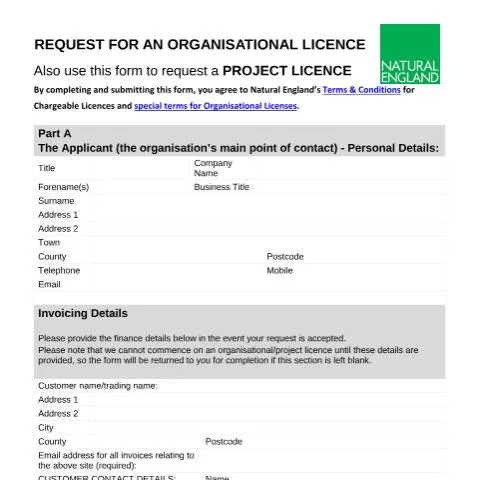
The three-part application structure reflects Natural England's systematic approach to evaluating organisational capacity and operational requirements. Part A establishes primary contact details and crucial invoicing arrangements, which must be completed before licence processing can commence. This administrative requirement reflects the ongoing relationship model inherent in organisational licensing, where annual fees and periodic reviews replace single-application charges.
Part B forms the substantive evaluation core, requiring detailed exposition of organisational motivations, operational timescales, and specific species interactions. The form prompts applicants to articulate why organisational licensing suits their operational model, moving beyond simple convenience arguments to demonstrate genuine operational need and capacity for protocol compliance.
Species and Activity Documentation
The application requires comprehensive mapping of existing protected species interactions across organisational activities. This encompasses both confirmed species presence and potential encounters based on habitat assessment and operational scope. Organisations must detail current individual licence holdings, providing Natural England with baseline understanding of existing licensing patterns and compliance history.
Activity categorisation follows Natural England's standard framework, encompassing scientific research, nature conservation, public health and safety, disease prevention, and livestock protection purposes. Many applicants tick multiple categories, reflecting the diverse operational contexts where protected species considerations arise within single organisations.
Strategic Timing and Operational Readiness
Natural England's emphasis on specific deadlines or timeframes reflects the strategic planning horizon required for successful organisational licensing. Unlike individual licences responding to immediate project needs, organisational applications require substantial lead time for protocol development, staff training implementation, and operational system integration.
Organisations approaching major development phases, contract renewals, or operational restructuring often initiate organisational licence applications 12-18 months in advance. This timeline accommodates Natural England's detailed assessment process, potential protocol refinements, and internal preparation for transitioning from individual to organisational licensing approaches.
The application form specifically asks whether organisations have "been discussing an organisational licence" with Natural England contacts, acknowledging the collaborative development process typically preceding formal applications.
Seasonal and Emergency Work Considerations
Organisational licences particularly benefit operations with seasonal activity patterns or emergency response requirements. Utility companies managing vegetation during bird nesting seasons, conservation organisations conducting habitat management within specific ecological windows, and emergency services requiring rapid response capabilities all demonstrate operational contexts where organisational licensing provides essential flexibility whilst maintaining wildlife protection standards.
Data Processing and Information Sharing Protocols
The comprehensive data sharing framework outlined in Part C reflects Natural England's coordination role within the broader wildlife protection infrastructure. Applicant information may be shared with statutory nature conservation bodies, including Natural Resources Wales, Northern Ireland Environment Agency, and Scottish Natural Heritage, ensuring coordinated approach across devolved jurisdictions.
Enforcement and compliance sharing extends to police forces, local planning authorities, and the Marine Management Organisation, creating integrated oversight mechanisms that support both licence holder compliance and broader wildlife protection enforcement. Specialist organisations such as the Bat Conservation Trust and British Trust for Ornithology receive relevant information to support species-specific monitoring and protection programmes.
Seven-Year Data Retention Framework
Natural England's commitment to retaining personal data for seven years after licence expiry reflects the long-term monitoring and evaluation requirements inherent in wildlife protection. This extended retention period enables retrospective analysis of licensing effectiveness, compliance patterns, and ecological outcomes, supporting continuous improvement in organisational licensing approaches.
The framework explicitly excludes automated decision-making or profiling, ensuring human oversight throughout the assessment and ongoing management processes. This approach recognises the complex, context-dependent judgements required in wildlife protection licensing.
Financial Framework and Ongoing Obligations
The mandatory invoicing details section reflects organisational licensing's subscription-based model, contrasting with individual licences' single-payment structure. Annual fees typically reflect the scope of authorised activities and geographical coverage, with organisations benefiting from reduced per-activity costs compared to multiple individual licence applications.
Purchase order requirements accommodate public sector and large corporate procurement processes, recognising that many qualifying organisations operate within structured financial frameworks requiring specific invoicing arrangements. The requirement for dedicated invoice email addresses ensures reliable financial communication throughout multi-year licence periods.
Operational Transition Planning
Successful organisational licence implementation requires substantial internal preparation beyond the application process. Organisations must develop internal protocols aligning with Natural England's requirements, implement staff training programmes ensuring consistent application of licence conditions, and establish monitoring systems demonstrating ongoing compliance.
The transition from individual to organisational licensing often involves temporary overlap periods where existing individual licences remain valid whilst organisational protocols are established and tested. This phased approach ensures continuous legal compliance whilst enabling operational adjustment to new frameworks.
Assessment Outcomes and Implementation Pathways
Natural England's assessment process extends well beyond form completion, typically involving site visits, protocol development workshops, and iterative refinement of proposed operational approaches. The organisation evaluates not just current compliance history but also organisational capacity for maintaining consistent standards across diverse operational contexts.
Successful applicants receive detailed licence conditions specifying authorised activities, geographical boundaries, reporting requirements, and review schedules. These conditions often include requirements for ecological training, monitoring protocols, and incident reporting procedures that maintain wildlife protection standards whilst enabling operational flexibility.
Organisations whose applications reveal gaps in current compliance or operational readiness may receive development recommendations rather than immediate licence refusal. This constructive approach enables organisations to address identified issues and reapply with enhanced preparedness, supporting Natural England's broader objective of encouraging responsible wildlife management practices across relevant sectors.
Licence Variations and Amendments During the Validity Period
Organisational licences for routine work are not static documents—circumstances change, and Natural England recognises that licence holders may need to modify their authorised activities during the three-year validity period. The variation process allows for adjustments without requiring a completely new application, though certain changes trigger more stringent assessment procedures than others.
Minor variations typically include extending the geographical scope within the same local authority area, adding additional personnel to the approved list, or making small adjustments to timing windows that don't affect peak breeding or hibernation periods. These modifications often require a simple written request supported by appropriate justification, with Natural England aiming to process straightforward variations within 15 working days of receiving complete information.
However, substantial variations demand more rigorous scrutiny. Adding new protected species to the licence scope, significantly expanding the geographical area (particularly across county boundaries), or introducing novel working methods that weren't covered in the original assessment require formal variation applications. These submissions must include updated ecological surveys if the original data is more than 12 months old, revised method statements demonstrating how additional species will be protected, and sometimes supplementary consultation with statutory bodies.
The fee structure for variations reflects this complexity gradient. Administrative amendments, such as updating contact details or correcting minor errors in site descriptions, typically incur no charge. Minor variations may attract fees ranging from £135 to £270, whilst major variations requiring substantial re-assessment can cost between £540 and £1,080, depending on the scope of changes and assessment time required.
Crucially, licence holders cannot implement variations until formal approval is received from Natural England. Working beyond the current licence scope, even whilst a variation application is pending, constitutes an offence under the Wildlife and Countryside Act 1981. This creates practical challenges for organisations facing urgent project modifications, emphasising the importance of building flexibility into initial applications wherever possible.
Some variations may trigger additional consultation requirements. If proposed changes affect Sites of Special Scientific Interest (SSSIs), Special Areas of Conservation (SACs), or involve European Protected Species not previously covered, Natural England must consult with relevant conservation bodies and may need to conduct Habitats Regulations Assessments. These processes can extend determination periods to 13 weeks or longer in complex cases.
Multi-Site Management and Regional Coordination Challenges
Large infrastructure operators, utilities companies, and nationwide conservation organisations often require coordinated approaches across multiple sites and regions. Managing organisational licences at scale presents unique challenges that go beyond simply multiplying single-site requirements, requiring sophisticated internal systems and careful coordination with Natural England's regional teams.
Regional variations in protected species distributions create particular complexities. A utility company maintaining overhead power lines might encounter great crested newts in Midlands locations, dormice in southern counties, and nesting birds throughout their network. Each species demands different seasonal restrictions, survey methodologies, and mitigation measures. The organisational licence must account for these regional differences whilst maintaining consistency in operational standards and personnel competency requirements.
Natural England's regional structure means that multi-regional licences often involve coordination between different area teams, each bringing local knowledge but potentially different interpretation approaches. Licence applicants benefit from early engagement with all relevant regional offices during the pre-application phase, ensuring consistent expectations and avoiding conflicting requirements that could compromise operational efficiency.
Personnel management across dispersed operations requires particular attention. Staff rotation between regions must consider different licence conditions and local ecological sensitivities. Training programmes need to cover the full range of species and scenarios that personnel might encounter, whilst maintaining records systems that demonstrate competency for each individual across all relevant protected species and regions covered by the licence.
Monitoring and reporting obligations multiply across multi-site operations. Each location may require different survey methodologies and reporting frequencies, creating administrative burdens that can overwhelm smaller organisations. Successful applicants often invest in digital data management systems that standardise recording methods whilst accommodating regional variations in species presence and seasonal activity patterns.
The three-year licence duration creates renewal challenges for large-scale operations. Coordinating surveys across dozens or hundreds of sites to support renewal applications requires careful planning and significant resources. Many organisations begin renewal preparations 12-18 months before expiry, conducting rolling surveys and updating ecological baselines to avoid operational disruptions.
Emergency response capabilities present additional complexities in multi-site contexts. When urgent works are required outside normal licence parameters—such as storm damage repairs affecting protected species habitats—organisations need clear protocols for rapid assessment and, where necessary, emergency licence applications. These protocols must account for regional variations in species sensitivity and Natural England's local emergency contact procedures.
Compliance Monitoring, Enforcement Actions, and Licence Withdrawal
Natural England's compliance monitoring for organisational licences operates through multiple mechanisms, ranging from routine desk-based reviews to unannounced site inspections. Understanding these enforcement procedures helps licence holders maintain compliance and avoid serious consequences that could result in licence suspension or withdrawal.
Annual returns form the foundation of compliance monitoring. These detailed reports must demonstrate adherence to licence conditions through systematic recording of activities, species encounters, mitigation measures implemented, and any incidents or deviations from approved methods. Natural England's wildlife licensing team reviews these returns for compliance patterns, identifying organisations that may require additional support or investigation.
Site inspections can occur at any time during licensed activities, with Natural England officers having powers to enter premises and examine working methods, records, and evidence of licence compliance. These inspections often focus on high-risk activities or follow up on reported concerns from third parties. Licence holders must ensure that site personnel understand their obligations to cooperate with inspections and can demonstrate current licence validity and relevant training records.
Common compliance failures include working outside approved seasonal windows, inadequate pre-commencement surveys, failure to implement specified mitigation measures, and insufficient record-keeping. More serious breaches involve causing unnecessary suffering to protected species, operating beyond geographical boundaries, or conducting activities not covered by the licence scope. Each category of breach triggers different enforcement responses.
Initial enforcement typically involves advisory letters highlighting specific concerns and requiring corrective action within specified timeframes. Natural England may mandate additional training for personnel, require enhanced monitoring procedures, or impose temporary restrictions on certain activities whilst compliance issues are resolved. These interventions aim to achieve compliance through cooperation rather than punishment.
However, serious or repeated breaches can result in formal enforcement action. Licence suspension immediately prohibits all activities covered by the organisational licence, potentially causing significant operational disruption and financial consequences. During suspension periods, organisations cannot conduct any work affecting protected species, even routine maintenance that would normally be permitted under the licence.
Licence withdrawal represents the most severe enforcement action, permanently removing authorisation and requiring fresh applications for any future activities. Withdrawn licences create reputational damage and can affect an organisation's ability to obtain future licences, as Natural England considers compliance history when assessing new applications. The withdrawal process includes formal notification procedures and opportunities for representations, though reinstatement is rare and requires demonstrating fundamental changes in operational procedures and management oversight.
Criminal prosecution remains possible for serious Wildlife and Countryside Act 1981 offences, even where organisational licences are held. Deliberately killing protected species, destroying breeding sites outside licence parameters, or operating with knowledge that licence conditions are being breached can result in unlimited fines and custodial sentences for responsible individuals. Company directors and senior managers may face personal liability where corporate failures result in wildlife crime offences.
Organisations can implement several strategies to minimise enforcement risks. Regular internal auditing of compliance procedures, maintaining comprehensive training records, establishing clear incident reporting protocols, and fostering positive relationships with Natural England's regional teams all contribute to successful licence management. Many licence holders also engage ecological consultants for periodic compliance reviews, providing independent assessment of operational procedures and identifying potential improvement areas before they become enforcement issues.