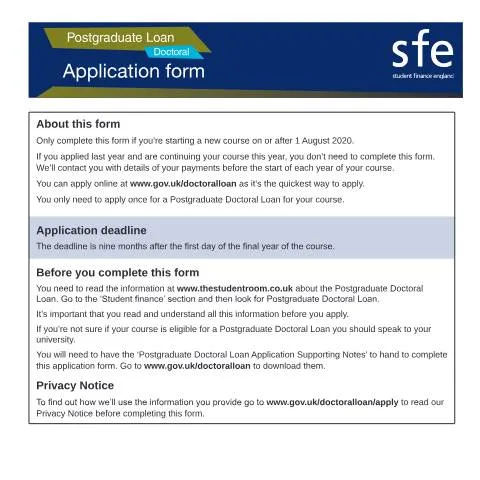
Understanding the 2020 to 2021 Postgraduate Doctoral Loan Application
Every year, thousands of students embark on their journey into postgraduate doctoral studies across the UK. For many, financial support is crucial in making this dream a reality. The 2020 to 2021 Student Finance Application Form for Postgraduate Doctoral Students is a key document that facilitates access to the necessary funds. This article delves into the nuances of this application, providing a comprehensive guide for prospective doctoral candidates.
Who Needs This Application?
This application is specifically tailored for new doctoral students commencing their courses on or after 1 August 2020. Existing students who received funding in the previous year do not need to reapply, as their funding will automatically continue. However, if you’re starting a new course or if you haven't applied previously, it is imperative to understand the specific requirements of the application process.
The Profile of Potential Applicants
As a prospective doctoral student, it’s crucial to assess whether you meet the eligibility criteria for the Postgraduate Doctoral Loan. Here’s a breakdown:
- Course Eligibility: Ensure your course is eligible by checking with your university. Only certain institutions and programmes qualify for the loan.
- Nationality: UK students, EU nationals, and International students may have different eligibility requirements. Familiarize yourself with these distinctions.
- Age Requirements: There are generally no age restrictions, but you must be at least 18 years old to receive the loan.
- Previous Funding: Consider your past financial aid history. If you have previously defaulted on a student loan, this may impact your application.
Step-by-Step Guide: Submitting Your Application
Completing the application involves several key steps. Here’s a chronological guide to navigating the process:
1. Preliminary Research
Before filling out the application form, ensure you understand the details of the loan:
- Maximum loan amount: Up to £26,445, payable in installment.
- Interest rates commence from the day of your first payment.
- Repayment begins only when your income exceeds £21,000.
2. Gathering Required Documents
Accurate documentation is crucial. Typical documents required include:
- Proof of identity (passport or ID card).
- National Insurance number confirmation.
- Details of your course and institution.
Refer to the Postgraduate Doctoral Loan Application Supporting Notes to ensure you have all necessary documents before you start the application.
3. Completing the Application Form
You can choose to apply online or via paper forms. Online applications are generally faster and allow for immediate acknowledgment of submission. Follow these tips while completing the form:
- Answer all questions accurately as per your identification documents.
- Pay attention to sections requiring supporting documents. Any missing information will delay processing times.
- Utilize the supporting notes to clarify any uncertainties while filling out the form.
Application Submission Channels: Online vs. Paper
Once the application is complete, consider how you wish to submit it. Each method has its pros and cons:
Online Submission
- Speed: The quickest method, with processing typically commencing immediately.
- Tracking: You can monitor the status of your application in real-time.
Paper Submission
- Accessibility: Ideal for applicants who may not have access to reliable internet or prefer a tangible record.
- Time: This method may introduce delays due to postal handling and processing times.
Understanding the Timeline: From Submission to Outcome
Knowing what to expect after submitting your application can ease anxiety. Here’s a general timeline of events:
1. Acknowledgment of Application
Upon successful submission, you should receive an acknowledgment within a few days, confirming receipt of your application.
2. Assessment Phase
Your application will enter the assessment phase, where the Student Loans Company (SLC) verifies your details and supporting documents. This may take around 4 to 6 weeks.
3. Outcome Notification
You will be informed of the outcome via your preferred communication method, usually email or post. If approved, details regarding your loan amount and disbursement schedule will be included.
Post-Application Support and Resources
Once your application is submitted, it’s essential to remain informed. Consider the following resources for ongoing support:
- Visit www.gov.uk/doctoralloan for updates and additional information.
- Engage with community forums, such as www.thestudentroom.co.uk, for advice and shared experiences from fellow applicants.
- Utilize social media channels to stay connected with updates from the Student Loans Company.
Special Circumstances: Navigating Challenges in the Application Process
Some applicants may face unique situations that could complicate their application. Here are common challenges and how to address them:
1. International Students
If you are an international student, you may face additional scrutiny regarding your eligibility. Ensure you have:
- Documentation supporting your residency status.
- Clarification from your university regarding course eligibility for funding.
2. Changing Courses
Deciding to switch courses after applying can impact your eligibility. Communicate promptly with the SLC to discuss your situation and the possible implications for your funding.
3. Disability Support
If you have a disability, you may qualify for Disabled Students’ Allowances (DSAs). This support is separate from your loan and does not need to be repaid. Ensure to:
- Provide medical documentation confirming your disability.
- Complete a separate application for DSAs through the SLC.
Final Thoughts: Preparing for Your Doctoral Journey
Securing funding for your postgraduate doctoral studies is a critical step in your academic journey. By understanding the intricacies of the Postgraduate Doctoral Loan application process, you can navigate potential hurdles and position yourself for success. Stay informed, and don’t hesitate to reach out for assistance from your university or the Student Loans Company if you encounter challenges. This proactive approach will ensure you’re well-prepared to embark on your academic adventure.
Understanding the Types of Financial Support Available for Postgraduate Doctoral Students
When considering postgraduate doctoral studies in the UK, it is crucial to understand the various types of financial support that are available to assist with tuition fees and living costs. For doctoral students, the primary sources of funding include government loans, scholarships, and grants, as well as support from universities and research councils.
The Postgraduate Doctoral Loan is one of the most significant funding options. This loan is available to students under the age of 60 who are typically studying full-time or part-time for a doctoral degree at a recognised UK institution. As of the 2020 to 2021 academic year, eligible students could borrow up to £26,445 to cover tuition fees and living expenses, with the loan being paid directly to the university in intervals throughout the year.
Furthermore, other funding options include scholarships and awards offered by universities, which can vary significantly from one institution to another. These scholarships are often merit-based and might be available for specific research topics. Research councils, such as UK Research and Innovation (UKRI), also provide funding through various schemes, including the Doctoral Training Partnerships (DTPs) that support students in specific research sectors.
Another avenue worth exploring is grants and bursaries. Many institutions have their own funds to assist students facing financial hardship. These typically do not have to be repaid, making them a viable option for students who are eligible. It is advisable for prospective doctoral students to consult their respective university's financial aid office to fully understand the options available to them and the application processes involved.
Step-by-Step Guide to Completing the Student Finance Application for Doctoral Loans
Completing the Student Finance application for a Postgraduate Doctoral Loan can be a daunting task for many students. However, following a systematic approach can alleviate some of the stress involved. Here’s a detailed step-by-step guide:
- Check Your Eligibility: Before starting your application, ensure you meet the eligibility criteria set by Student Finance England (SFE). This includes being a UK national or having settled status, being under 60 at the start of your course, and studying at an eligible institution.
- Gather Required Documents: Collect all necessary documentation beforehand. This includes your National Insurance number, bank details, and proof of identity, such as a passport or driving license. Specific institutions may also require additional documents related to your academic qualifications.
- Start Your Application: Visit the official Student Finance website and create an account if you do not already have one. This will give you access to the application form where you can begin entering your details.
- Complete the Form: The application form requires various personal details such as your address, course information, and financial situation. Take the time to fill in each section carefully, ensuring that all information is accurate to avoid any delays in processing.
- Submit Your Application: Once you have completed the form, review all information for accuracy, and then submit it. Keep a record of your application reference number for future correspondence.
- Provide Supporting Documents: After you submit your application, you may be asked to send additional documentation. Ensure that you do this promptly to avoid delays in receiving your funding.
- Await Confirmation: SFE will process your application and will notify you when your loan has been approved. This process can take several weeks, so patience is key.
- Manage Your Funding: Once you receive confirmation, keep track of your funding schedule, including when payments are disbursed to your university and when you can expect to receive financial support for living costs.
Navigating the Repayment Process for Doctoral Loans
Understanding the repayment process of your Postgraduate Doctoral Loan is essential, as it will impact your finances after graduation. Repayment begins in the April following your graduation, or the April four years after the start of your course, whichever comes first. Here are the key points to consider:
The repayment threshold for the 2020 to 2021 year was set at £21,000. This means that you will only start repaying your loan when your income exceeds this amount. Repayments are calculated as a percentage of your income above the threshold, specifically at 6%. Therefore, if you earn £25,000, your annual repayment would be based on the difference (£4,000), which results in a repayment of £240 per year, or £20 per month.
It's also important to note that your repayments are automatically deducted from your salary, similar to income tax, through the PAYE (Pay As You Earn) system. If you are self-employed, you will need to report your income annually through the Self Assessment process and make repayments accordingly.
Additionally, the loan is written off after 30 years if it is not fully repaid by then. This means that if your income does not exceed the threshold for an extended period, you may not end up paying back the full amount of the loan. Moreover, if you become permanently unfit for work, your loan may also be cancelled.
Staying informed about your loan balance and repayments is essential. You can do this by logging into your account on the Student Loans Company website, where you can see your repayment plan and how much you have paid to date.