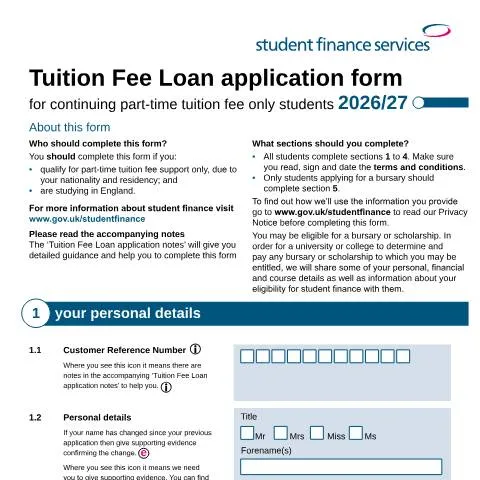
Continuing Part-Time Students: The Tuition Fee Only Application Route
For part-time students entering their second year or beyond, the landscape of student finance applications becomes notably more streamlined yet critically specific. The Tuition Fee Loan application for continuing part-time tuition fee only students represents a particular pathway within the Student Loans Company framework, designed exclusively for those whose eligibility circumstances limit them to fee support alone—typically due to nationality and residency restrictions that preclude access to maintenance funding.
This specialised application form, designated for the 2026/27 academic year, serves a distinct cohort: continuing part-time students studying in England who qualify solely for tuition fee assistance. Unlike their full-time counterparts or those eligible for comprehensive support packages, these applicants navigate a more constrained but correspondingly focused application process that acknowledges both their ongoing academic journey and their specific funding limitations.
The form's structure reflects this targeted approach, requiring completion of core sections whilst incorporating optional elements for those seeking additional institutional support through bursary schemes. Understanding this document's particular place within the broader student finance ecosystem proves essential for applicants who might otherwise find themselves applying through inappropriate channels or missing crucial deadlines.
Eligibility Boundaries and Qualification Criteria
The application's scope remains deliberately narrow, targeting students who meet two fundamental criteria simultaneously. First, applicants must qualify for part-time tuition fee support only due to their nationality and residency status—a restriction that immediately distinguishes this pathway from the broader student finance offerings available to domestic students or those with settled status.
Second, studies must be undertaken in England, reflecting the devolved nature of student finance across the UK nations. Students pursuing part-time courses in Scotland, Wales, or Northern Ireland would need to engage with their respective national funding bodies, each operating under distinct regulatory frameworks and eligibility criteria.
The continuing designation proves equally significant, indicating that applicants have previously received student finance and are progressing through an established course of study. This status affects both the application process and the information requirements, as the Student Loans Company maintains existing records and can reference previous academic and financial data.
Importantly, the form accommodates students whose circumstances may have evolved since their initial application. Those experiencing changes in course details, institution, or personal circumstances must provide updated information, whilst those continuing identical arrangements from the 2025/26 academic year can streamline certain sections of their application.
Application Architecture: Sectional Requirements and Completion Pathways
The form's design reflects a tiered approach to information gathering, with universal requirements balanced against conditional sections based on individual circumstances. Sections 1 through 4 require completion by all applicants, establishing the foundational framework of personal details, course information, funding requests, and contractual agreements.
Section 1 focuses on personal identification, requiring comprehensive contact details alongside the critical Customer Reference Number that links the application to existing Student Loans Company records. The inclusion of National Insurance number requirements reflects the integration between student finance systems and broader government databases, facilitating both eligibility verification and future repayment collection mechanisms.
Course and institutional details occupy Section 2, with particular attention to fee amounts and external funding sources. The form explicitly requests information about any contribution to tuition fees from employers, bursary schemes, or other funding sources, ensuring accurate calculation of required loan amounts and preventing over-funding situations that could create compliance issues.
| Section | Completion Requirement | Key Information Required |
|---|---|---|
| Section 1 | All applicants | Personal details, Customer Reference Number, National Insurance number |
| Section 2 | All applicants | Course details, tuition fees, external funding, study timeline |
| Section 3 | All applicants | Loan amount request, emergency contact details |
| Section 4 | All applicants | Terms and conditions agreement, signature and date |
| Section 5 | Bursary applicants only | Additional eligibility information for institutional support |
Section 5 represents the form's conditional element, requiring completion only by students seeking bursary consideration. This optional pathway enables institutions to assess additional support eligibility whilst maintaining the primary focus on tuition fee loans for the majority of applicants.
Loan Request Mechanisms and Funding Calculations
The heart of the application process centres on Section 3's loan request functionality, where applicants specify their precise funding requirements. The form offers two primary options: requesting the maximum available amount or selecting a reduced sum based on individual circumstances or preferences.
Maximum loan amounts align with the full tuition fee charges levied by the institution, ensuring that eligible students can secure complete fee coverage without requiring upfront payments. However, the option to request less than the maximum acknowledges that some students may have partial external funding, wish to limit their debt burden, or have other financial considerations influencing their borrowing decisions.
The direct payment mechanism warrants particular attention, as Tuition Fee Loans are paid directly to the university or college, bypassing student bank accounts entirely. This arrangement simplifies fee settlement whilst preventing misuse of funds, but requires accurate institutional details to ensure proper payment routing.
Students must also provide comprehensive information about alternative funding sources, including employer contributions, sponsorship arrangements, or other bursary schemes. This requirement serves multiple purposes: preventing over-funding, ensuring accurate loan calculations, and maintaining compliance with funding regulations that prohibit duplicate support for identical costs.
Documentation Requirements and Evidence Submission
The application incorporates a sophisticated evidence framework, with specific documentation requirements triggered by various circumstances. The form employs clear iconography to indicate when supporting evidence becomes necessary, directing applicants to accompanying guidance notes for detailed requirements.
Name changes since previous applications trigger mandatory evidence submission, typically requiring official documentation such as marriage certificates, deed polls, or other legal instruments confirming the alteration. This requirement ensures accurate record-keeping whilst preventing identity confusion that could delay processing or create compliance issues.
Course or institutional changes similarly demand supporting documentation, with universities and colleges required to confirm course details, fee amounts, and student enrollment status. The form explicitly warns that unconfirmed course details may delay student funding, emphasising the importance of accurate, verifiable information submission.
National Insurance number provision serves dual purposes: enabling cross-government data sharing for eligibility verification and establishing the foundation for future repayment collection through HM Revenue and Customs systems. The form clearly explains these data-sharing arrangements, ensuring transparency about how personal information will be utilised across government departments.
Institutional Coordination and Bursary Integration
Beyond basic tuition fee loans, the application form acknowledges the complex relationship between statutory student finance and institutional support schemes. Section 5's optional completion enables universities and colleges to assess students for additional bursary or scholarship opportunities, creating integrated support packages that maximise available funding.
The Student Loans Company facilitates this coordination through data sharing arrangements with educational institutions, providing personal, financial, and course details alongside eligibility information. This sharing enables institutions to make informed bursary decisions whilst reducing administrative burden on students who would otherwise need to submit duplicate information across multiple application systems.
Privacy considerations receive explicit attention, with the form directing applicants to comprehensive privacy notices available through the main government student finance portal. These notices detail how personal information will be used, shared, and protected across the various organisations involved in student finance administration.
The bursary integration mechanism proves particularly valuable for continuing students who may have developed relationships with their institutions and become aware of additional support opportunities unavailable during their initial application period. This pathway enables mid-course funding adjustments without requiring separate application processes.
Contractual Framework and Legal Obligations
Section 4's terms and conditions establish the legal foundation for the student-government lending relationship, incorporating both immediate contractual obligations and longer-term repayment responsibilities. The framework references the Teaching and Higher Education Act 1998 alongside associated regulations, creating statutory backing for the funding arrangements.
Applicants must confirm their understanding of comprehensive terms available through the main government portal, whilst acknowledging that incomplete or inaccurate information may result in funding withdrawal or prosecution. This dual approach—simplified application-level terms supported by detailed external documentation—balances accessibility with legal comprehensiveness.
The contractual structure designates the Secretary of State for Education as the formal lender, whilst enabling delegation to various operational bodies including the Student Loans Company. This arrangement provides governmental backing for the lending programme whilst allowing operational flexibility through specialist administrative organisations.
Signature and dating requirements complete the contractual framework, with the form explicitly warning that applications may be delayed unless properly signed and dated. This emphasises the legal significance of the document whilst ensuring that applicants consciously commit to the associated obligations.
Processing Timelines and Application Management
The 2026/27 academic year designation reflects the forward-looking nature of student finance applications, with forms typically becoming available well in advance of the relevant study period. This advance availability enables students to plan their finances effectively whilst allowing sufficient processing time for complex applications or those requiring additional evidence.
Course commencement dates specified in Section 2 play crucial roles in payment timing, as tuition fee loans are typically released to institutions at the beginning of each academic term. Students beginning studies mid-year or following non-standard academic calendars must provide precise start dates to ensure appropriate payment scheduling.
The form's integration with online account systems enables ongoing application management, with students able to update contact details, track application progress, and receive communications through digital channels. This hybrid approach—paper application supported by digital account management—accommodates various applicant preferences whilst maintaining comprehensive record-keeping.
Emergency contact requirements in Section 3 serve practical purposes beyond immediate application processing, establishing communication pathways for future correspondence, repayment management, and general account administration. These contacts may become particularly important for students whose circumstances change significantly during or after their studies.
Managing Changes in Circumstances During Your Application
Part-time students often experience fluctuating circumstances throughout their studies, and the Student Loans Company recognises that your financial situation may change between application submission and course commencement. Understanding how to properly report these changes can prevent delays in your funding and ensure you receive the correct amount of support.
If your household income changes significantly after submitting your application, you must notify Student Finance England within 30 days. This is particularly relevant for part-time students who may be in employment whilst studying, as job changes, redundancy, or salary adjustments can affect your eligibility for means-tested support. The SLC defines a significant change as typically more than £2,000 difference from the originally declared income, though this threshold may vary depending on your specific circumstances.
Course-related changes require immediate notification through your online account. If you switch from part-time to full-time study, or vice versa, this fundamentally alters your funding package and may require a completely new application. Similarly, changing your course start date, transferring to a different institution, or modifying your study intensity percentage will trigger a reassessment of your tuition fee loan entitlement.
Personal circumstance changes that must be reported include marriage, civil partnership, divorce, or separation, as these affect household income calculations. If you become a parent during your studies, this may qualify you for additional support or change your dependency status. Students who experience homelessness, care leaving status changes, or become estranged from their family should contact the SLC immediately, as these circumstances often unlock additional funding streams or remove parental income requirements.
The notification process varies depending on the type of change. Minor updates can often be made through your Student Finance account online portal, whilst significant changes may require telephone contact with the customer service team or submission of additional documentation. Keep detailed records of all communications and any reference numbers provided, as these will be essential if queries arise about your funding later in the academic year.
Understanding Tuition Fee Payment Schedules and Institution Coordination
The mechanics of how your tuition fee loan reaches your institution involve a carefully orchestrated payment schedule that part-time students should understand to avoid confusion about timing and amounts. Unlike full-time students who typically receive funding in three instalments, part-time tuition fee payments often follow a more complex pattern aligned with your specific study pattern and course structure.
Most institutions receive tuition fee loan payments directly from the SLC in termly instalments, but the exact timing depends on your course's academic calendar and your study intensity. If you're studying at 25% intensity over two years, your payments will be spread accordingly, with the SLC typically paying institutions within 4-6 weeks of each term's commencement. However, if your course follows a modular structure or has non-standard term dates, payment scheduling may be adjusted to match these arrangements.
It's crucial to understand that the SLC pays institutions based on your confirmed attendance and registration status. If you defer modules, take a break in studies, or reduce your study intensity mid-year, this will trigger adjustments to future payments. Your institution's student finance office should keep you informed about payment receipts, but maintaining regular contact ensures any discrepancies are identified quickly.
Some institutions operate internal bursary or hardship schemes that complement SLC funding, and these are often paid on different schedules. Understanding the distinction between SLC tuition fee loans and institutional support helps you plan your finances more effectively. If your institution offers payment plan options for any fees not covered by your loan, ensure these arrangements are compatible with your SLC funding timeline.
Payment delays can occasionally occur due to administrative processing, missing documentation, or changes in your study pattern. If your institution reports that SLC payments haven't arrived as expected, contact both your institution's finance office and the SLC directly. Keep records of your course registration and attendance, as these may be required to resolve payment queries efficiently.
Advanced Eligibility Scenarios and Edge Cases
Part-time student finance eligibility encompasses numerous complex scenarios that standard guidance doesn't always address comprehensively. Understanding these edge cases can be crucial for students whose circumstances don't fit typical patterns, ensuring they access all available support whilst avoiding potential complications.
Students with mixed study patterns present particular complexity. If you're combining part-time university study with apprenticeship training, professional qualifications, or other accredited learning, your eligibility may be affected by regulations governing concurrent study. The SLC generally prohibits funding multiple courses simultaneously, but specific exceptions exist for certain professional development programmes or where study is required by your employer. Always declare any additional learning activities on your application to avoid potential fraud allegations.
International students with evolving immigration status face unique challenges in maintaining funding eligibility. If you hold pre-settled status under the EU Settlement Scheme and expect to gain settled status during your course, this progression may affect your funding entitlements for future academic years. Students on Skilled Worker visas whose employers sponsor part-time study need to ensure their visa conditions permit the specific course and study intensity they're undertaking.
Previous study complications often arise for part-time students who've had interrupted education pathways. If you previously received funding for a course you didn't complete, or if you're returning to education after a significant gap, your Equivalent or Lower Qualification (ELQ) status requires careful assessment. The SLC maintains detailed records of all previous funding, and attempting to conceal prior study can result in funding withdrawal and potential legal action.
Students with disabilities may qualify for additional support through Disabled Students' Allowances (DSA), but accessing this alongside part-time tuition fee loans requires careful coordination. DSA applications often take longer to process than standard funding, so submit these applications as early as possible. If your disability affects your ability to study at standard intensity, you may qualify for funding at lower study percentages than typically permitted.
Military personnel and veterans accessing part-time education face specific eligibility considerations. Enhanced Learning Credits (ELC) from the Ministry of Defence can supplement SLC funding, but coordination between these funding sources requires careful planning. Service personnel studying whilst still serving need to ensure their study commitments are compatible with military obligations and that their commanding officers are aware of their educational pursuits.
Mature students returning to education after careers in public service may discover that pension contributions or redundancy payments affect their household income calculations in unexpected ways. The SLC's assessment of irregular income, such as consultancy fees or property rental, can significantly impact your funding entitlement, making accurate financial disclosure essential for avoiding funding adjustments later in your studies.