The Academic Continuity Process: Renewing Part-Time Student Support
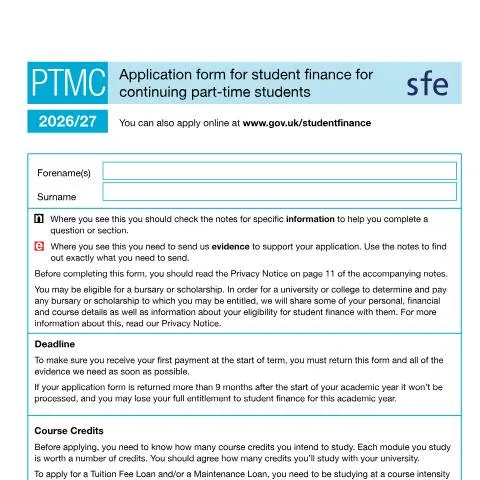
For thousands of part-time students across England, the transition from one academic year to the next involves more than simply enrolling for new modules. Those who have previously received student finance must navigate the PTMC Application Form, a specialised renewal document that ensures their funding continues seamlessly into the 2026/27 academic year. Unlike first-time applicants who complete comprehensive initial assessments, continuing part-time students work within an established framework where their previous entitlements and circumstances form the foundation for ongoing support.
The Student Loans Company recognises that part-time study patterns create unique challenges. Students may adjust their course intensity, change modules, or experience shifts in personal circumstances that affect their funding needs. The PTMC form addresses these variables whilst maintaining the administrative efficiency that comes from building upon existing student records. This approach acknowledges that continuing students represent a distinct category with established relationships with both their institutions and the funding system.
Understanding this renewal process becomes particularly crucial as part-time study continues to grow in popularity. Whether driven by career advancement, personal development, or the flexibility that part-time programmes offer working adults, these students require a funding mechanism that adapts to their evolving academic journey whilst maintaining the rigorous standards expected of public financial support.
Academic Requirements and Course Intensity Thresholds
The foundation of part-time student finance eligibility rests on course intensity calculations, measured through credit accumulation rather than simple attendance patterns. Each academic module carries a specific credit value, and students must demonstrate they will study at least 25% intensity during the academic year to qualify for both Tuition Fee Loans and Maintenance Loans.
This 25% threshold represents a significant commitment level that distinguishes serious academic pursuit from casual learning. Students approaching this minimum must carefully coordinate with their universities to ensure their selected modules meet the requirement. The calculation becomes more complex when students spread their studies across different terms or adjust their module selections mid-year, requiring ongoing communication with both the institution and the Student Loans Company.
| Course Intensity | Typical Credit Range | Available Funding | Key Considerations |
|---|---|---|---|
| 25-49% | 30-59 credits | Tuition Fee Loan, Maintenance Loan | Minimum threshold for loan eligibility |
| 50-74% | 60-89 credits | Full loan entitlements | Increased Maintenance Loan amounts |
| 75%+ | 90+ credits | Maximum available funding | Approaching full-time equivalent |
Universities play a crucial role in this process, as they must confirm the credit values and provide ongoing verification of student progress. The PTMC form requires students to specify their intended credit load upfront, creating a commitment that influences funding calculations throughout the academic year. Changes to this declared intensity may trigger reassessment processes that can affect payment schedules and total entitlements.
Navigating Household Income Assessments for Continuing Students
The income assessment process for continuing part-time students involves sophisticated calculations that extend beyond the student's own financial circumstances. While some students may qualify for non-means-tested support, those seeking the maximum available funding must navigate household income evaluations that can involve parents, partners, or both, depending on their dependency status and relationship circumstances.
Independent students face a more straightforward assessment focused primarily on their own income and that of any partner. However, determining independence involves multiple criteria including age, previous study, employment history, and family circumstances. Students who were classified as independent in previous years generally maintain this status, but significant life changes may trigger reclassification.
The complexity increases substantially for students whose funding depends on parental income. Parents must complete Section 7 of the form, providing detailed financial information that may include employment income, self-employment profits, benefits, pensions, and investment returns. This requirement can create coordination challenges, particularly when parents are reluctant to share financial information or when family relationships are strained.
Care leavers occupy a special category within this framework. While they typically qualify for maximum Maintenance Loans without income assessment, the Student Loans Company recommends they still complete household income sections. This approach enables access to additional funding streams and institutional bursaries that might otherwise remain unavailable.
Documentation Requirements and Evidence Standards
The PTMC application process demands extensive documentation that varies significantly based on individual circumstances. Unlike online applications that may accept digital uploads, this paper-based system requires physical documents that meet specific formatting and authenticity standards established by the Student Loans Company.
Identity verification remains fundamental, typically requiring original or certified copies of passports, driving licences, or birth certificates. However, continuing students may benefit from reduced documentation requirements if their identity was previously verified and no significant changes have occurred. The Student Loans Company maintains sophisticated record-keeping systems that can reference previous verifications, streamlining the renewal process for established students.
Income documentation presents more complex challenges. Employed individuals must provide P60 certificates, recent payslips, and potentially P11D forms if they receive benefits in kind. Self-employed applicants face additional scrutiny, requiring SA302 tax calculations, business accounts, and sometimes additional evidence of trading activities. The timing of these requirements often creates difficulties, as the application deadline may precede the availability of complete tax year documentation.
Students should begin gathering documentation early in the calendar year, particularly if their circumstances involve self-employment, rental income, or other complex financial arrangements that require detailed substantiation.
International students and those with overseas income face additional documentation challenges. Foreign income must be converted to sterling using specific exchange rates, and overseas documents often require official translation and authentication. These requirements can extend processing times significantly and may require early submission to ensure funding arrives before term begins.
The Critical Nine-Month Processing Window
Perhaps the most significant constraint facing continuing part-time students involves the nine-month application deadline that creates an absolute cut-off for processing. Applications submitted more than nine months after the academic year begins face automatic rejection, with no appeals process or exceptional circumstances provisions available.
This deadline reflects the Student Loans Company's need to manage payment schedules and prevent indefinite processing windows that could compromise the integrity of the funding system. However, it creates particular hardships for students whose circumstances change unexpectedly during the academic year or who encounter delays in gathering required documentation.
The countdown begins from the official start date of the academic year, not from when individual students begin their studies. This distinction becomes crucial for students who join courses late, take breaks, or follow non-standard academic calendars. Universities with multiple start dates or flexible entry points must clearly communicate these implications to students who might otherwise assume they have more time to complete their applications.
Processing times within this window vary considerably based on application complexity and seasonal demand. Straightforward renewals for students with unchanged circumstances might process within 4-6 weeks, while applications requiring extensive income verification or involving complex family situations can take 12-16 weeks or longer. The Student Loans Company prioritises applications based on term start dates, but this system can disadvantage students beginning studies later in the academic year.
Strategic Timing for Optimal Processing
Experienced continuing students often develop sophisticated timing strategies that maximise their chances of receiving funding when needed. Early submission, ideally within the first month of the application window opening, provides the greatest protection against processing delays and allows time to address any documentation issues that arise.
However, early submission must be balanced against the availability of required documents, particularly income evidence that may not be available until after the tax year ends. Students whose funding depends on the most recent tax year information may need to submit preliminary applications and update them as documentation becomes available.
Loan Amount Calculations and Payment Mechanics
The PTMC form requires students to specify their desired loan amounts across different categories, creating a framework where students can tailor their funding to their specific needs rather than accepting standardised packages. This flexibility represents a significant advantage of the part-time funding system but requires careful consideration of both immediate needs and long-term repayment obligations.
Tuition Fee Loans operate on a relatively straightforward basis, with students able to borrow up to the full amount charged by their institution. However, the timing of these payments directly to universities can create cash flow challenges for students who need to pay deposits or course fees before funding arrives. The Student Loans Company typically makes tuition fee payments in instalments aligned with term structures, but these may not match institutional payment requirements.
Maintenance Loan calculations prove more complex, incorporating household income assessments, course intensity levels, and regional variations that reflect different living costs across England. Students studying at lower intensities receive proportionally reduced maintenance support, creating a careful balance between encouraging serious academic commitment and recognising the realities of part-time study.
| Assessment Category | Maximum Annual Amount | Income Threshold | Reduction Rate |
|---|---|---|---|
| Full Maintenance Loan | Variable by region | £25,000 household income | £1 per £4.73 over threshold |
| Minimum Maintenance Loan | 65% of maximum | No income assessment | Available to all eligible students |
| Course Intensity Adjustment | Proportional to study level | Based on credit loading | Direct percentage calculation |
Payment scheduling for part-time students follows different patterns than full-time equivalents. Rather than termly payments, part-time funding often arrives in larger, less frequent instalments that require careful budgeting and financial planning. Students must coordinate these payment schedules with their course fees, living expenses, and other financial commitments to avoid cash flow problems.
Institutional Coordination and Bursary Integration
The relationship between Student Loans Company funding and institutional support creates a complex web of financial assistance that requires careful coordination. Universities and colleges often provide additional bursaries, scholarships, or hardship funds that complement government-backed loans, but accessing these requires sharing personal and financial information across multiple organisations.
The PTMC form explicitly acknowledges this data sharing, with the Student Loans Company providing institutions with relevant details about student eligibility, course intensity, and financial circumstances. This information enables universities to make informed decisions about additional support while ensuring that combined funding packages remain within appropriate limits.
Disabled Students' Allowance represents a particular coordination challenge, as it requires a separate DSA1 application form but integrates with the main funding assessment. Students with disabilities must navigate both processes simultaneously, ensuring that their support needs are comprehensively assessed while maintaining eligibility for standard funding streams.
Some universities provide dedicated support teams that help students coordinate between different funding sources, but this varies significantly across institutions. Students at universities with limited support services may need to manage these relationships independently, requiring careful attention to deadlines, requirements, and communication protocols across multiple organisations.
Managing Changes and Ongoing Obligations
The continuing student experience involves ongoing obligations that extend well beyond the initial application submission. Changes in circumstances, course modifications, or personal situations can trigger reassessment processes that affect funding levels and payment schedules throughout the academic year.
Students must promptly report changes in relationship status, income levels, course intensity, or study patterns that might affect their entitlements. Failure to report relevant changes can result in overpayments that must be repaid immediately, creating financial hardship and potentially affecting future funding eligibility. The Student Loans Company maintains sophisticated monitoring systems that can detect unreported changes, particularly those involving employment income or benefit receipts.
Course changes present particular challenges for part-time students who may need to adjust their study patterns due to work commitments, family responsibilities, or academic performance issues. Reducing course intensity below the 25% threshold triggers immediate funding cessation, while increases may enable additional support but require formal reassessment processes.
The repayment obligations that accompany student loans begin after graduation and are tied to income levels rather than fixed schedules. However, part-time students often have extended study periods that can complicate repayment calculations and create uncertainty about long-term financial commitments. Understanding these obligations becomes crucial for students making decisions about borrowing levels and future study plans.
Regular monitoring of online student accounts provides the primary mechanism for tracking application progress, payment schedules, and any issues requiring attention. Students should establish routines for checking their accounts and responding promptly to requests for additional information or documentation that could delay processing or payments.